- English
- ePUB (mobile friendly)
- Available on iOS & Android
eBook - ePub
About this book
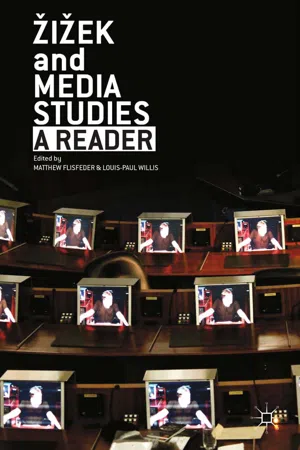
Film, media, and cultural theorists have long appealed to Lacanian theory in order to discern processes of subjectivization, representation, and ideological interpellation. Here, the contributors take up a Zizekian approach to studies of cinema and media, raising questions about power, ideology, sexual difference, and enjoyment.
Information
Part I
Media, Ideology, and Politics
1
Žižek’s Reception: Fifty Shades of Gray Ideology
By Paul A. Taylor
Introduction
A self-confessed dogmatic Lacanian-Hegelian, Slavoj Žižek holds the unusual, almost oxymoronic, status of being classed as a celebrity academic. He is routinely hyped by journalists as “the Elvis of Cultural Theory” or “the most dangerous philosopher in the West.” Despite, or, perhaps more accurately, because of his widespread popularity in nonacademic circles, his work has also received damning condemnation from some critics and fellow scholars. Occasionally vitriolic in his tone, Žižek appears to get under the skin of reviewers like few other thinkers, and indeed this has led to whole books designed to debunk him, such as the ambiguously titled The Truth of Žižek.1 This chapter explores Žižek’s negative reception in terms of both the divided response among intellectuals with a media voice and the still-divided, but much more positive, reception of his thoughts by audiences that are unusually large and enthusiastic considering the relatively esoteric theoretical nature of the material Žižek presents.
An important part of the intellectual context of Žižek’s reception is the chasm that exists between those who see themselves as part of an Anglo-Saxon tradition of empirically rooted quasiscientific social inquiry and those who are drawn to the much more openly speculative philosophy that has come to be known as continental thought. One major bone of contention between the two schools relates to the status of facts. While the Anglo-Saxon tradition tends to see them as statements that are verifiable by scientific testing, continental philosophy is known for emphasizing how their status is relative to the context from which they derive. Subsequently, a second difference exists between their chosen methods of conceptualizing those facts, especially in relation to the realm of culture. “Social science” applies rigorous methods to cultural phenomena, while continental philosophy seeks to understand those aspects of society that exist but which, it argues, cannot be adequately conceptualized via empirical methods. For example, ideology is a widely recognized phenomenon, but one that is observable through its affects/effects rather than any systematically measurable qualities.
In this chapter, forceful criticisms of Žižek’s attitude toward facts are illustrated with specific reference to his emblematic approach to the subject of violence. More generally, Žižek’s reception is dominated by two opposing, but both essentially uncritical, distortions:
i) Uncritical fixation upon the curiosity and entertainment value of a celebrity thinker.
ii) Hypercritical knee-jerk condemnation (that in its excess avoids actual substantive critique) from dogmatically empiricist commentators for whom Žižek’s speculative philosophy acts a “postmodern” plessor.2
Both of these types of response involve ignoring the substance of Žižek’s thought. The enjoyment of his theoretical pyrotechnics as entertainment requires the suspension of critical faculties for pure enjoyment of the spectacle, and this phenomenon is explored later using specific firsthand experience of giving a talk with Žižek at the Institute of Contemporary Arts in London.3 The hypercritical dismissal of Žižek, dealt with first here, often requires the active application of intelligence to avoid recognition of (as distinct from agreement with) what Žižek is actually saying. This willful conceptual myopia is illustrated using the particularly egregious example of John Gray’s New York Times review of Less Than Nothing and Living in the End Times, titled “The Violent Visions of Slavoj Žižek.”4
Gray’s Anatomy of Truth
John Gray’s fiercely dismissive New York Times review typifies the Anglo-Saxon–continental split, fueled as it is by the charge that Žižek does not engage with objective rational thought. Particularly significant is the precise nature of Gray’s questioning of Žižek’s notion of truth. When Gray asks, “Why should anyone adopt Žižek’s ideas rather than any others?” he proceeds to answer his own question with an accurate and cogent summary of the rationale behind Žižek’s method:
The answer cannot be that Žižek’s [ideas] are true in any traditional sense. “The truth we are dealing with here is not ‘objective’ truth,” Žižek writes, “but the self-relating truth about one’s own subjective position; as such, it is an engaged truth, measured not by its factual accuracy but by the way it affects the subjective position of enunciation.” If this means anything, it is that truth is determined by reference to how an idea accords with the projects to which the speaker is committed—in Žižek’s case, a project of revolution.5
Apart from the inaccuracy of the objection that Žižek’s method eschews “factual accuracy,” which we will shortly examine, this is an excellent summary of the reflexive essence of how he does, “in fact,” address an inescapable fact about facts themselves—they do not exist in a pure state of objectivity. But, while Gray is fully aware of the substantive answer to his charge that Žižek peddles merely subjective thoughts, in what might be seen as a rhetorical “Trojan mouse,” he chooses to proceed as if the mere act of describing an opposing position is equivalent to successfully undermining it.
Any purportedly neutral presentation of the facts requires deconstruction and critique to reveal the various forms of ideological bias that, in fact, pervade that appearance of neutrality—the essence of Heidegger’s distinction between what is true and what is merely correct. If Gray’s denunciation itself means anything, that meaning rests in its clear, albeit inadvertent, demonstration of a cynical aspect of contemporary culture that is frequently highlighted in the work he is busy scorning. This is Žižek’s notion of fetishistic disavowal—the phenomenon in which people are able to recognize a truth but proceed as if they hadn’t, a situation encapsulated in the psychoanalytical phrase “Je sais bien, mais quand même” (I know very well, but nevertheless). Thus, Gray knows that Žižek is explicit about the position from which he makes his subjective enunciations about the world and that this provides the reader with the basis from which to gauge its value. But he proceeds as if he didn’t know this and rhetorically caricatures Žižek’s method as the generation of ideas from an arbitrary basis. It is with comments like “If this means anything” that we can see the distinctly nonconceptual, strongly emotional energy expended on the widening of the empiricist–continental divide.
At the time of writing, the latest manifestation of knee-jerk emotionality directed at Žižek can be seen in his quarrel with Chomsky, predictably portrayed by the media in fighting terms—“The Slavoj Žižek v. Noam Chomsky spat is worth a ringside seat” and “Chomsky vs. ‘Elvis’ in a Left-Wing Cage Fight.”6 In a December 2012 online interview, Noam Chomksy’s disdain for Žižek’s brand of nonempiricist, reflexivity-privileging thought is conveyed unambiguously:
What you’re referring to is what’s called “Theory.” And when I said I’m not interested in theory, what I meant is, I’m not interested in posturing—using fancy terms like polysyllables and pretending you have a theory when you have no theory whatsoever. So there’s no theory in any of this stuff, not in the sense of theory that anyone is familiar with in the sciences or any other serious field. Try to find in all of the work you mentioned some principles from which you can deduce conclusions, empirically testable propositions where it all goes beyond the level of something you can explain in five minutes to a twelve-year-old. See if you can find that when the fancy words are decoded. I can’t. So I’m not interested in that kind of posturing. Žižek is an extreme example of it. I don’t see anything to what he’s saying.7
The best single illustration of this active unwillingness to recognize Žižek’s analysis of ideology and its relationship to facts and, additionally, how that unwillingness is facilitated by the sensationalist predispositions of the media, is provided by the reception that has met Žižek’s statement that historical despots like Hitler, Stalin, and Pol Pot were not violent enough and the accompanying, highly offensive, charge that Žižek therefore is guilty of celebrating violence—a sense of offense that memorably led Adam Kirsch of the New Republic to label Žižek “the Deadly Jester.”8
The likelihood that the misinterpretation of Žižek’s analysis of violence is somehow an oversight is greatly lessened when it is considered that Žižek has devoted an eponymous book-length treatise to the subject.9 At various points in his writings, Žižek unambiguously describes how history’s horrific outbursts of dictatorial violence have been the result of those dictators’ various failures to deal with the core contradictions at the heart of the societies they sought to radically alter. From this perspective, Hitler is a prime example of what psychoanalysis refers to as passage a l’acte—rather than deal with the true faults at the core of German society, he focused an entire society’s productive energy on the attempted extermination of a whole people. It is only in this very specific conceptual sense that Žižek makes the otherwise outrageous claim that Hitler’s violence was not violent ...
Table of contents
- Cover
- Title
- Copyright
- Contents
- List of Figures
- Acknowledgments
- Part I Media, Ideology, and Politics
- 1 Žižek’s Reception: Fifty Shades of Gray Ideology
- 2 The Sublime Absolute: Althusser, Žižek, and the Critique of Ideology
- 3 Student Fantasies: A Žižekian Perspective on the 2012 Quebec Student Uprising
- 4 The Objective: The Configuration of Trauma in the “War on Terror,” or the Sublime Object of the Medium
- Part II Popular Culture
- 5 The Priority of the Example: Speculative Identity in Film Studies
- 6 Imagining the End Times: Ideology, the Contemporary Disaster Movie, Contagion
- 7 Žižek and the 80s Movie Song: “There Is a Non-Relationship”
- 8 A Little Piece of the Reel: Record Production and the Surplus of Prosthetic Vocality
- 9 White Elephants and Dark Matter(s): Watching the World Cup with Slavoj Žižek
- Part III Film and Cinema
- 10 Contingent Encounters and Retroactive Signification: Zooming in on the Dialectical Core of Žižek’s Film Criticism
- 11 How to Kill Your Mother: Heavenly Creatures, Desire, and Žižek’s Return to Ideology
- 12Dialogue with American Skepticism: Cavell and Žižek on Sexual Difference
- 13 From Interpassive to Interactive Cinema: A Genealogy of the Moving Image of Cynicism
- 14 Beyond the Beyond: CGI and the Anxiety of Overperfection
- Part IV Social Media and the Internet
- 15 Slavoj Žižek as Internet Philosopher
- 16 The Real Internet
- 17 Enjoying Social Media
- 18 Is Torture Part of Your Social Network?
- Appendix Art Staging Feminine Hysteria: Schoenberg’s Erwartung
- Bibliography
- Notes on Contributors
- Index
Trusted by 375,005 students
Access to over 1.5 million titles for a fair monthly price.
Study more efficiently using our study tools.
Frequently asked questions
Yes, you can cancel anytime from the Subscription tab in your account settings on the Perlego website. Your subscription will stay active until the end of your current billing period. Learn how to cancel your subscription
No, books cannot be downloaded as external files, such as PDFs, for use outside of Perlego. However, you can download books within the Perlego app for offline reading on mobile or tablet. Learn how to download books offline
Perlego offers two plans: Essential and Complete
- Essential is ideal for learners and professionals who enjoy exploring a wide range of subjects. Access the Essential Library with 800,000+ trusted titles and best-sellers across business, personal growth, and the humanities. Includes unlimited reading time and Standard Read Aloud voice.
- Complete: Perfect for advanced learners and researchers needing full, unrestricted access. Unlock 1.5M+ books across hundreds of subjects, including academic and specialized titles. The Complete Plan also includes advanced features like Premium Read Aloud and Research Assistant.
We are an online textbook subscription service, where you can get access to an entire online library for less than the price of a single book per month. With over 1.5 million books across 990+ topics, we’ve got you covered! Learn about our mission
Look out for the read-aloud symbol on your next book to see if you can listen to it. The read-aloud tool reads text aloud for you, highlighting the text as it is being read. You can pause it, speed it up and slow it down. Learn more about Read Aloud
Yes! You can use the Perlego app on both iOS and Android devices to read anytime, anywhere — even offline. Perfect for commutes or when you’re on the go.
Please note we cannot support devices running on iOS 13 and Android 7 or earlier. Learn more about using the app
Please note we cannot support devices running on iOS 13 and Android 7 or earlier. Learn more about using the app
Yes, you can access Zizek and Media Studies by M. Flisfeder, L. Willis, M. Flisfeder,L. Willis in PDF and/or ePUB format, as well as other popular books in Social Sciences & Film & Video. We have over 1.5 million books available in our catalogue for you to explore.