- English
- ePUB (mobile friendly)
- Available on iOS & Android
eBook - ePub
About this book
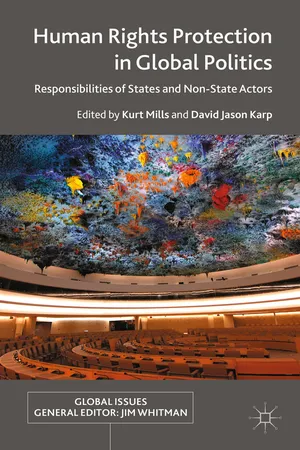
This edited book by Mills and Karp brings together political, legal and moral perspectives on the responsibilities of human rights protection in world politics today. It critiques a narrow focus on states' 'violations' of human rights, incorporates non-state actors, and looks beyond the 'Responsibility to Protect' policy framework.
Information
Part I
Responsibility and Human Rights
1
Introduction: Human Rights Responsibilities of States and Non-State Actors
David Jason Karp and Kurt Mills
The 2005 World Summit recognized the responsibility to protect. In one sense, this might be considered a normative revolution: a sign that the international human rights regime has reached a middle stage in a ‘lifecycle’ that has the potential to end in states’ internalization of the obligations of human rights protection (Finnemore and Sikkink 1998). In another sense, however, this was just a re-statement and consolidation of a long list of human rights responsibilities states have already taken on. These have been applied inconsistently, even hypocritically, over the last 65 years, as the modern human rights regime has developed (Krasner 1999). Looking beyond the text of the World Summit resolution itself and into its meaning and implications for theory and practice, we can ask: what is the best way to explain and understand these developments?
The main theoretical frameworks that have been used to answer this question so far in political science and international relations (IR) have been largely state-centered. They draw from rationalist and constructivist explanatory accounts of why rules are created and how states can be expected to act in response to them in conditions of anarchy. Questions about the actual nature and content of the responsibility to protect human rights have been largely taken for granted: as straightforwardly agreed in international law, or as instantiated in contemporary diplomatic discourse and practice, or as representing obvious philosophical or religious principles and treated as exogenous to the main scholarly analysis. As a result, most of the cutting-edge work on the nature of the responsibilities that are linked to human rights has come from other fields, such as international law (Meron 2006; Steiner et al. 2007; Langford et al. 2013), philosophy (Rawls 1999; Beitz 2009), or sociopolitical history (Lauren 2003; Hunt 2007). IR scholars are increasingly interested in examining the interrelationship between empirical and normative research (Price 2008; Snidal and Reus-Smit 2008; Snidal and Wendt 2009). This process is only just beginning to occur with regard to the responsibilities and duties associated with international human rights. This book seeks to fill a gap in knowledge on the human rights responsibilities of various global actors, and of the special nature of human rights ‘protection’ alongside a broader range of human rights responsibility. It accomplishes this, in part, by incorporating contributions of authors who work in multiple disciplines in the social sciences and humanities, rather than only those who would self-identify as specialists in disciplinary IR. Rather than being tied to a narrow, positivist understanding of IR as a sub-field of empirical political science, this book defines the field to which it contributes as including perspectives from history, law, politics, philosophy and sociology, but one that is still unified by taking the international and global realms as the main objects of study. Part I of this book, which includes this introduction as well as a chapter by Mitoma and Bystrom, sets the stage for this attempt – in part by exploring the conceptual nature (as opposed to purely legal or practice-based nature) of human rights responsibility – which the rest of the book then follows up on by looking at particular global actors, issues and/or cases.
Part II of this book constitutes a challenge to the inherently positivist idea that human rights outcomes and violations need to be ‘observed,’ or at least observable, in order to begin to have a coherent discussion of responsibility and accountability (see, e.g., Sikkink 2008). Several of this book’s chapters, but most prominently Bódig’s, explain and engage with the ‘respect–protect–fulfill’ tripartite division of human rights duties that, since the 1980s, now underpins so much of international-legal human rights practice (Eide et al. 1984; Shue 1996). According to this tripartite division, ‘respecting’ human rights is defined in terms of a responsibility not to deprive individuals of (access to) their human rights; for example, refraining from torture or from disallowing freedom of conscience. ‘Protecting’ human rights is defined in terms of a specific responsibility, usually thought of as falling on governments, to ensure that third parties do not deprive individuals of (access to) their human rights; for example, having an effective and responsible police force and justice system. ‘Fulfilling’ human rights is defined in terms of further specific responsibilities to provide individuals with (access to) their human rights; for example, providing for health and education services that cover all residents; providing food, water and shelter in the aftermath of a disaster.
A focus on observable violations as the main basis for determining human rights responsibility and accountability would mean that this responsibility is importantly retrospective: a human rights ‘violation’ happens, and then one looks after the fact at the chain of events and non-events that caused it in order to determine who is responsible. This can be contrasted, however, with prospective, ex ante duties that states have to individuals, ‘regarding acts that must be performed, or forbearances that must be observed’ (Erskine 2014: 117), irrespective of whether any harm is caused. Whelan’s chapter engages with an explicitly prospective account of the duties – going beyond just human rights duties – that states have to people. Conversely, Gibney looks mainly at the retrospective determination of human rights responsibility. His chapter analyses judicial mechanisms that, by their very nature, can only hold states to account after there are facts available upon which judgments can be taken. However, his argument shows why, even from the angle of retrospective responsibility, a simplistic ‘violations approach’ is still deficient. By positing that there can be different degrees of human rights responsibility, based on factors other than solely observable harms that have been caused, his chapter rounds off the book’s contribution to discussions about the complex nature of states’ human rights responsibilities, especially as compared to how the latter are typically understood in contemporary international-legal and policy discourse.
As compared to the issue of state duties, even less attention in IR scholarship has been focused on the growing number of responsibilities accruing to non-state actors, particularly private actors. This is true despite the attention that this topic has already garnered in international law (Alston 2005; Clapham 2006), philosophy (O’Neill 2001; Pogge 2007) and international political practice (DeWinter 2003; Ruggie 2013). There is a range of institutional moral agents in international relations, beyond just states and those composed of states (Erskine 2003). This theoretical point has immense practical relevance. By focusing mainly or even solely on states’ human rights duties, IR has by now fallen behind legal practitioners, activists and some states, who for the past ten years have accelerated the development of transnational and extra-territorial accountability for alleged human rights abuses committed by non-state actors (Teitel 2005; Karp 2009). IR scholars have a unique set of questions to ask about these developments. Legal and public-policy academics ask how effective regulation does and can happen. Philosophers ask which moral duties to protect human rights would a range of actors have and how to distribute them. An IR perspective can, first, set recent developments in the context of today’s actual world of states, quasi-states, international organizations and international nongovernmental organizations. There is already relevant (though contested) knowledge about the kind of world that we live in today, and about the kinds of actors and institutions that exist within it. This can be used to challenge both legal and philosophical assumptions about the human rights duties of non-state actors. Second, an IR perspective can empirically and critically investigate the kind of ‘appropriate action’ that activists are trying to prescribe; it can assess the potential consequences and implications of putting policy ideas regarding both state and non-state human rights responsibilities into practice.
Part III of this book responds to these gaps in some of the following ways. A chapter by Aaronson and Higham introduces and evaluates the United Nations Guiding Principles on Business and Human Rights (Ruggie 2011) in light of what the chapter’s authors view as governments’ failure to regulate non-state actors. Karp’s chapter offers a different perspective, which looks at non-state actors as potential human rights protectors, in part by situating both these Guiding Principles and also the World Summit-recognized Responsibility to Protect policy framework (R2P) against a conceptual account of the nature of duties of human rights protection. González Correa’s chapter critiques the currently proposed allocation of duties to businesses from yet a different angle: on the basis of a particular interactional understanding, which she views as incomplete, of the ‘impacts’ that private actors have on human rights victims. A chapter by Macbean and Nesossi interrogates the responsibilities of lawyers as particular kinds of non-state actors in China’s authoritarian and great-power context. Finally, Matelski’s chapter looks at education as a particular kind of human right for which both state and non-state actors (both domestic and international) may have responsibility in Myanmar’s specific domestic context.
Part IV of the book looks explicitly at the World Summit-recognized ‘Responsibility to Protect,’ from the angle of the duties and responsibilities that are associated with that framework in theory, in policy and in practice. While there is a significant international relations literature in this area (Weiss 2007; Evans 2008; Bellamy 2009; Pattison 2010), much of it is focused on one aspect of the responsibility to protect – for the most part military intervention. With a few exceptions (Ferris 2011), this literature frequently does not look at broader responsibilities, especially in the humanitarian realm. Yet, all of these international declarations and norm-making activities raise as many questions as they answer about the willingness of relevant actors to live up to their responsibilities, as well as potential conflicts between responsibilities. Mills identifies the military intervention aspect of the responsibility to protect as one part of a suite of responsibilities the international community has developed to address mass atrocities, which also includes international criminal justice and humanitarianism. Labonte looks at the role of humanitarianism in situations where both the host state and the international community manifestly fail to protect civilians. The chapter by Galchinsky addresses the issue of prevention, partly in order to correct the tendency of IR scholars to focus on intervention, which is only one element or ‘pillar’ of R2P. In a parallel but distinctive vein, Dunne and Gelber examine international argumentation about responsibilities of human rights protection as an independently important form of action.
Overall, the book moves beyond the constraints of the Responsibility to Protect policy framework in order to examine more comprehensively the human rights duties and responsibilities accruing to both state and non-state actors. Together, the book’s chapters build the argument that the existing literature on the idea of the responsibility to protect human rights is deficient, because: (1) it under-theorizes ‘responsibility’ and its various facets; (2) it incorrectly views the justiciability of human rights standards and a parallel focus on ‘violations’ of human rights as central to the notion of responsibility; (3) it focuses on state actors to the exclusion of the non-state actors who might also bear duties to protect human rights in theory and in political practice; (4) it under-appreciates the distinctions between humanitarianism and human rights, and between atrocity prevention and human rights protection.
The book as a whole also explores the tension between the prospective and retrospective aspects of the responsibilities of human rights protection. The book should leave readers with the impression that these two facets are each important, but that it is nevertheless crucial not to conflate one with the other as if there were no difference. For example, Gibney’s argument that there can be gradations in the degree of one’s human rights responsibility based on the intentions (a rough equivalent of criminal law’s mens rea) of the wrongdoer only fully makes sense when thinking retrospectively; often, the whole point of assigning prospective duties is to say to someone ‘you’re going to be responsible if anything happens,’ regardless of intent to do wrong, and regardless of the particular circumstances of particular cases. Ultimately, however, these prospective and retrospective aspects are not necessarily in tension. In other words, they do not necessarily represent radically different concepts of responsibility for human rights protection. As an analogy, think about the mantra ‘do no harm’ that is so central to doctors’ Hippocratic Oath. This is both a prospective duty of office and a retrospective standard that can be used after the fact to judge poor practice. Similarly, the prospective and retrospective aspects of the responsibilities of human rights protection can be viewed as different but equally important facets of the same thing. Who is responsible (prospectively) affects whether they can legitimately be held responsible (retrospectively) for failures of human rights protection. Retrospective accountability can take into consideration failures to act preventively and proactively (prospectively), if and when one has responsibilities to do so, rather than only failures to react to problems after they have arisen.
This interactivity between the prospective and retrospective aspects of the responsibilities of human rights protection is established by the book as a whole, but it is also clear in several of the book’s individual chapters. For example, the chapter by Macbean and Nesossi explores the interplay between the specific duties of the office of lawyers ‘as lawyers’ (prospective responsibility), and how they should advise their clients and/or take other public actions when faced with specific cases, contexts and circumstances (retrospective responsibility). A different kind of interplay is explored in Bódig’s chapter, when he suggests that social ideas about whether (and which) ‘violations’ of human rights can be concretely proven retrospectively, may ultimately condition and constrain the kinds of prospective obligation that are politically feasible to assign.
Organization of the book
With this general introduction to the book’s key themes in place, we now explain in greater detail how this book is organized, and outline the specific arguments that its chapters develop. The book’s four parts first address the broad issue of what we mean by responsibility, and then go on to examine human rights responsibilities of various types of actors: state, non-state and supra-state. These parts have been adopted as a necessary organizational device, which (we believe) creates a nice flow from one chapter to the next, and gives the book coherence. That said, the material in each of the book’s four parts is not entirely discrete. There could be grounds to put any particular chapter in more than one part of the book. In fact, we believe that it is a significant strength of this book that many of its chapters explore and engage with the themes of the book as a whole, rather than narrowing the scope of the analysis to a particular one of the book’s ‘parts’ or to a particular kind of global actor. The book analyzes how to situate responsibility for human rights and how such responsibility has been implemented in practice.
Responsibility and Human Rights
In their chapter entitled ‘Humanitarianism and Responsibility in Discourse and Practice,’ Glenn Mitoma and Kerry Bystrom note that there seems to be human rights and humanitarian responsibility everywhere: from a responsibility to protect people in Libya to a responsibility to provide humanitarian assistance in Haiti. The actors that seem to have acquired this responsibility are wide and varied, including states, international governmental organizations, nongovernmental organizations and even, it appears, international celebrities. They note the evolving understanding of sovereignty as responsibility. Through the lens of humanitarianism, they investigate different understandings of responsibility and note how ‘responsibility’ has come to dominate the humanitarian endeavor. In developing their understandings of humanitarian responsibility, they also make a distinction between the ‘maximalist,’ ‘absolutist,’ long-term human rights project, and the ‘limited,’ ‘flexible,’ ‘immediate’ practice of humanitarianism.
They posit and then disassemble four concepts of responsibility: causality and liability, bureaucracy and duty, power and philanthropy and a radical ethical obligation to others. Causality requires a retrospective empirical analysis of a situation and entails the deployment of data to identify how human suffering has been allowed to happen. Actors, such as the UN, then respond – or not, if adequate data is not available. Yet, humanitarian actors now also consider their role in potentially exacerbating suffering and thus are called upon to ‘do no harm’ by carefully reflecting upon their actions. They have thus taken on further causal responsibility. Not ...
Table of contents
- Cover
- Title Page
- Copyright
- Contents
- List of Tables
- Foreword
- Preface
- Notes on Contributors
- Part I: Responsibility and Human Rights
- Part II: States’ Responsibilities: Beyond ‘Violations’ of Human Rights
- Part III: Responsibilities of Non-State Actors
- Part IV: The Responsibility to Protect
- Index
Trusted by 375,005 students
Access to over 1.5 million titles for a fair monthly price.
Study more efficiently using our study tools.
Frequently asked questions
Yes, you can cancel anytime from the Subscription tab in your account settings on the Perlego website. Your subscription will stay active until the end of your current billing period. Learn how to cancel your subscription
No, books cannot be downloaded as external files, such as PDFs, for use outside of Perlego. However, you can download books within the Perlego app for offline reading on mobile or tablet. Learn how to download books offline
Perlego offers two plans: Essential and Complete
- Essential is ideal for learners and professionals who enjoy exploring a wide range of subjects. Access the Essential Library with 800,000+ trusted titles and best-sellers across business, personal growth, and the humanities. Includes unlimited reading time and Standard Read Aloud voice.
- Complete: Perfect for advanced learners and researchers needing full, unrestricted access. Unlock 1.5M+ books across hundreds of subjects, including academic and specialized titles. The Complete Plan also includes advanced features like Premium Read Aloud and Research Assistant.
We are an online textbook subscription service, where you can get access to an entire online library for less than the price of a single book per month. With over 1.5 million books across 990+ topics, we’ve got you covered! Learn about our mission
Look out for the read-aloud symbol on your next book to see if you can listen to it. The read-aloud tool reads text aloud for you, highlighting the text as it is being read. You can pause it, speed it up and slow it down. Learn more about Read Aloud
Yes! You can use the Perlego app on both iOS and Android devices to read anytime, anywhere — even offline. Perfect for commutes or when you’re on the go.
Please note we cannot support devices running on iOS 13 and Android 7 or earlier. Learn more about using the app
Please note we cannot support devices running on iOS 13 and Android 7 or earlier. Learn more about using the app
Yes, you can access Human Rights Protection in Global Politics by K. Mills, D. Karp, K. Mills,D. Karp in PDF and/or ePUB format, as well as other popular books in Politics & International Relations & Political Philosophy. We have over 1.5 million books available in our catalogue for you to explore.