- English
- ePUB (mobile friendly)
- Available on iOS & Android
eBook - ePub
About this book
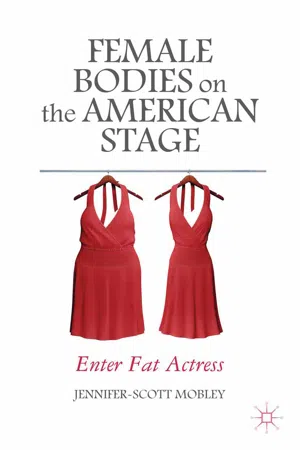
The fat female body is a unique construction in American culture that has been understood in various ways during the twentieth and early twenty-first centuries. Analyzing post-WWII stage and screen performances, Mobley argues that the fat actress's body signals myriad cultural assumptions and suggests new ways of reading the body in performance.
Information
Part I
Fat Dramaturgies
2
Fat Center Stage
This first category of so-called fat texts includes those in which the fat female body is directly addressed as part of the subject matter. In Bourdieu’s terms, as dramatic texts intended for live performance, all the pieces discussed in this chapter fall into a restricted field of cultural production.1 Unlike film or TV, live performance reaches a limited audience of viewers who have not only the economic means and sociocultural impetus to see theatre, possibly an indicator of higher education, but also geographic proximity to the theatre.2 The plays and productions I will discuss are geared toward different audience subsets, more specialized, nuanced, and restricted fields, but most would be considered to have commercial appeal and thus be economically attractive for a theatre to produce. All these plays take the (fat) female body literally as the central part of their subject matter, and I will identify what this means in terms of character psychology and dramaturgy. For example, Charles Laurence’s My Fat Friend (1974) and Jim Brochu’s Fat Chance (1993) feature the protagonists, originally played by Lynn Redgrave and Rue McLanahan respectively, padded and costumed to appear overweight. Both pieces dramatize the transformation of the fat woman from overweight to svelte and use fat primarily for comic effect. The content and fat narrative of these plays, written by men and geared toward a commercial audience, differ somewhat from Laura Cunningham’s Beautiful Bodies (1987), Madeleine George’s The Most Massive Woman Wins (1994), or Eve Ensler’s The Good Body (2004).3 The latter are feminist plays, many of which have enjoyed less commercial success, initially opening in regional houses and seeing subsequent productions largely in university theatre venues; through pathos and satire these playwrights attempt to shed light on the complicated relationship between women and their bodies. The characters and their stories actively confront the pressures in American culture to be thin and beautiful.
Fat Broads on Broadway
My Fat Friend by Charles Laurence originated at the Globe Theatre in London and opened on Broadway at the Brooks Atkinson theatre on March 31, 1974, and ran through December 7, 1974, for a total of 288 performances.4 The cast featured a newly slimmed down Lynn Redgrave, fresh from her Academy Award-nominated, internationally successful role in Georgy Girl as Vicky, the fat bookstore owner. George Rose played her feisty, gay lodger Henry, who drives much of the plot. Reviews of the American production suggest that Rose, in the role of Henry, stole the show. Rose was nominated for a Tony and won the Drama Desk Award in 1974. The predominance of a gay character and the alliance between fat and gay characters in this play could make My Fat Friend a candidate for chapter seven, “Queering Fat.” In fact, Time magazine reviewer Lance Morrow wrote, “the play might better have been called My Fag Friend.”5 On the other hand, since the plot of this play focuses squarely on the problem of a fat woman, I see it as a strong illustration of the way in which a playwright engages fat dramaturgically and the way in which the casting—in this case of a celebrity fat actress—enhances storytelling and audience reception.
The narrative of the play is simplistic, or as theatre critic Clive Barnes put it: “Despite its fat subject, it is a thin play, but it gives an opportunity for a trio of very funny performances and a new view of the onstage homosexual.”6 Vicky is a lonely, somewhat surly but witty, compulsive overeater who runs her own bookshop connected to her London flat. She has two gay male lodgers, the flamboyant Henry and the younger, subdued James, who is an aspiring novelist and a great cook. Because James is always preparing wonderful meals, Henry holds him responsible for Vicky’s most recent weight gain, which has put her over the edge emotionally. In the opening scene she has a revelation that she is fatter than ever and deplores her shape, even as she continues eating and Henry insults her. A good part of the first act is sustained by many wisecracks and fat jokes among the three friends, but the major plot point is that a gentleman caller, Tom, comes into the bookstore, meets Vicky, and asks her on a date. They have a wonderful time, but he must leave the country for several months for business. Upon his departure, Henry (whose name could be a reference to Pygmalion’s Henry Higgins) proposes that Vicky lose weight and surprise her new paramour when he returns for Christmas. By the second act Vicky has dramatically transformed her figure, with Henry verbally abusing her all the way. However, Tom returns from his business trip, and we discover that he actually liked the way Vicky looked before she lost weight, so she breaks off the relationship with him. Tom, who has brought her candy and other sweetmeats from his travels, hints that she could gain some weight back, and she retorts, “No, I’ll make bloody sure I don’t. This is me, I like the way I am and I haven’t enough spirit to be a pioneering sex symbol.”7 Newly in control of her life as a thin person, she decides it is time for James and Henry to move out. End of play.
For comic effect Laurence engages many of the classic fat jokes and fat pathologies that I have discussed in chapter one. Vicky is the quintessential fat girl. She has relatively low self-esteem, makes self-deprecating jokes, but just cannot stop eating. She hides candy and sweets, pours extra sugar over her cornflakes, eats to salve all of her emotions, and doesn’t even notice she’s eating until she catches a glimpse of herself in the mirror or notices that her jaws hurt from chewing. She is characterized as a liar both by Henry’s comments and by his description of her past behavior. For example, when Vicky is out (actually buying a new dress for her date), Henry explains to young James what she is most likely up to:
HENRY. The clever cunning cow . . . Well it’s obvious. She wouldn’t dare sit here in the fat dress and make a pig of herself, so she’s decided to cheat. One last glorious tour around the chip shops stuffing herself silly, I bet . . . I know her better than you do. It’s like living with an alcoholic, junky, kleptomaniac. You wait, these next few weeks are going to be murder. She’ll announce some grand new diet and beg us both to help her and then she’ll be up to every trick in the book. She’ll sit here large as—larger than life, moaning away and nibbling a carrot and all the time there’ll be cream cakes behind the cistern and Mars bars up her knickers.8
This monologue touches on nearly every aforementioned fat stereotype, although in the course of this play Vicky does not lie, hide food, or complain overly about her diet. She does drink excessively in one scene and she does smoke, which Henry praises as a good alternative to eating. However, from a viewer perspective, the smoking reinforces the notion that she is orally fixated and must substitute cigarettes for food.
As Vicky prepares for her date, Henry teases her mercilessly that Tom must be a monster of some sort to go out with her. Vicky insists Tom is “normal,” but Henry advises her to bring a silver bullet, crucifix, and pepper spray on her date. In another stereotypical behavior, Vicky frequently engages in self-deprecating humor, quipping to Tom: “Always ready to eat—story of my life.”9 When she returns from her date having had a wonderful time, Vicky admits:
VICKY. We went to a marvelous restaurant where I tried to be good but eventually made an incredible pig of myself. The sweet trolley alone was paradise.10
Clearly the playwright relies on all commonly held assumptions about fat women, including the self-awareness that eating is bad and within their control, if only they exercised restraint.
The second act begins four months later and opens with the grand revelation that Vicky has dropped forty-plus pounds, which is accomplished theatrically by the actress removing padding before appearing in the second act. By now Vicky is so enthusiastic and “in control” that she is taking diet pills and turning down the weekly sanctioned treat that Henry allots her. On Christmas Eve the three roommates eagerly await Tom and his reaction to Vicky’s new body. Tom arrives and is clearly surprised at her appearance and asks if she is ill. She refuses to join him in a drink because “Dr. Henry,” who has achieved the “world’s first body transplant,” made her give up alcohol as part of her weight-loss program. Vicky further emphasizes her lack of self-control and personal agency by giving all the credit for her accomplishment to Henry, whose support included berating her, infantilizing her, and watching her run laps around the park. When they are left alone, Tom confesses that he preferred her at her old weight and is appalled that she is trying to lose still more. Vicky declares she prefers her new body above anything, and Tom leaves.
During the dénouement scenes, Vicky and Henry try and understand why Tom preferred Vicky fat. They essentially conclude that Tom was indeed the monster that Henry thought he was for being attracted to a fat woman. Regardless, Tom’s response does suggest that he was more interested in Vicky’s body than anything else about her, which is a surprising yet still misogynist reversal. Nonetheless, her weight loss has miraculously made Vicky a saner, more balanced, independent woman. She muses:
VICKY. When Tom left this evening I was disappointed and a bit annoyed but I wasn’t shattered—none of my usual reactions, I didn’t rush to the nearest piece of cake, and suddenly I realized why—I’m a different person, Henry, externals do affect one’s way of thinking and I think it would be impossible for me not to change my way of living.11
With this speech the slim Vicky, now in control of her life because she is in control of her weight, asks the abusive Henry to move out, thus reinforcing another fat stereotype, which is that weight loss actually changes a person’s character.
Referring back to my statement about the way in which My Fat Friend intersects with “queer fat,” it is notable that throughout the play Henry characterizes himself as a kind of pariah and outsider due to his homosexuality. He suggests that his alliance with Vicky is in part due to their mutual status as societal outcasts and lumps James, who is in the closet and socially awkward, into this mix as well. He quips to James, who has maintained that he cares for Vicky regardless of her appearance and dislikes her dieting:
HENRY. You’re pretty peculiar too. You know, it’s a funny sensation and one I never thought I would experience, but for the first time in my life I feel completely and utterly normal.12
As I shall discuss in greater detail in chapter seven, My Fat Friend illustrates, as do many plays and cultural texts featuring fat characters as subversive individuals, the link between fat and gay identities. In this case, while Vicky is fat she is a “fag hag,” but when she loses weight, she dismisses her two gay friends, implying that she can now enter the realm of heteronormativity.
I must now move from the text of My Fat Friend to discuss the performance of Lynn Redgrave in the title role, which added complexity to the critical reception of this play and its relative popularity. Redgrave was one of the first celebrities to undergo a public battle with weight loss and spin her transformation into publicity by advertising for Weight Watchers in the 1980s.13 However, at the time of My Fat Friend in 1974 she had only recently left behind her Georgy Girl reputation as the hefty Redgrave sister. When the play opened in the United States, the New York Times featured an article entitled “Lynn Redgrave Fat? Only with Pads Now.” Below her picture, the caption reads, “Lynn Redgrave who went from 180 pounds to a svelte size ten by eating only one meal a day.” The focus of the article is not particularly on the play but on Redgrave’s weight-loss journey following Georgy Girl. She talks about all the diets she has tried and how the only success she has found to maintain her “Ford Model” figure is to eat only one meal a day, usually of steak or lamb chops, spinach, and an apple. If she gets really hungry during the day she allows herself to eat ...
Table of contents
- Cover
- Title
- Copyright
- Contents
- List of Illustrations
- Acknowledgments
- Introduction
- Part I Fat Dramaturgies
- Part II Fat Subjectivities
- Part III Reclaiming Fat
- Notes
- Bibliography
- Index
Trusted by 375,005 students
Access to over 1.5 million titles for a fair monthly price.
Study more efficiently using our study tools.
Frequently asked questions
Yes, you can cancel anytime from the Subscription tab in your account settings on the Perlego website. Your subscription will stay active until the end of your current billing period. Learn how to cancel your subscription
No, books cannot be downloaded as external files, such as PDFs, for use outside of Perlego. However, you can download books within the Perlego app for offline reading on mobile or tablet. Learn how to download books offline
Perlego offers two plans: Essential and Complete
- Essential is ideal for learners and professionals who enjoy exploring a wide range of subjects. Access the Essential Library with 800,000+ trusted titles and best-sellers across business, personal growth, and the humanities. Includes unlimited reading time and Standard Read Aloud voice.
- Complete: Perfect for advanced learners and researchers needing full, unrestricted access. Unlock 1.5M+ books across hundreds of subjects, including academic and specialized titles. The Complete Plan also includes advanced features like Premium Read Aloud and Research Assistant.
We are an online textbook subscription service, where you can get access to an entire online library for less than the price of a single book per month. With over 1.5 million books across 990+ topics, we’ve got you covered! Learn about our mission
Look out for the read-aloud symbol on your next book to see if you can listen to it. The read-aloud tool reads text aloud for you, highlighting the text as it is being read. You can pause it, speed it up and slow it down. Learn more about Read Aloud
Yes! You can use the Perlego app on both iOS and Android devices to read anytime, anywhere — even offline. Perfect for commutes or when you’re on the go.
Please note we cannot support devices running on iOS 13 and Android 7 or earlier. Learn more about using the app
Please note we cannot support devices running on iOS 13 and Android 7 or earlier. Learn more about using the app
Yes, you can access Female Bodies on the American Stage by J. Mobley in PDF and/or ePUB format, as well as other popular books in Social Sciences & Art General. We have over 1.5 million books available in our catalogue for you to explore.