eBook - ePub
Educational Developments, Practices and Effectiveness
Global Perspectives and Contexts
- English
- ePUB (mobile friendly)
- Available on iOS & Android
eBook - ePub
Educational Developments, Practices and Effectiveness
Global Perspectives and Contexts
About this book
Exploring a range of educational developments and practices in different national contexts in Australia, Canada and Switzerland, this book analyses the effectiveness of such initiatives. Case studies in the book include business and online education, supporting students with disabilities and school-wide pedagogical improvement.
Information
Topic
EducationSubtopic
Education General1
Researching and Extending Developments in Contemporary Educational Practice
Jennifer Lock, Petrea Redmond and Patrick Alan Danaher
Introduction
Educational practice is centrally concerned with the quality and impact of teaching and learning designs and techniques. Developing practice in ways that enhance and increase that quality and impact is the mission of educational practitioners and researchers alike. This kind of educational development is predicated on understanding the multiple contexts in which students learn and the diverse means available to educators to teach their students effectively. Yet appreciating why and how particular educational strategies work in specific circumstances does not necessarily guarantee equivalent success in different contexts.
From this perspective, Alexander (2000) suggested that we ‘search for evidence as to what it means to be educated’ (p. 28) and at the same time that we consider ‘[w]hat benchmarks of “sound” academic development have we, as educational researchers, offered as alternatives’ (p. 28) to government-mandated educational standards. On the basis of this tension, even contradiction, Alexander ‘proffer[ed] the study of academic development as a viable agenda for the research community’ (p. 28). The complexity of this construct of academic development is paralleled by the equivalent complexity of teaching and learning, the dynamic character of human beings and the large range of sociocultural and contextual spaces in which education occurs.
Accordingly, this chapter, like this book, is focused directly on exploring research and scholarship pertaining to developments in contemporary educational practice. We see such developments as having a positive semantic valence, akin to terms such as advances, changes, improvements, refinements, reforms and transformations. On the other hand, we concede that educational developments are complex and multifaceted phenomena that elude easy analysis and resist automatic application to other contexts. Furthermore, we accept that the concept of educational development is contested in the literature, reflecting diverse and sometimes contradictory assumptions about the character and significance of formal education and the contributions of development to enacting relevant educational provision (see, for example, Amundsen & Wilson, 2012; Gibbs, 2013; Bridges, 2014). Moreover, educational development is ‘multi-faceted, inter-related, overlapping and dynamic’ (Land, 2001, p. 10). Once it has been articulated, educational development is then recontextualised to address problems in specific fields of practice (Shay, 2012). Yet, as we noted above, solutions and explanations that work in one context may not suit a different context.
There are distinct forms of educational development (Taylor & Rege Colet, 2010), and we note that the term educational developers has a specific meaning in further and higher educational contexts (Shay, 2012), which are certainly germane to the concerns of this book. At the same time, we envisage educational development as having a wider reach and relevance, and as referring more broadly to the processes of conceptualising, initiating, implementing and evaluating educational change at varying levels of complexity (see also Lehtomäki et al., 2014).
Even the concept of development is contested in the terrain of academic development, where it ‘can be interpreted according to various ontological and epistemological standpoints’ (Webb, 1996, p. 65). Multiple perspectives about the complexity of knowledge are not new and can explain the wide range of definitions and approaches to research practice in the area of educational development identified by Alexander (2000), who also suggested that, if we consider that development ‘refers to systemic change over time’ (p. 30), then, ‘[i]n the case of academic development, the focus of that transformation is centred on the process of formal learning’ (p. 30). In addition, ‘[a] further significant attribute of academic development practice is the practitioner’s attitude to change’ (Land, 2001, p. 10).
The objective of this chapter is to situate the subsequent chapters and the book as a whole in a larger field of scholarship that frames the discussions in the individual chapters and to which those chapters also contribute additional perspectives and understandings. The chapter consists of the following three sections:
• selected current literature about educational developments and practices;
• conceptual frameworks for analysing and evaluating educational developments and practices; and
• the book’s rationale, structure and intended contributions to extending current understandings of educational developments and practices.
Educational developments and practices
Inevitably, given the breadth and depth of the subject matter and the diversity of approaches to researching it, the current literature about educational development and practice reveals considerable variability in understandings of, and strategies for implementing, educational development. For instance, Amundsen and Wilson (2012) articulated six distinct clusters of techniques for enacting educational development in various contexts:
• The skill focus cluster … that focus[es] on the acquisition or enhancement of observable teaching skills and techniques. …
• The method focus cluster … that focus[es] on mastery of a particular teaching method. …
• The reflection focus cluster … that focus[es] on change in individual teacher conceptions of teaching and learning.
• The institutional focus cluster … that focus[es] on coordinated institutional plans to support teaching improvement.
• The disciplinary focus cluster … that focus[es] on disciplinary understanding to develop pedagogical knowledge.
• The action research or inquiry focus cluster … that focus[es] on individuals or groups of faculty investigating teaching and learning questions of interest to them.
(p. 97, emphasis in original)
While we lack the space in this section of the chapter to demonstrate and elaborate each cluster identified by Amundsen and Wilson (2012), their relevance to this discussion lies in highlighting the multiple understandings of educational developments and practices operating at very different levels of activity, including systems and institutional foci through to individual lessons and classroom interactions. Certainly, the literature exhibits a wide diversity of teaching and learning approaches from equally varied perspectives. For instance, current examples of this research encompass the impact of cognitive and learning styles (Evans & Cools, 2011), engaging with students with disabilities (Bunning et al., 2013), the opportunities and challenges of medical education (Dolmans & van der Vleuten, 2010) and contemporary practices in maximising the relevance and sustainability of workplace learning (Cairns & Malloch, 2011).
A significant subset of this scholarship about educational developments and practices has taken up the complex yet crucial question of what works in relation to educational development. That is, which factors appear to be influential in generating successful outcomes from educational development strategies? Again, these factors vary according to educational contexts, disciplines and systems. For example, Biggs and Tang (2011) elicited several elements of effective approaches to teaching and learning in the higher education sector. With regard to teaching, they synthesised at least some of the current thinking about quality teaching as follows:
Quality teaching produces quality learning[;] hence the importance of staff development and reflective practice. Quality teaching has two aspects: what the teacher does when interacting with students, and how the curriculum is structured and organized. A number of teaching methods encourage student metacognition, but no particular method is as important as the way the teacher interacts with the student, whatever the method. (p. 77)
Similarly, Hattie (2012) summarised decades of research into the multifaceted relationship between teaching and learning, and about ‘what works’ (p. 2) in successful teaching. He encapsulated those success factors in a way that resonates with some of the points made earlier in this chapter, as well as with the succeeding chapters in this volume:
The fundamental thesis of this book is that there is a ‘practice’ of teaching. The word practice, and not science, is deliberately chosen because there is no fixed recipe for ensuring that teaching has the maximum possible effect on student learning, and no set of principles that apply to all learning for all students. But there are practices that we know are effective and many practices that we know are not. … Instead, evidence of impact or not may mean that teachers need to modify or dramatically change their theories of action. Practice involves notions of a way of thinking and doing, and particularly of learning constantly from the deliberate practice in teaching.
(p. 4, emphasis in original)
On a different but equally diverse canvas, Bhuasiri, Xaymoungkhoun, Zo, Rho and Ciganek (2012) articulated ‘6 dimensions and 20 critical success factors for e-learning systems in developing countries’, including ‘the importance of curriculum design for learning performance’ and the centrality of ‘[t]echnology awareness, motivation, and changing learners’ behaviour’ (p. 843). Likewise, Cochrane (2010) distilled the following ‘[c]ritical success factors’ in maximising the effectiveness of mobile learning projects:
the importance of the pedagogical integration of the technology into the course assessment, lecturer modelling of the pedagogical use of the tools, the need for regular formative feedback from lecturers to students, and the appropriate choice of mobile devices and software to support the pedagogical model underlying the course. (p. 133)
On a smaller but no less significant scale, various scholars have outlined the perceived relationship between educational development and enhanced teaching and learning practices in relation to specific disciplines. These accounts have been directed at disciplines as diverse and multifaceted as media education (Buckingham, 2003), medical education (Kern et al., 2009), music education (Mark & Madura, 2014) and science education (Appleton, 2006). Similarly, focused analyses have examined this same relationship with regard to particular levels and types of educational provision, including early childhood education (Gordon & Browne, 2011), elementary or primary school education (Graham et al., 2012), secondary school education (Singer & the Hofstra New Teachers Network, 2014), special education (Brownell et al., 2010), teacher education (Alexander & Hammond, 2012), adult education (Merriam & Brockett, 2007) and higher education (Tight, 2012). Likewise, attention has been given to this same relationship in terms of currently topical educational issues such as the implications of educational futures research (Young & Muller, 2010) and the notion of interprofessional education (Thistlethwaite & Moran, 2010).
This short overview of current scholarship has highlighted the contextualised character of the understandings of and approaches to educational developments and practices and how that character varies according to the disciplinary focus and/or the level and type of educational provision. At the same time, the literature demonstrated convergences and synergies across these different forms of teaching and learning that reflected the potential for some kind of consensus about at least some of the elements of effective educational development and of what works in contemporary educational practices. These elements include, for instance, appropriate alignment among various aspects of the educational enterprise (Lam & Tsui, 2013) and the importance of authentic assessment (Dennis et al., 2013). Certainly, there is a considerable need for further research in this specific scholarly field, such as that described in this book.
Conceptual frameworks for analysing and evaluating educational developments and practices
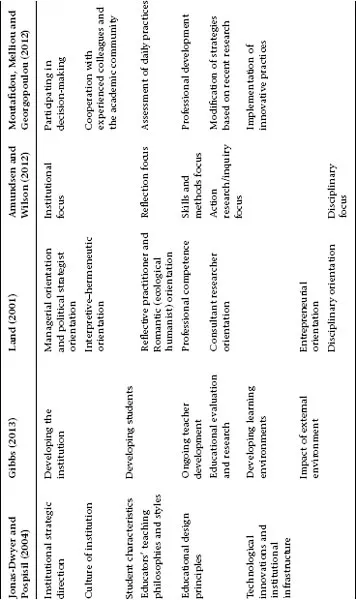
Table 1.1 presents a comparison of different conceptual frameworks distilled from the literature for analysing and evaluating educational developments and practices. There are some general consistencies across the different perspectives. There seems to be agreement that attention must be paid to the institutional focus, the ongoing professional competence of the educator through professional development and reflective practice, research-based practice and the impact of technology.
Interestingly, the focus seems to be on teaching rather than on learning, even though Alexander (2000) suggested that research in academic development is a search for ‘long-term changes that students undergo when engaged in formal learning’ (p. 28), including cognitive, social and emotional lifelong and lifewide learning rather than cognitive learning that would be relevant until a student had completed the related assessment. Moreover, academic development includes ‘interactions between teachers and students, as well as between students and teachers’ (Alexander, 2000, p. 31). Table 1.1 also highlights that academic development is a complex concept influenced strongly by internal and external stakeholders and relationships.
Table 1.1 Comparison of conceptual frameworks about educational developments and practices
In relation to learning, Biggs and Tang (2011) encapsulated the three components of student motivation most likely to promote sustained learning outcomes, and accordingly most liable to contribute directly to learners’ educational development:
(1) The task provided – the teaching/learning activity itself – must be valued by the student and not seen as busy-work or trivial. …
(2) The student must have a reasonable probability of success in achieving the task. …
(3) A Theory Y climate is best for quality learning. Learners learn best when they feel free to move, are trusted and are able to make decisions and take responsibility for their own learning – consistent with clear policies and procedures and with an organized environment for learning.
(p. 66, emphasis in original)
In a review of the literature relating to academic staff development and student learning outcomes conducted for the New Zealand Ministry of Education, Rivers (2005) asserted that ‘good teaching has positive impacts on student outcomes; and teachers can be assisted to improve the quality of their teaching through a variety of academic interventions’ (p. 3). Ongoing professional competence of the educ...
Table of contents
- Cover
- Title Page
- Copyright
- Contents
- List of Figures and Tables
- Foreword by Thomas Michael Power
- Acknowledgements
- Notes on Contributors
- List of Abbreviations
- 1. Researching and Extending Developments in Contemporary Educational Practice
- Section I: Educational Developments and Improving Outcomes for Learners and Teachers
- Section II: Educational Developments and Specialised Disciplines of Knowledge
- Index
Trusted by 375,005 students
Access to over 1.5 million titles for a fair monthly price.
Study more efficiently using our study tools.
Frequently asked questions
Yes, you can cancel anytime from the Subscription tab in your account settings on the Perlego website. Your subscription will stay active until the end of your current billing period. Learn how to cancel your subscription
No, books cannot be downloaded as external files, such as PDFs, for use outside of Perlego. However, you can download books within the Perlego app for offline reading on mobile or tablet. Learn how to download books offline
Perlego offers two plans: Essential and Complete
- Essential is ideal for learners and professionals who enjoy exploring a wide range of subjects. Access the Essential Library with 800,000+ trusted titles and best-sellers across business, personal growth, and the humanities. Includes unlimited reading time and Standard Read Aloud voice.
- Complete: Perfect for advanced learners and researchers needing full, unrestricted access. Unlock 1.5M+ books across hundreds of subjects, including academic and specialized titles. The Complete Plan also includes advanced features like Premium Read Aloud and Research Assistant.
We are an online textbook subscription service, where you can get access to an entire online library for less than the price of a single book per month. With over 1.5 million books across 990+ topics, we’ve got you covered! Learn about our mission
Look out for the read-aloud symbol on your next book to see if you can listen to it. The read-aloud tool reads text aloud for you, highlighting the text as it is being read. You can pause it, speed it up and slow it down. Learn more about Read Aloud
Yes! You can use the Perlego app on both iOS and Android devices to read anytime, anywhere — even offline. Perfect for commutes or when you’re on the go.
Please note we cannot support devices running on iOS 13 and Android 7 or earlier. Learn more about using the app
Please note we cannot support devices running on iOS 13 and Android 7 or earlier. Learn more about using the app
Yes, you can access Educational Developments, Practices and Effectiveness by Jennifer Lock, Petrea Redmond, Patrick Alan Danaher, Jennifer Lock,Petrea Redmond,Patrick Alan Danaher in PDF and/or ePUB format, as well as other popular books in Education & Education General. We have over 1.5 million books available in our catalogue for you to explore.