eBook - ePub
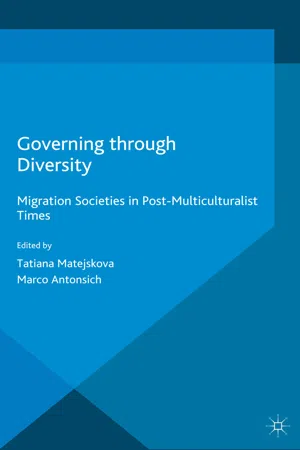
Governing through Diversity
Migration Societies in Post-Multiculturalist Times
- English
- ePUB (mobile friendly)
- Available on iOS & Android
eBook - ePub
Governing through Diversity
Migration Societies in Post-Multiculturalist Times
About this book
This cross-disciplinary edited collection presents an integrated approach to critical diversity studies by gathering original scholarly research on ideational, technical and actual social dimensions of contemporary governance through diversity.
Information
Part I
Ideational Field: Conceptualizing Diversity
1
The Difference Diversity Makes: A Principle, a Lens, an Empirical Attribute for Majority–Minority Relations
Paolo Boccagni
Introduction
This chapter explores the contribution of diversity, as a concept and a research optic, to the debate on immigrant incorporation and majority–minority relations in Europe. While the use of this term abounds in the recent literature, its meaning often sounds unduly self-evident, as if it were a principle in its own right. There is still little reflection on the variety of stances and interests which underlie it at a number of levels: as an approach to interethnic relations, an empirical attribute, a (potential) new mode of immigrant incorporation or even a more fashionable synonym for multiculturalism, apparently less burdened with ideological and normative implications.
The term “diversity” has long been used in management studies and practice, primarily in the US. What it conceptually adds to migration studies is less obvious – except, perhaps, an emphasis on the interdependence between race or ethnicity, culture and other significant axes of social differentiation or, indeed, discrimination: religion, gender, generation and so on. Is this enough to justify the theoretical significance of diversity, or should its success story be attributed to different, mainly political factors? Against this background, I discuss how diversity has entered, and modified, an already “overcrowded” semantic field, which includes notions such as integration, incorporation and multiculturalism. Does diversity entail anything new regarding, for instance, the national(ist) rhetorics and self-understandings of receiving societies, or about the everyday practices and life prospects of “their” immigrants and ethnic minorities?
By critically mapping the main understandings and constructions of diversity, I assess the potential for employing it as a meaningful concept, with particular attention to its ethno-cultural bases – rather than, say, linguistic or religious ones (Kraus, 2012). Admittedly, this is just one of the potential backgrounds to diversity-oriented discourses and practices. Nonetheless, it does cover the prevalent uses of diversity for purposes of identification and classification across different realms of research and practice, concerning immigrants (and their descendants) or minorities otherwise categorized.
In what follows, I look into the added value of diversity at three levels: first, as a byword, a principle or a concept in itself; second, as a lens upon group and individual interactions between the societal mainstream and a number of minorities along “ethnic” or other lines; and last, as an empirical attribute of multiethnic societal arrangements, and hence as an object of social research, whatever the level of analysis (individual, group, societal), the empirical forms of diversity (views, discourses, practices and so on) and the research viewpoint (that is, the subjective constructions of diversity versus its objective concretizations). Based on this conceptual overview, I question the widespread, if often implicit, tendency to assume diversity as a reformulation of the philosophical and political tenets of multiculturalism. Overall, the chapter aims to pave the way for a cognitive transition in framing diversity, less in principled or evocative terms than as a multidimensional tool for exploring interethnic and majority–minority relations in everyday life.
What’s in a word? A descriptive marker, a principle and a concept
Diversity is an important building block for most public representations of majority–minority relations. While its discursive salience is remarkable in today’s European Union (Kraus, 2012), it has long been a widespread, even commonsensical notion in multiethnic societies such as the US (Bell & Hartmann, 2007; Wood, 2003).1 What this “block” consists of, however, is a less debated point. Diversity is often assumed to be a self-evident notion, although its meaning is, at least in part, specific to context, and possibly to culture (Jonsen et al., 2011). No universal or widely shared definition of this concept can be found in the social science literature; the frequency and variety of its uses are inversely proportional to its analytical clarity. The plurality of its connotations, the loose ways of defining it, and the conflation between descriptive and prescriptive stances are all part and parcel of its success story (Vertovec, 2012).
Conceptual foundations
References to diversity are pervasive in workforce and organizational studies (for example, Jonsen et al., 2011; Qin et al., 2013; DiTomaso et al., 2007) and, to a lesser extent, in the education (for example, Moses & Chang, 2006) and anti-discrimination literature (Wrench, 2007). Its distinctive significance and implications for the broader field of majority–minority relations, however, have been relatively understudied – with an increasing number of exceptions over the last few years.2
At its simplest, diversity is synonymous with any “condition of heterogeneity within a certain whole” (van Ewijk, 2011, p. 684). In a similar vein, Harrison and Klein (2007) define it as “the distribution of differences among members of a unit with respect to a common attribute”. What qualifies diversity as a concept, though, is not just any perceived attribute, but, rather, “a meaningful characteristic: one that influences the identity and the way of life of that person” (van Ewijk, 2011, p. 685). Diversity, in other words, gains significance not as a “pre-social category”, but as one “loaded with attributed meanings”: the “perceived, evaluated form of (cultural) difference … constructed by societal agents by drawing demarcation lines between classifications with social meanings” (Faist, 2009, p. 178).
Three conceptual implications of this view of diversity should be highlighted here. First, the “demarcation lines” can be drawn and made meaningful within as much as between social groups. Diversity does not apply only to intergroup (generally speaking: majority–minority) relations. It may also emerge as an internal property of any given collective – no matter how “homogeneous” the latter was supposed to be. Second, what makes diversity “matter” as a concept is not interpersonal or group difference per se, but its social construction as meaningful – that is, as an appropriate basis for category making, and possibly for group making as well. Third, diversity points to an increasing de-standardization of the forms and criteria of social differentiation, but also of the subjective bases for individual and group identification. To put it another way, diversity is “not only the amount of variation in a certain attribute, but [it] is also subject to individuals’ reactions to that attribute” (Qin et al., 2013, p. 9).
In all these respects, diversity is primarily a matter of social (and, in part, subjective) definition. Of critical relevance, and inescapably relative and context-dependent, are, then, the social criteria which underpin diversity as a complex of individual and aggregate classifications and, often, hierarchizations. Central to diversity are the societal “modes of differentiation” (Vertovec, 2009) that are constructed as significant by a given social actor and its counterparts, though not necessarily in the same terms. Such modes include, along with culture, race or ethnicity, a number of other meaningful attributes – gender, age, social class, legal status, sexual orientation, (dis-)ability and so on. The diversification of this spectrum of attributes, as salient and legitimate criteria for drawing the boundaries of societal membership, belonging or recognition, is a remarkable development in itself. It is also a marker of the increasing public salience of diversity, at least as a principle – or possibly, according to its detractors, as an empty shell.
At a minimum, then, diversity stands for two simultaneous social developments: a significant ethno-cultural diversification (or even fractionalization) and its interlocking with other axes of societal differentiation, as argued above. As Kraus (2012, p. 13) has it, the discursive prevalence of diversity reflects “an increased ‘underdetermination’ of ethnic and national identities” as distinctive markers, given the greater awareness of the multifactorial roots of any social category or arrangement, and the greater visibility of non-ethnic ways of identification, belonging, classification and recognition.
While far from new (especially in long-standing immigration societies), the category of diversity-as-societal-heterogeneity is suitable to translate into empirical analysis the intersectionality claims of many feminist scholars (as summarized, most recently, by Anthyas, 2013). Interestingly, a growing ethno-national differentiation of immigrant minorities – together with the greater salience of other lines of differentiation – has also contributed to the crisis of institutionalized multiculturalism, as a set of policies implicitly based on the coexistence between a low number of ethnic communities, seen as internally cohesive and well distinct from each other (Entzinger, 2005).
Normative implications
Having mentioned these conceptual bases, the current discursive visibility of diversity has primarily to do with its strong descriptive and evocative power. Diversity is used as a catchword for a general state of things, but also as a socially meaningful value to be achieved, maintained or contested – depending on the underlying ideological agenda. Much has been written, indeed, on diversity as “both a description of the social reality and a moral commitment” about it (Bell & Hartmann, 2007, p. 899).
In more explicitly prescriptive terms, “diversity” as a principle has gained visibility in human resources management, as well as in several policy domains (Vertovec, 2012). As a part of this trend, it has also been emerging – though in an often vague and abstract tenor – in the self-representation of several stakeholders of immigrant integration, including local authorities, non-governmental organizations (NGOs) and enterprises. Indeed, compared with the past, a trend of greater public recognition of (and openness to) ethno-cultural diversity has been documented across liberal-democratic receiving societies (Bauböck, 2008; Kraus, 2012). This has been most apparent, first, in the relatively uncontroversial forms of “celebration multiculturalism” involving leisure and consumption (that is, arts, foods, sports and so on); second, in the grassroots transformations of material cultures along lines of hybridity, “fusion” or syncretism (Vertovec, 2009); last, in the development of a more inclusive political discourse, rhetorically condensed into slogans such as “together (or united) in diversity”, “valuing diversity” and the like. The latter development has been facilitated by the discursive elaboration of international agencies such as UNESCO (Dietz, 2007) and, more relevant in terms of its implications for the corporate sector, the European Commission (Vertovec, 2012).
As all these instances suggest, discursive appeals to diversity have expanded well beyond the sphere of the workplace and of human resources management. The gentrification of traditionally deprived ethnic neighbourhoods across European societies, for instance, has been accompanied by an emphasis on the “consumable” and “marketable” side of diversity. Appealing to this notion, particularly under progressive local authorities, is consistent with urban narratives, which conjugate economic advancement, social inclusion and cultural allure. Diversity, then, emerges (also) as a fertile terrain for public culture (Bell & Hartmann, 2007) – in fact, as a commodity: what “converts difference into pleasure”, as Ahmed (2007, p. 246) aptly put it.
Whatever the discursive field, diversity is generally framed as something positive and desirable – or perhaps, in a critical reading, as “a gently unifying, cost-free form of political commitment attuned to the mediated, consumer logics of contemporary societies” (Lentin & Titley, 2008, p. 13). Interestingly, though, the lexicon of diversity has also been appropriated by a variety of social movements and counter-hegemonic initiatives, “as an anti-essentialist claim against all too reified notions of culture and ethnicity” (Dietz, 2007, p. 10).3 No doubt, the faceted vision of diversity is a welcome reminder against all hyper-culturalist, essentialist and “groupist” accounts of ethnic, cultural or religious difference. Moreover, once revisited as a subjectively meaningful marker, diversity opens up some space for the expression and recognition of specific identities and affiliations, as opposed to all pre-established and externally imposed classifications. As a subjectively claimed attribute, in other words, it has the potential to catalyse “a trend toward expressing ‘who you are’ ” (Vertovec, 2012, p. 304). As a general category, nonetheless, diversity provides a dubious and slippery terrain for claim making and mobilization, whether related to issues of redistribution or of recognition.
In itself, advocating for diversity is tantamount to framing societal heterogeneity as an ordinary and “commonplace” matter (Wessendorf, 2009) – something that simply is out there and does not need to be questioned. Celebrating the normality of diversity does not necessarily affect the power asymmetries and the broader inequalities that are likely to underpin any given societal arrangement. Making a strong case for societal diversity, then, results in a paradoxically depoliticized argument: as if there were no reasons for seeing diversity as a salient issue per se – although the strong societal inequalities that are often associated with diversity are such by all measure (Herring & Henderson, 2011; Olwig, 2013).
Indeed, the mainstream discursive uses of diversity, including its translation into all sorts of “diversity programmes”, typically fail in appreciating “how diversity is structurally embedded” (Faist, 2009, p. 279); or, put differently, how pervasive the underlying social inequalities are, and what factors shape and reproduce them. While evocative, the notion of diversity says little about the structural conditions under which a given mode of differentiation is relevant, and even less about the power relationships that underpin it. I will return to this critical issue below.
Diversity as a lens on majority–minority relations (and a way of handling them)
Importantly, the semantic potential of diversity need not be reduced to a policy principle or a broad representation of societal heterogeneity. Whatever its uses as a byword, diversity can also be employed as a lens on the changing interethnic relationships between natives and immigrants at an individual and at an aggregate level. Diversity can be appreciated as a way of looking at the situated interaction between ethnicity (or immigrant background) and any other attribute that gains power as a marker of difference. As such, the diversity lens escapes essentialist views of the “difference” between natives and newcomers – or, for that matter, between the mainstream and a variety of minorities. If it is to prove helpful as a heuristic perspective on societal differentiation, diversity must not be conceived as a mechanical summing up of differences, but as a multidimensional and multi-perspectivist approach to the study of “ ‘lines of difference’ … that is of identities, identity markers and discriminatory practices. Not the essence of given identity discourses, but the intersections between diverse and contradictory discourses and practices constitute the main ‘object’ of the diversity approach” (Dietz, 2007, p. 22).
Along these lines, a diversity optic helps refine the traditional criticisms of immigrant assimilationism, and possibly of its more recent rewritings. If broadly framed as “nonconformity” with the ethno-cultural composition of receiving countries (Knotter et al., 2011), diversity sheds light on the pitfalls inherent in any account of one-sided immigrant adaptation to the majoritarian society. The same criticism holds for the label of integration, now more fashionable (in Europe at least). Assuming receiving societies as previously “integrated” does not do justice to their historical trajectories and to the endogenous differentiation associated with a number of “minorities” – even before labour immigration made for another, more visible layer of diversity (Lentin & Titley, 2008). Interestingly, though, the shifting contours of this societal diversification are hard to frame only within “cultural containers” isolated from each other – whatever the attendant claims for recognition and institutional support, as in the traditional accounts of multiculturalism.
To contend that any societal arrangement is internally diverse, and that the view of society as a territorialized and state-centric entity is itself deceptive ...
Table of contents
- Cover
- Title Page
- Copyright
- Contents
- List of Illustrations
- Notes on Contributors
- Introduction: Governing through Diversity
- Part I: Ideational Field: Conceptualizing Diversity
- Part II: Technical Field: Managing and Practicing Diversity
- Part III: Social Field: Social Relations of Heterogeneity
- Conclusion: Nation and Diversity – A False Conundrum
- Index
Trusted by 375,005 students
Access to over 1.5 million titles for a fair monthly price.
Study more efficiently using our study tools.
Frequently asked questions
Yes, you can cancel anytime from the Subscription tab in your account settings on the Perlego website. Your subscription will stay active until the end of your current billing period. Learn how to cancel your subscription
No, books cannot be downloaded as external files, such as PDFs, for use outside of Perlego. However, you can download books within the Perlego app for offline reading on mobile or tablet. Learn how to download books offline
Perlego offers two plans: Essential and Complete
- Essential is ideal for learners and professionals who enjoy exploring a wide range of subjects. Access the Essential Library with 800,000+ trusted titles and best-sellers across business, personal growth, and the humanities. Includes unlimited reading time and Standard Read Aloud voice.
- Complete: Perfect for advanced learners and researchers needing full, unrestricted access. Unlock 1.5M+ books across hundreds of subjects, including academic and specialized titles. The Complete Plan also includes advanced features like Premium Read Aloud and Research Assistant.
We are an online textbook subscription service, where you can get access to an entire online library for less than the price of a single book per month. With over 1.5 million books across 990+ topics, we’ve got you covered! Learn about our mission
Look out for the read-aloud symbol on your next book to see if you can listen to it. The read-aloud tool reads text aloud for you, highlighting the text as it is being read. You can pause it, speed it up and slow it down. Learn more about Read Aloud
Yes! You can use the Perlego app on both iOS and Android devices to read anytime, anywhere — even offline. Perfect for commutes or when you’re on the go.
Please note we cannot support devices running on iOS 13 and Android 7 or earlier. Learn more about using the app
Please note we cannot support devices running on iOS 13 and Android 7 or earlier. Learn more about using the app
Yes, you can access Governing through Diversity by Tatiana Matejskova, Marco Antonsich, Tatiana Matejskova,Marco Antonsich in PDF and/or ePUB format, as well as other popular books in Social Sciences & Politics. We have over 1.5 million books available in our catalogue for you to explore.