- English
- ePUB (mobile friendly)
- Available on iOS & Android
eBook - ePub
About this book
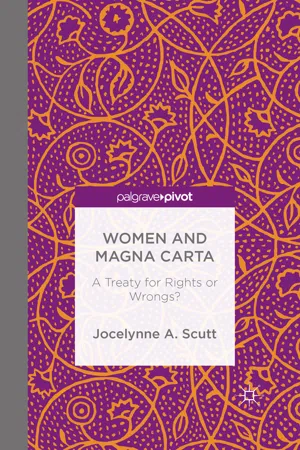
On the eight-hundredth anniversary of the Magna Carta, Women and the Magna Carta investigates what the charter meant for women's rights and freedoms from an historical and legal perspective.
Information
Topic
HistoriaSubtopic
Historia europea medieval1
Introduction – Magna Carta: Women’s Rights or Wrongs?
Abstract: In 2015 Magna Carta turned 800. A treaty between king and barons, today Magna Carta is claimed as a fundamental statement of rights. No woman was at Runnymede. Women appear in Magna Carta as attached to men – widows and daughters. So, asks Scutt, does Magna Carta speak for women? Some women spoke independently in medieval Britain, although church and aristocracy circumscribed all women’s sphere. Little is written of women and Magna Carta historically or in women’s rights campaigns. Mary Wollstonecraft demanded rights, and some campaigns reflect Magna Carta’s terms without invoking them directly. For men, Magna Carta is ‘adaptable’, a ‘speaking statute’ encompassing new rights and supporting contemporary claims. Scutt asks if Magna Carta thus promotes women’s rights, or does it symbolise wrongs done to women?
Keywords: Magna Carta a ‘speaking’ statute; Magna Carta ‘adaptable’; Magna Carta’s impact on women; no women in Magna Carta; sexual prejudice; women and Magna Carta rights
Scutt, Jocelynne A. Women and Magna Carta: A Treaty for Rights or Wrongs? Basingstoke: Palgrave Macmillan, 2016. DOI: 10.1057/9781137562357.0003.
John by the grace of God, king of England, lord of Ireland, duke of Normandy and Aquitaine, count of Anjou, to his archbishops, bishops, abbots, earls, barons, justices, foresters, sheriffs, reeves, ministers and all his bailiffs and faithful men, greeting ...
Magna Carta 1215
Magna Carta initiated
Magna Carta is generally seen as a statement of rights. A treaty between king and barons, its provisions often claim to extend rights and freedoms to ‘ordinary’ British subjects. When agreed at Runnymede in 1215, neither barons nor king had any concept of ‘equal rights for all’ (beyond themselves); there was no desire to include the masses. The barons’ intentions were twofold. Magna Carta was designed to curb King John’s excesses towards them and theirs: clauses limited his power to extract taxes and other emoluments, reduced his prerogative to determine when and whom wards and widows might marry, and denied his right to assert untrammelled power over rivers and royal forests. Equally or more significantly, the treaty established a council of twenty-five, chosen by and from the barons, to ensure the king’s compliance. The Council of Barons would ‘with all their might ... observe, maintain and cause to be observed’ the ‘peace and liberties’ confirmed and granted by Magna Carta, while ‘anyone in the realm’ could ‘take an oath to obey the orders of the twenty-five barons’ in enforcing it.1
At its heart, Magna Carta meant that the monarch could no longer exercise independent and complete power. Rather, King John (and, as intended, his successors) would be obliged not only to comply with its provisions, but to follow the barons’ interpretation of them, submitting to their final ‘say’ on whether or not he strayed or disobeyed. The king would not be above the law.
It was not as if kings had never sealed agreements with nobles before. John’s father, King Henry II, did so. Yet there was no suggestion that Henry ruled at their behest. As it was, John was never expected to rule. Of Henry and Eleanor of Aquitaine’s eight children, William died early, leaving next-in-line Henry as heir. Henry died just short of thirty. Matilda, being a woman, was automatically ‘out’. Next, Geoffrey died, so upon Henry II’s demise, in 1189, Richard succeeded him. Ten years on, Richard’s unexpected death meant John reigned.
‘John the Tyrant’ generated such unrest, bitterness and resentment that barons rebelled. Albeit successful in securing his seal to Magna Carta, they mistrusted his readiness to comply. Indeed, a king should not be a law unto himself. Henry II, Richard I, and fifteen years of John’s rule precipitated the barons into thoughts of shared control. Thoughts transformed into action. The twenty-five would serve as a permanent imperial ‘directorate’. All twenty-five were men.
In Magna Carta, not a single woman’s name appears. Women are mentioned, but through their relationships with men, as with heiresses, wards or widows, and the Scots’ king’s daughters – John’s hostages. Women were classified by affiliated or sexual status. As Henrietta Leyser’s Medieval Women notes, men could be considered collectively ‘as knights, merchants, crusaders’. Women were ‘virgins, wives or widows [and] mothers’.2 None was an archbishop, bishop, abbot, earl, baron, justice, forester, sheriff, reeve, minister, bailiff or ‘faithful man’. Although, as Louise Wilkinson recounts in Women as Sheriffs, on 18 October 1216 John appointed a woman, Lady Nicholaa de la Haye (c.1169–1230), as joint sheriff (with a man) of Lincolnshire and ‘worthy ... of God’s protection “in body and soul” ’, she played no part in Magna Carta. Nor did any other woman.
No woman signed. Yet women were not entirely lacking status. Nor were they voiceless. In the Time Traveller’s Guide, Ian Mortimer reflects upon ‘high-status females [being] just as highly respected as high-status males’ (at least, by underlings). Two centuries after Magna Carta, Margery Kempe’s autobiography appeared. A century before, Hildegard of Bingen preached throughout Europe, travelling from Paris to Switzerland, to southern Germany, back to France and around once more. Clamorous listeners requested written versions of her orations. Her commanding remonstrations had the interdict against her convent removed. She wrote to popes, bishops, nuns, emperors and nobility. Her works comprised hundreds of letters, songs, poems, books – including discourses on herbal remedies and the human body, a commentary on the Gospels and one on the Athanasian Creed, and a play set to music, the Ordo Virtutum. She exchanged letters with her friend and rival, Elizabeth of Shonau, who authored three books of Visions (two, perhaps, with her brother Egbert) and Liber viarum Die, enjoining the clergy and the laity, wed and unwed, to live lives of piety and holiness, without hypocrisy or cant.3
Yet class did not inhibit sexual prejudice. Mortimer’s Time Traveller’s Guide records the medieval convention of holding women responsible for ‘all physical, intellectual and moral weaknesses of society’. A contradictory mixture of traits and physical attributes asserted that women were ‘smaller, meeker, more demure, more gentle, more supple and more delicate’, simultaneously being ‘more envious and more laughing and loving’, while the souls of women housed malice, more so than men’s. Besides, it was said, women exceeded men in mendacity and feebleness of nature, always working in a more tardy fashion and moving at a pace slower than a man.4 In light of this bigotry, it is little wonder that women were absent from Magna Carta’s drafting, negotiation, sealing or execution.
In Magna Carta, JC Holt denotes ‘adaptability’ as Magna Carta’s ‘greatest and most important characteristic’. Part of its potential, he concludes, is an interpretation giving it ‘qualities which the men (sic) of 1215 did not intend’.5 Does this mean Magna Carta supported women claiming legal rights, protections and status, or it could advance them? Do women’s claims ‘fit’ and – if extending to women –

Does Magna Carta advance women’s rights, or is it a recipe for controlling women, perpetuating domination rather than liberation?
Magna Carta, women, law and history
Some six centuries after Runnymede, Magna Carta’s exhortations for freemen’s rights resonated with Mary Wollstonecraft and her contemporary, American Joel Barlow:
The word ‘liberty’ ... would not have been known in any language, had people not felt deprived of it; and some are ‘free men’ because ‘men are not all free’.6
As Wollstonecraft expostulated in 1792, neither were women ‘all free’. Hence, her proclamation in A Vindication of the Rights of Woman, building on and generating centuries of women’s struggle for freedom, for rights as freewomen, and for freedom as persons. Resonating beyond the UK and US, Wollstonecraft became a rallying cry for women throughout the Empire and then the Commonwealth. Women from Canada, Australia and Aotearoa/New Zealand initiated their own struggles, interacting across oceans, and across national boundaries.
As Chapter 2, ‘Are Women Persons’, recounts, the failure to acknowledge women as identities in their own right permeates actual history, the writing of history and the recognition that women might make and record history too. Over centuries, women have recorded their own lives and the lives of other women, yet male treatises and men’s histories are more often published and remembered. Women’s works come to attention, then fade, are sometimes recovered, or new generations of women write ‘herstory’ all over again. What of women and Magna Carta?
Unearthing women writing of women’s worlds and works at the time of John, Runnymede, Magna Carta and the rebellion’s impact on them is not so easy. Histories are there – Judith M. Bennett and Ruth Mazo Karras with The Oxford Handbook of Women and Gender (2013), Vicki Leon’s Outrageous Women (1998), and Marcelle Theibaux’s collection, The Writings of Medieval Women (1994) – showing women did and could write ‘then’. Magna Carta features by its very absence, yet historians’ concentration on men’s involvement and its impact on men may be unremarkable, for Eileen Power’s 1920s work on Medieval Women and Medieval English Nunneries recognises women moved within a circumscribed sphere – if women moved at all:
... the ideas about women were formed on the one hand by the clerkly order [the Church], usually celibate, and on the other hand by a narrow caste [the aristocracy], who could afford to regard its women as an ornamental asset, while strictly subordinating them to the interests of its primary asset, the land ... [T]he accepted theory about the nature and sphere of women was the work of the classes least familiar with the great mass of womankind.7
Whether highborn or lowborn, women lived under the direction of fathers, husbands, or church. Although young men were subject to their father’s will, those highborn being deployed in marriage to make alliances and increase a family’s wealth and status, unlike young women they were not perennial ‘non-persons’. Once reaching their age of majority, sons gained a preeminent place in their own household or that prospect lay before them. For a woman, whatever her age, personhood was beyond her realm.
As for treatises reflecting law and legal history, that Magna Carta might be significant for women’s liberty was not within contemplation of jurists Bracton (c.1210–c.1268), Coke (1552–1634), Hale (1609–1676), and Blackstone (1723–1789). Nor did Glanville (1112–1190), John’s tutor and chief minister of England during Henry II’s reign, anticipate it. In London in 1854, Barbara Leigh-Smith Bodichon published her Laws of England Concerning Women, then in 1894 Charlotte Carmichael Stopes’ British Freewomen appeared, claiming Magna Carta’s language for women, whatever judges might say. In the US, Elizabeth Cady Stanton’s Women’s Bible, Parts I (1895) and II (1898), reflected the law’s failure to acknowledge women’s ‘whole’ identity and religion’s undermining of it. However not until 750 years after Magna Carta did Albie Sachs and Joan Hoff Wilson’s ground-breaking work appear, analysing women’s lack of personhood in US and UK law. Sexism and the Law, published in 1978, confronted deftly the judicial guile (perhaps cunning) producing the jurisprudential nonsense deeming women as ‘non-persons’. Sachs and Wilson exposed this excuse for women’s absence from bench and bar, parliament and professorships for what it was: a manufactured reason for legitimating women’s absence when truth was, bluntly, that (too many) men did not want women there. Magna Carta won no mention. Nor did it when, almost fifty years on, Robert J. Sharpe and Patricia I. McMahon in The Persons Case (2007) once more addressed the law’s women-are-not-persons conundrum.
From 1759 to 1797, Wollstonecraft lived and died, for years judged wan...
Table of contents
- Cover
- Title
- 1 Introduction Magna Carta: Womens Rights or Wrongs?
- 2 Are Women Persons?
- 3 Are Women Peers?
- 4 Can Women Be Householders?
- 5 Access to Law and Justice
- 6 No Taxation without Representation
- 7 Bring Up the Bodies
- 8 Conclusion Claiming Magna Carta Rights
- List of Cases
- Bibliography
- Index
Trusted by 375,005 students
Access to over 1.5 million titles for a fair monthly price.
Study more efficiently using our study tools.
Frequently asked questions
Yes, you can cancel anytime from the Subscription tab in your account settings on the Perlego website. Your subscription will stay active until the end of your current billing period. Learn how to cancel your subscription
No, books cannot be downloaded as external files, such as PDFs, for use outside of Perlego. However, you can download books within the Perlego app for offline reading on mobile or tablet. Learn how to download books offline
Perlego offers two plans: Essential and Complete
- Essential is ideal for learners and professionals who enjoy exploring a wide range of subjects. Access the Essential Library with 800,000+ trusted titles and best-sellers across business, personal growth, and the humanities. Includes unlimited reading time and Standard Read Aloud voice.
- Complete: Perfect for advanced learners and researchers needing full, unrestricted access. Unlock 1.5M+ books across hundreds of subjects, including academic and specialized titles. The Complete Plan also includes advanced features like Premium Read Aloud and Research Assistant.
We are an online textbook subscription service, where you can get access to an entire online library for less than the price of a single book per month. With over 1.5 million books across 990+ topics, we’ve got you covered! Learn about our mission
Look out for the read-aloud symbol on your next book to see if you can listen to it. The read-aloud tool reads text aloud for you, highlighting the text as it is being read. You can pause it, speed it up and slow it down. Learn more about Read Aloud
Yes! You can use the Perlego app on both iOS and Android devices to read anytime, anywhere — even offline. Perfect for commutes or when you’re on the go.
Please note we cannot support devices running on iOS 13 and Android 7 or earlier. Learn more about using the app
Please note we cannot support devices running on iOS 13 and Android 7 or earlier. Learn more about using the app
Yes, you can access Women and The Magna Carta by Jocelynne Scutt in PDF and/or ePUB format, as well as other popular books in Historia & Historia europea medieval. We have over 1.5 million books available in our catalogue for you to explore.