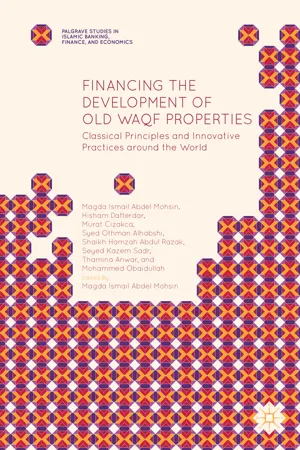
This book presents successful case studies in Muslim and Muslim minority countries that have revolutionized the redevelopment of idle waqf properties into productive land trusts. The revival of this institution over the last two decades shows the growing optimism in galvanizing the socioeconomic role of waqf by adopting its flexible shariah measures. Innovative ways of financing redevelopment allow Muslims to extend these roles to include new beneficiaries. New uses for these properties include providing services to the community, opening jobs for the majority of people, funding small entrepreneurs, educating the masses, providing health care, and sheltering the poor and needy. Countries under study include Sudan, Turkey, Malaysia, Indonesia, Singapore, New Zealand, Kuwait, Oman, Qatar, and Iran. Additionally, the book examines the International Development Bank's role in financing the development old waqf properties in different countries.
eBook - ePub
Financing the Development of Old Waqf Properties
Classical Principles and Innovative Practices around the World
- English
- ePUB (mobile friendly)
- Available on iOS & Android
eBook - ePub
Financing the Development of Old Waqf Properties
Classical Principles and Innovative Practices around the World
About this book
Information
© The Author(s) 2016
Magda Ismail Abdel Mohsin, Hisham Dafterdar, Murat Cizakca, Syed Othman Alhabshi, Shaikh Hamzah Abdul Razak, Seyed Kazem Sadr, Thamina Anwar and Mohammed ObaidullahFinancing the Development of Old Waqf PropertiesPalgrave Studies in Islamic Banking, Finance, and Economics10.1057/978-1-137-58128-0_11. Legal Framework of the Institution of Waqf
Magda Ismail Abdel Mohsin1 , Hisham Dafterdar2, Murat Cizakca3, Syed Othman Alhabshi4, Shaikh Hamzah Abdul Razak1, Seyed Kazem Sadr1, Thamina Anwar5 and Mohammed Obaidullah6
(1)
INCEIF – The Global University of Islami, Kuala Lumpur, Malaysia
(2)
Manama, Bahrain
(3)
Ucuncu Nilufer Caddesi, No. 25, Dobruca Mahallesi, Osmangazi, Bursa, Turkey, 16090
(4)
Kuala Lumpur, Malaysia
(5)
Auckland, New Zealand
(6)
Islamic Development Bank Group, Islamic Research and Training Institute, Jeddah, Saudi Arabia
Waqf is a financial charitable institution established by withholding immovable and movable properties to perpetually spend its revenue on fulfilling public or family needs, depending on the preferences of and conditions set by the founder. Once the property is created as waqf, it can never be given as gift, inherited or sold. It belongs to Allah (swt), and the waqf property always remains intact. Only its generated revenue is channelled to the beneficiaries. The main motivation for a founder to create waqf is clearly stated in both the Quran and the Sunnah.
As highlighted in Surah Al-i’-‘Imran (3:92), the creation of waqf is a way for founders to attain righteousness:
By no means shall ye attain righteousness unless ye give (freely) of that which ye love; and whatever ye give, of a truth God knoweth it well.
As highlighted in the hadith reported in Sahih Muslim, the creation of waqf is one of the ways to generate continuous rewards for the founder even after his death. Abu Hurairah (ra‘) reported Allah’s messenger (Pbuh) as saying:
When a man dies his acts come to an end, except three things, recurring charity, or knowledge (by which people benefit), or pious offspring, who pray for him.
Therefore, in this regard, the institution of waqf is a unique and everlasting financial institution that provides endless goods and services to Muslim societies, on the one hand, and compounds reward to its founders in the Hereafter, on the other (Mohsin 2015). The main objective of this chapter is to present an overview of the institution of waqf.
1.1 Definition of Waqf
The terms, waqf (plural awqaf) and habs (plural ahbas), are masdar (verbal nouns in Arabic), and literally they both mean (al-habs wa al-man): to stop and to prevent. The word tasbil is also used in the same sense, (fi sabil Allah): devoting to the way of Allah. In English, the term waqf is translated as ‘religious endowment’, but this translation may not convey the sense of devotion and grace to which waqf is associated in Islam. Although the terms waqf, habs and tasbil carry the same meaning, different countries prefer different usage. For example, the term waqf is used in Lebanon, Israel, Jordan, Iraq and the United Arab Emirates, while the term habs is more commonly used in North Africa. In Turkey, the term vakif (plural evkaf) is used, and in Malaysia the term waqf is spelt as wakaf (plural awkaf). All these terms have the same meaning, which is the holding and preservation of a certain sadaqah jariah: a continuous charity with the intention of prohibiting any use or disposition of the property outside the specific purposes to which the property is dedicated and in a way that it cannot be bequeathed or sold (al-Zubidi).
There is a consensus among Muslim jurists regarding the definition of these terms. According to them, all these terms mean the confinement of the property from the owner and the dedication of its usufruct to charitable purposes. However, they disagree on the permissibility and revocability of waqf. The disagreement in opinion between Muslim jurists in this regard created an unclear interpretation in certain Muslim countries. This occurred to such an extent that contemporary Muslim jurists used it as a way to abolish the waqf, especially during the end of the nineteenth century and the beginning of the twentieth century. This position acted as a catalyst in destroying the role of the institution of waqf during that time until its recent revival of this institution. Hence, we need to shed some light on this point of disagreement since our call is for the development of all old waqf properties in the various Muslim and Muslim-minority countries.
According to the definition of waqf given by the four schools of Islamic law, the first definition given by Imam Abu Hanifah, the founder of the Hanafi school of law, is “the detention of a specific property from the ownership of the founder of the waqf, and dedicating its revenue to charitable purposes in the manner of a loan” (al-Hanafi). According to Imam abu Hanifah, the founder has the right to return waqf property to his ownership. The owner can also sell it, i.e. the waqf is revocable (al-Sarakhsi). Moreover, his opinion regarding movable properties being dedicated as waqf is not valid (Zaidan). In consideration of these views, it means that a founder who created a waqf can reclaim and can sell it. Besides, no movable properties, such as books, weapons, horses or even money, can be created as waqf. In contrast to Abu Hanifah’s opinion, his disciple Abu Yusuf developed a system of legal doctrines that became the Hanafi definition of waqf (Al-Zuhaili). Abu Yusuf stated that waqf is only valid if it is irrevocable, i.e. cannot be reverted back to the founder, but made in perpetuity (al-Hanafi). Regarding the movable properties to be endowed as waqf, Abu Yusuf agreed that no movable property can be endowed as waqf, but weapons of war, cattle and implements of animal husbandry attached to the dedicated waqf land and books can be dedicated as waqf (ibn ‘Abidin). He based his opinion on the following hadith of the Prophet (Pbuh): ‘The Prophet (Pbuh) said; Khalid b. al-Walid has appropriated his horse and armor for the cause of Allah’ (al-N’isa’i). According to him, waqf of movable property is valid only if it was customary during the time of the Prophet (Pbuh) (al-Tarabulsi). In contrast to the latter view, another disciple of Abu Hanifah Imam Zufar approved all movable properties to be dedicated as waqf (al-Dhaahabi). He also included the waqf of dirham (pl. darahim) and dinar (pl. dananir), i.e. waqf al-nuqud (cash waqf) (ibn-‘Abidin). Moreover, Imam Zufar deduced that jewelry could also be dedicated as waqf. He based his opinion on the act of Hafsah, the wife of the Prophet (Pbuh) and the daughter of ‘Umar b. al-Khattab, who dedicated her jewelry to her relatives (abu al-Su‘ud). In addition, both Imams Muhammad and al-Sarakhsi had approved all movable properties subject to not only customary law during the Prophet’s (Pbuh) time but also customs arising in other times and countries.(Cizakca 2000a, b).
For the second school of law, Imam Malik b. Anas, the founder of the Maliki School of Law, considered waqf as confinement for the cause of Allah, which agrees with the view of Abu Yusuf in terms of the irrevocability and perpetuity of waqf. Moreover, Imam Malik also agreed on both immovable and movable properties as a subject matter of waqf even if it is cash waqf (al-Amin). With respect to the other two schools of law, both Imam al-Shafi‘i and Imam Ibn Hanbal defined waqf as: ‘the confinement of the property and the pledge of its usufruct in perpetuity for the cause of Allah’. They both agreed on the validity of creating both immovable and movable properties as a subject matter of waqf (Abu Zuhrah).
From the previously mentioned and considering the different views of the Muslim jurists, we realize that, in general, all four schools of law agreed upon the irrevocability and the perpetuity of the waqf once it is established. Moreover, movable properties as a subject matter of waqf is also accepted by the majority of Muslim scholars since it gives the right to different categories of people to create waqf in the form of cash. This (waqf) right is needed at the present time as a means of fundraising and capital accumulation, generating the much-needed financing to provide different goods and services within Muslim societies.
1.2 Classification of Waqf Properties
Various schools of Islamic law classified waqf properties in different ways. In this chapter, the classification of waqf properties is divided into two: al-mawquf ‘alaihm/the beneficiaries and al-mawquf/endowed property.
1.2.1 Classification Based on al-Mawquf ‘Alaihim/the Beneficiaries
According to this type of classification, waqf is divided into three types: waqf khayri/public waqf, waqfdhurri/family waqf and al-waqf al-mushtarak/mixed waqf (Imam).
Public waqf is an endowment made by the founder to support the general good and welfare of the poor and the needy in society. Usually the founders create such waqfs in the form of buildings, such as mosques, schools, hospitals, orphanage houses, guest houses, or in the form of basic infrastructure, dedicated books, land for cemeteries, wells and dedicated weapons..
Family waqf is an endowment made by the founder for his children, grandchildren, relatives or for other persons he specifies. If the beneficiaries specified by the founder are no longer alive, then only in this case will the waqf property be transferred to public welfare purposes.
Mixed waqf is a waqf created by a founder to support both the public and his family, i.e. the founder dedicates a portion of his property to his family and another part to the public.
1.2.2 Classification Based on al-Mawquf/Endowed Property
This type of waqf is divided into three: Manqul & Ghair Manqul/Movable and Immovable, Sahih & Ghair Sahih/Sound and Unsound and Mubashir & Ghair Mubashir/Direct and Indirect.
1.2.2.1 Manqul & Ghair Manqul/Movable and Immovable
Movable waqf is an endowment made by the founder in the form of movable properties, such as cattle and implements of animal husbandry, books, crops, weapons and currency as well as shares of joint-stock companies.
Immovable waqf is an endowment made by the founder in the form of immovable properties, such as lands, fields, farms, buildings in the form of mosques, schools, hospitals, or basic infrastructures, such as bridges, roads, water supply, etc.
1.2.2.2 Sahih & Ghair Sahih/Sound and Unsound
Sound waqf is the waqf that is founded upon mulk land, i.e. upon privately owned freehold property over which the owner held complete rights of alienation. In contrast, unsound waqf is the waqf that is founded on state land.
1.2.2.3 Mubashir & Ghair Mubashir/Direct and Indirect
Direct waqf is an endowment made by the founder to serve the people directly (Kahf 1998a, 21). For example, this could be building mosques for people for prayer, building schools to educate the masses, building hospitals to provide health care services, etc. To sustain this direct waqf, the creation of indirect waqf is needed in order to provide the running expenses for them, i.e. direct waqfs. For example, revenue-generating shops, houses, agricultural lands, etc. could be dedicated so that the revenue generated are channeled towards supporting the direct waqfs.
1.3 Key Restrictions for the Creation of Waqf
Once a property is created as waqf, it should be placed under three key restrictions: irrevocability, perpetuity and inalienability.
1.3.1 Irrevocability of Waqf
This is the most important feature of waqf as there is a consensus among the majority of Muslim jurists that the founder cannot revoke the dedication if the property has already been declared as waqf (Rashid and Husain). This means that a waqf...
Table of contents
- Cover
- Frontmatter
- 1. Legal Framework of the Institution of Waqf
- 2. Development and Administration of the Institution of Waqf (Past and Present)
- 3. The Role of Waqf in Modern Economic Development
- 4. Current Development of Waqf Properties in Selected Countries and Their Socioeconomic Roles
- 5. Waqf Development: The Islamic Development Bank Experience
- 6. Modus Operandi and Structures of the Classical and the Innovative Modes of Finance
- 7. Conclusion
- Backmatter
Trusted by 375,005 students
Access to over 1.5 million titles for a fair monthly price.
Study more efficiently using our study tools.
Frequently asked questions
Yes, you can cancel anytime from the Subscription tab in your account settings on the Perlego website. Your subscription will stay active until the end of your current billing period. Learn how to cancel your subscription
No, books cannot be downloaded as external files, such as PDFs, for use outside of Perlego. However, you can download books within the Perlego app for offline reading on mobile or tablet. Learn how to download books offline
Perlego offers two plans: Essential and Complete
- Essential is ideal for learners and professionals who enjoy exploring a wide range of subjects. Access the Essential Library with 800,000+ trusted titles and best-sellers across business, personal growth, and the humanities. Includes unlimited reading time and Standard Read Aloud voice.
- Complete: Perfect for advanced learners and researchers needing full, unrestricted access. Unlock 1.5M+ books across hundreds of subjects, including academic and specialized titles. The Complete Plan also includes advanced features like Premium Read Aloud and Research Assistant.
We are an online textbook subscription service, where you can get access to an entire online library for less than the price of a single book per month. With over 1.5 million books across 990+ topics, we’ve got you covered! Learn about our mission
Look out for the read-aloud symbol on your next book to see if you can listen to it. The read-aloud tool reads text aloud for you, highlighting the text as it is being read. You can pause it, speed it up and slow it down. Learn more about Read Aloud
Yes! You can use the Perlego app on both iOS and Android devices to read anytime, anywhere — even offline. Perfect for commutes or when you’re on the go.
Please note we cannot support devices running on iOS 13 and Android 7 or earlier. Learn more about using the app
Please note we cannot support devices running on iOS 13 and Android 7 or earlier. Learn more about using the app
Yes, you can access Financing the Development of Old Waqf Properties by Magda Ismail Abdel Mohsin,Hisham Dafterdar,Murat Cizakca,Syed Othman Alhabshi,Shaikh Hamzah Abdul Razak,Seyed Kazem Sadr,Thamina Anwar,Mohammed Obaidullah in PDF and/or ePUB format, as well as other popular books in Business & Financial Services. We have over 1.5 million books available in our catalogue for you to explore.