eBook - ePub
Preserving the Sixties
Britain and the 'Decade of Protest'
- English
- ePUB (mobile friendly)
- Available on iOS & Android
eBook - ePub
Preserving the Sixties
Britain and the 'Decade of Protest'
About this book
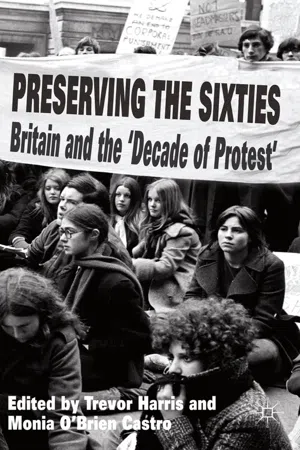
Re-examining the long-held belief that the Sixties in Britain were dominated mainly by 'youth' and 'protest', the authors in the collection argue that innovation was everywhere shadowed by conservatism. A decade fascinated by itself and, especially, by the future, it also was tormented by self-doubt and accompanied by a fear of losing the past.
Information
1
Sixties Britain
The cultural politics of historiography
Mark Donnelly
This chapter provides a critical survey of recent historical accounts of Sixties Britain, particularly those texts that intersect with wider memory discourses about the Sixties as being a ‘decade of protest’.1 Its primary function is to provide a framing historiographical analysis for the book’s subsequent chapters, each of which problematizes a more specifically defined aspect of Sixties British culture, social change or political activism. Its secondary function is to discuss possible ways in which readers can orient themselves in relation to a field of historical writing where interpretive disputes have become more than matters of purely academic interest. These disputes, of course, have a transnational rather than purely British focus of attention, and some important writing about Sixties Britain is to be found in texts whose approach is internationally comparative, or at least multi-national in scope. Fifty years on, the Sixties (whichever precise periodization is preferred)2 remain a productive site of research for scholars from different disciplinary backgrounds – particularly within North American and (some) European academies. Indeed, the potential for continuing research work on the Sixties is deemed sufficiently important for the decade to warrant its own academic journal.3 Sixties histories continue to proliferate in a variety of genres and cultural forms – audio, visual and written, with texts that range from review articles to rock star memoirs – and they still generate an unusually high degree of interpretive partisanship.4 The Sixties have frequently polarized commentators into the ‘pros’ (who might discursively construct the decade as being a high point of affluent, socially progressive, liberalized modernity, and as a period that produced radical challenges to various social, sexual and political norms), and ‘antis’ (who might imagine the Sixties to be the decade that legitimized personal and social irresponsibility, radical posturing, cultural infantilism, uncritical endorsement of the ‘new’, and so forth). Historians – notwithstanding their claims about professional integrity, the primacy of disinterested archival research, and their ability to generate secure knowledge of the past – simultaneously feed off and help to sustain these wider cultural skirmishes about what the Sixties ‘meant’. Historians contribute to a wider social knowledge of the Sixties, but they also research and write their accounts from within a culture in which that social knowledge circulates and has a purchase. As Patrick Finney has stated, ‘historical writing is a product not merely of empirical factors but also of context-grounded aesthetic, ideological and moral choices’ – and this is why, he argues, we should think in terms of a ‘cultural politics of historical knowledge’ (pp. 6, 10).
This chapter seeks to explore such a cultural politics of historical knowledge within the field of writing about Sixties Britain. It refuses the still dominant way of conceptualizing the Sixties as a referent that can be subject to positivist forms of historical evaluation and audit – ‘what was Sixties Britain really like?’. Instead, it proceeds by recognizing at the outset the ‘doubleness’ of historical writing – history is a genre that, on the one hand, invokes disciplinary protocols of empirical research and source criticism, and which, on the other, has always relied on poetic (fictive) techniques of composition and figuration to construct an imagined world within a text for readers to encounter. As Docker and Curthoys understood, it is this doubling that creates the space within historiography for uncertainty, disagreement and creativity. My argument here will be that we should welcome the unavoidable pluralism and uncertainty generated by historiographical practices; moreover, we should recognize that our reading of history texts is as perspectival and context-bound as the act of writing those texts. Therefore, the task of textual surveys such as this is to move beyond conventional historiographical analysis and towards a more fundamental set of ‘meta’ questions about historical practices. Such questions would be ontological rather than methodological: what is historical enquiry, what are its goals, whose interests are served by contemporary productions of historical knowledge, and how do we justify continuing to think historically about subjects like the Sixties?
In his major comparative survey, The Sixties: Cultural Revolution in Britain, France, Italy and the United States, c.1958–c.1974 (1998), Arthur Marwick directly answered questions of both a methodological and ontological type. In the opening section of this book, Marwick reaffirmed the epistemological assumptions that stood behind his work:
My methods are those of the professional historian, a scientist, I have said, rather than a poet or novelist . . . We need a history supported by evidence and based on dispassionate analysis. We need a history which tells it, as nearly as humans can, as it was. We do not need a history which goes on and on about the wickedness of the bourgeoisie, or which is merely designed to support predetermined theories about language, ideology, narratives, and discourse as agents of bourgeois hegemony.
(ibid., p. 20)
However, it is hard to recognize what followed this opening discussion of sources and methods as ‘dispassionate analysis’. Instead – and this is not intended as a criticism per se – Marwick weaved a personalized and idiosyncratic path through his own selection of source materials. In effect, The Sixties became an extended vehicle for Marwick to articulate his own liberal-humanist ideology, and to rebut what he termed ‘the Great Marxisant Fallacy’. He used the term ‘fallacy’ throughout the text to reference (and disparage) all manifestations and variants of Sixties Marxist theory – which he believed had been shown to be ‘simply incorrect’ (ibid., p. 14). These variants included the work of ‘cultural theorists’ and ‘postmodernists’, who may have thought that they were challenging the normative conceptual categories and vocabularies that underwrote existing political and social arrangements in the Sixties, but who, in Marwick’s terms, were metaphysicians whose theories warranted a ‘full frontal exposure’ (ibid., pp. 20–1, 809). He referred specifically in this context to writers such as Marcuse, Lévi-Strauss, Barthes, Lacan, Althusser, Derrida and Foucault, whose ideas were variously dismissed on ideological and/or ad hominem grounds. The problem with Marxists in the Sixties, argued Marwick, was that they were ‘so busy looking for a revolution which could not happen’ that they missed the one that did – the ‘cultural revolution’ (ibid., pp. 14–15). Indeed, Marwick’s primary aim in The Sixties was to substantiate and elucidate his progressive reading of the period, which he saw as being characterized by widespread increases in personal and social freedoms (at least in the four countries discussed).5 The most important of these freedoms were what Marwick described as the related phenomena of entrepreneurialism, individualism, and ‘doing your own thing’; ‘massive’ material improvements in consumption; a general sexual liberation; emancipation from the old canons of fashion, which in turn helped to set the body free; and – contrary to the dominant ideology critique of Herbert Marcuse and Theodor Roszak – a liberal, progressive presence within institutions of authority that enabled the extension of freedoms to occur.6 The irony of Marwick’s account of a period that was apparently defined by its enabling of increasing freedoms, however, was the extent to which that account was itself so intolerant of dissenting or alternative viewpoints. By mistaking empiricism for a coherent epistemology rather than a research method, Marwick believed that his work in the archives – valuable though it undoubtedly was – had taken him towards the goal of producing a singular, true account of the Sixties, one in which the ‘cultural revolution’ of the period ‘established the enduring cultural values and social behaviour for the rest of the century’ (ibid., p. 806).
Despite the weight of the book, the breadth of Marwick’s erudition and the cultural authority of the publisher (Oxford University Press), The Sixties had a mixed critical reception.7 Indeed, it was fashionable for a time among contemporary British historians – at least among those who attended the Institute of Contemporary British History’s 2001 conference – to cite approvingly James Obelkevich’s negative review of the book. It might have been expected that Marwick had left himself open to the charge that his empiricism-as-epistemology was intellectually untenable in the wake of postmodernism and the linguistic turn. But the principal point of Obelkevich’s critique was that Marwick had not been attentive enough to archival sources, and that only by consulting more primary documents could historians clear away the ‘myths’ about the Sixties (2000, p. 333). According to this line of interpretation, Marwick had been overly concerned with the ‘trendy’ Sixties – the Arts Labs, experimental theatres, ‘swinging’ scenes, rebellious students and psychedelic music. But the ‘ordinary’ Sixties, claimed Obelkevich, the lives of people in suburbs, provincial towns and villages, who watched Coronation Street and liked Cliff Richard records, had disappeared from view in Marwick’s account. Obelkevich wanted a history that wrote such people back into the story, and one that ‘above all’ used the ‘sources’ to capture the ‘all-too-human-realities’ of the Sixties (ibid., p. 336). Dominic Sandbrook’s two-volume history of the decade, Never Had It So Good: A History of Britain from Suez to the Beatles (2005) and White Heat: A History of Britain in the Swinging Sixties (2006), is perhaps the most self-conscious attempt yet to provide the kind of general ‘demythologizing’ account of the Sixties that Obelkevich apparently had in mind. In the Preface to the first volume, Sandbrook adapted E. P. Thompson’s oft-quoted line from The Making of the English Working Class (1963) and announced that he would rescue from the condescension of posterity the lives of the ‘kind of people who spent the 1960s in Aberdeen or Welshpool’, and whose memories of the Sixties were likely to be of ‘bingo, Blackpool and Berni Inns’ (2005, p. xix). Sandbrook went on to argue that many people who lived through the Sixties never embraced social and cultural change with much enthusiasm. In any case, he tells us, the media version of the Sixties – mini-skirts, Mini cars, Swinging London, psychedelia – was only experienced by a young, privileged and educated minority. In places like Hull or Wolverhampton, DIY was more popular than LSD, The Black and White Minstrel Show was more important than avant-garde cinema, and more people watched the average Second Division football match than attended the Albert Hall’s counter-cultural Poetry Reading of June 1965.8 Such historical ‘truths’, Sandbrook believed, have long been overlooked because of the metropolitan snobbery of historians. This was why, he argued, historians have never shown much interest in writing about places like Basildon and Stevenage – derided by commentators in the Sixties as exemplars of soulless New Town aesthetics – even though they were generally popular with their inhabitants.
None of this is to suggest, however, that Sandbrook wrote a particularly unorthodox historical account of the Sixties. Despite having an apparently different perspective on the period from Marwick – a difference that Sandbrook attributed to the fact that he was too young to have experienced the Sixties at first hand – both writers agreed that affluence and new consumer freedoms were defining features of the decade. According to Sandbrook, high-street fashion was one of the main signifiers of Sixties ‘new times’ – recalling the kind of modernist commentary that threaded together Piri Halasz’s observations on ‘London: The Swinging City’ in Time magazine in April 1966. Moreover, one of the ‘heroes’ of White Heat was Terence Conran, the entrepreneur behind the designer furniture store Habitat, whose ‘idealised ethos of economic wealth, artistic effervescence and technological sophistication . . . pointed the way to a better tomorrow in Harold Wilson’s Britain’. Sandbrook believed that Habitat, which opened in May 1964, was the most important retailing institution in Britain since the Second World War, its presence on the high street marking out mid-Sixties Britain as a pinnacle of design innovation and consumerism (2006, p. 80). This was a reading of Sixties mass-market aesthetics that was shared by others, and it featured strongly in a Victoria and Albert Museum exhibition, ‘British Design 1948–2012: Innovation in the Modern Age’ (2012). The ‘long Sixties’ section of this exhibition began with a display about the Whitechapel Art Gallery’s ‘This is Tomorrow’ show in 1956, and it went on to reference key features of the Sixties art-design-commerce interface: Mary Quant and Bill Green fashions, style magazines Queen and Nova, poster designers Martin Sharp and Michael English, fabric designer Shirley Craven from Hull Traders, the Cramer Saatchi advertising agency, and David Hockney.9 Meanwhile the film Blow-Up (1966) silently played on a loop, with the David Bailey-esque fashion photographer lead character perhaps subliminally referring visitors to their own status as tasteful but passive gazers. Neither the V&A exhibition nor White Heat, it should be said, offered uncritical endorsements of the culture they described. Sandbrook acknowledged that the core constituency for Conran’s designs was limited to a predominantly young, affluent, ‘with it’ middle class (2006, pp. 62–5). Meanwhile, the V&A’s ordering of its exhibits suggested that a growing sense of unease with the rational modernism of high-Sixties design produced a counter-aesthetic in the form of late-Sixties, anti-technological romanticism. Nonetheless, it is fair to use these two ‘texts’ as exemplars of a particular perspective on one aspect of Sixties British culture: the idea that the period saw a ‘democratic’ reconfiguration of the relationship between the worlds of elite art and mass commerce.
Curiously perhaps, given that he devoted two lengthy volumes to the decade, Sandbrook’s overarching thesis about the Sixties was that continuity and tradition ultimately proved to be the dominant forces. By 1970, he concluded in White Heat, Britain was largely the same country that it had been 40 or even a hundred years before – in fact in his next book, State of Emergency. The Way We Were: Britain, 1970–1974, he went on to argue that there was also much more continuity between the 1970s and 1960s ‘than we commonly remember’ (2010, p. 10). Citing Orwell’s The Lion and the Unicorn in support of his analysis, Sandbrook invoked the trope of an unchanging British ‘national character’ that would always endure, like an ‘everlasting animal stretching into the future and the past’ (2006, p. 749). Sixties social and cultural change, he argued, was a ‘halting, fragmentary and bitterly contested’ process, and by the time that the decade was over, the instinctive conservatism of middlebrow British culture had reasserted itself as a necessary antidote to the country’s ‘moral decay’ (ibid., p. 747). The popularity of Dad’s Army – the comedy TV series set in southern England in 1940 – was read here as proof that the national mood had grown tired of change, and instead had become nostalgic for that time of imagined social cohesion known as ‘the people’s war’. Sandbrook’s history of Sixties Britain, therefore, was written from a conservative perspective – politically and culturally. In some respects, Never Had It So Good and White Heat can be read as an exercise in filling out earlier narrative and interpretive templates that had been left by writers who shared similar ideological ground. One thinks here of Christopher Booker’s The Neophiliacs, which argued that a worship of novelty and innovation in late-fifties and early-Sixties Britain gave way after 1966 to a cultural climate of ‘after-math, disillusionment, exhaustion, even of reaction’ (1969, p. 292), and Bernard Levin’s The Pendulum Years, which described the Sixties as ‘shaken and ambiguous years’, and a ‘credulous age’ in which irrationalism held sway and charlatans posing as gurus were gul...
Table of contents
- Cover
- Title Page
- Copyright
- Contents
- List of Tables and Figures
- Notes on Contributors
- Foreword
- Acknowledgements
- Introduction
- 1. Sixties Britain: The cultural politics of historiography
- Part I: Politics
- Part II: Culture
- Conclusion
- Index
Trusted by 375,005 students
Access to over 1.5 million titles for a fair monthly price.
Study more efficiently using our study tools.
Frequently asked questions
Yes, you can cancel anytime from the Subscription tab in your account settings on the Perlego website. Your subscription will stay active until the end of your current billing period. Learn how to cancel your subscription
No, books cannot be downloaded as external files, such as PDFs, for use outside of Perlego. However, you can download books within the Perlego app for offline reading on mobile or tablet. Learn how to download books offline
Perlego offers two plans: Essential and Complete
- Essential is ideal for learners and professionals who enjoy exploring a wide range of subjects. Access the Essential Library with 800,000+ trusted titles and best-sellers across business, personal growth, and the humanities. Includes unlimited reading time and Standard Read Aloud voice.
- Complete: Perfect for advanced learners and researchers needing full, unrestricted access. Unlock 1.5M+ books across hundreds of subjects, including academic and specialized titles. The Complete Plan also includes advanced features like Premium Read Aloud and Research Assistant.
We are an online textbook subscription service, where you can get access to an entire online library for less than the price of a single book per month. With over 1.5 million books across 990+ topics, we’ve got you covered! Learn about our mission
Look out for the read-aloud symbol on your next book to see if you can listen to it. The read-aloud tool reads text aloud for you, highlighting the text as it is being read. You can pause it, speed it up and slow it down. Learn more about Read Aloud
Yes! You can use the Perlego app on both iOS and Android devices to read anytime, anywhere — even offline. Perfect for commutes or when you’re on the go.
Please note we cannot support devices running on iOS 13 and Android 7 or earlier. Learn more about using the app
Please note we cannot support devices running on iOS 13 and Android 7 or earlier. Learn more about using the app
Yes, you can access Preserving the Sixties by T. Harris, M. O'Brien Castro, T. Harris,M. O'Brien Castro,Kenneth A. Loparo,Monia O''Brien Castro in PDF and/or ePUB format, as well as other popular books in History & British History. We have over 1.5 million books available in our catalogue for you to explore.