- English
- ePUB (mobile friendly)
- Available on iOS & Android
eBook - ePub
About this book
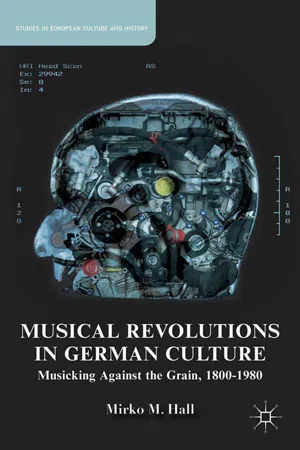
Drawing upon the philosophical insights of Friedrich Schlegel, Walter Benjamin, Theodor W. Adorno, and Blixa Bargeld, this book explores the persistence of a critical-deconstructive approach to musical production, consumption, and reception in the German cultural sphere of the last two centuries.
Information
Notes
Introduction Musicking as a Cultural Practice
Unless otherwise noted, all translations from German are my own. Likewise, all italics within quotations appear in the original text unless indicated by my own emphasis.
1.Hannah Arendt, Men in Dark Times (New York: Harcourt Brace & Company, 1968).
2.For a “utopian” reading of these emancipatory practices, see Slavoj Žižek, The Year of Dreaming Dangerously (London: Verso Press, 2012).
3.Friedrich Hölderlin, “Patmos,” in Hymns and Fragments, trans. Richard Sieburth (Princeton: Princeton University Press, 1984), 89.
4.For a damning assessment of this political era from a perspective similar to the critical theory of the Frankfurt School, see Robert Hullot-Kentor, Things Beyond Resemblance: Collected Essays on Theodor W. Adorno (New York: Columbia University Press, 2006), 2–3.
5.Since the early twentieth century, Berlin has maintained a strong leftist political tradition (especially, in its eastern boroughs) as well as a large and diverse alternative scene of artists, musicians, and writers. While first drafting this text, Berlin was governed by an unprecedented “red-red coalition” of the center-left Social Democratic Party of Germany and the far-left Party of Democratic Socialism, which succeeded the Socialist Unity Party of Germany, the Marxist–Leninist political party that had previously ruled East Germany.
6.Rolf Dieter Brinkmann, Briefe an Hartmut. 1974–1975 (Reinbek bei Hamburg: Rowohlt Verlag, 1999), 93.
7.For a late capitalist study of this ideological appropriation, see Joseph Heath and Andrew Potter, Nation of Rebels: Why Counterculture Became Consumer Culture (New York: HarperCollins Publishing, 1995).
8.EA80, 2 Takte Später, self-release, 1985, LP.
9.Peter Wicke, Rock Music: Culture, Aesthetics and Sociology, trans. Rachel Fogg (Cambridge, UK: Cambridge University Press, 1990), 174–75. This passage is taken from the text’s conclusion, which was rewritten for the English translation. Wicke’s original conclusion addresses the future of popular music in the former East Germany. See his Rockmusik. Zur Ästhetik und Soziologie eines Massenmediums (Leipzig: Reclam Verlag, 1987), 236–50. He is Germany’s first professor for the Theory and History of Popular Music at the Humboldt-Universität zu Berlin. I kindly acknowledge Wicke for supporting my affiliation with the university’s Center for Popular Music Research during my academic stay in Berlin from 2003 to 2004.
10.Following philosopher Antonio Gramsci’s formulations on hegemony, a “cultural-revolutionary” condition is a historically specific field of possible “collective and individual subject formations.” In this new cultural hegemony, people would achieve—through sound—an enhanced critical understanding of their historically and ideologically specific subjectivity. See Jürgen Link, “Kulturrevolutionäre Strategien und Taktiken—Damals und Heute (Vortrag im Mai 1988 an der FU Berlin im Rahmen der Ringvorlesung ‘Mai 68 und die Folgen’),” kultuRRevolution 21 (Juli 1989): 31.
11.Jürgen Habermas, Knowledge and Human Interests, trans. Jeremy J. Shapiro (Boston: Beacon Press, 1971), 55.
12.Herbert Marcuse, “A Note on Dialectic,” in Reason and Revolution: Hegel and the Rise of Social Theory, 2nd ed. (Boston: Beacon Press, 1960), ix.
13.Pamela M. Potter, Most German of the Arts: Musicology and Society from the Weimar Republic to the End of Hitler’s Reich (New Haven: Yale University Press, 1998), x.
14.Christopher Small, Musicking: The Meanings of Performing and Listening (Hanover, NH: Wesleyan University Press, 1998), 9.
15.For standard historical and theoretical surveys of the Frankfurt School, see Susan Buck-Morss, The Origin of Negative Dialectics: Theodor W. Adorno, Walter Benjamin, and the Frankfurt Institute (New York: Macmillan Free Press, 1977); David Held, Introduction to Critical Theory: Horkheimer to Habermas (Berkeley: University of California Press, 1980); Martin Jay, The Dialectical Imagination: A History of the Frankfurt School and the Institute of Social Research, 1923–1950 (Berkeley: University of California Press, 1996); and Rolf Wiggershaus, The Frankfurt School: Its History, Theories, and Political Significance, trans. Michael Robertson (Cambridge, MA: Massachusetts Institute of Technology Press, 1994). For a revealing study of the school’s exile from Nazi oppression in New York and California from 1934 to 1950, see Thomas Wheatland, The Frankfurt School in Exile (Minneapolis: University of Minnesota Press, 2009).
16.Max Horkheimer, “Traditional and Critical Theory,” in Critical Theory: Selected Essays, trans. Matthew J. O’Connell et al. (New York: Seabury Press, 1975), 199. Here, critical theory differs from post-structuralist theory and criticism by its insistence on retaining the concept of the subject, however problematic and fractured.
17.Theodor W. Adorno, Towards a Theory of Musical Reproduction: Notes, a Draft and Two Schemata, ed. Henri Lonitz, trans. Wieland Hoban (Cambridge, UK: Polity Press, 2006), 230.
18.See Mário Vieira de Carvalho, “Towards Dialectical Listening: Quotation and Montage in the Work of Luigi Nono,” Contemporary Music Review 18 (1999): 37–85.
19.Mário Vieira de Carvalho, “ ‘New Music...
Table of contents
- Cover
- Title
- Introduction Musicking as a Cultural Practice
- One Friedrich Schlegel and Romanticized Music
- Two Walter Benjamin and the Dialectical Sonority
- Three Theodor W. Adorno and Radical Music
- Four Blixa Bargeld and Noise
- Coda Toward a Musical Future Perfect
- Notes
- Bibliography
- Index
Trusted by 375,005 students
Access to over 1.5 million titles for a fair monthly price.
Study more efficiently using our study tools.
Frequently asked questions
Yes, you can cancel anytime from the Subscription tab in your account settings on the Perlego website. Your subscription will stay active until the end of your current billing period. Learn how to cancel your subscription
No, books cannot be downloaded as external files, such as PDFs, for use outside of Perlego. However, you can download books within the Perlego app for offline reading on mobile or tablet. Learn how to download books offline
Perlego offers two plans: Essential and Complete
- Essential is ideal for learners and professionals who enjoy exploring a wide range of subjects. Access the Essential Library with 800,000+ trusted titles and best-sellers across business, personal growth, and the humanities. Includes unlimited reading time and Standard Read Aloud voice.
- Complete: Perfect for advanced learners and researchers needing full, unrestricted access. Unlock 1.5M+ books across hundreds of subjects, including academic and specialized titles. The Complete Plan also includes advanced features like Premium Read Aloud and Research Assistant.
We are an online textbook subscription service, where you can get access to an entire online library for less than the price of a single book per month. With over 1.5 million books across 990+ topics, we’ve got you covered! Learn about our mission
Look out for the read-aloud symbol on your next book to see if you can listen to it. The read-aloud tool reads text aloud for you, highlighting the text as it is being read. You can pause it, speed it up and slow it down. Learn more about Read Aloud
Yes! You can use the Perlego app on both iOS and Android devices to read anytime, anywhere — even offline. Perfect for commutes or when you’re on the go.
Please note we cannot support devices running on iOS 13 and Android 7 or earlier. Learn more about using the app
Please note we cannot support devices running on iOS 13 and Android 7 or earlier. Learn more about using the app
Yes, you can access Musical Revolutions in German Culture by M. Hall in PDF and/or ePUB format, as well as other popular books in History & European History. We have over 1.5 million books available in our catalogue for you to explore.