eBook - ePub
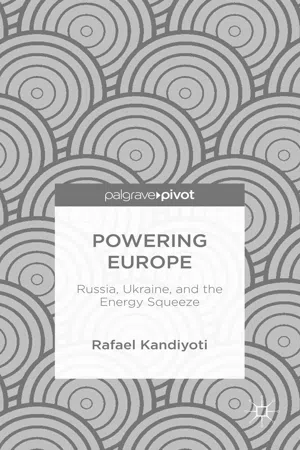
Powering Europe: Russia, Ukraine, and the Energy Squeeze
Russia, Ukraine, and the Energy Squeeze
- English
- ePUB (mobile friendly)
- Available on iOS & Android
eBook - ePub
Powering Europe: Russia, Ukraine, and the Energy Squeeze
Russia, Ukraine, and the Energy Squeeze
About this book
Seeking clarity about the conflict in Ukraine and responding to the urgent need to analyze Europe's energy prospects outside of Russia, Kandiyoti links analysis of real energy infrastructure with analysis of the political and economic dynamics unfolding at local, national, regional, and global levels.
Information
1
Europe, Russia, Ukraine: One Continent?
Abstract: This chapter presents a survey of Europe’s geopolitical topography, concentrating on developments in Central and Eastern Europe since the breakup of the Soviet Union. Ukraine’s position as a focal point of geopolitical rivalry between the United States, the European Union and Russia will be examined against a backdrop of Russian energy exports to the West. The eastward expansion of NATO and the EU has sharpened the competition between Russia and the West, accentuated vacillations within Ukraine’s political elites and aggravated a host of domestic Ukrainian rivalries. Meanwhile, the population’s yearning for decent governance has gone unheeded.
Kandiyoti, Rafael. Powering Europe: Russia, Ukraine, and the Energy Squeeze. New York: Palgrave Macmillan, 2015. DOI: 10.1057/9781137501646.0006.
1.1 End of empire
In the 1980s, the political map of Europe looked quite different. The three Baltic republics lined up as Soviet Socialist Republics (SSRs), as did Ukraine and Byelorussia (now Belarus). These five countries traced an arc between the Baltic and the Black Sea. Warsaw Pact countries formed an outer ring of defence in Central and Eastern Europe between NATO and the Soviet Union.1 They all hosted large Soviet military bases in addition to their own armies, making up a formidable array of conventional forces facing West.
Within the Soviet Union itself, the 1980s was a period of stagnation. The price of crude oil, the major currency earner, was in decline and the aging leadership was unable to revitalize the country’s economy. Eastern Europe was in ferment and popular discontent against communist dominance could no longer be controlled.
By the time Mikhail Gorbachev rose to power, everything was in disarray. The cautious steps taken towards economic reform mostly backfired. Elections designed to relax central controls created new opposition centres and released powerful centrifugal forces. After nearly five decades, the monolith was no longer able to hold together.
When in November 1989, crowds descended on the Berlin wall, the East German authorities did not have the political will to defend it. As the Warsaw Pact crumbled in all but name, Gorbachev agreed to the phased withdrawal of Soviet troops from Eastern Europe. At about the same time, the Baltic SSRs and Armenia declared independence. By then it was clear that new structures would be needed to replace the old USSR. When a Union-wide referendum was held in March 1991 to determine whether constituent republics wanted a new Union treaty, six former SSRs did not even participate.2
The new “Union Treaty” prepared after the referendum was designed to give wider powers to the republics. Sections of the Soviet Communist Party hierarchy in Moscow resisted these changes. A coup d’état followed, led by the head of the armed forces and the head of the KGB. It flopped for lack of support.
The failed coup d’état of August 1991, mounted by some of Gorbachev’s highest ranking associates was an attempt to arrest the disintegration of the Soviet Union. It backfired spectacularly. Tanks sent by the coup leaders to surround the Russian parliament building were stopped by the crowds. Boris Yeltsin, the newly elected president of the Russian Federation famously climbed on one of the tanks to make a speech. By the time the coup leaders were arrested and Gorbachev brought back to Moscow from temporary house arrest in Crimea, Yeltsin had more than filled the power vacuum. He turned the parliament of the Russian Federation into the new, effective power centre.
Yeltsin had run for president of the Russian Federation in June 1991, against the approved Party candidate and won by a wide margin. After August 1991, he used the Russian presidency as a platform to weaken the position of Gorbachev as Union President. His actions shattered what remained of the Union state machinery, setting off a cascade of events leading to the definitive breakup of the Soviet Union.
Ukraine’s change of heart
The Union-wide referendum had been held in March 1991. The question put to the vote was whether to preserve the USSR as a “. . . renewed federation of equal sovereign republics.” The poll widely endorsed the preparation of a new Union Treaty.3 In Ukraine those in favour of staying within the Union exceeded 70 percent, with an overall turnout of over 80 percent.
Everything changed after the attempted coup of August 1991. As Boris Yeltsin’s Russian Federation gradually supplanted Union structures in Moscow, the people of Ukraine no longer saw their future in a partnership with a Russian Federation.
More than any other single factor, it was Ukraine’s edging towards full independence that marked the point beyond which Moscow’s grip gave way: without Ukraine, a Moscow centred Union simply did not make sense. In late 1991, Yeltsin added to the chaos by “taking control of the Union parliament, the Foreign Ministry and all security organs.”4 He persisted in attempts to preserve Moscow’s central role, by establishing the Commonwealth of Independent States (CIS), to be led by Russia, Ukraine and Belarus. By then, however, no one in Ukraine was listening.
On 25 December 1991, in a televised speech lasting ten minutes, Mikhail Gorbachev announced the formal dissolution of the Soviet Union as well as his resignation. Within two cataclysmic years after the fall of the Berlin wall, the Soviet Union had been swept away and the Warsaw Pact with it.5
Yeltsin at the helm
The economic “shock therapy” administered by the Yeltsin regime at the behest of international financial organizations, after the dissolution of the Soviet Union, mandated a systematic withdrawal of the State from the economic sphere. It led to the dismantling of large sectors of the Russian economy. Social services collapsed while millions lost their livelihoods, inflicting dire poverty on wide sections of the population. Life expectancies were cut short by several years in less than a decade—a rare occurrence in peacetime.6 Attempts by the Russian parliament in 1992 and 1993 to check the vertiginous drop in living standards led to a power struggle with Yeltsin. Parliament censured Yeltsin for his responsibility in the developing catastrophe. In return, Yeltsin dismissed Parliament, apparently exceeding his constitutional powers. When the Supreme Soviet, in turn, dismissed Yeltsin for violating the constitution, the President ordered the army to storm the Parliament building.
It was the same “White House” from which, during the attempted Communist coup two years earlier, that Yeltsin had emerged to denounce the attack on democracy from the top of a tank. At the time, he had been widely acclaimed as the saviour of Russian democracy. In October 1993, the army proceeded to shell parliament on Yeltsin’s orders. Many died. The survivors were imprisoned. The “Shock Therapy” ran its course, alongside privatizations of Soviet state assets, which in retrospect still looks like a feeding frenzy of historical proportions. It led to the creation of a new class of “oligarchs,” many of whom were or became the President’s political allies. They kept him in power, nearly until the end of the decade, although by 1996 he was already a very sick man.
The 1990s in Russia will be remembered as a time when the Federation was financially fragile and geopolitically vulnerable. Mismanagement was not a new phenomenon in Russia, but in the chaos which accompanied the plunder of state owned assets, the Government accumulated immense amounts of debt. Russia’s state finances crashed in 1998. From about mid-1999, Yeltsin was gradually eased from the presidency to make way for Vladimir Putin.
1.2 Russia friend or Russia foe?
After 1991, parts of the Russian foreign policy establishment imagined that the long confrontation with the West could be put behind them. They appear to have expected that the dissolution of the Soviet Union and the Warsaw Pact would make NATO irrelevant and that it might wither away or perhaps morph into an overarching trans-European security structure. They seem to have expected that the West would initiate moves to integrate Russia into Euro-Atlantic frameworks.
They could not have been more wrong and the evidence was before their eyes. In an article published in Foreign Affairs, M. E. Sarotte relates the following conversation between James Baker and Mikhail Gorbachev, which took place in May 1991, seven months before the Soviet Union was dissolved.7 “According to Soviet records,” Gorbachev tells James Baker: “‘You say that NATO is not directed against us, that it is simply a security structure that is adapting to new realities. Therefore, we propose to join NATO.’ Baker refused to consider such a notion, replying dismissively, ‘Pan-European security is a dream.’ ”
In fact, the 1990s saw a number of moves to bring Russia a little closer to the mainstream of the international community. Russia’s bid to join the World Trade Organization (WTO) was eventually successful. Russia was also invited to G7 meetings, to be given a seat during separate “G8-sessions.” Later, in 2002, the Russia–NATO council was formed to discuss matters of common interest.
What Russia had really wanted was admission into the inner sanctum of the alliance that, not so long ago, had been their mortal enemy. That simply did not happen.
During this time, Russian foreign policy also endeavoured to remain engaged with former Soviet republics, working to revive and maintain something akin to their former economic and political ties. In doing so, Moscow seems...
Table of contents
- Cover
- Title
- Introduction
- 1 Europe, Russia, Ukraine: One Continent?
- 2 A Quietly Voracious Continent: Europes Oil and Gas Imports
- 3 Natural Gas as a Political Weapon?
- 4 Nabucco, South Stream and the Southern Gas Corridor
- 5 Russian Geopolitics and Ukrainian War
- 6 Economic Warfare and Europes Gas Supplies
- 7 New Cold War?
- Index
Trusted by 375,005 students
Access to over 1.5 million titles for a fair monthly price.
Study more efficiently using our study tools.
Frequently asked questions
Yes, you can cancel anytime from the Subscription tab in your account settings on the Perlego website. Your subscription will stay active until the end of your current billing period. Learn how to cancel your subscription
No, books cannot be downloaded as external files, such as PDFs, for use outside of Perlego. However, you can download books within the Perlego app for offline reading on mobile or tablet. Learn how to download books offline
Perlego offers two plans: Essential and Complete
- Essential is ideal for learners and professionals who enjoy exploring a wide range of subjects. Access the Essential Library with 800,000+ trusted titles and best-sellers across business, personal growth, and the humanities. Includes unlimited reading time and Standard Read Aloud voice.
- Complete: Perfect for advanced learners and researchers needing full, unrestricted access. Unlock 1.5M+ books across hundreds of subjects, including academic and specialized titles. The Complete Plan also includes advanced features like Premium Read Aloud and Research Assistant.
We are an online textbook subscription service, where you can get access to an entire online library for less than the price of a single book per month. With over 1.5 million books across 990+ topics, we’ve got you covered! Learn about our mission
Look out for the read-aloud symbol on your next book to see if you can listen to it. The read-aloud tool reads text aloud for you, highlighting the text as it is being read. You can pause it, speed it up and slow it down. Learn more about Read Aloud
Yes! You can use the Perlego app on both iOS and Android devices to read anytime, anywhere — even offline. Perfect for commutes or when you’re on the go.
Please note we cannot support devices running on iOS 13 and Android 7 or earlier. Learn more about using the app
Please note we cannot support devices running on iOS 13 and Android 7 or earlier. Learn more about using the app
Yes, you can access Powering Europe: Russia, Ukraine, and the Energy Squeeze by Rafael Kandiyoti in PDF and/or ePUB format, as well as other popular books in Politics & International Relations & Energy Industry. We have over 1.5 million books available in our catalogue for you to explore.