The idea of the "mamma italiana" is one of the most widespread and recognizable stereotypes in perceptions of Italian national character both within and beyond Italy. This figure makes frequent appearances in jokes and other forms of popular culture, but it has also been seen as shaping the lived experience of modern-day Italians of both sexes, as well as influencing perceptions of Italy in the wider world. This interdisciplinary collection examines the invented tradition of mammismo but also contextualizes it by discussing other, often contrasting, ways in which the role of mothers, and the mother-son relationship, have been understood and represented in culture and society over the last century and a half, both in Italy and in its diaspora.
eBook - ePub
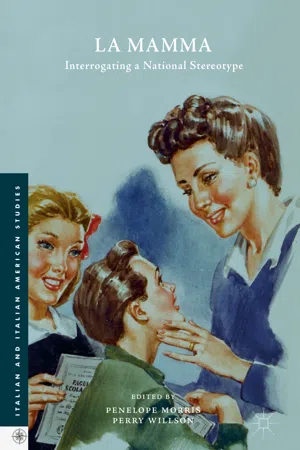
La Mamma
Interrogating a National Stereotype
- English
- ePUB (mobile friendly)
- Available on iOS & Android
eBook - ePub
La Mamma
Interrogating a National Stereotype
About this book
Information
© The Author(s) 2018
Penelope Morris and Perry Willson (eds.)La MammaItalian and Italian American Studieshttps://doi.org/10.1057/978-1-137-54256-4_11. La Mamma: Italian Mothers Past and Present
Penelope Morris1 and Perry Willson2
(1)
School of Modern Languages and Cultures, University of Glasgow, Glasgow, UK
(2)
School of Humanities - History, University of Dundee, Dundee, UK
Translations from Italian source material are the authors’ own.
End AbstractMotherhood, as an idea, has been and remains fundamental to how Italian women, whether mothers or not, think about themselves. It has also strongly shaped how Italian men view, and have viewed, women and it is part of how Italians have been perceived and represented by others in the wider world. The Catholic Church, with its emphasis on women’s essential maternal duty and destiny, and its veneration of the Madonna as an (impossible) ideal of chaste motherhood, has played an important part in this. As historians and others have argued, however, both the lived realities of Italian mothers, and the cultural constructions of their role, have varied greatly over time, in different regions of Italy and between social classes. Even the Catholic vision of maternal duty was not immutable. From the middle of the twentieth century, the Church gradually began to accept new roles for women, including in politics and employment, albeit without abandoning an emphasis on the importance and sanctity of maternity.1
Beyond the Church there have been many lay figures, particularly “experts” of various kinds such as medical doctors, who have been interested in how mothering should be done. In many of these discussions of the maternal role there has been a tension between notions of mothering as innate, instinctive or “natural” and ideas of different ways of doing it, of motherhood as practice, with the two often coexisting uneasily. From the Risorgimento to more recent times, moreover, various political movements have, in their own and differing ways, based their arguments regarding women’s role and destiny primarily on the maternal. The meaning of this, however, has been far from uniform. While many have invoked women’s maternal role as a reason to curtail their access to the public sphere, others, including certain types of feminists, have presented it as legitimizing such access. Italy has not, of course, always been entirely distinctive in its historical emphasis on women’s maternal role, nor in the diversity of opinions about the meanings and practice of motherhood. Attitudes to and debates about motherhood in other European countries have often been not dissimilar, and indeed changed in similar ways, to the Italian example.
Mammismo
There is, however, one particular representation of motherhood that is very much Italian—mammismo. Indeed, the idea of the “mamma italiana” and her dependent, spoilt, offspring (particularly sons) is one of the most widespread and recognizable stereotypes in perceptions of Italian national character both within Italy and beyond its borders. As historian Anna Bravo has described her, the mamma of the stereotype is:
Incomparably loving, servant and owner of her children, often in tears but always on her feet holding the family together … Adored, feared and caricatured, in discussions about the Italian family, “la Mamma” has become a glorious archetype … the enduringly popular image of the Italian mother is of a strong woman who dotes on her son and dedicates herself to him intensively. In exchange she gets the right to veto his choices, his constant attentions and an unrivalled emotional and symbolic dependency. As eternal sons, Italian men struggle to grow up and find it hard to accept new roles for women: Italian women, whether mothers or not, treat men with the sort of indulgence that is normally reserved for children.2
This primitively possessive, domineering and, at the same time, indulgent figure makes frequent appearances in jokes and other forms of popular culture, but references to it have also abounded in serious media debates about Italy’s social fabric. Mammismo has been cited, for example, as a contributing factor to many of what are perceived to be recent and current “problems” with the Italian family, such as Italy’s dramatically low birth rate and the extremely unequal gender division of labour within Italian households. Of all such “problems,” the one that gives rise to the most persistent references to the stereotype is the advanced age at which many Italian “children” (particularly, but not only, male “children”) leave the parental home. The causes of this phenomenon lie, of course, in a number of factors, including very concrete economic and social ones like high levels of youth unemployment and housing shortages. Here, the focus has shifted to an extent from the role of the mother to the adult “children” themselves, seen as far too unadventurous and comfortable in the “golden cage” of the parental home.3 The flames of this debate were fanned when, in October 2007, the Italian Finance Minister Tommaso Padoa-Schioppa famously referred to stay-at-home adult offspring as “bamboccioni” (big babies). He thereby launched an unfortunate expression (the use of which has proved remarkably persistent) that led to a furore in the Italian media.4 This is a good example of a persistent, unhelpful tendency for politicians and the media to blame Italy’s economic problems on supposedly embedded “cultural” traits, sets of beliefs or values which create behavioural patterns that hinder economic development.5
A quick internet search suffices to demonstrate that this term (or the similar “mammone”), and the idea of Italian men as immature, perpetual children who struggle to grow up and disentangle themselves from the suffocating, protective web of their mothers’ apron-strings, is well known not just within Italy but also crops up in foreign observations about modern Italian society. A typical example, randomly selected from many, is an article in The Guardian newspaper in 2010 on “Why Italy’s mamma’s boys can’t cut the ties.”6 References to mammismo and to overly mothered, dependent sons abound in the Italian media and on websites. One example was a quiz included in PourFemme magazine in 2015 to help Italian women investigate the extent to which the man in their life was a mammone at heart.7 This was obviously meant as a light-hearted diversion but it epitomizes the fact that the idea of mammismo is an instantly recognizable one to Italians today. Even quite serious news articles often find it hard to resist references to the stereotype, the term bamboccione enjoying especial popularity.8 Two stories that were particularly widely reported, both in Italy and abroad, were the assertion by Cardinal Angelo Bagnasco (Archbishop of Genoa) in 2014 that mammismo was one of the greatest threats to marriage in Italy and the claim by Gian Ettore Gassani (lawyer and president of Italy’s matrimonial lawyers’ association), that 30 per cent of marital breakdowns were caused by interfering mothers-in-law and their over-dependent sons.9
The stereotype, or versions of it, has also sometimes surfaced in films and novels, particularly, but not exclusively, those with comic intent. Hollywood and American sitcoms have been important vehicles for this but home-grown products have also played a part. Unlike the perhaps better-known stereotype of the overbearing Jewish mother, in mammismo-inspired comedy it is generally—as Silvana Patriarca points out in her chapter in this volume—the son, rather than the mother herself, who is the main comedic figure.10 The comic actor Alberto Sordi’s classic screen performances as a mamma’s boy in a series of 1950s films were important in helping embed the figure of the weak and dependent male in the Italian popular imagination. Such portrayals are not, however, simply a feature of the past. For example, Gianni Di Gregorio’s film Gianni e le donne (2011) in which a man, despite being 60 years old, a husband and father, continues to be dominated by his demanding elderly mother, suggests the enduring appeal of the weak downtrodden male as a comedic trope.11
There are recent literary examples too, like the novel Confessioni di un mammone italiano (2014) by David Leone, which focuses, as the title suggests, on the protagonist Alfredo’s obsessive and dependent relationship with his mother.12 Similarly, Alberto—the main character of Giuseppe Culicchia’s novel Ameni inganni (2011)—seems a classic mammone. At the age of 41 he still lives with his mother and is even financially supported by her pension. Instead of working he hides at home, devoting his time to reading soft porn and building model spaceships.13 Both novels focus on what happens, albeit in different ways and with different outcomes, to these overgrown adolescents when they attempt to face up to the outside world and the complexity of adult relationships.
It would be ridiculous, of course, to suggest that Italian literary and cinematographic production has only, or even particularly often, represented mothers in this way. Much more common, particularly before the 1980s and in works by male authors, were one-dimensional portrayals of mothers, seen purely through the eyes of sons and reduced “to a single emotion: unconditional devotion to their offspring.”14 Alongside such depictions, however, there has also been a wide range of more nuanced representations of mothers, as indeed Fanning’s chapter demonstrates, and the last four decades in particular have seen a flourishing of explorations of the maternal in literature by women.
Nor has the “mama’s boy” been the only representation of Italian masculinity. For many, until fairly recently, the stereotype (and, often, the lived reality) of men as authoritarian husbands and fathers—the “padre-padrone”—has been a more familiar image than the weak son spoiled by his mother. Representations and ideals of masculinity have not, of course, been unchanging, with, for example, the militaristic hyper-virile fascist model succeeded by the idea of the “uomo di successo” during the economic miracle.15 Various scholars, moreover, have seen the second half of the twentieth century as a period of “crisis for masculinity,” a crisis which has been particularly evident in film, with “the fragile male […] central to Italian cinema.”16 Indeed, Italian films of this period often dwell either overtly or implicitly on this theme. Jacqueline Reich, for example, has argued forcefully that Marcello Mastroianni—perhaps the best-known male film star of this period—was, rather than a “Latin lover,” more often seen in the role of the “inetto” (inept man), who, “underneath the façade of a presumed hyper-masculinity,” is really “an anti-hero […] at odds with and out of place in a rapidly changing political, social, and sexual environment.”17
Stereotypes
Stereotypes are, of course, a far from easy, and often u...
Table of contents
- Cover
- Front Matter
- 1. La Mamma: Italian Mothers Past and Present
- 2. Mammismo/Momism: On the History and Uses of a Stereotype, c.1940s to the Present
- 3. Mothers, Workers, Citizens: Teresa Noce and the Parliamentary Politics of Motherhood
- 4. Problems and Prescriptions: Motherhood and Mammismo in Postwar Italian Advice Columns and Fiction
- 5. Conceptualizing the Maternal: Representations, Reflections and Refractions in Women’s Literary Writings
- 6. Neapolitan Mothers: Three Generations of Women, from Representation to Reality
- 7. Mammas in Italian Migrant Families: The Anglophone Countries
- 8. Queer Daughters and Their Mothers: Carole Maso, Mary Cappello and Alison Bechdel Write Their Way Home
- 9. Beyond the Stereotype: The Obstacle Course of Motherhood in Italy
- Back Matter
Trusted by 375,005 students
Access to over 1.5 million titles for a fair monthly price.
Study more efficiently using our study tools.
Frequently asked questions
Yes, you can cancel anytime from the Subscription tab in your account settings on the Perlego website. Your subscription will stay active until the end of your current billing period. Learn how to cancel your subscription
No, books cannot be downloaded as external files, such as PDFs, for use outside of Perlego. However, you can download books within the Perlego app for offline reading on mobile or tablet. Learn how to download books offline
Perlego offers two plans: Essential and Complete
- Essential is ideal for learners and professionals who enjoy exploring a wide range of subjects. Access the Essential Library with 800,000+ trusted titles and best-sellers across business, personal growth, and the humanities. Includes unlimited reading time and Standard Read Aloud voice.
- Complete: Perfect for advanced learners and researchers needing full, unrestricted access. Unlock 1.5M+ books across hundreds of subjects, including academic and specialized titles. The Complete Plan also includes advanced features like Premium Read Aloud and Research Assistant.
We are an online textbook subscription service, where you can get access to an entire online library for less than the price of a single book per month. With over 1.5 million books across 990+ topics, we’ve got you covered! Learn about our mission
Look out for the read-aloud symbol on your next book to see if you can listen to it. The read-aloud tool reads text aloud for you, highlighting the text as it is being read. You can pause it, speed it up and slow it down. Learn more about Read Aloud
Yes! You can use the Perlego app on both iOS and Android devices to read anytime, anywhere — even offline. Perfect for commutes or when you’re on the go.
Please note we cannot support devices running on iOS 13 and Android 7 or earlier. Learn more about using the app
Please note we cannot support devices running on iOS 13 and Android 7 or earlier. Learn more about using the app
Yes, you can access La Mamma by Penelope Morris, Perry Willson, Penelope Morris,Perry Willson in PDF and/or ePUB format, as well as other popular books in Literature & European Literary Criticism. We have over 1.5 million books available in our catalogue for you to explore.