- English
- ePUB (mobile friendly)
- Available on iOS & Android
eBook - ePub
About this book
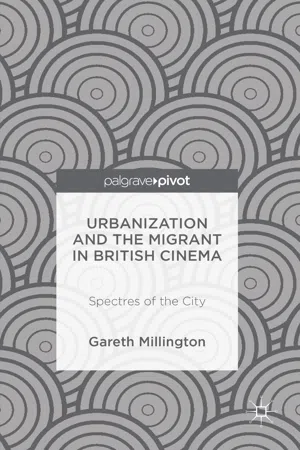
This book examines a cycle of films about migration made in the late 1990s and 2000s. It argues that these films present a novel (and radical) aesthetic of planetary urbanization based upon the mobility of the migrant and the dissolution of the city. A stimulating cinematic analysis of our expanding urban fabric, it offers an alternative to the 'cultural cityism' of many other films about migration. The author demonstrates that this particular film cycle offers a rare, sustained consideration of the travails and struggles for urban life by migrants beyond and without the city. Yet the city haunts these films like a spectre: the city that has been lost, the 'present' city that excludes and the possible 'cities of refuge' of the future. Offering new insights into the cinematic portrayal of the figure of the migrant and how this is constructed in relation to urbanization processes, this book will appeal to students and scholars of sociology, film and media studies, human geography, and urban studies.
Information
© The Author(s) 2016
Gareth MillingtonUrbanization and the Migrant in British Cinema10.1057/978-1-137-47399-8_11. Introduction: Cinema and Urban Society
Gareth Millington1
(1)
University of York, York, UK
Abstract
This chapter begins by considering the importance of cultural questions in the critical study of planetary urbanization. After introducing the aims of this study, the chapter provides a brief sketch of each of the seven films analysed here. This is followed by a discussion of realism and a short summary of the key arguments made in this book. The chapter then introduces the notion of spectrality, focusing in particular on how the ‘spectre of the city’ haunts the films analysed here. The chapter closes by providing an outline of the structure of the book.
Keywords
Planetary urbanizationUrban cultureSpectres of the citySocial realismMigrationCinema and citiesAestheticsCinematic urbanism refers to the critical study of how cinema captures and processes images of the city and then projects these to the public, in the process making a contribution to the ‘making of the modern’ (AlSayyad 2006). There has been resurgent interest in this field recently, from both urban and film studies. The history of the modern city and cinema are deeply intertwined. As Koeck and Roberts (2010: 1) put it, the metropolis and the moving image are inseparable constituents of the modern urban imaginary. Yet, renewed interest in the cinematic city does beg the question why now? This question is especially pertinent when the city and cinema have, separately and together, been viewed as on their way to extinction (Donald 1999; Robins 1996; Brenner 2013; Merrifield 2014). Interest in the cinematic city may then be due to the need to understand the rapid urban change that many cities have experienced in the last 40 years since the hegemonic rise of neoliberalism, to visualize transformations that are connected to processes such as gentrification, securitization, widening inequality, the rise and fall of financial markets, and global migration. Attentiveness to the cinema may also be linked to the desire to see images of a more authentic city, to remember or reconnect with what is now imagined to be a richer, more organic urban experience. As Gilloch (2015: 200) puts it, ‘[f]ilm presents to us, and redeems, the very soul of the city on screen, the modern metropolitan soul in these most soulless times’. This wish to revel in the perceived soulfulness of the twentieth-century metropolis seems reasonable, especially during an age when it has been argued that ‘[t]he image of the city no longer works so readily as a topographical projection. No longer does it function as a transitional space for the collectivity’ (Robins 1996: 132). Nostalgia for images of the city is indicative too of the entanglements of the city with ‘postmodern culture’, especially in the sense that cities are obvious sites where the past is very much part of the present. Cities are layered with meaning over time. We read cities as palimpsests of space, where ‘[t]he strong marks of present space merge in the imaginary with traces of the past, erasures, losses, and heterotopias’ (Huyssen 2003: 7). The enmeshing of the material and the hermeneutic explains AlSayyad’s (2006) conviction that distinctions between the real city and the ‘reel’ city are being eroded; that the actual and virtual may be seen more productively as mutually constitutive. While this is not exactly the position adopted here, the point is an important one. How we imagine or feel about the city has always been a part of the ‘reality’ of the city.
While the cinematic city is often an object of nostalgia, it is also the case that urban sociologies and/or geographies of film are being developed more reflexively to advance critical understanding of the ongoing development of urban modernity. This book begins from the premise that British cinema during the late 1990s and 2000s offers a rare, sustained examination of urbanization and migration, in relation not only to both the city (London) but also to the transformation of sites ‘outside’ the city, such as suburbs and small cities and towns that occupy subordinate positions within London’s ‘power geometries’ (Massey 2005). 1 It takes as its theoretical focus the problematic that Henri Lefebvre identifies between the planetarization of the urban—which he views as economically and technologically driven—and a global urban society based upon ‘the re-appropriation by human beings of their conditions in time, in space and in objects—conditions that were, and continue to be, taken away from them […]’ (Lefebvre 2003: 179). The contradiction is that urban society is made possible by the same processes that threaten to diminish urban life. In practice, contemporary expansive urbanization ‘entails the ongoing sociospatial transformation of diverse, less densely agglomerated settlement spaces that are being ever more tightly linked to the major urban centres’ (Brenner 2009: 205). Indeed in all the films discussed here, London is the ‘centre’ around which urbanization unfolds.
The seven films examined here—Beautiful People (Jasmin Dizdar, 1999), The Last Resort (Pawel Pawlikowski, 2000), In This World (Michael Winterbottom, 2002), Dirty Pretty Things (Stephen Frears, 2002), It’s a Free World (Ken Loach, 2007), Ghosts (Nick Broomfield, 2006) and Somers Town (Shane Meadows, 2008)—are usually treated separately or in pairs as ‘contemporary’ films about migration or ‘new communities’ (e.g. Loshitzky 2010; Sargeant 2005). Although some of these films have been commented upon in relation to how they represent London (e.g. Brunsdon 2007; Mazierska and Rascaroli 2003), generally speaking, they have not been examined in terms of how they relate to critical urban theory and concerns with planetary urbanization, the dissolution of the city and the right to the city. They have not previously been recognized or analysed as a ‘cycle’ of films that acts as an ‘art of exposure’ (Sennett 1990) in redeeming the material and human realities of urbanizing space/s that hitherto lacked an image. Of course, it is usually only with hindsight that a selection of films is recognized as a film cycle, that is, ‘a historically circumscribed group of films sharing common industrial practices, stylistic features, narrative consistencies, and spatial representations’ (Dimendberg 2004: 11).
This chapter begins by considering the importance of cultural questions in critical attempts to understand planetary urbanization. It then makes a comparison between the study contained here and Brunsdon’s (2007) much broader study of London in cinema. The purpose of this exercise is to identify the distinct intellectual (and geographical) space in which this book sits rather than act as critique of Brunsdon’s study. The chapter then acknowledges why the late 1990s and 2000s were a remarkable period in the history of London—the period when London was truly realized as ‘global London’—before providing a brief sketch of each of the seven films analysed here. This is followed by a discussion of realism and a summary of the key arguments made in this book. There follows an introduction to the notion of the spectral, suggesting how the ‘spectre of the city’ haunts the films analysed here in three different ways. The chapter closes by providing an outline of the structure of the book.
Urbanization and Culture
Cultural questions have thus far been sidelined in discussions of planetary urbanization. One gets the sense that questions of culture are viewed as secondary or somehow decorative: that culture is not as important as ‘real’ urban issues such as infrastructure, networks or industry, or that culture is derogated as an instrument of ideology rather than expression. However, from reading Lefebvre’s work on the city and the urban—especially his insistence on the role of spatial practice and representational spaces in the production of space (Lefebvre 1991)—it is clear that culture should be understood as both political and productive. Culture is ideological and a site of struggle and creation. Culture has the potential to evade ‘the science of the city’ (Lefebvre 1996: 156). Lefebvre argues that ‘apart from the economic and political revolution […] the right to the city also demands […] a permanent cultural revolution’ (ibid.: 180). In attempting to understand urbanization through the lens provided by cinema this book still very much aligns with Brenner et al.’s (2011: 235) definition of a critical urban theory which holds ‘that capitalism and its associated forms contain the possible as an immanent, constitutive moment of the real—as contradiction and negation’. Cinema, it is argued here, is a primary cultural form where ‘the possible’ is explored and communicated to a wider audience. As part of the real, rather than existing in parallel to it, cinema can be an instigator or medium of negation.
London (or Not)
At this early stage, it is worth drawing boundaries between this exercise and other approaches to studying the city in cinema. One useful way of doing this is to draw comparisons between this study and Brunsdon’s (2007) cinematic study of London. Brunsdon’s excellent book is on a par with other comprehensive cinematic studies of cities, such as New York (see Sanders 2003; Blake 2005; Pomerance 2007; Corkin 2011) and Los Angeles (see Fine 2004; Shiel 2013). London, Brunsdon convincingly argues, is a special case because it is an old imperial city, the capital of a nation that was dominant in a pre-cinematic era and already imagined through poems, paintings, novels and so on. Cinema evokes these meanings, thereby accounting for the continuing influence of horror and Victorian gothic in London cinema over, say, modernist aesthetics such as noir. Cinema makes visible these Londons of the past, whilst overlaying and projecting a variety of new meanings. Brunsdon is interested in ‘whole’ films rather than the ways that a collection of cinematic representations mediate a city over a particular period. She aims to uncover the many different Londons found in cinema and the ways in which London is invoked by a film (ibid.: 5). Ultimately Brunsdon finds London is cinematically illimitable; it ‘exceeds all attempts to exert “some kind of epistemological authority over it”, to render it knowable’ (ibid.: 12). Brunsdon draws clear lines between her own project and Iain Sinclair’s reading of London films, which she argues, is primarily about London; his assertion being that cinema helps reveal the ‘essence’ of the city. What is at stake is whether London in cinema tells us about cinema and how it is able to render the city in different ways (which is Brunsdon’s position) or whether cinema helps us learn about the real, actual city, with this latter approach focusing upon the qualities or adequacies of ‘representation’ (Sinclair’s standpoint).
The present study is less ambitious. Whereas Brunsdon’s book focuses on the entire post-World War II (WWII) period, this present work concentrates on a relatively small cycle of films made between 1999 and 2008. Some of these films are set in London but others reveal urbanizing spaces and flows of migration that exist because of London’s novel form of contemporary super-centrality. Consequently, this both is and is not a book about London. The focus here lies in how the urbanization that emanates from London is shown and made sense of in cinema, and how these images of urbanization constitute an active moment in urbanization processes themselves. In this sense, this study is more integrated with critical urban theory; it is interested in urban spaces that are emerging within the sphere of influence of London and their relation or non-relation with the cinematic image. In addition, this study is much less interested in the significance of individual films than is Brunsdon’s study. In this book, analysis will coalesce on themes that are expressed, sometimes in a contradictory manner, across the cycle. It is hoped that what follows here is bolder in scrutinizing the boundaries between the ‘cinematic city’ and the actual or real city, focusing in particular upon the relation between aesthetics and politics. Nevertheless, as well as much admiration for the scope and detail of Brunsdon’s endeavour, there is much agreement on the point that cinema never simply offers a ‘representation’ of the city. Neither can it ever be cinematically grasped in its totality.
This book is...
Table of contents
- Cover
- Frontmatter
- 1. Introduction: Cinema and Urban Society
- 2. Cinema, Cities and Urbanization
- 3. Urbanization and Migration: From City to Camp?
- 4. Dissolving City
- 5. Horizontal Distributions
- 6. Conclusion: Contra Brooklyn: Dissensus and the Limits of Realism
- Backmatter
Trusted by 375,005 students
Access to over 1.5 million titles for a fair monthly price.
Study more efficiently using our study tools.
Frequently asked questions
Yes, you can cancel anytime from the Subscription tab in your account settings on the Perlego website. Your subscription will stay active until the end of your current billing period. Learn how to cancel your subscription
No, books cannot be downloaded as external files, such as PDFs, for use outside of Perlego. However, you can download books within the Perlego app for offline reading on mobile or tablet. Learn how to download books offline
Perlego offers two plans: Essential and Complete
- Essential is ideal for learners and professionals who enjoy exploring a wide range of subjects. Access the Essential Library with 800,000+ trusted titles and best-sellers across business, personal growth, and the humanities. Includes unlimited reading time and Standard Read Aloud voice.
- Complete: Perfect for advanced learners and researchers needing full, unrestricted access. Unlock 1.5M+ books across hundreds of subjects, including academic and specialized titles. The Complete Plan also includes advanced features like Premium Read Aloud and Research Assistant.
We are an online textbook subscription service, where you can get access to an entire online library for less than the price of a single book per month. With over 1.5 million books across 990+ topics, we’ve got you covered! Learn about our mission
Look out for the read-aloud symbol on your next book to see if you can listen to it. The read-aloud tool reads text aloud for you, highlighting the text as it is being read. You can pause it, speed it up and slow it down. Learn more about Read Aloud
Yes! You can use the Perlego app on both iOS and Android devices to read anytime, anywhere — even offline. Perfect for commutes or when you’re on the go.
Please note we cannot support devices running on iOS 13 and Android 7 or earlier. Learn more about using the app
Please note we cannot support devices running on iOS 13 and Android 7 or earlier. Learn more about using the app
Yes, you can access Urbanization and the Migrant in British Cinema by Gareth Millington in PDF and/or ePUB format, as well as other popular books in Social Sciences & Emigration & Immigration. We have over 1.5 million books available in our catalogue for you to explore.