- English
- ePUB (mobile friendly)
- Available on iOS & Android
eBook - ePub
About this book
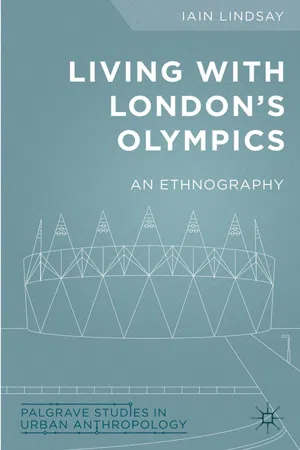
The quadrennial summer Olympic Games are renowned for producing the world's biggest single-city cultural event. This mega-event attracts a live audience of millions, a television audience of billions, and generates incredible scrutiny before, during, and after each installment. This is due to the fact that underpinning the 17 days of spectacular sporting events is approximately a decade worth of planning, preparing, and politicking. It is during this decade that prospective host cities must plan and win their bids before embarking upon seven years of urban upheaval and social transformation in order to stage the world's premier sporting event. This book draws on seven years of ethnographic inquiry around the London 2012 Olympics and contrasts the rhetoric and reality of mega-event delivery. Lindsay argues that in its current iteration the twin notions of beneficial Olympic legacies and Olympic delivery benefits for hosting communities are largely incompatible.
Information
CHAPTER 1
The New(Ham) World
In introducing the London borough of Newham, I will draw on a combination of statistical data and first-hand accounts to provide an indication of everyday life in this complex, unique, and diverse urban setting. What follows explores the composition of the borough: its peculiarities and dichotomies. I shall consider how hosting the Olympics was intended to transform Newham, and who was involved in such a project at the local level.
Newham: A Place to Live, Work, and Stay?
Data from the 2001 British census and additional data from the Office of National Statistics (ONS) emphasize Newham’s diversity and population growth, which have attracted media attention:
•Newham is the most ethnically diverse district in England.
•In 2001 the population numbered 243,737 (a rise of 10.2% from the 1991 census).
•Newham has the highest fertility rate in the country (the 2009 figures show an average of 2.87 children per woman, compared to the national average of 1.95).1
Statistical data also shows that Newham residents have a lower life expectancy and a higher rate of premature mortality than anywhere else in Britain. The local health issues are typical of situations of poverty and deprivation and show no signs of abating. The data released by the Newham Council2 indicates that those experiencing poor health are far less likely to be in employment, resulting in lower incomes, poorer housing conditions, and reduced access to opportunities. In correlation, they indicate that employment is a key element in improving long-term health, which would suggest that those who fall into the poverty trap would have an incredibly difficult time getting out of it.
The London borough of Newham and the City of London are just 5 miles apart. They are, however, separated by two London Underground zones and are, to all intents and purposes, two worlds apart economically, socially, culturally, and in as many other categories as one can fathom. In stark contrast with the affluence evident in the City, Newham presents many characteristics that would indicate why this borough would be receptive to widespread Olympic regeneration. According to the 2007 Index of Multiple Deprivation,3 this is one of the most deprived areas in the UK. In 2008, the Newham Household Survey Panel (NHPS)4 recorded that, after housing costs were taken into consideration, the poverty rate was more than double the London average (45.3% as opposed to 22.1%). These figures emphasize a correlation between poverty and ethnicity, the highest levels of poverty being recorded among Asian Bangladeshis (61%) and Asian Pakistanis (59%); at 33%, poverty among white people was also well over the London average. Poverty among black people was recorded at 22%.
Newham’s deprivation was spread throughout the borough, as opposed to the centralized pockets of deprivation observable in other locations.5 The visibly high levels of deprivation that permeated the borough were reflected in the public perceptions gathered from across London’s 32 boroughs. This survey of opinions illustrated the negative connotations attached to the borough by those who were intimately familiar with it. For example, in 2008, Newham residents reported the lowest levels of satisfaction with their local area, the highest levels of anti-social behavior, and the second lowest levels of “community cohesion” in London.6 These concerns were reflected in Newham’s housing situation; for example, in 2009, it was reported that “over twice as many private houses in Newham were designated unfit for living within (15% compared to 6% in London) and 50% of social housing stock in Newham was below Decent Homes Standard.”7 At the same time, the demand for housing increased; in 2010, 33.5% of households were on the Newham’s housing register, a 10% increase on the figures reported in 2000.8 These findings indicate the scale of Newham’s Olympic regeneration and illustrate the challenges faced by public services such as policing and health provisions during the Olympic Games and beyond.
The League of Nations
One of the most significant characteristics of this borough is that there is no majority/minority population. According to the Annual Population Survey 2008, published by the Office for National Statistics (ONS), 64.6% are “non-white.” The primary ethnic groups are white and Asian but we need further sub-division to appreciate fully the diversity of this borough. Of the 39% classified as white residents, 32.6% defined themselves as “British.”9 Of the 38% classified as Asian, 13.9% were Pakistani, 10.2% were Indian, 7% Bangladeshi and the remaining 5.1% were “Asian other.” Additionally, in 2001, 20% of Newham’s population was classified as black; 12.4% of these were African, 6.5% Caribbean and 1.1% “Black other.” Add to such diversity, 1.6% Chinese and 2.6% people of other ethnicity. As is exemplified by the remarks of a Newham Community Worker, the white British are considered an ethnic minority group in Newham, with specific events designed to cater for them. “Most places you go in Newham,” he said, “have visual reminders of the diversity of the borough. The minorities posters provided by Newham council are usually full of smiley and happy blacks and Asians. As a result of these constant visual reminders the white working class feel under threat and increasingly more marginalised and foreign. They often feel like they have lost their place in society, which has been gradually whittled away by other groups that attain greater social prominence. Less than one third of the community are white indigenous or white working class, and these tend to be much older than the rest of the borough. Their numbers are decreasing all the time as they die or move out of Newham to be closer to their children who moved out of the borough years earlier” (Fieldwork Interview, April 2010).
This aging white, working-class population had a sound basis for their feelings of marginalization, their numbers dwindling as a result of what Hobbs called “white flight” (1988). As the Local Economic Assessment 2010 – 2027, published in October 2010, summarized:10
•The population of Newham is rising, and is projected to continue to rise significantly.
•Newham has a very young and highly diverse population.
•Newham has high levels of population churn compared to London as a whole.
•Newham is a highly deprived borough with especially high rates of deprivation affecting children and older people.
•Poverty in Newham is high and life expectancy is lower than the London average.
White people were a waning Newham group and were conscious of their ever-diminishing social standing. They may be seen as a lost—certainly, an aging—generation whose history was becoming less and less recognized. As a consequence, some were attempting to preserve their cultural history, which is exemplified in the following excerpt from my fieldwork notes of June 2011:
Newham’s older, white working class had a desire to get together to tell stories and reminisce about their shared histories but often they lacked the ability or location to do so. As a result, community centres, such as the Froud centre in Manor Park created programmes that kick-started this basic human function. They granted permission for this to occur in schemes such as a lunch club for these people. These meetings are not simply about a nostalgic mourning of the past, although much reminiscing does take place. Rather, these programmes attempt to help white people to feel less marginalised in today’s Newham. They do this by involving young people from the diverse community into these meetings. These young people voluntarily cook for the old people, serve them, and eat with them. They listen to the old people’s stories in an attempt to bridge the gaps between the present and the past. They are creating an environment for informal learning to occur.
I attended one such event. The walls of the cafeteria where the event was held were covered with black and white photos taken in Newham in the past; the faces were too white, there were ships of all shapes and sizes in the docks and the images hinted at a lost magical past the way photos tend to do. Buddy Holly and Chuck Berry provided the soundtrack for the twenty or so old white pensioners to shuffle into the room, all wearing heavy coats and hats despite the warmth of the summer’s day radiating through the large windows. These pensioners searched for their names on the two long tables at the center of the room. The tables were nicely set and the imagery was reminiscent of the stereotypical Christmas dinner setting. Each table sat around 15 people, and the pensioners were interspersed with gaps that would be filled by the dozen young people who either helped them to their seats or were in the kitchen helping with the cooking. “Bangers and mash” (sausages and mashed potatoes) was a particular favorite it seemed, having been chosen over fish and chips or a lamb roast at the end of the group’s last meeting, weeks earlier.
After the food had been served and eaten, the plates were cleared and the space became filled with contented, comfortable, and lively conversation. Conversation-prompts permeated the scene; in addition to the photographs that charted various decades of modification and transformation of the lived environment, there were collections of magazines, catalogues and adverts that prompted discourse about fashion, technology, culture, and iconography through the ages. As the barriers between the old and young, the white British and the diverse Newham representatives decreased, the conversations became increasingly jovial and light-hearted. To give an example, Mary, an 80-year-old lady, recounted for all who cared to listen: “I was married for 62 years. I fell in love with my Dave because he had a nice motorbike. When I met him, I told him to take me for a ride on the back of his bike, we rode for a while and he took me out to the countryside. It was such fun that when we got to a field I let him have a feel.” The day culminated with a sing-a-long to East End Music Hall tunes such as “Roll-out-the-Barrel,” which prompted further conversations between the old and the young about the origins and historical resonance of the terms “Lucifer” and “fag,” and how “during the war the bastard German snipers would shoot the British if they saw a cigarette being lit,” which arguably proved one of the most effective anti-smoking campaigns to date. With that, it was time to return to the present; on went the overcoats and the pensioners shuffled out onto the busy and diverse Newham streets.
Indigenous white people formed a segment of contemporary Newham. Establishing what proportion of Newham’s populace this group exactly represented proved to be challenging. The composition and density of the population in Newham is a complex issue. In 2008, a Greater London Authority (GLA) report raised the estimated population of Newham to 265,688.11 However, both the figures produced by the GLA and the earlier census appeared problematic because of significant numbers of unregistered peoples living illegally in the borough. In September 2011, two new Task Forces were initiated by Newham Council to tackle the growing menace of what was referred to as “super sheds”; best described as “ramshackle illegal buildings in gardens, often housing people living in squalor.”12 These shanty-style dwellings were tracked through the use of aerial photography and infrared imagery. The borough officials were also attempting to cut down on all forms of slum landlord practice, which included breaking up family homes into tiny residential units that contained no communal space.
A 2009 study by Mayhew13 attempted to account for residents ignored by the official figures, including those living in the borough for less than one year. This study estimated that the Newham population was 270,100.14 Arguably, the figures generated by this study are more accurate than the official figures quoted earlier, because they are based on administrative data sets (such as school rolls, council tax records, and GP registrations). However, the study does highlight the fact that there are many “sleepers” that could not be included in the figures. Accordingly, it suggested that in 2008, there were over 15,000 “unconfirmed citizens” living at unregistered Newham addresses, estimated to be predominantly young males who had recently arrived in the UK. More recent population estimates suggest that as many as 320,000 people now live in Newham (Bagehot 2012). 15
In this regard, Newham was emblematic of what the anthropologist Gordon Mathews described as “low-end” globalization, which he defined by differentiating it from the globalization involving big brands and huge corporations. He argued that a low-end globalization was typical of informal economies; it spoke to those seeking a better life in foreign countries through such opportunities as temporary work, asylum, or work in the sex industry. Mathews argues that this kind of globalization is dominant in much of the developing world (2011, p. 13). It would appear to be pertinent to Olympic-delivery Newham. What follows is an indication of living with “low-end” globalization, which in some parts of Newham has become synonymous with criminality. For some Newham residents life is governed by fear of such criminality.
The City of Dreadful Night?
Newham’s crime figures, in parallel with the escalating population, are high and rising. According to a report published in October 2010 by the local charity, Aston Mansfield,16 Newham saw an increase in recorded crime in 10 of the 15 crime categories. Crimes that increased in Newham but not London-wide between the years ending in November 2009 and 2010 were:
•Homicide
•Burglary (residential and total)
•Gun crime (a 52% increase, compared to an 8% decrease across London)
•Motor vehicle crime
•Violence against the person
As the following example from my fieldwork notes indicates, these crime statistics contributed to the way everyday life in the borough unraveled. Marta, 21, and Laura, 28, were two single female Hungarian economic migrants who moved to Newham in 2010 from a small Hungarian town, in the hope of having a better and more interesting life in London. They arrived in the UK on an early morning, after a three-day coach ride across Europe. On arrival, they quickly moved into a small, one-bedroom, rented apartment, which had been arranged through a family contact; it was basic but seemed to have all they needed. They were happy to finally be there and were ready to get to know the area; they were soon to discover the day/night dichotomy of Newham. Looking out of their window into the street outside, they were met with the unmistakable sight of prostitutes walking up and down, soliciting their wares; these streets were theirs to work from 10:00 pm until early morning. This was a new reality to the Hungarians. They were ambivalent about such occupation of public space, but understood that for some women this was a way of life and that was how things were. What was more unsettling for the pair was the diversity of the borough, which they were completely unprepared for, coming from a mono-cultural Hungarian province. Newham was indeed very foreign to them, and it took them a long ...
Table of contents
- Cover
- Title
- Introduction In Pursuit of Olympic Gold
- Chapter 1 The New(Ham) World
- Chapter 2 The 2012 Transition: Process and Politics
- Chapter 3 Newham Divide and Document
- Chapter 4 Life in the Shadow of the Olympic Torch
- Chapter 5 Employment and Capital Gains
- Chapter 6 The Rings of Exclusion
- Chapter 7 Securitization: The Olympic Lockdown?
- Chapter 8 Big Game Hunting: Baiting the Hooks
- Chapter 9 Going for the Gold: The All-Consuming 2012 Ethos
- Chapter 10 Conclusion: Extinguishing the Olympic Torch
- Notes
- References
- Index
Trusted by 375,005 students
Access to over 1.5 million titles for a fair monthly price.
Study more efficiently using our study tools.
Frequently asked questions
Yes, you can cancel anytime from the Subscription tab in your account settings on the Perlego website. Your subscription will stay active until the end of your current billing period. Learn how to cancel your subscription
No, books cannot be downloaded as external files, such as PDFs, for use outside of Perlego. However, you can download books within the Perlego app for offline reading on mobile or tablet. Learn how to download books offline
Perlego offers two plans: Essential and Complete
- Essential is ideal for learners and professionals who enjoy exploring a wide range of subjects. Access the Essential Library with 800,000+ trusted titles and best-sellers across business, personal growth, and the humanities. Includes unlimited reading time and Standard Read Aloud voice.
- Complete: Perfect for advanced learners and researchers needing full, unrestricted access. Unlock 1.5M+ books across hundreds of subjects, including academic and specialized titles. The Complete Plan also includes advanced features like Premium Read Aloud and Research Assistant.
We are an online textbook subscription service, where you can get access to an entire online library for less than the price of a single book per month. With over 1.5 million books across 990+ topics, we’ve got you covered! Learn about our mission
Look out for the read-aloud symbol on your next book to see if you can listen to it. The read-aloud tool reads text aloud for you, highlighting the text as it is being read. You can pause it, speed it up and slow it down. Learn more about Read Aloud
Yes! You can use the Perlego app on both iOS and Android devices to read anytime, anywhere — even offline. Perfect for commutes or when you’re on the go.
Please note we cannot support devices running on iOS 13 and Android 7 or earlier. Learn more about using the app
Please note we cannot support devices running on iOS 13 and Android 7 or earlier. Learn more about using the app
Yes, you can access Living with London's Olympics by I. Lindsay in PDF and/or ePUB format, as well as other popular books in Social Sciences & Anthropology. We have over 1.5 million books available in our catalogue for you to explore.