eBook - ePub
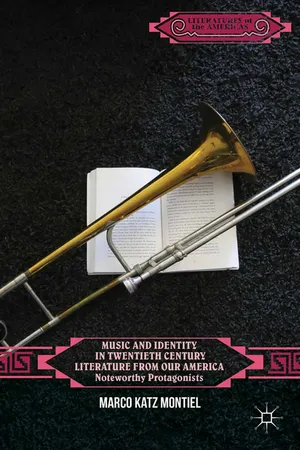
Music and Identity in Twentieth-Century Literature from Our America
Noteworthy Protagonists
- English
- ePUB (mobile friendly)
- Available on iOS & Android
eBook - ePub
Music and Identity in Twentieth-Century Literature from Our America
Noteworthy Protagonists
About this book
Offering a one-of-a-kind approach to music and literature of the Americas, this book examines the relationships between musical protagonists from Colombia, Cuba, and the United States in novels by writers such as Gabriel García Márquez, Alejo Carpentier, Zora Neale Hurston, and John Okada.
Information
Topic
LetteraturaSubtopic
Critica letterariaPart I
First Movement: Numbers, Music, and the Reality of Gabriel García Márquez
I was obliged to work hard; whoever is equally industrious will succeed just as well.
Johann Sebastian Bach
Numbers appear regularly in reviews of Gabriel García Márquez. “The most casual reader of García Márquez notes his fondness for numbers,” observes Michael Wood. “There are one hundred years of solitude, and in the novel of that name the rain pours down on Macondo for exactly four years, eleven months, and two days. A traveler circles the earth sixty-five times. Gargantuan eaters consume for breakfast eight quarts of coffee, thirty raw eggs, and the juice of forty oranges.” Jean Franco adds the numbers arising from “Florentino Ariza’s prolonged passion for Fermina Daza, a passion that is finally consummated after fifty years, nine months and four days, when they are both over 70 years old” (573). These enumerations tend to take on a Cabbalistic tone; rather than lending the works an air of mathematical credibility, the accumulation of data suggests something of the romance, passion, and magic thought to imbue literature from Latin America. “The numbers call up an air of legend,” decides Wood, “a precision that mildly mocks the idea of precision.”
García Márquez added more figures during his Nobel address. After taking note of five wars and seventeen governments overthrown, the newly crowned laureate mentioned “20 million Latin American children who died before the age of two, more than the number born in Europe since 1970. 120 thousand have disappeared due to repression,” he added,
which would be like knowing nothing of the whereabouts of every inhabitant of Uppsala. Wanting to change things, nearly 200 thousand women and men died throughout the continent, and more than 100 thousand perished in three small strong-willed nations of Central America: Nicaragua, El Salvador, and Guatemala. If this had happened in the United States, the corresponding figure would be 1.6 million violent deaths in four years.
From Chile, a traditionally hospitable country, one million have fled, 12% of the population. Uruguay, a miniscule nation of two-and-a-half million inhabitants considered the most civilized country on the continent, has exiled one in five citizens. Since 1979, the Civil War in El Salvador has created a refugee every twenty minutes. All of the exiles and emigrants forced out of Latin America would make up a country more populated than Norway.1 (“La soledad”)
Calling this situation “a reality not made of paper”2 (papel, with its double significance of a dramatic role played by a thespian as well as a material on which text appears), the author asked, “How can anyone think that the social justice advanced Europeans try to impose in their own countries would not with other methods and under different conditions be a Latin American objective as well?”3 Acknowledging the chances of a worldwide disaster as “a simple scientific possibility,”4 García Márquez nevertheless concluded his address by summoning up all of the optimism he could muster in order to call for a new utopia in which love, happiness, and opportunity could flourish.
García Márquez was working on El amor en los tiempos del cólera (known in English as Love in the Time of Cholera) at the time he prepared his Nobel acceptance speech, a conjuncture that uncloaks his thinking about politics during that novel’s creative process. The author, writes Margaret Snook, describes this novel “as his most political work in that it presents the class struggle on all fronts”5 (95). Attempting to comprehend the connection between this novel and the reality of politics, critics and scholars have applied a wide variety of critical techniques to El amor en los tiempos del cólera. Beginning with foundational studies, such as Robin Fiddian’s metonymic reading of the relationship between Florentino and the adolescent “as a re-enactment of the treacherous destruction of young America by the Florentine (i.e. the Columbus Renaissance) spirit of Europe” (204), these critiques have emerged from the perspectives of Marxist, Feminist, Lacanian, and other theoretical schools along with their offshoots and combinations up through the time of this writing. Two decades after Fiddian’s initial consideration of the novel, John Cussen takes issue with the idea of América Vicuña as standing in for a victimized continent, arguing instead that El amor en los tiempos del cólera deliberately confronts the religious history surrounding Laura Vicuña, a late nineteenth-century Chilean martyr declared venerable by Pope John Paul II at the same time the novel came out, in order to demonstrate how “the Church’s chastity ethic and the legends that support it are laughable” (388). As one might expect in the case of any novel by this most famous Nobel Laureate, the reviews and critiques add up to yet another prodigious—and ever-increasing—number.
Chapter 1
Exposition: Literary and Musical Consonances
In connection with El amor en los tiempos del cólera, I add here a few more numbers: the word música appears thirty-seven times, violín seventeen, banda eleven, and orquesta, coro, and ópera seven times apiece. The instruments and ensembles mentioned here perform music elaborated in 3/4 and 4/4 time, implying deliberate—and significant—shifts between triple and duple rhythms. Along with these technical references, the narration refers to the execution of these and other musical elements by well-known composers and performers who create and actuate established works from formal and demotic repertoires. Few critics have noticed this wealth of music, and fewer still have attributed much significance to it. As a corrective to this oversight, this chapter will consider music as a way of understanding the novel and also contextualizing this work in its author’s call for an understanding of Latin America’s “reality not made of paper.” Specifically, music provides a means of stepping into debates over the love in El amor en los tiempos del cólera and the relative merits of Fermina Daza’s two lovers. Beyond the place of music as an accompaniment to love, these comparisons of Florentino Ariza and Juvenal Urbino often encapsulate the competing interpretation of the numbers provided by García Márquez as either mysteriously coded views of passionate Latino reality or hard data enumerating human conditions in need of attention.
The musical meanings of El amor en los tiempos del cólera will make more sense after a brief review of comparisons arising from the novel’s critical history, first that of the male rivals, a topic that leads ineluctably into similar bifurcations of Latin American politics and society, which I call here “Arriba Ariza” and “Juvenal the Heavy.” Sandwiched in between these two, we must consider “Faithless Fermina,” who may turn out to have more wisdom than that normally acknowledged in this female literary figure. Standard—and, I argue, stereotyped—views of these characters have played their papel in “Gabriel García Marketing,” a term employed by Alejandro Herrero-Olaizola to describe the multiple marketing mechanisms that converted the love in El amor en los tiempos del cólera from individual passion into an industry (197). Given the author’s availability and willingness to talk with scholars, interviews about the new book appeared rapidly, “and they came up with the answers they sought,” argues Luis Beltrán Almería, namely that “El amor en los tiempos del cólera is a romantic novel”1 (225). This “must be read as the story of a grand passion,” confirms a review by the eminent Peruvian literary scholar Antonio Cornejo Polar. “It could be argued, then, that love is the protagonist of García Márquez’s latest novel”2 (163). Readers, including many prominent critics, cheered for Florentino, blamed Fermina, and disdained Juvenal in numbers large enough to drive “Gabriel García Marketing” into the showroom of Oprah Winfrey’s turbocharged book club. Selling works by García Márquez outside of Spanish-speaking countries requires translations, thus leading to further interpretive entanglements. As some readers extrapolate from a novel or series of narratives, they start believing themselves capable of “Translating Latin America,” a tricky process that not only creates ludicrous—although sometimes inadvertently humorous—criticism but also leads to serious political implications.
Arriba Ariza
El amor en los tiempos de cólera relates a simple love story. As a teenager, Fermina agrees to marry Florentino. Overcoming punishments dealt out by her father, who objects to the union, she prepares for the wedding, but suddenly decides that she does not want to marry her young suitor. After breaking up with Florentino, she meets Juvenal, a doctor whose financial success makes this courtship pleasing to Fermina’s father. Even though he loses Fermina to Juvenal, Florentino never stops planning for a reunification with his beloved. When Juvenal passes on, Florentino reappears in Fermina’s life and—after another, more prolonged, courtship—takes her up the river on a voyage that never ends.
García Márquez begins his text with reference to sound. “We hear it even before the novel begins,” observes Stefan Mattessich, “with the epigraph, comprised of two lines by the vallenato singer Leandro Díaz” (335). Along with “its literary weight,” adds Juan Carlos Díaz, the lyric of “La diosa coronada” (“The Crowned Goddess”) “conveys a heartfelt story of love, despair, and humor that only a prodigious mind like that of Leandro can capably synthesize into just a few lines.”3 Anachronistically, Florentino wakes Fermina one evening in the nineteenth century with a waltz arrangement, in 3/4 time, of this twentieth-century composition normally played in 4/4 time. The next day,
Florentino Ariza confirmed that he had presented the serenade, and that the waltz had been composed by him and had the name with which he knew Fermina Daza in his heart: The Crowned Goddess. He did not return to the park to play it, but habitually did so on moonlight nights in spots picked out for the purpose of letting her hear it in her bedroom without being frightened. One of his favorite sites was the pauper’s cemetery, exposed to sun and rain on a destitute hill where vultures slept, and where the music achieved supernatural resonances. Later he learned to understand the direction of the winds, and thus could be sure of having his voice arrive where it needed to go.4 (100)
Claudette Kemper Columbus points out the return of this song in the last chapter as Fermina discovers how much better everything in the world appears from the deck of her floating paradise with Florentino. “Playing the waltz, ‘The Crowned Goddess,’ on the violin, the very well-versed Florentino serenades his one true love, who gives him nightly enemas” (96). As one might suppose from this humorous observation, Columbus finds two levels operating in García Márquez’s novel, with a subtler, more profound, message that subverts the meanings seemingly offered by the obvious reading. “Love in the Time of Cholera on the manifest level seems to support sentimental notions that it attacks on the latent level” (89). In this way, explains Columbus, centers of power are also subverted by the author’s assault on sentimentality, a comfort zone in which readers are most likely to resist satire. Columbus’s reading of the novel credits the author with a precarious strategy that interpellates readers, who are unlikely to have embarked on this literary journey with an expectation of their own culpability. For Columbus, García Márquez writes “about the vast majority of us entering the twenty-first century supposedly enlightened on psychological, social, and environmental issues, but actually substituting our own narcissistically sentimental selves.” The author’s enchantment, however, softens this inquisition with “a safe distance between the reader and the text, as if the reader were outside that world, innocent of complicity with a narcissistic society, innocent in a history of planetary despoliation and social injustice that imperil [sic] nations and species” (91). By ignoring Florentino’s obvious role in planetary despoliation and social injustice, sentimental readers can glorify Florentino’s passion, which plays out in a far-off time and place and thus embodies a view of a glamorous but unthreateningly distant Latin America.
Laura Otis, one of the few scholars to notice the sounds of El amor en los tiempos del cólera, sees this music upholding the love story. In her view, the “amorous codes” in the novel “include movements of fans, the arrangements of flowers, and the selection of musical themes, and Florentino eventually becomes adept at all of his culture’s secret languages” (270). Otis points to the mentorship of Lotario Thugut as a turning point in Florentino’s development of communication skills; the mentor provides his protégé with both the Morse code and musical knowledge that provide hidden means of sending messages during the young lover’s pursuit of Fermina. “Eventually, Florentino replaces his electronic messages to Fermina with musical ones and succeeds in sending them right under her father’s nose” (284). Employed in this manner, the telegraph becomes as romantic an instrument as the violin and both serve as tools for the furtherance of true love.
In the novel, the violin saves Florentino from getting discharged as a telegraph employee. After he raised flags incorrectly and caused other confusions, notes the text, the company received many complaints about their young helper. “His lovesickness caused so much disorder in distribution and provoked so many protests from the public that Florentino Ariza would have been left without employment if Lotario Thugut had not maintained him at the telegraph company and taken him to play the violin with the church choir”5 (89). This happens even though the boss, whose name resonates from one of the inner stories of El Quijote, is old enough to be his employee’s grandfather. Cross-generational friendships form commonly among musicians, who generally have more interest in musical compatibility than in the relative ages of colleagues. In this case, the elder musician’s friendship continues to serve the younger man well:
Lotario Thugut, former music teacher of [Florentino’s] Uncle León XII was the one who advised the latter to take on his nephew as a writer, giving the reason that he was an insatiable cons...
Table of contents
- Cover
- Title
- Overture
- Part I First Movement: Numbers, Music, and the Reality of Gabriel García Márquez
- Part II Intermezzo: Musical Segmentalizing
- Part III Second Movement: Meanwhile, on the Other Side of the Caribbean
- Part IV Third Movement: Stretching the Northern Boundaries of America
- Part V Coda: More Possibilities for Discovering Music in American Literature
- Notes
- Works Cited
- Index
Trusted by 375,005 students
Access to over 1.5 million titles for a fair monthly price.
Study more efficiently using our study tools.
Frequently asked questions
Yes, you can cancel anytime from the Subscription tab in your account settings on the Perlego website. Your subscription will stay active until the end of your current billing period. Learn how to cancel your subscription
No, books cannot be downloaded as external files, such as PDFs, for use outside of Perlego. However, you can download books within the Perlego app for offline reading on mobile or tablet. Learn how to download books offline
Perlego offers two plans: Essential and Complete
- Essential is ideal for learners and professionals who enjoy exploring a wide range of subjects. Access the Essential Library with 800,000+ trusted titles and best-sellers across business, personal growth, and the humanities. Includes unlimited reading time and Standard Read Aloud voice.
- Complete: Perfect for advanced learners and researchers needing full, unrestricted access. Unlock 1.5M+ books across hundreds of subjects, including academic and specialized titles. The Complete Plan also includes advanced features like Premium Read Aloud and Research Assistant.
We are an online textbook subscription service, where you can get access to an entire online library for less than the price of a single book per month. With over 1.5 million books across 990+ topics, we’ve got you covered! Learn about our mission
Look out for the read-aloud symbol on your next book to see if you can listen to it. The read-aloud tool reads text aloud for you, highlighting the text as it is being read. You can pause it, speed it up and slow it down. Learn more about Read Aloud
Yes! You can use the Perlego app on both iOS and Android devices to read anytime, anywhere — even offline. Perfect for commutes or when you’re on the go.
Please note we cannot support devices running on iOS 13 and Android 7 or earlier. Learn more about using the app
Please note we cannot support devices running on iOS 13 and Android 7 or earlier. Learn more about using the app
Yes, you can access Music and Identity in Twentieth-Century Literature from Our America by Kenneth A. Loparo,Marco Katz Montiel in PDF and/or ePUB format, as well as other popular books in Letteratura & Critica letteraria. We have over 1.5 million books available in our catalogue for you to explore.