- English
- ePUB (mobile friendly)
- Available on iOS & Android
eBook - ePub
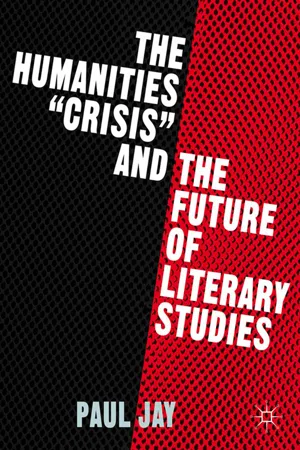
The Humanities "Crisis" and the Future of Literary Studies
About this book
Demonstrating that the supposed drawbacks of the humanities are in fact their source of practical value, Jay explores current debates about the role of the humanities in higher education, puts them in historical context, and offers humanists and their supporters concrete ways to explain the practical value of a contemporary humanities education.
Information
Topic
EducationSubtopic
Education Theory & PracticeC H A P T E R 1

THE HUMANITIES CRISIS THEN AND NOW
Nearly everyone seems to believe the humanities are in crisis. Hardly a week has gone by since I began research for this book late in 2009 without an article in the Chronicle of Higher Education, New York Times, Wall Street Journal, Inside Higher Ed, or Washington Post about the declining prestige of the humanities, the defunding of its programs, and the poor employment prospects of its students. The supposed causes of the crisis are by now familiar. Students and their parents have increasingly come to see a college or university education as vocational training. They want maximum value for the high cost of higher education, and that value is increasingly measured in utilitarian terms. Courses in the humanities seem of little practical use at best, and, at worst, like a waste of time. The intangible value of an education in history, philosophy, literature, and the fine arts is of decreasing interest to families worried about their children’s employment prospects. Study in the humanities disciplines seems backward looking and without any utility in an age of exploding technology. For this reason students are flocking to the science, technology, engineering, and mathematics (STEM) disciplines because, unlike the humanities, they are forward looking. Add to all of this the pressures of a sustained economic recession and the increasing corporatization of higher education, where the bottom-line mentality of boards of trustees dominated by executives from the business community tends to dominate budget priorities, and you have something like a constellation of forces that, worse than a crisis, seem to portend the very end of the humanities.
The only problem with this dire scenario of the contemporary plight of the humanities is that there is little that is new about it at all. The humanities have always been in a state of crisis. As Frank Donoghue has shown in The Last Professors: The Corporate University and the Fate of the Humanities (2008), the educational value of humanities courses has regularly been questioned by business elites who worried about their practical value. From this point of view contemporary debates about the practical value of the humanities seem nearly as old as the humanities themselves. As Donoghue observes, “The terms of the so-called crisis, from the academic humanist perspective, are always the same: corporate interests and values are poised to overwhelm the ideals of the liberal arts and to transform the university into a thoroughly businesslike workplace” (1). From early in the twentieth century, Donoghue observes, “the great capitalists . . . saw in America’s universities a set of core values and a management style antithetical to their own” (2). “America’s early twentieth-century capitalists,” he demonstrates, “were motivated by an ethically based anti-intellectualism that transcended interest in the financial bottom line,” for it had its ultimate origins in a “distrust of the ideal of intellectual inquiry for its own sake” (3). From this point of view questions about the utility of a humanities education do not seem part of a contemporary crisis, but rather, are a structural character of higher education.
The perennial nature of the rhetoric of crisis surrounding the humanities also becomes clear by simply searching “crisis of the humanities” in the Humanities Citation Index. That search will turn up nearly 20 articles dating back to 1990. According to these articles the humanities have fallen into crisis because of the emergence of cultural studies, a new focus on canons and culture, the influence of Nietzsche, political and economic forces, or simply because they’re becoming irrelevant. In 2010, Wayne Bivens-Tatum, the philosophy and religion librarian at Princeton University, searched “crisis in the humanities” in JSTOR and found articles on the topic dating from 1922. He notes that by the 1940s “a steady stream of complaints” about the state of the humanities had developed. Indeed, his essay is full of quotes from scholars in the 1940s, 1950s, and 1960s (1965 saw the publication, for example, of a book titled Crisis in the Humanities) decrying the crisis in the humanities. And, as he points out, the reasons for that crisis are nearly always the same. “Not only is the sense of crisis decades old and persistent,” he observes, “but for the most part the causes are as well. Students are choosing professional programs over the humanities; the sciences have the most authority and get the most funding; there are too many humanities PhDs; they’re evaluated by standards appropriate to the sciences but not the humanities. Every generation of scholars wakes up afresh, looks about, and thinks the sky is falling.” The sky may be falling, he dryly points out, “but if it is, it seems to be falling very slowly.”
One of the big problems with the current rhetoric of crisis in the humanities is that much of the evidence cited to document that crisis has increasingly proved to be inaccurate. Take what has become the nearly axiomatic idea that the crisis in the humanities can be measured by falling enrollments and decreasing majors. This is a recurrent point made by those who argue the humanities are in crisis. Let’s look at a couple of examples. The first is an autumn, 2009, essay in The American Scholar by William M. Chace called “The Decline of the English Department.” Chace calls attention to the drop in students majoring in English between 1970–1971 and 2003–2004, noting that majors declined from 7.6 percent of students receiving the bachelor’s degree at the beginning of this period to 3.9 percent at the end. Chace’s assertions recall similar ones made earlier that year by the literary critic John M. Ellis in “Why Students Flee the Humanities.” Ellis, a founder of the National Association of Scholars, is the author of Literature Lost: Social Agendas and the Corruption of the Humanities (1999). Ellis laments a drop in English majors and blames it on the rise of critical theory and political correctness (an accusation I will explore in much more detail later in this book).
As the economy improved dramatically during the 1980s the figure for English majors rose with the economy, reaching 4.7% by the end of the decade. But now the familiar pattern broke down: as the economy continued to get stronger, the figures for English majors began to go in the opposite direction, the first time this had happened. By 1995, English majors had declined to 4.3% of all bachelor’s degrees, and by 2005 they had gone down to 3.7%, the same figure that was seen at the economy’s bottom in the early 80’s—except that the economy had now been booming almost continuously for 20 years.1
As a number of commentators have pointed out, these claims are based on very misleading data. Much of the problem stems from the fact that critics such as Chace and Ellis date the decline they lament from 1970, an unprecedented high point in humanities enrollments. The truth is that humanities enrollments have held remarkably stable. According to Ben Schmidt the percentage of humanities majors has held steady between 1984 and 2010, measuring 6.5 percent at the beginning and ending of this period, with some upticks between 1988 and 1996. As Schmidt points out, “That overall pattern gives the lie to any arguments that claim the humanities are being eroded by things like ethnic studies or a departure from the classics. Students aren’t any less interested in majoring in history or English now than they were at the moment deconstructionism hit American shores.” The big decline, his analysis shows, was between 1970 and 1980, when humanities majors fell from a high of about 17 percent to 8 percent. However, they moved up again beginning in 1985, reaching a peak in the mid-1990s of about 10 percent, then settled back to around 8 percent until the 2008 recession when they slipped down to 6 percent.
Michael Bérubé draws on Schmidt’s work in a July 1, 2013, article to make the same point: arguments that humanities enrollments have declined due to the rise of theory and political correctness have no basis in fact (a point he has been making since 2002).2 “There was a decline in bachelor’s degrees in English,” he points out, “just as there was a drop-off in humanities enrollments more generally. But it happened almost entirely between 1970 and 1980. It is old news. Students are not ‘now making the jump’ to other fields, and it is not ‘getting worse.’ It is not a ‘recent shift.’ There is no ‘steady downward spiral.’ It is more like the sales of Beatles records—huge in the 60s, then dropping off sharply in the 70s.” And, he continues, “because the real lament is almost always about recent intellectual and curricular developments in the humanities,” the enrollment numbers are “little more than a pretext for jeremiads.”
Scott Saul also throws some cold water on the idea that the humanities crisis can be demonstrated by falling enrollments. In a July 2013 article in the New York Times titled “The Humanities in Crisis? Not at Most Schools,” Saul, like Bérubé, points out that the “downward trajectory” of the humanities looks “striking” only if you use the 1960s as a benchmark. But from this point of view the so-called crisis in the humanities “is a half-truth.” It is true, Saul points out, that humanities majors have dropped at elite universities such as Cornell, where, between 2006 and 2011, the number of history majors dropped 49 percent, and the number of English majors dropped 37 percent, and Yale, where “the number of English majors plummeted more than 60 percent between 1991 and 2012.”3 Yet, the humanities are doing much better at many other colleges and universities that have a more diverse student body. He points out that nationwide, enrollment in what he calls the “softest” humanities disciplines, English, foreign languages and literatures, and the arts, “has been remarkably steady over the last two decades, hovering between 9.8 percent and 10.6 percent of total bachelor’s degrees awarded.” At the University of California, Berkeley, for example, “the English department this year graduated 375 majors, or 5 percent of the class.” Like Schmidt, Saul notes that according to Humanities Indicators, a project of the American Academy of Arts & Sciences, the share of bachelor’s degrees earned in the humanities has stayed remarkably steady between 1987 and 2010 (10% in 1987, and about 11% in 2010, with some brief fluctuations up during the overall period).4 And Saul makes the same point Bérubé does about the claim that critical theory and political correctness have damaged humanities enrollments: “Here we must straighten out one of the great misconceptions that has circulated around humanities professors: that we are a trendy lot, ‘tenured radicals’ wrenching the curriculum into irrelevance as we impose the latest theoretical paradigm upon it. Yet 30 years from the culture wars of the 1980s, what is remarkable is the continuity with the curriculum of old.”5
Enrollment figures, then, do not bear out the claim that the humanities are in crisis, that students are fleeing the humanities because they’ve been ruined by critical theory and political correctness. The simple truth is that humanities enrollments have fluctuated for a range of reasons between the late 1960s and the present, but they do not justify in themselves the claim that the humanities are in crisis.6 The emergency in the humanities looks overblown, as well, if we examine employment figures. While critics of the humanities claim that students do themselves a financial and vocational disservice by majoring in the humanities (so much so that Florida recently entertained the idea of charging humanities majors higher tuition than STEM majors), the facts are not nearly as alarming as these critics make them out to be. Jordan Weissmann, in an Atlantic magazine article titled “The Best Argument for Studying English? The Employment Numbers,” has recently pointed out that “according to the most recent survey of the college graduate labor market by the Georgetown Center on Education and the Workforce . . . recent humanities and liberal arts majors had 9 percent unemployment” (in 2010–2011). He notes that his is “right about on par with students in computer and math fields (9.1 percent), psychology and social work (8.8 percent), and the social sciences (10.3 percent). And it’s just a bit above the average across all majors of 7.9 percent.” A close look at the statistics (from a survey done by the Georgetown Center on Education and the Workforce) reveals that immediately after graduation the 9.8 percent and 9.5 percent unemployment rates for English and History majors, respectively, were lower than those for economics majors (10.4 percent) and political science majors (11.1 percent). For the computer science major, he points out, “which is regularly talked about as if it’s the single most practical major a young person can choose these days, graduates are still staring at 8.7 percent joblessness.” While it is true that students who major in health, business, education, the hard sciences, and engineering have lower unemployment rates and higher salaries, Weissmann notes that humanities students have gravitated to the humanities in part because they do not consider earning high salaries as their top priority.7
Arguments that the humanities crisis can be measured by falling enrollments and are increasingly caused by poor employment opportunities for humanities graduates are nearly always tied to the idea that the humanities have no practical value. The skills students need to get ahead, so the argument goes, are taught in business schools and the STEM disciplines. However, this argument is also belied by the facts. Increasingly, employers in the business and corporate world are expressing an enthusiastic interest in hiring students with the capabilities humanities students obtain. Take, for example, Edward B. Rust Jr., chairman and CEO of State Farm Insurance Companies, who observes that “at State Farm, our employment exam does not test applicants on their knowledge of finance or the insurance business, but it does require them to demonstrate critical thinking skills” and “the ability to read for information, to communicate and write effectively, and to have an understanding of global integration.”8 And in an essay whose title asks, “What Can I Do with My Liberal Arts Degree?” Diana Gehlaus notes that “surveys by the National Association of Colleges and Employers (NACE) show that most hiring managers care more about a job candidate’s skills than they do about a college major. And the skills employers say they want most in a candidate, such as communication and critical thinking, are precisely those for which liberal arts students are known.”9 Then there is Google, which more than any other company has sung the praises of humanities students and intends to recruit many of them. “We are going through a period of unbelievable growth,” reports Google’s Marissa Mayer, “and will be hiring about 6,000 people this year—and probably 4,000–5,000 from the humanities or liberal arts.”10
This evidence regarding the marketability of humanities students belies Frank Donoghue’s assumption (in The Last Professors) that the “the corporate world’s hostility” (xiii) toward humanistic education remains as intense today as it was a century ago when industrialists such as Andrew Carnegie dismissed such an education as “literally, worthless” (xiv). Donoghue ignores changes in the global economy, the culture, and the humanities themselves since Carnegie’s day that have given employers in a range of fields—corporate, technological, nonprofits, arts foundations, and so on—a dramatically more favorable view of the humanities’ usefulness based on the range of transferable skills they teach. When students in the humanities acquire literary, philosophical, historical, and artistic knowledge they also develop an impressive range of workplace competencies: the ability to read and analyze information and arguments, summarize the positions of others and think critically about their underlying assumptions, and to develop in writing their own analyses, arguments, and recommendations. These core competencies are supplemented by a range of more general capabilities fostered by courses in fields such as rhetoric and composition, literary criticism and critical theory, philosophy, history, and theology, which include the ability to confront ambiguity and think imaginatively about complex problems, and to reflect skeptically about received truths, abilities that are increasingly sought for in upper management positions in today’s information-based economy. Even more important for operating as global citizens in a transnational marketplace, studying the literary, philosophical, historical, and theological texts of diverse cultures teaches humanities students to put themselves in the shoes of people who see and experience the world very differently from their own accustomed perspectives. For an increasingly globalized workforce these skills are not incidental. They are central. In fact, students today who don’t major in the humanities may well be relegating themselves to less ambitious career options than those who do.
It is becoming increasingly clear that narrow training in the STEM disciplines is simply not enough to meet the challenges of the twenty-first-century workplace. This recognition recently moved Damon Horowitz, director of Engineering at Google, to return to Stanford to pursue a PhD in philosophy. Explaining his decision, Horowitz wrote, “If you ar...
Table of contents
- Cover
- Title
- Introduction
- 1 The Humanities Crisis Then and Now
- 2 Professionalism and Its Discontents
- 3 Humanism, the Humanities, and Political Correctness
- 4 Getting to the Core of the Humanities, or Who’s Afraid of Gloria Anzaldúa?
- 5 Aesthetics, Close Reading, Theory, and the Future of Literary Studies
- Conclusion: The Humanities and the Public Sphere in the Age of the Internet
- Notes
- Works Cited
- Index
Trusted by 375,005 students
Access to over 1.5 million titles for a fair monthly price.
Study more efficiently using our study tools.
Frequently asked questions
Yes, you can cancel anytime from the Subscription tab in your account settings on the Perlego website. Your subscription will stay active until the end of your current billing period. Learn how to cancel your subscription
No, books cannot be downloaded as external files, such as PDFs, for use outside of Perlego. However, you can download books within the Perlego app for offline reading on mobile or tablet. Learn how to download books offline
Perlego offers two plans: Essential and Complete
- Essential is ideal for learners and professionals who enjoy exploring a wide range of subjects. Access the Essential Library with 800,000+ trusted titles and best-sellers across business, personal growth, and the humanities. Includes unlimited reading time and Standard Read Aloud voice.
- Complete: Perfect for advanced learners and researchers needing full, unrestricted access. Unlock 1.5M+ books across hundreds of subjects, including academic and specialized titles. The Complete Plan also includes advanced features like Premium Read Aloud and Research Assistant.
We are an online textbook subscription service, where you can get access to an entire online library for less than the price of a single book per month. With over 1.5 million books across 990+ topics, we’ve got you covered! Learn about our mission
Look out for the read-aloud symbol on your next book to see if you can listen to it. The read-aloud tool reads text aloud for you, highlighting the text as it is being read. You can pause it, speed it up and slow it down. Learn more about Read Aloud
Yes! You can use the Perlego app on both iOS and Android devices to read anytime, anywhere — even offline. Perfect for commutes or when you’re on the go.
Please note we cannot support devices running on iOS 13 and Android 7 or earlier. Learn more about using the app
Please note we cannot support devices running on iOS 13 and Android 7 or earlier. Learn more about using the app
Yes, you can access The Humanities "Crisis" and the Future of Literary Studies by P. Jay in PDF and/or ePUB format, as well as other popular books in Education & Education Theory & Practice. We have over 1.5 million books available in our catalogue for you to explore.