- English
- ePUB (mobile friendly)
- Available on iOS & Android
eBook - ePub
About this book
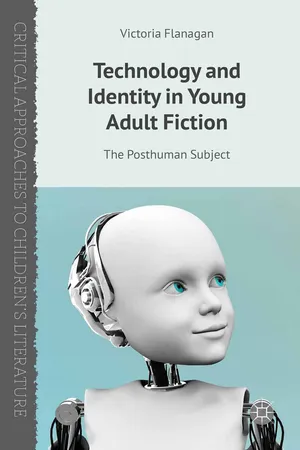
Technology and Identity in Young Adult Fiction is not a historical study or a survey of narrative plots, but takes a more conceptual approach that engages with the central ideas of posthumanism: the fragmented nature of posthuman identity, the concept of agency as distributed and collective and the role of embodiment in understandings of selfhood.
Information
Topic
LetteraturaSubtopic
Critica letteraria1
Posthumanism in Young Adult Fiction
At its most basic level, posthumanism – “after” or “beyond” humanism – is a critical discourse that seeks to reformulate and revision the humanist subject in the modern digital era. This, of course, is a major project, which perhaps explains why posthumanism has so many different (and sometimes competing) tenets. Even arriving at a definition seems to be a problematic exercise, because although theorists can agree that posthumanism goes beyond humanism, what this might actually mean or involve in precise terms is up for debate. Cary Wolfe maintains that posthumanism “generates different and even irreconcilable definitions” (2010: xi), while Timothy D. Harfield argues that “polysemy is built into the term ‘posthumanism’ itself, and in such a way as to make agreement with respect to its definition all but impossible” (2013: 266). One of the reasons for this lack of consensus and plurality of meaning lies in relation to exactly how the prefix “post” should be interpreted when applied to the concept of “humanism”. While it might be tempting to view “posthumanism” as a negation of “humanism”, this is not the case – because, as Harfield suggests, the “outright rejection of humanism might serve to perpetuate the very problems that many posthumanists seek to address” (2013: 268). Harfield’s point is an important one, and it is especially relevant to my analysis of young adult (YA) fiction here. Posthumanism should not be understood as an ideology that entails the end of the humanist subject. Instead, it should be viewed as a reconceptualisation and expansion of the human subject. It involves an ongoing critique of the human condition – and this critique uses the principles of reason (on which humanism is also based) to deconstruct the privileged status of the humanist concept of subjectivity. In this way, posthumanism offers new understandings of what it means to be human in the world today – and, within the context of literature produced for children and adolescents, this agenda aligns neatly with the ideology that underpins many recently published narratives, each of which uses technology as a motif for exploring new relationships between the mind and the body, or forms of subjective agency that are altruistic, networked and collective.
Humanism
Before progressing further, it is important to first consider what is meant by the term “humanism”. A rather obvious comment to make at this point is that “humanism”, like “posthumanism”, can be defined in different and competing ways. At its most basic level, humanism is the philosophy or ideological discourse that places the rational, autonomous and cohesive human self at its centre, rejecting the notion that identity is culturally produced and therefore conditional. “Humanism” also refers to the Renaissance intellectual movement, spearheaded by figures such as Petrarch, Machiavelli and Thomas More, which championed the study of the great classical authors. It can be defined as an ideology that rejects notions of the divine or supernatural, and instead perceives the human being as central. J.A. Symonds, author of The Renaissance in Italy: The Revival of Learning (1897), was responsible for popularising humanist concepts and ideas within Britain in the nineteenth century (at which time the term “humanism” was first coined). His books clearly articulate the spirit of humanism and emphasise the role of rationality in humanist concepts of selfhood – which appealed at this juncture in history because they coincided with the religious scepticism that characterised Enlightenment thinking. Symonds distils humanist ideology in the following way:
The essence of humanism consisted in a new and vital perception of the dignity of man as a rational being apart from theological determinations, and in the further perception that classic literature alone displayed human nature in the plenitude of intellectual and moral freedom. It was partly a reaction against ecclesiastical despotism, partly an attempt to find the point of unity for all that had been thought and done by man, within the mind restored to consciousness of its own sovereign faculty.
(Symonds, 1898: 52)
The construction of man as a rational and sovereign being, argues Tony Davies, stood in clear contrast to the transcendent authority of God and the Church. The appeal of humanism in this context lay in its metanarrative about human subjectivity, which Davies terms a “particularly powerful and complex notion of the ‘human’ – a quality at once local and universal, historical and timeless . . . [which] continues to shape not just the identity and subjectivity but the practical existence of a large proportion of the people, and the peoples, of the world” (2008: 22). Davies here articulates the essentialism that he calls a “precondition if not a definition of humanism itself” (2008: 123). The notion of an essential and universal human nature, which transcends time and culture, is an immensely appealing and comforting idea – and Davies reminds us that it is an idea that has endured for over 200 years and still retains currency today.
Pramod Nayar’s definition of “the human” as it relates to humanism emphasises rationality and self-determination, but also implies that such a construct hinges on exclusionary practices:
The human is traditionally taken to be a subject (one who is conscious of his/her self ) marked by rational thinking/intelligence, who is able to plot his/her own course of action depending on his/her needs, desires, wishes, and, as a result of his/her actions, produces history. The human has traditionally been treated as male and universal. It is always treated in the singular (the human) and as a set of features or conditions: rationality, authority, autonomy and agency.
(2014: 5)
As Nayar’s summation underlines, agency – the human subject’s right to be self-defining and autonomous – is a central principle of humanism, as is human consciousness or self-awareness. Within Western children’s literature and YA fiction, humanism is a dominant ideological force. As narratives for young readers generally pivot on the concepts of identity development and maturation, humanism has played an important role in the ideological conceptualisation of agency within these fictions. Underpinning much literature for children, especially narratives that engage with the heroic or quest paradigm, is a construction of agency based on the principles of individualism, action and autonomy. This is even more pronounced within the genre of YA fiction, where an individualistic construction of agency prevails in narratives that frequently revolve around the adolescent character’s acquisition of independence and concomitant separation from the family unit.
Posthumanism: How to define it?
How, then, can posthumanism be defined in relation to humanism, rather than situating it in opposition to humanism? And in what sense might posthumanism be applicable to critical readings of contemporary adolescent literature? I would first like to make a distinction between the terms “posthuman” and “posthumanism”, which are sometimes used interchangeably but should be taken as separate and distinct concepts – much like the terms “human” and “humanism”. “Posthuman” refers to the technologically mediated human subject, whose existence has been transformed through technoscience – either chemically, surgically or mechanically. “Posthuman” can therefore also indicate the condition of existing in a world that has been irreversibly altered by technology.
“Posthumanism”, in contrast, is the critical ideology that seeks to deprivilege the status of the humanist subject. It does so, according to Nayar, by providing “a new conceptualization of the human”, which “addresses the question of the human in the age of technological modification, hybridized life forms, new discoveries of the sociality (and ‘humanity’) of animals and a new understanding of life itself” (2014: 3). It is this idea of posthumanism offering a “new understanding of life itself” that informs my own use of the concept throughout this book, as it is what I see reflected in my primary corpus’ innovative and engaging narrative exploration of the relationship between youth subjectivity and technology. The model of posthumanism that I use here (and I would like to stress again that there are various – often competing – models of posthumanism currently in existence) is primarily influenced by the work of Nayar, Hayles and Donna Haraway. Cary Wolfe’s emphasis on the role of animals in posthuman deconstructions of the humanist subject is something that I have not taken up here – however, I am very much in agreement with him when he contends that existence in the modern digital age requires “new theoretical paradigms” in order to make sense of the ways in which being and experience have been changed by technological development:
posthumanism names a historical moment in which the decentering of the human by its imbrication in technical, medical, informatics, and economic networks is increasingly impossible to ignore, a historical development that points toward the necessity of new theoretical paradigms (but also thrusts them on us), a new mode of thought that comes after the cultural repressions and fantasies, the philosophical protocols and evasions, of humanism as a historically specific phenomenon.
(2010: xv–xvi)
The overlap between posthumanism and other ideological movements such as poststructuralism, feminism and transhumanism points to the complexity of posthumanism as a critical philosophy. This complexity is something that children’s literary criticism has, thus far, dealt with in a very limited way, which is not at all surprising given the pervasiveness of humanist ideological constructions of subjectivity in all genres of children’s literature. My intention in this book is to redress this critical gap by considering a range of issues raised by posthumanism (such as the limitations of the human subject and the interrogation of the unified self in the modern digital age, the significance of embodiment, and the effects of virtual reality, advances in biotechnology and digital surveillance on human subjectivity) and exploring how such issues are represented in literary texts produced for adolescent readers.
The key issues raised by posthumanism include: the relationship between embodiment and cognition; the independent and unified humanist subject versus the fragmented, destabilised and collective posthuman subject; and the significance of the cyborg, a figure that plays a pivotal role in posthuman ideology because of the way in which it subverts binary distinctions between human/machine and real/artificial. Over time, this critical orientation has been complicated by the concurrent development of “transhumanism”, a concept that intersects with posthumanism. Transhumanism focuses on the propensity for the human body to become radically transformed by technology (Bostrom, 2005). To the extent that this type of transformation affects our understanding of what constitutes the category of “human”, there are parallels between posthumanism and transhumanism – both focus on the impact of technology on human subjectivity and social relationships. The technological modification of the human body is a recurring motif in sci-fi narratives for adolescents (as a result of genetic engineering or cybernetic intervention), and the dialogic interplay between the transhuman and the posthuman is one that has immediate relevance to a children’s literary context. Young adult narratives that are set in technofuturistic worlds are typically concerned with exploring how technologically modified bodies might extend or challenge normative definitions of what it means to be a human being. They ask questions about the importance of human “authenticity” or originality (in the case of cloned characters), the role of memory in the production of human subjectivity (particularly since memories can be mechanically inserted or retained in genetically engineered bodies), and the relationship between embodiment and cognition. However, one of the defining characteristics of transhumanism as a critical philosophy is its ethical dimension. Transhumanism is thus an ideology that is underpinned by an ethical approach to technological human enhancement, as asserted by Nick Bostrom, whereby individuals should each have the right to choose whether or not to undergo such enhancement:
Transhumanists argue that the best way to avoid a Brave New World [a reference to Aldous Huxley’s novel] is by vigorously defending morphological and reproductive freedoms against any would-be world controllers. History has shown the dangers in letting governments curtail these freedoms . . . Because people are likely to differ profoundly in their attitudes towards human enhancement technologies, it is crucial that no one solution be imposed on everyone from above but that individuals get to consult their own consciences as to what is right for themselves and their families.
(2005: 206)
Bostrom’s comments here are useful in the sense that they clearly articulate a divide between transhumanism and the type of attitudes towards biotechnology that are evident in texts for children and adolescents. This is because the concept of free will or agency (which can be loosely defined as the ability of action to transcend its material context) is problematic when applied to children and adolescents, who are normally subject to the control of their parents or legal guardians and cannot experience or attain complete personal autonomy. This lack of agency is reflected in children’s literature, which has traditionally sought to formulate in very specific ways the types of “agency” available to child characters. In a discussion of agency in children’s literature, John Stephens writes that children’s literature “has tended to reduce the degree and define the contexts in which the agency of young people is possible” (2010: 142).
The point to make here is that YA fiction that deals with the issue of technological body modification rarely depicts such modification as voluntary for child or adolescent subjects. In the context of body modification, child/adolescent characters are routinely depicted as disempowered or subordinated subjects. Decisions regarding these modifications are made by either parents, legal guardians or the state – and the role of the young protagonist is to come to terms with their body and the scientific engineering that has affected or produced it. In some cases, these protagonists have been born as a result of genetic engineering (and therefore played no role in the decision). Good examples of this type of narrative include: Dusk (2004) by Susan Gates, which focuses on a child character named Dusk who is a genetic mutation, her DNA a fusion of human and hawk genes; and The House of the Scorpion (2002) by Nancy Farmer, about a young boy who is actually a clone of an elderly drug lord, created for the purpose of providing replacement organs. In direct contrast to Bostrom’s pronouncements about the need for transhumanists to defend “morphological and reproductive freedoms against any would-be world controllers”, these novels depict dystopian visions of genetic engineering in fictive worlds that are ruled by totalitarian governments or individuals that use technology for unethical purposes. The child characters of these novels are the products of such regimes: they are victims of circumstance, rather than empowered advocates of technological progress.
Protagonists who were not born as a result of technoscientific intervention, but have experienced body modification as a result of surgical intervention after a serious accident, are similarly uninvolved in the decision-making process. The Adoration of Jenna Fox by Mary E. Pearson (2008), Skinned by Robin Wasserman (2008) and Cinder by Marissa Meyer (2012) each depict adolescent female characters who become cyborgs when inanimate (electronic, metallic or robotic) material is fused with their organic human body. These novels emphasise that such body modification does not constitute “morphological freedom”, to use Bostrom’s terminology, as it is made clear that without such medical intervention each character would have certainly died. Body modification is thus an alternative to death (instead of an opportunity to scale new heights of human intelligence and achievement), so is not constructed as an act of free will but rather as an act of desperation from parents willing to go to any lengths to save their children. That each young woman suffers significant social marginalisation as a result of her cyborg body further problematises Bostrom’s utopian vision of ethical body transformation. For these reasons, my examination of various YA texts in this book only refers to posthumanism, as the ethical philosophy underpinning transhumanism is rarely evident in narratives produced for young readers. Posthumanism, which focuses more broadly on the end or transformation of the humanist subject as a result of modern technological developments, is much more suited to the type of ideological representation of technology and child subjectivity in this literature. This is because the emphasis on subjectivity in posthumanism, specifically in relation to the act of deprivileging the historical status of the human subject, complements YA fiction’s thematic and ideological preoccupation with subject formation. Adolescence is often constructed in terms of its “otherness” or liminality within this genre, and thus parallels the alignment of the posthuman with “otherness” as a means through which to destabilise the exclusionary construction of the humanist subject.
A second ideology that is often associated with posthumanism is anti-humanism. Anti-humanism is a discourse or set of beliefs that is critical of humanism and its construction of humanity as the centre of all existence. Proponents of anti-humanism, such as Louis Althusser, Michel Foucault and Martin Heidegger, oppose the notion of “human exceptionalism” that has dominated Western thought and modes of being since the Enlightenment. Anti-humanists such as Nietzsche, according to Elizabeth Grosz, wished to interrogate the elevated construction of “the human” and did so by championing a “life conceived without man as its culmination or centre, life that unfolds through man rather than directs itself to man” (2004: 10). This critical attitude to the hierarchised positioning of human subjects above animals and the natural environment has played a crucial role in the development of posthumanism, which, as mentioned in the Introduction, is similarly committed to deconstructing the historically privileged status of the liberal humanist subject. However, the relatively minor differences in the two movements’ nomenclature are offset by more substantial conceptual discrepancies in the methodological approach that each takes to the project of destabilising humanist ideology. Foucault provides an effective illustration of these differences through his work on the perception of human cognitive processes and behaviours. His writing famously provides an examination of the histories of disciplines in the social sciences in which the human subject was formed, focusing on how the concept of “human nature” has operated in particular cultures and time periods. His conclusion is that knowledge cannot be grounded in the human subject because knowledge, like the human subject, is socially constructed.
Posthumanism is indebted to the thinking of anti-humanists such as Foucault. However, it is epistemologically different from anti-humanism in terms of how it deploys the concept of a socially constructed human subject. Critiques of humanism, explains Nayar, such as Foucault’s brand of poststructuralist anti-humanism, are based on the notion that:
there are no essential features of the human subject because “human nature” is socially constructed and therefore knowledge cannot be grounded in the human subject and its cognitive processes because knowledge, like human nature is socially constructed. Posthumanism, especially th...
Table of contents
- Cover
- Title Page
- Copyright
- Contents
- Acknowledgements
- Introduction
- 1. Posthumanism in Young Adult Fiction
- 2. Narrating Posthuman Subjectivity
- 3. Digital Citizenship in the Posthuman Era
- 4. Reworking the Female Subject: Technology and the Body
- 5. Surveillance Societies: Privacy and Power in YA Fiction
- 6. Subjectivity in Cyberspace: Technorealism and the Merging of Virtual and Material Selves
- Conclusion
- Bibliography
- Index
Trusted by 375,005 students
Access to over 1.5 million titles for a fair monthly price.
Study more efficiently using our study tools.
Frequently asked questions
Yes, you can cancel anytime from the Subscription tab in your account settings on the Perlego website. Your subscription will stay active until the end of your current billing period. Learn how to cancel your subscription
No, books cannot be downloaded as external files, such as PDFs, for use outside of Perlego. However, you can download books within the Perlego app for offline reading on mobile or tablet. Learn how to download books offline
Perlego offers two plans: Essential and Complete
- Essential is ideal for learners and professionals who enjoy exploring a wide range of subjects. Access the Essential Library with 800,000+ trusted titles and best-sellers across business, personal growth, and the humanities. Includes unlimited reading time and Standard Read Aloud voice.
- Complete: Perfect for advanced learners and researchers needing full, unrestricted access. Unlock 1.5M+ books across hundreds of subjects, including academic and specialized titles. The Complete Plan also includes advanced features like Premium Read Aloud and Research Assistant.
We are an online textbook subscription service, where you can get access to an entire online library for less than the price of a single book per month. With over 1.5 million books across 990+ topics, we’ve got you covered! Learn about our mission
Look out for the read-aloud symbol on your next book to see if you can listen to it. The read-aloud tool reads text aloud for you, highlighting the text as it is being read. You can pause it, speed it up and slow it down. Learn more about Read Aloud
Yes! You can use the Perlego app on both iOS and Android devices to read anytime, anywhere — even offline. Perfect for commutes or when you’re on the go.
Please note we cannot support devices running on iOS 13 and Android 7 or earlier. Learn more about using the app
Please note we cannot support devices running on iOS 13 and Android 7 or earlier. Learn more about using the app
Yes, you can access Technology and Identity in Young Adult Fiction by V. Flanagan in PDF and/or ePUB format, as well as other popular books in Letteratura & Critica letteraria. We have over 1.5 million books available in our catalogue for you to explore.