- English
- ePUB (mobile friendly)
- Available on iOS & Android
eBook - ePub
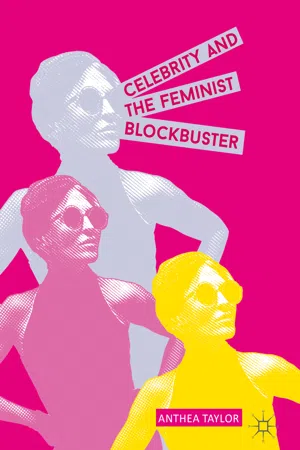
Celebrity and the Feminist Blockbuster
About this book
In the first book-length study of celebrity feminism, Anthea Taylor convincingly argues that the most visible feminists in the mediasphere have been authors of bestselling works of non-fiction: feminist 'blockbusters'. Celebrity and The Feminist Blockbuster explores how the authors of these popular feminist books have shaped the public identity of modern feminism, in some cases over many decades. Maintaining a distinction between women who are famous because of their feminism and those who later add feminism to their 'brand', Taylor contends that Western celebrity feminism, as a political mode of public subjectivity, cannot in any simple way be seen as homologous with other forms of stardom. Moving deftly from the 1960s to the present, focusing on how feminist authors have actively worked to manufacture their public personas, she demonstrates that the blockbuster remains crucial to feminist celebrification but is now often augmented with digital media. Advancing celebrity studies by placing the figure of the feminist front and centre, Celebrity and the Feminist Blockbuster is essential reading for all those interested in gender, popular feminism, and the politics of renown.
Information
Subtopic
Film & Video© The Author(s) 2016
Anthea TaylorCelebrity and the Feminist Blockbusterhttps://doi.org/10.1057/978-1-137-37334-2_11. Introduction
Anthea Taylor1
(1)
Department of Gender and Cultural Studies, University of Sydney, Sydney, Australia
An erratum to this publication is available online at https://doi.org/10.1057/978-1-137-37334-2_10
End AbstractFeminism has always had its celebrities, a situation that has historically caused much anxiety. Within the women’s liberation movement, the making, and marketing, of ‘media stars’ was, as Martha Shelley’s comments suggest, believed to be thoroughly inconsistent with the goals and anti-hierarchical principles of second wave feminism: ‘These media stars, carefully coiffed and lathered with foundation makeup, claim to represent all women. In actuality, they are ripping all women off … If large numbers of women are going to passively depend on a few stars to liberate them, instead of getting themselves together to do it, the movement will surely fail’ (cited in Gever 2003, p. 84). Such women, in their commodification of feminism, were routinely dismissed as ‘selling out’ the movement, selfishly privileging the individual over the collective, and, as Shelley argued, potentially jeopardizing the success of the women’s movement itself. During feminism’s second wave, such charges were most commonly levelled against the author of bestselling feminist non-fiction, who was implicated in mainstream commercial publishing ventures (as opposed to ostensibly more politically sound feminist presses). 1
In 1971, Germaine Greer, long known for her own work in artfully cultivating a star feminist persona, made clear the role of the ‘feminist blockbuster’ in the celebrification of certain women over others:
One of the biggest problems with Greer’s statement above, apart from its positioning of readers as ‘lemmings’, is its characterization of fame as something done to reluctant, passive feminist authors. Greer, however, is not alone in making this somewhat disingenuous assumption, which is predicated on the disavowal of feminist agency in the celebrification process, and which underestimates the power of bestselling feminist works of non-fiction, such as her own, in reaching large audiences of women who may not have otherwise engaged with feminism. ‘Blockbuster’ feminist authors like Greer, and Helen Gurley Brown and Betty Friedan before her, and Naomi Wolf, Roxane Gay, Sheryl Sandberg, Amy Poehler, and Lena Dunham after her, are all women who have actively worked to shape our understandings of Western feminism, in some cases over many decades. With the assistance of various cultural intermediaries, they have all laboured to establish and maintain a public feminist persona, as well as putting their celebrity capital to what could be broadly considered ‘feminist’ uses.Now that Women’s Liberation has become a subject upon which each publishing house must bring forth its book … the struggle for the liberation of women is being mistaken for yet another battle of the books. Each publishing house backs its own expertise to identify the eventual bible of the women’s movement, characterizing it as a religious cult in which one publisher will corner the credibility market, sending the world’s women rushing like lemmings after a book. The hapless authoresses of the books in question find themselves projected into the roles of cult leaders, gurus of helpless mewing multitudes … (in Murray 2004, p. 179, my emphasis)
As the public embodiment of feminism, such women have come to mediate what this complex social movement means in the popular imaginary. Celebrity feminism, as I have previously argued, is itself an internally variegated phenomenon but it appears that, historically, the most visible form of celebrity feminist has been the popular non-fiction author (Tuchman 1978; Taylor 2008, 2010). For Shane Rowlands and Margaret Henderson (1996), a ‘feminist blockbuster’ is a bestselling, skilfully marketed, often contentious popular feminist book, with a heavily celebrified author; and to this I would add that the blockbuster is a text that endures. While readership figures, through bestseller lists such as those offered by the New York Times, on which all these books have appeared, are a useful gauge of cultural impact, it is also significant that such publications receive extensive media coverage and engagement, thereby reaching a much broader audience than their actual readers. But in addition to their success as commodities and wider cultural visibility, Sandra Lilburn et al. have suggested ‘what all these books [feminist blockbusters] have in common is an author who functions as a public persona, a celebrity—who has the capacity to create a space for public debate on feminism’ (2000, p. 343). The authors analyzed here certainly have created, and worked to sustain, such a discursive space. Rather than being ‘well known for their well-knownness’ (Boorstin 1971, p. 97), in Chris Rojek’s (2001) typology they can be classified ‘achieved celebrities’, in that their renown is, at least initially, predicated on one specific achievement: the publication of a bestselling feminist work of non-fiction.
As myriad feminist scholars have made clear, the field of representation matters politically, in terms of shaping our understandings of gender as well as feminism itself (Dow 1996; Gill 2007; Griffin 2015). Popular cultural texts, in which I include the blockbuster and media representations of its authors, work to inform whether, how, and to what extent women come to engage with feminism, making sustained analysis of them and the political and cultural work they do vital. While many women celebrities over the past few years, including Emma Watson and Beyoncé, have eagerly claimed an identification with feminism, my definition of celebrity feminism does not encompass such figures. For me, as I will further outline in Chap. 2, a celebrity feminist is someone whose fame is the product of their public feminist enunciative practices; that is, they are famous because of their feminism. In this definition, the feminist blockbuster author reigns supreme, even in the twenty-first century.
Asserting that celebrity has always been a significant resource for feminism, here I have two key goals: to understand how these books and their authors shape the kinds of feminism that come to circulate in the mediasphere, and how their celebrity feminism works, and develops, as a ‘performative practice’ (Marwick and boyd 2011) across various sites and platforms, in ways that are not in any simple sense homologous with other forms of fame. As I argue throughout, the function of these women in actively keeping feminism alive in the mainstream cultural imaginary cannot be overstated. Through them, certain stories—including histories—come to stand for feminism. Whatever we think of this metonymic slippage, it is undoubtedly part of feminism’s conditions of possibility in mainstream media and popular culture, and has been since at least the early 1960s. Blockbusters, as commercially successful forms of feminism, are evidence of what has been called ‘the mainstreaming of feminism’ 2 but while this commodification has often been viewed as solely negative, here I seek to provide a more nuanced analysis. By challenging critical and popular narratives about celebrity feminism’s essential failings, I am interested in laying bare the possibilities, alongside the much-canvassed limitations, of making select women publicly visible as authoritative feminists.
Rather than being ‘unspeakable’ (Tasker and Negra 2007, p. 3), feminism is arguably now more visible than it ever has been, in no small part due to new media, but also because of the myriad ways in which it has been incorporated into popular culture more broadly. This has not, however, led to the demise of the feminist blockbuster as a resonant cultural form. Blockbusters, as I will demonstrate, remain part of what Claire Hemmings calls the dominant ‘feminist grammar’ in the public sphere; here I recognize that there is much at stake, not just in the kinds of ‘feminist storytelling’ they privilege but in who is able to tell these stories (2011, p. 1). 3 Although individual chapters will of course offer a brief analysis of each blockbuster and consider the regimes of value in which they became implicated, this study is not primarily focused on the formal aspects of these books, or even literary reception processes. Rather, its central preoccupation is what these blockbusters helped make possible: the celebrification of their feminist authors, and what that celebrification made possible in feminist terms. That is, how they—these books, as well as representations and self-representations of the women who penned them—have worked to shape the ‘public identity’ 4 of Western feminism, in some cases over many decades, popularizing feminism and rendering it accessible for women into whose lives it may not otherwise have flowed. Here I am interested in the kinds of feminist stories that are (able to be) told, as well as the kinds of feminist politics that are performed, promoted, and enabled by the celebrification of these authors.
In engaging with texts from the early 1960s to the present I seek to map the changing contours of the feminist blockbuster, as well as of feminist fame itself. What are we to make of the fact that, despite postfeminist proclamations of the redundancy of feminist critique (McRobbie 2009), particular iconic feminists continue to culturally reverberate and new feminist non-fictional books become bestsellers? The relatively recent development of ‘celebrity studies’ as a field of critical inquiry provides the opportunity to review the contribution of these women to public understandings of modern feminism, as well as the processes of celebrity-making itself. This book, therefore, makes an important contribution to what Sarah Projanksy has recently dubbed ‘feminist star studies’ (2014), but while her deployment of this phrase signals feminist scholarship preoccupied with stardom, my work doubles its meaning to apply it to the feminist study of distinctly feminist stars; stars that, I argue, are inextricably tied to the blockbuster form and its associated promotional apparatus.
Celebrity feminism, including in its blockbuster variant, continues to be disdainfully characterized as ‘faux feminism’ (McRobbie 2009; hooks 2013). But rather than dismissing the feminism embodied by these authors in favour of ‘some real authentic feminism which is “elsewhere”’ (Brunsdon 1997, p. 101; Wicke 1994), that exists outside popular culture, I suggest that participation in the networks of celebrity in and of itself can be conceptualized as a feminist practice, not as something distinct from or extraneous to other forms of feminist activism. However, as Su Holmes and Diane Negra tell us, the ‘forms and functions of female celebrity’ (2011; see also Jermyn and Holmes 2015) have been markedly under-examined within the booming critical industry that is celebrity studies. Indeed, as Brenda Weber also notes, gender is ‘infrequently considered … an important modality in the theorization of celebrity’ (2012, p. 15). In keeping with this gendered elision, feminist figures have also received short critical shrift, with this being the first book-length study on celebrity feminism. However, celebrity studies does provide valuable critical tools through which to interrogate public sub...
Table of contents
- Cover
- Front Matter
- 1. Introduction
- 2. ‘Blockbuster’ Feminism and Celebrification
- Part I. Part I
- Part II. Part II
- Erratum to: Celebrity and the Feminist Blockbuster
- Back Matter
Trusted by 375,005 students
Access to over 1.5 million titles for a fair monthly price.
Study more efficiently using our study tools.
Frequently asked questions
Yes, you can cancel anytime from the Subscription tab in your account settings on the Perlego website. Your subscription will stay active until the end of your current billing period. Learn how to cancel your subscription
No, books cannot be downloaded as external files, such as PDFs, for use outside of Perlego. However, you can download books within the Perlego app for offline reading on mobile or tablet. Learn how to download books offline
Perlego offers two plans: Essential and Complete
- Essential is ideal for learners and professionals who enjoy exploring a wide range of subjects. Access the Essential Library with 800,000+ trusted titles and best-sellers across business, personal growth, and the humanities. Includes unlimited reading time and Standard Read Aloud voice.
- Complete: Perfect for advanced learners and researchers needing full, unrestricted access. Unlock 1.5M+ books across hundreds of subjects, including academic and specialized titles. The Complete Plan also includes advanced features like Premium Read Aloud and Research Assistant.
We are an online textbook subscription service, where you can get access to an entire online library for less than the price of a single book per month. With over 1.5 million books across 990+ topics, we’ve got you covered! Learn about our mission
Look out for the read-aloud symbol on your next book to see if you can listen to it. The read-aloud tool reads text aloud for you, highlighting the text as it is being read. You can pause it, speed it up and slow it down. Learn more about Read Aloud
Yes! You can use the Perlego app on both iOS and Android devices to read anytime, anywhere — even offline. Perfect for commutes or when you’re on the go.
Please note we cannot support devices running on iOS 13 and Android 7 or earlier. Learn more about using the app
Please note we cannot support devices running on iOS 13 and Android 7 or earlier. Learn more about using the app
Yes, you can access Celebrity and the Feminist Blockbuster by Anthea Taylor in PDF and/or ePUB format, as well as other popular books in Media & Performing Arts & Film & Video. We have over 1.5 million books available in our catalogue for you to explore.