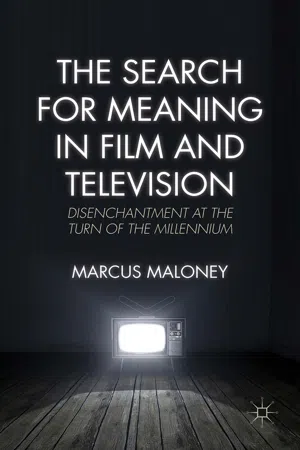
eBook - ePub
The Search for Meaning in Film and Television
Disenchantment at the Turn of the Millennium
- English
- ePUB (mobile friendly)
- Available on iOS & Android
eBook - ePub
The Search for Meaning in Film and Television
Disenchantment at the Turn of the Millennium
About this book
This book is concerned with the difficulties faced by modern Westerners in their search for a meaningful life. It sheds light on this enduring cultural dilemma through a close reading of four popular film and television narratives.
Information
Topic
Sciences socialesSubtopic
Art général1
Introduction
Whither are we moving?
Friedrich Nietzsche, The Gay Science
The capacity of people to make coherent sense of their lives amidst the ‘stormy seas’1 of the modern era remains a central focus in social and cultural inquiry. Essentially, it is a problem of meaning: an ongoing concern about the extent to which modern Western culture, in its seemingly ever-increasing fragmentation and plurality, provides a clear framework for living. This book will shed light on this enduring cultural dilemma through a close reading of four popular film and television narratives: Pixar’s animated feature film Toy Story (1995); Christopher Nolan’s Batman Begins (2005) and The Dark Knight (2008); the television romantic comedy Sex and the City (1998–2004); and, finally, the mobster drama The Sopranos (1999–2007). Each of these popular cultural texts is exemplary in its own way, and each one has much to say about the dilemma in focus here.
The cultural readings that form the basis of the chapters to follow are guided by a number of central and inter-related questions. First, in what ways do these popular stories speak to the modern West’s meaning dilemma? What do they have to say about contemporary culture and its capacity to illuminate fundamental questions of human existence? What are the core problems faced by the central characters and how are they resolved? Finally, and perhaps most importantly, do the four popular stories suggest hope or despair in the modern West’s search for meaning? Is there at least some indication of an anchoring metaphysical coherence or are we, as German philosopher Friedrich Nietzsche feared, ‘straying, as through an infinite nothing?’2
Meaning and the modern West
For all its material achievements, the modern West has long been accused of a deeper impoverishment. In this judgement, ordinary lives have become meaningless processions of working days, punctuated by transient moments of pleasure gleaned from empty acts of consumption. At the end of this absurd cycle is death, and then nothing. Like all caricatures, this pessimistic view of life in the modern West contains as much distortion as it does underlying truth. On the one hand, to suggest that modern life is meaningless is to engage in a patent falsehood denying the lived experiences of most people: human relationships are formed and nurtured; dreams and aspirations are followed and sometimes achieved; even work, as ostensibly banal as it may seem to some, remains a deeply meaningful activity for many. Whether through family and friends or work, an overseas trip or simply a well-prepared meal, human beings continue to find meaning in the modern West. And yet, at the margins of all modern experience lies an unshakeable sense that something is missing—an intimation of meaninglessness.
This modern problem of meaning, contested in the sphere of culture, is the central concern of this book. Before proceeding, however, it is necessary to sketch out working definitions of this inquiry’s two most fundamental concepts: meaning and culture. Human beings are driven by needs reducible into two categories: material and metaphysical; needs of the body and needs of the mind and/or soul. In its capacity to meet the basic requirements for physiological survival, the socioeconomic order established by the modern West has proven successful. However, beyond such requirements lies the no less vital human need to make sense of ourselves and each other, and of the universe in which we all reside. In other words, when not seeking material comfort and security, human beings seek meaning: some metaphysical clarity of purpose and significance; an overarching narrative with which to justify our actions. Here, the modern West stands on shakier ground.
So much of what we do as human beings represents either an effort to find meaning or a subsequent expression of what has been found. From this ongoing process, we derive an intricate tapestry of mutual understandings3 with which we produce and reproduce our societies. Culture is the term which signifies this uniquely human endeavour—to quote John Carroll, ‘that is what culture is, and does’.4 In cultural terms, the modern West is an outlier: having gradually abandoned the religious understandings which traditionally govern culture, the modern West has instead come to place its faith in the secular and rational. It is yet to find its bearings in the wake of this transformation. Indeed, where once stood a clearly articulated Christian narrative, now stands only the human being, and his or her restless ability to think. The modern West’s material achievements have their origins here, as do the deeper uncertainties with which it continues to wrestle.
This intellectual ground has been well trodden, and it is important now to offer a more direct engagement with those to whom this book is indebted. First and foremost, there is Nietzsche. Nietzsche’s most famous expression of the meaning dilemma resides in The Gay Science, a work comprised almost entirely of brief parables and aphorisms. The Gay Science reaches a crescendo of sorts in the parable of the madman in which, through his deranged mouthpiece, Nietzsche declares the death of God at the hands of the modern West:
God is dead. God remains dead. And we have killed him. How shall we comfort ourselves, the murderers of all murderers? What was holiest and mightiest of all that the world has yet owned has bled to death under our knives: who will wipe this blood off us? What water is there for us to clean ourselves? What festivals of atonement, what sacred games shall we have to invent? Is not the greatness of this deed too great for us? Must we ourselves not become gods simply to appear worthy of it?5
For Nietzsche, the murdering of God is the modern West’s definitive act and the source of its unshakeable emptiness. Moreover, to suggest—as reason would compel—that Nietzsche speaks purely in metaphor here is to essentially expose one’s own metaphysical blood stains. Put simply, Nietzsche means precisely what he says: ‘God is dead’ and ‘we have killed him’. Of both the event itself and its implications, much is conveyed through this brief parable. Most important to this book is the madman’s assertion of what is lost to the world in the demise of its maker: the orienting principle of human affairs; the meaning of everything. Conveyed through a series of rhetorical questions, the madman’s description of these implications gains anxious momentum with each sentence:
How could we drink up the sea? Who gave us the sponge to wipe away the entire horizon? What were we doing when we unchained this earth from its sun? Whither is it moving now? Whither are we moving? Away from all suns? Are we not plunging continually? Backward, sideward, forward, in all directions? Is there still any up or down? Are we not straying, as through an infinite nothing? Do we not feel the breath of empty space? Has it not become colder? Is not night continually closing in on us?6
The parable begins with the madman walking into the marketplace: a microcosm of the modern West’s capitalist edifice and the material expression of its secular rational foundations. The tragic absurdity of Nietzsche’s madman is swiftly established: he lights a lantern ‘in the bright morning hours’ and vainly cries, ‘I seek God! I seek God!’ An anonymous throng of onlookers respond with laughter: ‘Did he lose his way like a child?’ The absurd figure finds his frantic declarations of loss and emptiness ultimately met by bewilderment: ‘the madman fell silent and looked again at his listeners; and they, too, were silent and stared at him in astonishment’. Resigning himself to the deafness of his audience, the madman throws his lantern to the ground, smashing it ‘into pieces’. The full implications of God’s death are yet to reveal themselves in these bright morning hours: ‘This tremendous event is still on its way, still wandering; it has not yet reached the ears of men … This deed is still more distant from them than the most distant of stars—and yet they have done it themselves.’ The parable ends with the madman entering a church: ‘What after all are these churches now if they are not the tombs and sepulchres of God?’7
Nietzsche’s parable sets the scene here: the problem on which this book is focused begins with the death of God. However, to gain the fullest understanding of the modern critique elegantly contained within the parable of the madman, one must turn to Nietzsche’s first work, The Birth of Tragedy. Ostensibly a study of Athenian tragedy and its significance in Ancient Greek culture, The Birth of Tragedy teases out a theory of what constitutes and nourishes culture per se. The object in question is myth which, for Nietzsche, provides solace from the ‘horror and absurdity’8 of life as it inevitably comes to be understood in prosaic, rational terms. Reason alone leads to nihilism, the belief that everything is meaningless. Nietzsche’s formulation of myth apropos Ancient Greek culture is complex and, moreover, fraught with apparent contradictions. His essential argument about myth itself, however, is simple: a culture’s mythic stories, told and retold through art, serve as the nucleus around which its binding morals and values are formed and transmitted. More fundamentally, myth provides a redemptive ‘veil of illusion’ against the paralysing ‘insight into the terrible truth’ of material existence.9
It must be noted that Nietzsche favoured nihilism over Christianity and would devote much of his subsequent work seeking to elevate the former’s potential as an existential stepping stone whilst dismantling what he saw as the latter’s life-negating compassion.10 This is beside the point of things here, an important story for another occasion. What is crucial is the Nietzschean division outlined in The Birth of Tragedy between mythic and rational cultures: between cultures which bestow redemptive meaning on humanity’s inevitable suffering and those which would seek to eliminate such suffering through rational thought. As foundations for culture, the two are incompatible. Under the harsh light of reason, the mythic frameworks collapse.
What, then, constitutes, if not sustains, modern Western culture? When mythic understandings are shattered by reason, what, in reason, replaces them? First of all, for Nietzsche, ‘theoretical man’,11 of whom Socrates is progenitor, replaces God at the centre—hypothetically inviolable and ultimately alone. The culture of theoretical man is moved by his restless delusion of human perfectibility through correct thinking; it bears the seeds of its own demise:
We should not be afraid when the fruits of that optimism ripen; when society, leavened from top to bottom by such a culture, slowly begins to quake with extravagant surges and yearnings; when belief in the earthly happiness of all men, belief in the possibility of such a universal culture of knowledge, is slowly transformed into the menacing demand for such an Alexandrian earthly happiness …12
Here, Nietzsche points to a culture fated to collapse under the weight of its own utopian aspirations. The rational desire to eliminate suffering turns in on itself, becoming an albatross. Crucially, the first signs of fracture are present in the bright morning hours: ‘the blight that lies dormant in the womb of theoretical man is gradually beginning to frighten modern man’.13 Reason alone is no basis for existence, a burgeoning truth confirmed by the tragic restlessness of Goethe’s Faust: ‘We need only compare him with Socrates to see that modern man has begun to sense the limitations of the Socratic delight in knowledge, and yearns for a shore from the wide and barren sea of knowledge.’14 We come full circle to the madman.
At the end of this corrupt modern project resides Nietzsche’s ‘last man’. The last man emerges at the beginning of Thus Spoke Zarathustra: a work centring on the eponymous Persian prophet whom Nietzsche re-envisions as the herald of a new anti-Christian and anti-modern epoch—himself, essentially. Following years of solitude in the mountains, Zarathustra returns to society to declare the coming of the Ubermensch, an ‘overman’ representing the next stage in human evolution. For the overman, binding morals and values are redundant: ‘Behold, I teach you the overman: he is the lightning, he is the frenzy.’15 Much like the madman, Zarathustra’s grand prophecy is ultimately met with ridicule from his audience. Unperturbed, the prophet cautions them against the destination towards which their conceited society is headed: ‘Let me address their pride. Let me speak to them of what is most contemptible: but that is the last man.’16
Standing on the ossified ground of reason, the last man has lost all connection to metaphysical understandings: ‘ “What is love? What is creation? What is longing? What is a star?” thus asks the last man, and he blinks.’ Comfort is the sole value to which this last man aspires, with solidarity reduced to its mere function: ‘ “We have invented happiness,” say the last men, and they blink … One still loves one’s neighbour and rubs against him, for one needs warmth.’ Work is recast as but one apathetic means of passing time: ‘ “One still works, for work is a form of entertainment. But one is careful lest the entertainment be too harrowing.” ’ The democratic spirit dissolves into self-regulating conformity: ‘ “No shepherd and one herd! Everybody wants the same, everybody is the same: whoever feels different goes voluntarily into a madhouse.” ’ Even pleasure is sought only in so far is it remains undisruptive to the last man’s vapid existence: ‘ “One has one’s little pleasure for the day and one’s little pleasure for the night: but one has regard for health.” ’ Finally, the last man surveys all prior epochs with a delusional, and deeply fragile, sense of self-importance: ‘ “Formerly, all the world was mad,” say the most refined, and they blink.’17
Essentially, Nietzsche offers the first full portrait of the modern West as a culture and era marked by loss and uncertainty, and, in its valorising of human reason, vanity on the scale of delusion. However, with his fondness for parables, metaphor and spiteful sentiments, Nietzsche remains a difficult figure in philosophy and social thought—too malicious for some, too opaque for others. The necessary task of sober rearticulation would fall to another German thinker: one of the founding fathers of sociology, Max Weber. Like Nietzsche, Weber sees the modern West’s core problem as metaphysical: a problem of meaning stemming from the rise of secular rationalism—or rationalisation, to use his now canonical sociological term.
Weber’s first allusion to this problem can be found on the final pages of his seminal work of sociology, The Protestant Ethic and the Spirit of Capitalism. The lion’s share of The Protestant Ethic is devoted to Weber’s explication of the religious foundations of modern capitalism: a forcefully implied rebuttal to Karl Marx’s fundamental belief in the economic determination of all things social. The distinction here between Marx and Weber is in no way an aside: following both Nietzsche and Weber, an indispensable precept of this book is that the structures and organisation of any given society can be seen as material expressions of its wellspring of shared meanings—that is, expressions of its culture. There remains no more convincing substantiation of this view than The Protestant Ethic in which Weber carefully delineates a causal relationship in the West between Protest...
Table of contents
- Cover
- Title Page
- Copyright
- Contents
- Acknowledgements
- 1. Introduction
- 2. Just a Toy
- 3. Batman and Society
- 4. Self, Sex and the City
- 5. Tony Soprano and the Big Nothing
- 6. Conclusion
- Notes
- Bibliography
- Index
Trusted by 375,005 students
Access to over 1.5 million titles for a fair monthly price.
Study more efficiently using our study tools.
Frequently asked questions
Yes, you can cancel anytime from the Subscription tab in your account settings on the Perlego website. Your subscription will stay active until the end of your current billing period. Learn how to cancel your subscription
No, books cannot be downloaded as external files, such as PDFs, for use outside of Perlego. However, you can download books within the Perlego app for offline reading on mobile or tablet. Learn how to download books offline
Perlego offers two plans: Essential and Complete
- Essential is ideal for learners and professionals who enjoy exploring a wide range of subjects. Access the Essential Library with 800,000+ trusted titles and best-sellers across business, personal growth, and the humanities. Includes unlimited reading time and Standard Read Aloud voice.
- Complete: Perfect for advanced learners and researchers needing full, unrestricted access. Unlock 1.5M+ books across hundreds of subjects, including academic and specialized titles. The Complete Plan also includes advanced features like Premium Read Aloud and Research Assistant.
We are an online textbook subscription service, where you can get access to an entire online library for less than the price of a single book per month. With over 1.5 million books across 990+ topics, we’ve got you covered! Learn about our mission
Look out for the read-aloud symbol on your next book to see if you can listen to it. The read-aloud tool reads text aloud for you, highlighting the text as it is being read. You can pause it, speed it up and slow it down. Learn more about Read Aloud
Yes! You can use the Perlego app on both iOS and Android devices to read anytime, anywhere — even offline. Perfect for commutes or when you’re on the go.
Please note we cannot support devices running on iOS 13 and Android 7 or earlier. Learn more about using the app
Please note we cannot support devices running on iOS 13 and Android 7 or earlier. Learn more about using the app
Yes, you can access The Search for Meaning in Film and Television by M. Maloney in PDF and/or ePUB format, as well as other popular books in Sciences sociales & Art général. We have over 1.5 million books available in our catalogue for you to explore.