eBook - ePub
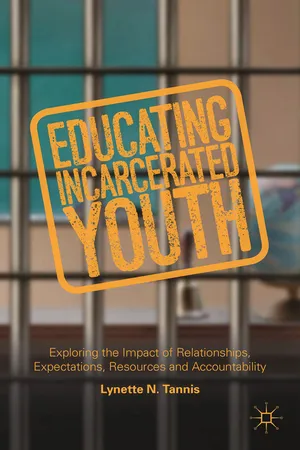
Educating Incarcerated Youth
Exploring the Impact of Relationships, Expectations, Resources and Accountability
- English
- ePUB (mobile friendly)
- Available on iOS & Android
eBook - ePub
Educating Incarcerated Youth
Exploring the Impact of Relationships, Expectations, Resources and Accountability
About this book
This book explores the perceptions and role of juvenile justice educators. Through researching the support structures of educational facilities and analysing the positive features of these learning environments, Tannis evaluates how best to educate incarcerated young people and prepare them for their transition back into society.
Information
1
Introduction
On February 6, 2012, during an Askwith Forum at the Harvard Graduate School of Education, I had the opportunity to ask U.S. Secretary of Education Arne Duncan:
How much are we engaging our juvenile justice educators in . . . conversations to ensure that our children who are incarcerated . . . disproportionately children of color, disproportionately children of poverty and children with special needs, to ensure that while they are incarcerated the opportunity gap does not continue to persist?
Secretary Duncan responded,
It’s a great question. . . . I tell you some of the most inspiring educators are folks who have dedicated their lives to working with those young people, and there are huge challenges, technology challenges . . . transition challenges . . . so it’s very difficult. But, you have some amazing educators who are in those tough situations every single day working very, very hard and making a real difference; but we have to continue to listen to them. We have to continue to learn, share what’s working. But, I have to tell you a huge part of my focus is preventing more young people from getting locked up. I think it’s so tough on the back end. . . . I think the voice of those educators is critical. . . .
This book provides the voices of 15 juvenile justice educators in four facilities in Florida. I hope this book will help assuage the current paucity of research conducted on juvenile justice education.
Many believe all children are entitled to a high-quality education, yet this sentiment becomes less pervasive when the children are our nation’s incarcerated youth. The varied risk factors of incarcerated youth “make them arguably the most challenging population of school age students that are served in the public sector,”1 with many being at least two academic years behind their peers.2 Despite this, little research encompasses the demands that this unique context places on juvenile justice teachers and administrators.
Although juvenile justice courts were established in the United States more than 100 years ago,3 there is very little research on education programs in juvenile justice facilities. For example, there are no studies examining the math instruction and only four studies examining the reading instruction provided for incarcerated youth,4 despite our nation’s mandates for proficiency in mathematics and language arts as required by the No Child Left Behind Act of 2001. Many states have adopted the Common Core State Standards as a way to introduce common rigorous academic standards throughout our nation, but to what extent are we ensuring all our nation’s children are being exposed to these rigorous standards and challenged and supported to meet or exceed these standards? Among other assessments, nationally we have the NAEP (National Assessment of Educational Progress). Districts are selected, and students in grades 4, 8, and 12 take this rigorous assessment. Reading and mathematics are administered every two years. Upon analyzing the data, the overall results for our nation’s students are bleak. We want rigor. We want to continually increase our competitiveness, but this won’t happen until “all really means all”—until we challenge and support all children, especially our most disenfranchised youth, to achieve high academic standards.
My extensive literature review uncovered only two studies5 and one memoir6 aimed at better understanding the challenges faced and the educational practices utilized by juvenile justice educators. And, surprisingly, most of the national studies that have been done specifically focused on juvenile justice education are more than 10 years old.
Critics of the current system of education implore researchers to evaluate the educational programs provided for incarcerated youth. Foley contends that “the educational needs of these youth and the efficacy of correctional education programs must be examined by researchers,correctional administrators, and educators.”7 Despite what we know about youth who are incarcerated and the few studies conducted citing educational best practices, much less is known about the juvenile justice educators who are responsible for providing these youth with a quality education. Six years ago, Florida’s Juvenile Justice Educational Enhancement Program urged researchers to “focus on this distinct population, their problems, and needs to inform policy.”8
Despite the unique conditions of incarceration, the documented disadvantages of these youth, the importance of this rehabilitative opportunity for juveniles, and the costs to society that incarceration and recidivism incur, we currently have negligible scholarly research that takes advantage of the insights of juvenile justice educators whose careers are focused on their success.
Houchins et al.9 conducted a study to better understand the facilitators and the barriers juvenile justice teachers in Louisiana face when working to provide incarcerated youth with a quality education. Seventy-eight teachers from three facilities completed a multiple-choice and open-ended response survey. The study revealed that personnel issues included poor staff morale, needs for professional development and increased classroom space, and racism. The study also found academic issues, including the need for more vocational programs (career and technical education), reductions in class sizes, and academic materials and Internet access in the classrooms.
Foley and Gao10 surveyed 41 correctional educators in the Midwest who were responsible for providing educational services to incarcerated youth housed in juvenile justice facilities. These researchers sought to understand the teachers’ educational practices for incarcerated students with and without special needs by using a four-part survey to collect data focusing on assessment practices, instructional programs, special education, and demographic data. They found that 90% of the facilities provided GED courses, 72.5% provided vocational education, and 70% had literacy programs. One-on-one instruction was provided almost 50% of the time, and the most frequent instructional materials used were textbooks, workbooks, and worksheets.
Wilder11 provided her experiences as a teacher in a juvenile facility, located in a southeastern state, housing the largest concentration of male juvenile sex offenders in the state. She found that reading is not encouraged, supplies are limited, worksheets provide the main mode of instruction, and the televisions inside most of the classrooms are used to pacify the students. According to Wilder, “In this system, it does not seem to matter if the students are learning anything or even if they are attempting to learn.”12 She created hands-on experiences for her students and incentivized them with candy and food.
After reviewing the vital statistics of incarcerated youth on the national level and within Florida, I decided to focus more closely on four juvenile justice residential facilities within Florida. My study aimed at learning whether and how principals and teachers who are responsible for educating incarcerated youth housed in residential facilities perceive themselves as providers of high-quality education to incarcerated youth.
To gain a deeper understanding of these educators’ perceptions of the educational services they provide, I interviewed the school district’s principals, who oversee the educational programs at each facility, and a reading, math, and special education teacher13 or vocational teacher within each of the four facilities. I collected documentation/artifacts that included the interviewed teachers’ lesson plans, staff handbooks, professional development opportunities, student learning inventories, teachers’ and students’ schedules, and the staff meeting agendas from all four facilities and visited and observed classroom instruction and meetings at three of them.
Owing to the dearth of up-to-date research on juvenile justice educators, I conducted a qualitative study. According to Maxwell, “The strengths of qualitative research derive primarily from its inductive approach, its focus on specific situations or people, and its emphasis on words rather than numbers.”14 This qualitative study uses an inductive approach to effectively capture, analyze, and present my time spent interviewing and observing 15 juvenile justice educators in Florida.
To describe and organize the interviews, observations, and documentation/artifacts, I sought to use a conceptual framework, but my extensive search did not uncover an existing framework through which this research could best be analyzed. For this reason, my qualitative study required a grounded approach. I therefore used thematic analysis as a tool to interpret these phenomena15 and organized this study using a multiple-case method.16
The Selection Process
I selected Florida because of the large number of youth housed in its residential facilities, its explicit expectations for providing a high-quality education for its incarcerated youth, and the accountability system provided through the JJEEP Quality Assurance process. In addition to using the FLDOE/JJEEP Quality Assurance process, which began in 1998, Florida sought to better meet the educational needs of their incarcerated youth by enacting Florida Statute 1003.52 (1a) in 2002:
The Legislature finds that education is the single most important factor in the rehabilitation of adjudicated delinquent youth in the custody of Department of Juvenile Justice programs. It is the goal of the Legislature that youth in the juvenile justice system continue to be allowed the opportunity to obtain a high-quality education.
Florida’s incarcerated youth, therefore, are required and expected to receive a comparable education to their non-incarcerated peers.17
Table 1 Demographic data for four Florida juvenile justice residential facilities

After reviewing Florida’s Juvenile Justice Educational Enhancement Program’s (JJEEP) 2008–2009 Quality Assurance ratings for the educational programs housed in Florida’s residential facilities, I found that 15% of the facilities were rated superior, 47% high satisfactory, 24% satisfactory, 12% marginal satisfactory, and 2% below satisfactory.18
Initially, I selected one facility in each of the three identified categories—superior, satisfactory, and marginal satisfactory—having the highest scores within their ranges and similar student demographic data. I sought to examine the factors that existed within facilities with similar student populations to further analyze the divergent ratings for the educational services provided. However, when I began seeking research approvals, the chief executive officer (CEO) of the superior-rated facility would not allow me to observe the classrooms within his facility. The school district approved my resea...
Table of contents
- Cover
- Title
- Copyright
- Contents
- List of Tables and Figure
- Preface
- Acknowledgments
- 1 Introduction
- 2 Contextual Setting
- 3 Greta Olive Juvenile Justice Academy1
- 4 Hubert B. Juvenile Justice Residential Facility1
- 5 Gladys C. Juvenile Justice Academy1
- 6 Philip I. Juvenile Justice Residential Center1
- 7 Cross-Facility Discussion
- 8 Implications and Conclusion
- Notes
- Bibliography
- Index
Trusted by 375,005 students
Access to over 1.5 million titles for a fair monthly price.
Study more efficiently using our study tools.
Frequently asked questions
Yes, you can cancel anytime from the Subscription tab in your account settings on the Perlego website. Your subscription will stay active until the end of your current billing period. Learn how to cancel your subscription
No, books cannot be downloaded as external files, such as PDFs, for use outside of Perlego. However, you can download books within the Perlego app for offline reading on mobile or tablet. Learn how to download books offline
Perlego offers two plans: Essential and Complete
- Essential is ideal for learners and professionals who enjoy exploring a wide range of subjects. Access the Essential Library with 800,000+ trusted titles and best-sellers across business, personal growth, and the humanities. Includes unlimited reading time and Standard Read Aloud voice.
- Complete: Perfect for advanced learners and researchers needing full, unrestricted access. Unlock 1.5M+ books across hundreds of subjects, including academic and specialized titles. The Complete Plan also includes advanced features like Premium Read Aloud and Research Assistant.
We are an online textbook subscription service, where you can get access to an entire online library for less than the price of a single book per month. With over 1.5 million books across 990+ topics, we’ve got you covered! Learn about our mission
Look out for the read-aloud symbol on your next book to see if you can listen to it. The read-aloud tool reads text aloud for you, highlighting the text as it is being read. You can pause it, speed it up and slow it down. Learn more about Read Aloud
Yes! You can use the Perlego app on both iOS and Android devices to read anytime, anywhere — even offline. Perfect for commutes or when you’re on the go.
Please note we cannot support devices running on iOS 13 and Android 7 or earlier. Learn more about using the app
Please note we cannot support devices running on iOS 13 and Android 7 or earlier. Learn more about using the app
Yes, you can access Educating Incarcerated Youth by Lynette Tannis in PDF and/or ePUB format, as well as other popular books in Social Sciences & Comparative Education. We have over 1.5 million books available in our catalogue for you to explore.