This book illustrates a pathway for knowledge production to benefit from interweaving the seemingly disparate historical experiences of Indigenous Peoples and computer science education. The resulting practice of ancestral computing for sustainability holds the power to mitigate the destructive forces of the field, while extending the potential of traditionally underserved and unheard populations. Reimagining the field of computer science, interwoven with traditional lifeways, presents compelling new discoveries in research and harnesses the rich tapestries that are Indigenous populations. Returning healthy lifeways to a center stage long-occupied by tightly controlled, Eurocentric learning methods opens worlds of opportunity that have felt lost to time.
eBook - ePub
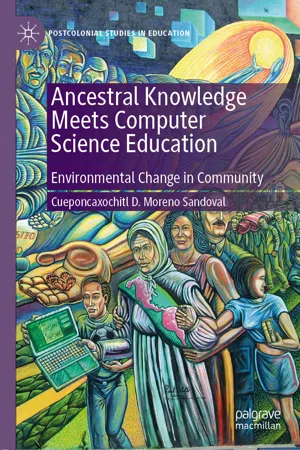
Ancestral Knowledge Meets Computer Science Education
Environmental Change in Community
- English
- ePUB (mobile friendly)
- Available on iOS & Android
eBook - ePub
Ancestral Knowledge Meets Computer Science Education
Environmental Change in Community
About this book
Information
Topic
EducationSubtopic
Comparative Education© The Author(s) 2019
Cueponcaxochitl D. Moreno SandovalAncestral Knowledge Meets Computer Science EducationPostcolonial Studies in Educationhttps://doi.org/10.1057/978-1-137-47520-6_11. Uprooting Systems of Colonization: Naming Learning Ecologies as Eurocentric
Cueponcaxochitl D. Moreno Sandoval1
(1)
Native American and Mexican Indigenous Studies, Ethnic Studies Program, California State University, Stanislaus, Turlock, CA, USA
Each chapter in this book details specific aspects of my career-long research, and explores concepts and intersections of interest in a way that invites dialogue, and attempts to interweave a detailed picture of where we came from and what we can grow toward.
In this work, you will be introduced to the concept of Ancestral Computing (AC), which explores socio-cultural and -historical ecosystem approaches to solving complex problems. We are working toward social transformation, especially dismantling the remainders of colonialism all around us. Inherent in this system is the coloniality of power , a term popularized by Anibal Quijano , which speaks to lasting consequences of European colonialist practices. Evidence ranges from seemingly “inherent” social orders, to restriction of access to certain forms and methods of knowledge acquisition.
Next, we integrate what el vivir comunitario, or community wellness, entails, and how this path toward healing our communities with ancestral knowledge, healed and decolonized lifeways, and repairing the warped identities we inherited from forming our identities under colonialism leads to a brighter future for all.
At the end of this chapter, you will find an explanation of the study conducted in East Los Angeles, and further explanation of this book’s structure. But first, a dedication and a setting of intent.
We 1 acknowledge the Four Directions, beginning with our bodies turned to the direction where the rising sun peeks over the horizon. Our bare feet planted in the earth. We listen to the call of the concha as its vibrations penetrate through our skin. We rattle sonajas 2 and inhale the old smell of burning copal 3 as we colorfully move in unison to the ancient beat of the drum. We acknowledge and ask permission to the old guardians of the land we stand on to begin participatory research as ceremony so that this work continues to nurture el vivir comunitario (or communal wellness 4 ) with a focus on educational excellence in AC for sustainability. We tie ourselves to this place 5 and nurture its sanctity as we continue our journey toward educational excellence, even in the face of disdain. In a time when restrictive policies manifest present-day colonialism in our public schooling systems, when these colonialist ideologies and practices attempt to dismantle our collective dignities, we brace ourselves. We feel gratitude for the work that has led us here and we spiritually and mentally prepare for the work ahead of us.
In Buen Vivir / Vivir Bien Filosofía, políticas, estrategias y experiencias regionales andinas, Fernando Huanacuni Mamani writes how a people “who march toward their liberation” with dignity and sovereignty is unstoppable. May the voice of time and Mother Earth accompany us on this journey.
La cultura cura 6 —literally meaning “the culture 7 cures” and, by extension, “the old ways of our ancestors will help us heal”—is a common invocation drawn by a narrative that, in this book, is rooted in the ancestral knowledge of the Mexicayotl , an old way of understanding and practicing ancestral knowledge systems that originated from Mexico. While some scholars have suggested that the Mexicayotl is a form of religion, I respectfully disagree. Like many other English terms in this book, fitting a religious category to describe the Mexicayotl is like fitting a square into a circle, or comparing apples and oranges; it is nearly impossible because the worldviews are incomparable. For example, one of the main areas of non-comparison is the lack of a centralized governing body in the Mexicayotl , as opposed to religious sectors that have organized governing bodies. This query sets the tone for this book as the narrative that brings together ancestral knowledge and computer science education, two seemingly disparate bodies of knowledge. Ancestral knowledge systems, for the scope of this book, are rooted in the ancestral foodways of the Mexicayotl across the ecologies of teaching and learning, a student-led organization named Movimiento Estudiantil Chican@s de Aztlan (MEChA), a computer science course, and a larger schooling community that included multiple circles of participation. Through these complex ecologies, we will follow Itzel, a high school junior at the time of the beginning of this critical narrative inquiry.
There are various layers of complexity that go along with two traditions that stem from two different language roots, worldviews, knowledge systems. Unfortunately, as religion is one of those, Religion is defined by the Oxford Dictionary (2015) as a Mesoamerican 8 (Kirchhoff, 1943) cultural practices to resist neoliberalism in schools under the coloniality of power 9 (Quijano, 2000). This book reveals living Mesoamerican AC 10 practices as an asset-based approach to teaching and learning within a student-led organization, a CS classroom and a larger schooling community of El Sereno.
At its core, this book is an historical document that speaks back to the dominant European epistemology of urban schools. I unearth the cultural practices of Mesoamerican-descent populations as academic practices while addressing the disequilibrium of social and material value placed on the historical epistemologies of Mesoamerican-descent peoples in one comprehensive public high school of El Sereno. This Narrative Inquiry follows the academic voice of a mestiza consciousness (Anzaldúa, 1987) exposing non-Eurocentric academic practices, such that a plurality of knowledge systems is reinforced. For example, I “write bilingually and…switch codes without having always to translate…using my serpent’s tongue…overcom[ing] the tradition of silence.” (Anzaldúa, 1987) Because of the non-Eurocentric academic approach, you may find that reading this research elicits an emotional response. I respectfully ask that you experience that emotion and reflect on it as part of the journey toward decolonizing 11 educational practices, ya que “pa’ todo hay remedio, menos la muerte.” 12 I have included several endnotes as a guide to the alterative model (Grosfoguel, 2008) I present in this book. The number of endnotes does not “justify” my position, rather, end-noting is used here to scaffold the learning and engagement of those who may not be familiar with a mestiza consciousness and who are open to becoming familiar with a native-to-the-Western-hemisphere epistemological approach within this schooling community.
The purpose of this participatory action research is to explore an approach and effect that exposes the socio-cultural and -historical wealth of a community of practice as it bridges a positive academic cultural identity in learning and collective agency in a student-led organization, a computer science classroom and larger schooling community at an urban high school in Los Angeles on a path toward general educational excellence and wellness. Each of these organizational structures is described through the participation of Itzel, 13 a junior at Lomas High School in 2009 who weaved these structures over three years. This path moves away from the colonizing paradigm that dominates the way we generally conceptualize such situations. In our everyday lived experience, there is an unforgiving momentum to adopt ways of being that are Eurocentric within a coloniality of power , especially in schools. This work is about unearthing the AC of a community’s cultural wealth (Yosso & Solórzano, 2006) as a dialectical theory . 14 In exposing the long legacy of the cultural assets of this community of practice, we are careful to be critical of our own predispositions, thereby avoiding falling into another yet Eurocentric perspective, which romanticizes, essentializes, and exoticizies a culture as “the other” by looking at it through a foreign gaze. Yet it is impossible to delineate what is Eurocentric and what is not as the lines are not so easily clear-cut and we do not fit a nicely organized binary of opposites. Similarly, we cannot place ourselves in solely Mesoamerican practices because it is impossible to avoid interactions with neoliberalism. Yet this book exposes a process that complicates and challenges the often-taken-for-granted monolithic approach to living, learning, and dying. We draw upon socio-historical ways of exposing the process of a culture, which is not static, monolithic, or two-dimensional. Instead, we (re)discover assets that have been passed on to us by the elders in our families and communities as principal knowledge-keepers. In addition, we walk toward learning more about our own ways, by making yearly pilgrimages to Mexico 15 to read our ancient books and plant our feet on our ancient structures with careful and critical minds, and by studying our anthropological works. Through our work to form our own cultural identities from the ground up, we seek to act critically for sustainable and equitable educational excellence as we (re)develop healthy families and a healthy community. This work zeroes in on the way in which a CS classroom with a teacher, whose background does not reflect the cultural history of his students, experiences this vision and action.
My father once told my siblings and me after the first purchase of a computer for our home, “Yo quiero que aprendan de las computadoras porque esas van a apoderarse del mundo algún día 16 .” I was a sophomore in high school. Our parents saved up years of recycling glass and plastic bottles con tanto sacrificio to purchase a computer so that my siblings and I would be well equipped to do our homework assignments that required computeriz...
Table of contents
- Cover
- Front Matter
- 1. Uprooting Systems of Colonization: Naming Learning Ecologies as Eurocentric
- 2. Internalized Colonization, Unearthed: Student Activism for Social Change
- 3. Planting Seeds of Hope: Teacher Collaboration to Support Student Inquiry
- 4. Critical Self-Consciousness for Collective Action in Social Commonplace: Building a Sustainable Environment for Planting Seeds of Hope, 2009–2010
- 5. Cultivating Computing as Activism: Historicizing Cultural Identities as Academic Practices, 2010–2011
- 6. Spreading Seeds of Hope from Student-Led Initiatives to Classroom Practices para el Vivir Comunitario, 2011–2012
- Back Matter
Trusted by 375,005 students
Access to over 1.5 million titles for a fair monthly price.
Study more efficiently using our study tools.
Frequently asked questions
Yes, you can cancel anytime from the Subscription tab in your account settings on the Perlego website. Your subscription will stay active until the end of your current billing period. Learn how to cancel your subscription
No, books cannot be downloaded as external files, such as PDFs, for use outside of Perlego. However, you can download books within the Perlego app for offline reading on mobile or tablet. Learn how to download books offline
Perlego offers two plans: Essential and Complete
- Essential is ideal for learners and professionals who enjoy exploring a wide range of subjects. Access the Essential Library with 800,000+ trusted titles and best-sellers across business, personal growth, and the humanities. Includes unlimited reading time and Standard Read Aloud voice.
- Complete: Perfect for advanced learners and researchers needing full, unrestricted access. Unlock 1.5M+ books across hundreds of subjects, including academic and specialized titles. The Complete Plan also includes advanced features like Premium Read Aloud and Research Assistant.
We are an online textbook subscription service, where you can get access to an entire online library for less than the price of a single book per month. With over 1.5 million books across 990+ topics, we’ve got you covered! Learn about our mission
Look out for the read-aloud symbol on your next book to see if you can listen to it. The read-aloud tool reads text aloud for you, highlighting the text as it is being read. You can pause it, speed it up and slow it down. Learn more about Read Aloud
Yes! You can use the Perlego app on both iOS and Android devices to read anytime, anywhere — even offline. Perfect for commutes or when you’re on the go.
Please note we cannot support devices running on iOS 13 and Android 7 or earlier. Learn more about using the app
Please note we cannot support devices running on iOS 13 and Android 7 or earlier. Learn more about using the app
Yes, you can access Ancestral Knowledge Meets Computer Science Education by Cueponcaxochitl D. Moreno Sandoval in PDF and/or ePUB format, as well as other popular books in Education & Comparative Education. We have over 1.5 million books available in our catalogue for you to explore.