eBook - ePub
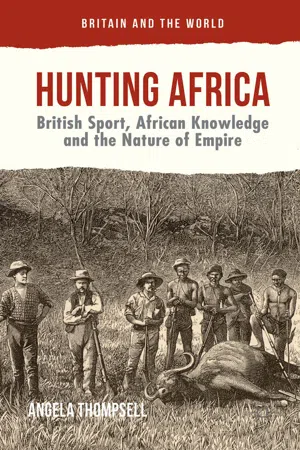
Hunting Africa
British Sport, African Knowledge and the Nature of Empire
- English
- ePUB (mobile friendly)
- Available on iOS & Android
eBook - ePub
About this book
This book recovers the multiplicity of meanings embedded in colonial hunting and the power it symbolized by examining both the incorporation and representation of British women hunters in the sport and how African people leveraged British hunters' dependence on their labor and knowledge to direct the impact and experience of hunting.
Information
1
Real Men/Savage Nature: The Rise of African Big Game Hunting, 1870–1914
The popular fascination with African game hunting can be dated to 1848, when a man named Roualeyn Gordon-Cumming returned to Britain after spending five years hunting in southern Africa. He brought home with him 30 tons of curios and animal trophies, and two years later he opened his collection to the public. For one shilling, visitors could view his ‘multitudinous victories over the native Lords of the forest and plain’. The exotic nature of the exhibit was heightened by the presence of Ruyter, a Khoikhoi man who had accompanied Gordon-Cumming to Britain and who explained ‘to the public the different objects’ on display.1 The show proved a tremendous success, receiving, among other accolades, the gracious approval of Prince Albert. In combination with Gordon-Cumming’s two-volume travelogue, which was reportedly ‘read with as much avidity as a romance by all sorts and conditions of man’,2 the display transformed the former soldier and hunter into an iconic figure. The press described him as ‘the African sportsman’ or, more colourfully, as ‘the lion hunter of Central Africa, in the prime of manhood’.3 After participating in the Great Exhibition in 1851, Gordon-Cumming toured Britain with his collection and finally settled in Scotland in 1858. There he opened a private museum and collected a ‘goodly toll’ from tourists travelling along the Caledonian Canal until his death in 1866.4
Gordon-Cumming was not the first to taste or write of the ‘splendid sport’ to be had in southern Africa, but he was the first to generate widespread interest in it.5 It was for this reason that an author writing in 1901 named him the ‘Pioneer or Father of South African Sport’, but he was also a man ahead of his time, at least in terms of marketing his sport.6 In the 1840s and ’50s, most British hunters in Africa were traders in search of ivory and skin, and their activities did little to draw the interest of the British public, which was interested far more in explorers’ expeditions or accounts of the slave trade than narratives of sport. By the 1880s, however, interest in hunting was growing rapidly, and by the early 1900s, thousands of British men and women were travelling to Africa intent on hunting the big game of eastern and central Africa. By then, the safari had been born, and to this day, it remains one of the primary tourist products of east and southern Africa.7
How can we explain this rapid rise of African big game hunting and the continued appeal of safaris? In the Victorian era, British men hunted all over the world, so why did hunting in Africa become so popular, and once it did, how did this sport come to define Western views of Africa? At a fundamental level, the 1880s marked the beginning of the rapid European colonization of Africa, which made travel in the continent more attractive to Westerners. Historians have also long argued that the particular appeal of big game hunting in these decades was connected to the sport’s capacity to symbolize Britain’s imperial and manly prowess at a time when many were expressing grave doubts about both.8 The ability of hunting to accomplish these twin tasks so well in Africa, however, was a product of the connection it forged between metropolitan Britain and the primitive world Britons imagined the ‘African Interior’ to be. As the following chapters show, the practice of hunting entailed complex encounters with the societies that inhabited these territories, but the appeal of big game shooting arose in large part from the image of untamed wilderness that it promoted. This was a dynamic era, and the colonization of Africa brought tremendous changes to the logistics, demographics and experience of hunting. Going on safari in 1910 was a radically different proposition than being an ivory hunter in the 1870s, yet the image of untamed wilderness persisted, giving coherence and romance to an institution which in practice represented many different ideas and experiences at one and the same time. Indeed, it was the variety of meanings attached to hunting that made the sport such a significant factor in how Britons imagined and interacted with Africa.
Hunting comes into its heyday
From the earliest days of European exploration, when Portuguese sailors were making their way down the West African coast, hunting furthered Western interests and interest in Africa,9 but it was not until the late nineteenth century that the continent began to be thought of as a hunter’s paradise and not until the twentieth century that hunting became one of the dominant attractions of Africa. Up until that point, hunting provided Dutch, Portuguese and, later, British settlers with vital resources and valuable trade goods, but in the latter case, it was African hunters who provided most of those commodities.10 The expansion of the colonial frontier also owed more in South Africa to the Trekboers’ desire to escape governmental controls and in Mozambique to the Portuguese colonists’ desire for land and gold than to the demands of hunting.11 European involvement with Africa began escalating in the early nineteenth century, however, and with it European participation in commercial and recreational hunting, but it was only at the end of the century that the new imperial vision of Darkest Africa, colonial expansion, popular and scientific demands for greater knowledge of Africa, and new ideas about masculinity and the sport of hunting itself combined to make African big game hunting an iconic symbol of romantic adventure, imperial dominance, British greatness and manly enterprise. These developments also radically changed the culture and experience of hunting itself.
In 1806, during the Napoleonic Wars, Britain wrested the southern Cape of Africa from the Dutch, and as John MacKenzie showed in his history of colonial game hunting, the trade in animal products began to increase at astounding rates immediately after the war. Between 1815 and 1825, ivory exports alone grew by more than 28,000 per cent, and while they declined thereafter, the continued demand for these commodities spurred British, Boer and African investment in commercial hunting.12 Most of these hunters were already resident in southern Africa. Only a few men travelled to Africa specifically to hunt, but the travelogues of those who did formed the foundation for the hunting phenomenon that developed in later decades.13 In the mid-nineteenth century, though, it was explorers and missionaries who became the undisputed icons of adventure and good works on the continent, and for the vast majority of these men, hunting was at most an ancillary activity. Several did not hunt at all, and others only hunted for subsistence purposes or hired African or European hunters who kept them and their parties supplied with meat, animal products and trade goods.14 There were, of course, those who engaged in hunting as a sport, but even then, their accounts of it typically comprised only small portions of the lengthy travelogues and memoirs they penned upon their return to Europe or, in the case of missionaries, to promote their work amongst the faithful back home.15
While hunting was not the focal point of these men’s travels or narratives, collectively they created the world that future hunters dreamed about as young boys. Africa had long been thought of as barbaric, and even as a physically unhealthy place for Europeans, but, ironically, the more Britons travelled there, the more they saw it as the ‘Dark Continent’, a land of savagery and mystery. As Patrick Brantlinger wrote, ‘Africa grew dark as Victorian explorers, missionaries, and scientists flooded it with light, because the light was refracted through an imperialist ideology that urged the abolition of “savage customs” in the name of civilization.’16 The change in how Westerners perceived Africa was compounded by a related shift in their presumed knowledge of the continent. For centuries, Europeans had collected information from Arab, African and European travellers and missionaries, but by the nineteenth century, new standards of cartography prompted geographers to dismiss much of this data as it had not been gathered by approved methods—or by approved European observers—and the details were contradictory.17 Thus, while early European maps of Africa were rich in features, though often inaccurately placed, the Victorians thought of Africa as a ‘geographical blank’ and often represented it as such on popular maps.18
Filling in those blank spaces became an international race ennobled by the goal of furthering mankind’s knowledge, and in the 1850s and 1860s, African explorers, in the words of Dane Kennedy, ‘came to embody those qualities the Victorians regarded as emblematic of all that was best about themselves as a people—manly courage, moral virtue, individual enterprise, patriotic spirit, and scientific curiosity’.19 The image Westerners had, however, of explorers striding purposely across tracts of undeveloped African wilderness was complete nonsense. Africa was already criss-crossed by numerous trade routes, and European explorers, far from trailblazing, were generally not even following these routes so much as the African guides they had hired to show them the way. Nonetheless, the narratives written by these men fired the imaginations of Europeans back at home, and in risking their health, lives and sometimes their fortunes in pursuit of lofty goals, they fostered a vision of heroic, white manliness and romantic adventures in a land increasingly perceived as the antithesis of modern, Western civilization.
By the 1870s, the excitement for exploration was waning. The major lakes and mountains had been located, and what remained was the less romantic task of gathering further information about places, things and people already generally known. Yet, the public’s interest in Africa was only continuing to grow, and by the end of the century, big game hunters had come into their ‘heyday’.20 Despite the relative lack of metropolitan interest in hunting in the early to mid-nineteenth century, the life of the African hunter had its own romantic appeal, particularly among young boys. When later hunters spoke of what had inspired them ‘to leave the ways of civilization and seek adventure in the wilds’, it was not explorers’ or missionaries’ travelogues they cited but those of early hunters.21 Certainly, part of the appeal of hunting for them was the chance ‘to explore unknown regions on the dark continent of Africa’ and thereby contribute to mankind’s store of knowledge, but these young men were intent on ‘emulating the “deeds of derring-do”’ and experiencing ‘the free-and-easy gipsy sort of life’ they had read about in the works of mid-century hunters.22 African hunting promised middle- and upper-class men the opportunity to exchange the ‘worry of braces . . . [and] the struggles with a waistcoat’ for the ‘short-sleeve life’ of the frontier, and it offered settlers’ sons an alternative to the farm or mine.23 Put simply, it represented adventure and ‘liberty’, and it is important not to overlook the intense, visceral attraction of hunters’ presumed lifestyle and the landscapes associated with it. As one military officer asked, ‘Where is the lover of sport who, having once caught a glimpse of its [Africa’s] glorious plains and wild herds . . . does not long to cast off the collar of civilization, plunge into its untrodden wilds, and live a freed man?’24
In the mid-century and even in the early 1870s, however, very few middle- and upper-class men felt they could do so. A life of hunting and wandering in southern Africa was not a promising future for a young man in Britain. Most of those who answered the call of adventure in these years were men who had ‘no rosy prospects’ elsewhere and dreamed of ‘“making good”’ in a land they saw as opening-up.25 Some of these men were ‘gentlemen by birth and education’ who lacked connections or capital, and, naturally, several sons of Cape Colony farmers also tried their fortunes as big game hunters. Many who came from Britain, however, were from the lower middle class or even the margins of society. According to one traveller, the ranks of southern African big game hunters included ‘deserters from the army & navy . . . ruined gamesters . . . ne’er do wells who do no better here than anywhere else, yet [are] always sanguine & amusing . . . and an occasional odd fish . . . known to be suspected of the worst crimes’.26 Even Frederick Courteney Selous, who would become the most well-known and respected hunter of the day, only set out for Africa in 1870 after he assaulted a gamekeeper in Germany who had caught him poaching. To avoid arrest, Selous fled the country, and it was at that critical juncture that his banker-father finally agreed to Selous’ long-held dream of hunting in southern Africa.
Selous landed in Cape Colony at an auspicious moment. The Scramble for Africa was still more than a decade away, but European interest in Africa was accelerating, particularly in southern Africa, where the discovery of diamonds to the north of Cape Colony in 1869 had altered the economic outlook of the region. These new possibilities combined with a few expansionist forays on the part of Britain drew more middle- and upper-middle-class men to the Cape, as well as to north-eastern Africa, which had become strategically more important with the opening of the Suez Canal that same year. Ideas about masculinity were also shifting back at home. Elite public schools had already been training upper-class boys to be ‘men of action’ rather than of thought, but middle-class men in the middle of the century primarily defined their manliness in terms of their authority within the home. By the 1870s, however, there was a new idealization of ‘robust hypermasculinity’ and the rough, adventurous life a man might lead on the imperial frontier.27 The Empire had become something of a crucible for masculinity in the eyes of Britons, and by the 1880s, there was no longer quite the same sense that going to Africa meant giving in to temptation. By the 1890s, proponents of the sport like Lord Randolph Churchill were proclaiming that just ‘six months of African hunting life would make a man “a 10 lb. better fellow all around”’.28 The much-romanticized life of the African hunter that had been so appealing to ...
Table of contents
- Cover
- Title
- Copyright
- Dedication
- Contents
- List of Illustrations
- Acknowledgements
- Introduction: Reconsidering Hunting as a Site of Masculine and Imperial Domination
- 1. Real Men/Savage Nature: The Rise of African Big Game Hunting, 1870–1914
- 2. ‘The Bitter Thraldom of Dependence’: Negotiating the Hunt
- 3. Guns and Reeds: Africanizing British Big Game Hunting
- 4. Lady Lion Hunters: An Imperial Femininity
- 5. ‘To Make a Fetish of Roughing It’: Reimagining Hunting in the Age of Safaris, 1900–1914
- Conclusion: Imperial Mastery
- Notes
- Bibliography
- Index
Trusted by 375,005 students
Access to over 1.5 million titles for a fair monthly price.
Study more efficiently using our study tools.
Frequently asked questions
Yes, you can cancel anytime from the Subscription tab in your account settings on the Perlego website. Your subscription will stay active until the end of your current billing period. Learn how to cancel your subscription
No, books cannot be downloaded as external files, such as PDFs, for use outside of Perlego. However, you can download books within the Perlego app for offline reading on mobile or tablet. Learn how to download books offline
Perlego offers two plans: Essential and Complete
- Essential is ideal for learners and professionals who enjoy exploring a wide range of subjects. Access the Essential Library with 800,000+ trusted titles and best-sellers across business, personal growth, and the humanities. Includes unlimited reading time and Standard Read Aloud voice.
- Complete: Perfect for advanced learners and researchers needing full, unrestricted access. Unlock 1.5M+ books across hundreds of subjects, including academic and specialized titles. The Complete Plan also includes advanced features like Premium Read Aloud and Research Assistant.
We are an online textbook subscription service, where you can get access to an entire online library for less than the price of a single book per month. With over 1.5 million books across 990+ topics, we’ve got you covered! Learn about our mission
Look out for the read-aloud symbol on your next book to see if you can listen to it. The read-aloud tool reads text aloud for you, highlighting the text as it is being read. You can pause it, speed it up and slow it down. Learn more about Read Aloud
Yes! You can use the Perlego app on both iOS and Android devices to read anytime, anywhere — even offline. Perfect for commutes or when you’re on the go.
Please note we cannot support devices running on iOS 13 and Android 7 or earlier. Learn more about using the app
Please note we cannot support devices running on iOS 13 and Android 7 or earlier. Learn more about using the app
Yes, you can access Hunting Africa by Angela Thompsell in PDF and/or ePUB format, as well as other popular books in History & African History. We have over 1.5 million books available in our catalogue for you to explore.