- English
- ePUB (mobile friendly)
- Available on iOS & Android
eBook - ePub
About this book
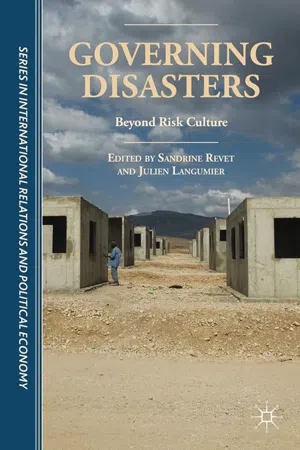
Based on extensive ethnographic and historical research conducted in diverse field locations, this volume offers an acute analysis of how actors at local, national, and international levels govern disasters; it examines the political issues at stake that often go unaddressed and demonstrates that victims of disaster do not remain passive.
Information
P A R T 1
Anticipation, Preparedness, and Controversies
C H A P T E R O N E
Governing by Hazard: Controlling Mudslides and Promoting Tourism in the Mountains above Alma-Ata (Kazakhstan), 1966–1977
Marc Elie
This chapter undertakes a political history of the government by disaster. The story takes place in a decisive moment of Soviet history, when the governments of the republics “self-sovereignized” and appropriated for their own purposes the resources of a rhetoric of transformation that had since the 1920s been central to the Soviet project. In Kazakhstan, the movement toward autonomy was reflected in scientific and technological development and the realization of ambitious urban and environmental planning projects, which several years earlier had been the exclusive prerogative of Moscow. The Kazakh government was able to exploit glacial hazards to create local assent for its protection projects and institutionalize a purely Kazakhstani official expertise that efficiently excluded all dissident scientific approaches, however well-reputed and recognized they might be on the Soviet scene.
On July 15, 1973, a devastating mudslide hurtled down the valley of Malen’kaya Almatinka, which overlooks the capital of Soviet Kazakhstan, Alma-Ata (today’s Almaty). Originating at an altitude of more than 3,500 meters in the glaciers of the Tuiuk-Su peak, the mudslide was stopped 8.5 km downhill by a hundred-meter high embankment dam constructed during 1966–1972 at a point where the valley narrows, forming what is known as the “Medeo” Gorge. Checked in its race to the capital, the mudslide almost entirely filled the reservoir, threatening to submerge and destroy the dam. Over the course of two weeks, thousands of workers and soldiers labored around the clock to save the dam. They only just averted a major disaster. Already a monument to Soviet “big science” in the late 1960s, the Medeo Dam became a monument to the heroism of the rescue workers of 1973, as sung by the great Kazakh poet Zhuban Muldagaliev (1920–1988):
Only a monument
To the struggle against the wild forces of nature
Is still missing from the parks of Alma-Ata
The dam is that monument!1
An enormous territory situated between Russia, Central Asia, and China, the Soviet Socialist Republic of Kazakhstan was at the time firmly in the hands of the first secretary of the Kazakh Communist Party, Dinmukhamed Akhmedovich Kunaev (1964–1986). He was the dam’s patron, having fervently defended the idea of building it against opposition from the local scientific intelligentsia. Thanks to support in Moscow from the general secretary of the CPSU, Leonid Brezhnev, and several prominent scientists, Kunaev was able to overcome the resistance of certain specialists and force through the project for the dam as the sole defense protecting the Kazakh capital. The imposition of the dam and the rise to power of Kunaev took place concurrently. These two developments put an end to the fierce public controversies over the best protection for Alma-Ata, which had prospered in the period of relative political pluralism in Kazakhstan that characterized the last years of Khrushchev’s leadership.2
The political leadership of Soviet Kazakhstan sought to make 1973 the year that the “black dragon”—the mountainous hazard that had threatened Alma-Ata since its foundation in 1854—was definitively vanquished.3 That year put the seal on the Medeo Dam as the ultimate solution against mudslides and as the capital’s ultimate protection. Yet scientific uncertainty concerning the mudslides hampered attempts to calm the controversy. Indeed, in scientific circles, 1973 was instead a time of intense quarrels that threatened the dam’s legitimacy. What’s more, with global warming damaging the glaciers and urban expansion in the valleys above Alma-Ata, disastrous mudslides were to regularly recall the limits—indeed, the negative consequences—of the efforts implemented in the 1970s and 1980s to control them.
The favorable outcome of the 1973 disaster marked a new stage in the history of Alma-Ata and Soviet Kazakhstan: the dam, which had been seen as sealing the valley, was now seen as opening up the valley and its resources, particularly to the “white gold” of tourism. The capital began to annex the mountains, mainly via the two mountain rivers that crossed it, the Malen’kaya and Bol’shaya Almatinkas. The construction of a protective network against mudslide required the creation of infrastructure and thus facilitated the development of tourist activity. In keeping with processes specific to the “economy of disasters,”4 the prevention and management of torrential and glacial hazards acted as motors for the development of mountain areas.
The story that is told here centers on the evolution of the technological and scientific controversies that impacted political decision making. This choice was dictated by the paucity of publications and archival sources addressing the social and environmental aspects of the conquest of the mountains and the effort to contain natural hazards. How is one to know what the inhabitants of Alma-Ata thought of the mountain infrastructure projects that culminated a few cable lengths away from the capital at an altitude of 5,000 meters? What were the conflicts among residents and local authorities that gave rise to plans for zoning and riverbed modification? How were the mudslides that hurtled down the valleys in 1973, 1975, and 1977 (to only speak of the period studied here) experienced? In its present state, the information available for consultation in Kazakhstan does not afford sophisticated answers to these questions. Only scattered information is to be had regarding what the inhabitants might have thought of the steps taken by scientists and governments to protect them or the decisions leading up to them. Indeed, what information is to be found—whether in administrative and technical sources (Kazakh government papers, the archives of the weather service) or the reports issued by research institutes—has an almost inadvertent quality. We are here far from the “living archive” celebrated by Arlette Farge.5 For the sources are characterized by blatant contradiction between government and scientific community assertions that they were acting on behalf of the people and their total lack of interest in what these same people might think (the secret services are an exception here but their archives are not available for consultation). There is sufficient evidence to advance the hypothesis that their plans provoked contradictory responses, sometimes very critical ones. At the risk of exaggerating the degree to which the population supported the state’s transformational projects, the present article shows how, despite setbacks, Kazakhstan’s leader, Kunaev, succeeded in consolidating his power and imposing a protection plan centered on the single dam he had sponsored. To do so, he relied on three tools: an all-out propaganda campaign appealing to the old clichés of the “victory over nature” and the technoscientific cult; the development of Alma-Ata as a winter sports capital; and institutional reorganization intended to create an impression of unanimity around the Medeo Dam project while marginalizing alternative proposals and criticism among scientists.
In the Shelter of the Dam?
The Medeo Dam gave the inhabitants of Alma-Ata a false sense of security. Indeed, in the course of its construction, official rhetoric imposed themes that unwittingly underestimated the parameters of the mudslides and exaggerated the dam’s effectiveness. Nor was this a matter of pure and simple disinformation: the technocrats and engineers responsible for the dam were themselves convinced that the giant dam represented the optimal protection against mudslides for Alma-Ata. They tended to allow themselves to be taken in by their own assurances and exaggerations: Medeo, it was claimed, would protect the town for 100 or even 1,000 years.6
The first theme was that of the giant dam itself: the dam “sealed” the valley “for eternity” and provided an absolute guarantee against mudslides.7 The media hammered away at the idea that the other, less massive and radical types of protective works proposed by opponents of the dam in the first half of the 1960s did not secure against mudslides. It discredited alternative projects by humiliating their proponents.8 The second theme concerned the use of explosives. Indeed, the construction process chosen for the first section of the building site consisted in provoking landslides on the flanks of the Malen’kaya Almatinka via two giant explosions, one in October 1966 and the other in February 1967. The media celebrated the method of directional explosions, which, it was claimed, had allowed a 105-meter tall wall to be constructed in one go.9 The myth of the “creative explosion” encouraged the belief that the town was effectively and inexpensively protected as early as 1967, though this was not the case. Assurances that the town was safe after the explosions of 1966–1967 concealed the scale of work yet to be done in order to realize the anticipated parameters of the dam.
In the media, the politicians, scientists, and engineers responsible for the dam insisted that the 1966–1967 explosions had had no negative effects on the local population and surrounding structures nor resulted in collateral damage. Only a small number of environmentalists recognized that the explosions had disfigured the Medeo Gorge, with the explosive blasts and attendant fires, landslides, and poisoning of all life by toxic gas entirely destroying the natural environment at the bottom of the valley and along the flanks of the river within a perimeter of at least 400 meters.10 Associated with protest against the dam, the accusation of environmental destruction was suppressed at the time but resurfaced in the late 1980s with the onset of perestroika and the revival of movements to protect nature. A controversy regarding the ecological consequences of building the dam was widely covered in the media: by interrupting the winds that blew from above into the valley, the dam could contribute to the deterioration of urban air quality. This position was vigorously challenged by the dam’s defenders.11
Yet, despite the media’s celebration of “the largest explosion in the history of civil engineering,” neither of the two explosions succeeded in lifting the mass of earth and gravel that had been anticipated in calculations. The first explosion created a 1.7-million-meter3 mound instead of the 1.94-million-meter3 mound that had been forecast. At this point, the “dam” was just a heap of gravel measuring 500 meters long and 60 meters high (1,810 meters above sea level), or a little more than half the height anticipated in the project (112 meters, 1,860 meters above sea level). The second explosion was particularly unfortunate: it raised the dam to just 72 meters and only contribut...
Table of contents
- Cover
- Title
- Introduction
- Part 1 Anticipation, Preparedness, and Controversies
- Part 2 Participation and Consultation
- Part 3 Issues of Memory
- Postscript: Thinking (by way of) Disaster
- Notes on Contributors
- Index
Trusted by 375,005 students
Access to over 1.5 million titles for a fair monthly price.
Study more efficiently using our study tools.
Frequently asked questions
Yes, you can cancel anytime from the Subscription tab in your account settings on the Perlego website. Your subscription will stay active until the end of your current billing period. Learn how to cancel your subscription
No, books cannot be downloaded as external files, such as PDFs, for use outside of Perlego. However, you can download books within the Perlego app for offline reading on mobile or tablet. Learn how to download books offline
Perlego offers two plans: Essential and Complete
- Essential is ideal for learners and professionals who enjoy exploring a wide range of subjects. Access the Essential Library with 800,000+ trusted titles and best-sellers across business, personal growth, and the humanities. Includes unlimited reading time and Standard Read Aloud voice.
- Complete: Perfect for advanced learners and researchers needing full, unrestricted access. Unlock 1.5M+ books across hundreds of subjects, including academic and specialized titles. The Complete Plan also includes advanced features like Premium Read Aloud and Research Assistant.
We are an online textbook subscription service, where you can get access to an entire online library for less than the price of a single book per month. With over 1.5 million books across 990+ topics, we’ve got you covered! Learn about our mission
Look out for the read-aloud symbol on your next book to see if you can listen to it. The read-aloud tool reads text aloud for you, highlighting the text as it is being read. You can pause it, speed it up and slow it down. Learn more about Read Aloud
Yes! You can use the Perlego app on both iOS and Android devices to read anytime, anywhere — even offline. Perfect for commutes or when you’re on the go.
Please note we cannot support devices running on iOS 13 and Android 7 or earlier. Learn more about using the app
Please note we cannot support devices running on iOS 13 and Android 7 or earlier. Learn more about using the app
Yes, you can access Governing Disasters by S. Revet, J. Langumier, S. Revet,J. Langumier in PDF and/or ePUB format, as well as other popular books in Social Sciences & Politics. We have over 1.5 million books available in our catalogue for you to explore.