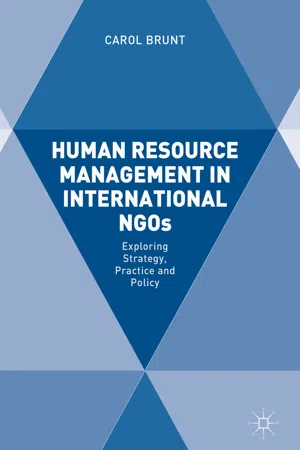
This insightful book examines human resource management practice and its perceived impact on performance in the non-profit sector. Presenting case studies of six NGOs in Kenya, it explores HRM practices in a non-profit setting, and uncovers details about HRM practice by organizations in the development sector that are not found in NGO management books. Informed by the author's practical experience in the field, Human Resource Management in International NGOs is a unique study that marries theory and practice, challenging the reader to reflect on the interpretative application of management theory and stakeholder participation.
eBook - ePub
Human Resource Management in International NGOs
Exploring Strategy, Practice and Policy
- English
- ePUB (mobile friendly)
- Available on iOS & Android
eBook - ePub
About this book
Information
© The Editor(s) (if applicable) and the Author(s) 2016
Carol BruntHuman Resource Management in International NGOs10.1057/978-1-137-57306-3_11. Exploring the Black Box: Inside the Development Sector in Kenya
Carol Brunt1
(1)
University of Wisconsin-Whitewater, Whitewater, USA
1.1 Introduction
This is an introduction to human resource management (HRM) process in the non-profit sector, specifically the development sector in Kenya. The chapter identifies the importance that HRM plays in its contribution to organisational performance and, in so doing, sets the stage for an exploration of HRM policy and practice among select international non-governmental organisations (NGOs) in Kenya. These organisations are situated within a sectoral culture, one that is shaped by historical practices and partnerships among stakeholders, characterised by resource dependency and impacted by social institutions within the country.
The chapter begins with an overview of the aid industry and the role that NGOs play in the delivery of foreign aid. This provides the reader with a description of the multiple stakeholders in the development sector. Kenya is presented as the African country chosen as the setting for the research study. Its role as a regional economic leader, its recognition as a regional transportation centre, identifies Kenya as a favourable environment for industry, government and international NGOs (INGOs) to establish their headquarters. It is a growing sector whose organisations reflect an organisational culture of commonly held beliefs, norms and values, and a national culture defined by regulatory environment and political support. Moreover, following its independence in 1963, Kenya received support from INGOs that are still operational in country today. As stakeholder relationships have evolved over the past 50 years, the exploration of these relationships within the context of HRM policy presents findings that may be considered relevant to INGOs operational in other countries.
The conceptualisation of human resources within non-profit organisations (NPO) is not as a monetised asset whose value is reflected in the balance sheet or bottom line, but rather, in collaborative terms, as an asset that provides meaningful contributory value to the functioning of the organisation and recognition that an organisation is only as good as its staff (Edwards 1996; Hudson 2004). HRM practices, such as recruitment and selection, and involvement in organisational decision-making are among the effective HRM practices identified by Purcell et al. (2003) as contributing to organisational performance. These HRM practices form the basis of the exploration of HRM policy and practice among INGOs in Kenya for their identification of human resources through recruitment and selection processes and the meaningful engagement of these resources through participatory management practices.
A staple of INGO theory (Chambers 1986; Covey 1996; Friedmann 1992; Smillie 1995), participation entered mainstream discourse in the development sector through the World Bank’s Voices of the Poor report (Narayan et al. 2000). It was widely adopted by donors as a development practice and as noted by the Organisation for Economic Co-operation and Development (OECD), “partnership is now a cornerstone of the new agenda for international aid” (Fowler 2000: 3).
The underlying notion that shapes the book’s message is the positive relationship between HRM practice and organisational performance. That a link exists between HRM practice and performance is demonstrated in Purcell et al.’s (2003) study on HRM-performance relationship that builds on existing literature (e.g., Huselid 1995; MacDuffie 1995; Delaney and Huselid 1996; Guest 1997; Pfeffer 1998). The HRM practice-performance link is described by Purcell et al. (2003) as the “black box”, its contents unknown and waiting to be discovered within. It is a suitable metaphor with which to introduce the relationship between HRM practice and organisational performance as little is known of this relationship within INGOs themselves.
1.2 Organisations in the Development Sector
NGOs historically played a significant role in the distribution of assistance to those in need. The oldest recorded NGO, Les Soeurs de la Congrégation de Notre Dame, was established in Canada in 1653 and still operates today in parts of Latin America (Smillie 1995). Other church-based organisations providing assistance to countries overseas were established in the UK and France in the mid-late nineteenth century. INGOs, such as Save the Children UK and CARE International, were created to provide relief services during wartime and continued to be active following World War II as the West took on an increasingly active role in providing assistance to the world’s poor and vulnerable (Suzuki 1998; Smillie 1995).
As stakeholders in global development, INGOs, primarily headquartered in North America, the UK and Western Europe, 1 were largely absent from public discourse prior to the 1980s, and operated on the periphery of the global economy. Beginning in the 1980s, INGOs, as a distinct group of organisations within the larger non-profit sector, increased the size and the scale of their activities in response to humanitarian and longer-term development needs around the world.
The 1980s represented a turning point. From the 1980s onwards, INGOs were favoured by official donor agencies such as the World Bank and the UK’s Department for International Development (DfID), as flexible, cost-effective and reliable delivery mechanisms of aid monies (Chambers 1986; Hyden 1983). Since the mid-1980s and the end of the Cold War, INGOs have grown in importance as the scale of their activities increased to meet ever-increasing demands for humanitarian assistance and longer-term development aid. The following countries of Afghanistan, Central African Republic (CAR), Democratic Republic of Congo (DRC), Iraq, Libya, Nigeria, Somalia, South Sudan, Syria and Yemen were identified as being in Severe Humanitarian Crisis at the end of 2015 based on a measure of “vulnerability, access constraints and current humanitarian need”, an assessment that identifies immediate needs in these countries for nutritional support, health services, access to water and sanitation, shelter and protection, in order to respond to acute and severe malnutrition, food insecurity and water shortages (Assessment Capacity Project 2015: 1).
In 2014, international humanitarian response totalled US$24.5 billion, an increase of 19.5 % over the previous year (Global Humanitarian Assistance 2015). In 2013, 19 % of total funding or US$3.0 billion (Global Humanitarian Assistance 2015) was channelled through NGOs, both international and national, an increase from 17.3 % (US$2.1 billion) in 2009 (Global Humanitarian Assistance 2011). Bilateral and multilateral donors are an important source of funding for the development sector. In 2013, the total disbursements by OECD’s Development Assistance Committee (DAC) countries to Africa in the form of bilateral aid was US$29.36 billion (Table 2.2.1, OECD 2015: 4) and from multilateral agencies totalled US$20.6 billion (Table 2.2.5, OECD 2015: 6).
The rise in importance and visibility of INGOs parallels the decline in service delivery by governments in the Global South. Evidence suggests that aid delivery mechanisms such as bilateral financial transfers and structural adjustment programmes (SAPs) failed to produce the expected results of largely Western donors as the resultant financial constraints on governments in developing countries reduced budgetary capacity to provide essential services to their populations (Dichter 1999; Madon 2000). In its 1991 report, the World Bank emphasised the importance of NGOs as instrumental in “(mitigating) the costs of developing countries ‘institutional weaknesses’” (World Bank 1991: 135). Scholars note that in the absence of effective state mechanisms for aid distribution, donors turned their attention to non-state mechanisms to focus on what Edwards and Hulme (1996: 961) refer to as the “new policy agenda”, composed of market-based development and civil society development as a means of ensuring services reach the poor (McKie 2007; Easterly 2006; Van Rooy 2001; Marcussen 1996).
For their part, INGOs claimed comparative advantage, in part, due to their claims of cultural sensitivity to local conditions and their relations with local communities (Chambers 1996; Dichter 1999; Edwards 1999a; Fowler and Biekart 1996). Today, NGOs continue to contribute to human development through improved access to essential services for Kenya’s population (PBO Task Force 2015: 1).
As an important source of financial resources, the influence of official donor agencies on development practice continued into the new Millennium. In 2005, reported funding for Kenyan NGOs from external donors (excluding foundations) represented 88.4 % of the overall NGO funding basket (Kanyinga et al. 2007: 38). Donor agencies control the disbursement of aid monies from their respective governments in the West to organisations including INGOs whose resource dependency holds them strictly accountable to the donors for the use of donor funds.
In the intervening decade between 2000 and 2010, INGOs continued to grow in size, and to expand their range of services, while facing mergers within the sector, the arrival of new players and a global downturn in the economy that impacted the availability of financial resources. In combination, these factors have contributed to defining what the development sector is today. Social institutions such as regulatory environments and political support influence INGOs as stakeholders within the development sector.
The development sector has experienced tremendous growth rates in Kenya as reflected in its rates of programme spending and employment creation. Kenya was chosen as the geographic focus of the research in recognition of both its key economic position in the region as a member of the East African Community (EAC) and the choice of the capital, Nairobi, as the prime location for regional INGO and UN headquarters. 2
Kenya’s real GDP growth rose to 5.7 % in 2013, and while it is estimated to have fallen slightly in 2014 to 5.3 %, projections for 2015 and 2016 forecast increases in GDP to 6.5 % and 6.3 %, respectively (African Economic Outlook 2015). The contribution of INGOs to economic growth is evident. In 2000, the total expenditure of the non-profit sector was 2.5 % of total GDP, representing 2.1 % of employment among the economically active population (Kanyinga et al. 2007).
Kenya’s capital, Nairobi, is acknowledged as a transportation centre and the chosen location of multiple donor agencies and INGOs. Nairobi is host to the world headquarters of UN Habitat and the United Nations Environment Programme (UNEP), and the regional offices of some of the world’s largest INGOs, such as Oxfam International, Save the Children and World Vision. The identification of Kenya as a preferred location for the development community fits neatly with the objectives of this research study providing a significant presence of INGOs as a research population from which to sample.
NGOs, both international and national, are only one of a multitude of organisations in the broader non-profit sector including self-help groups, women’s groups, youth groups, cooperatives, foundations/trusts and unions that expe...
Table of contents
- Cover
- Frontmatter
- 1. Exploring the Black Box: Inside the Development Sector in Kenya
- 2. Recruitment
- 3. Selection
- 4. Participation
- 5. Implications for INGO Management Process
- 6. What Have We Learned?
- Backmatter
Trusted by 375,005 students
Access to over 1.5 million titles for a fair monthly price.
Study more efficiently using our study tools.
Frequently asked questions
Yes, you can cancel anytime from the Subscription tab in your account settings on the Perlego website. Your subscription will stay active until the end of your current billing period. Learn how to cancel your subscription
No, books cannot be downloaded as external files, such as PDFs, for use outside of Perlego. However, you can download books within the Perlego app for offline reading on mobile or tablet. Learn how to download books offline
Perlego offers two plans: Essential and Complete
- Essential is ideal for learners and professionals who enjoy exploring a wide range of subjects. Access the Essential Library with 800,000+ trusted titles and best-sellers across business, personal growth, and the humanities. Includes unlimited reading time and Standard Read Aloud voice.
- Complete: Perfect for advanced learners and researchers needing full, unrestricted access. Unlock 1.5M+ books across hundreds of subjects, including academic and specialized titles. The Complete Plan also includes advanced features like Premium Read Aloud and Research Assistant.
We are an online textbook subscription service, where you can get access to an entire online library for less than the price of a single book per month. With over 1.5 million books across 990+ topics, we’ve got you covered! Learn about our mission
Look out for the read-aloud symbol on your next book to see if you can listen to it. The read-aloud tool reads text aloud for you, highlighting the text as it is being read. You can pause it, speed it up and slow it down. Learn more about Read Aloud
Yes! You can use the Perlego app on both iOS and Android devices to read anytime, anywhere — even offline. Perfect for commutes or when you’re on the go.
Please note we cannot support devices running on iOS 13 and Android 7 or earlier. Learn more about using the app
Please note we cannot support devices running on iOS 13 and Android 7 or earlier. Learn more about using the app
Yes, you can access Human Resource Management in International NGOs by Carol Brunt in PDF and/or ePUB format, as well as other popular books in Business & Human Resource Management. We have over 1.5 million books available in our catalogue for you to explore.