- English
- ePUB (mobile friendly)
- Available on iOS & Android
eBook - ePub
About this book
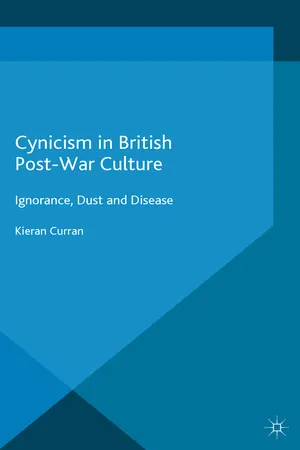
This book is the first academic text to examine cynicism as a driving force in the context of post-war British culture. It maps a sensibility that transcends divisions between high and low culture, and encompasses figures such as Philip Larkin, John Lennon and Stephen Patrick Morrissey.
Information
1
Annus Mirabilis: Philip Larkin
In the immediate post-World War II period, life was understandably more fractured and disturbed in Britain than before. People had been subject to the onslaught of the Blitz, and had apparently grown more unified in the face of this. The realities of rationing and frugality had emerged with increased sharpness, resulting in a general sense of ennui and apathy which continued beyond the VE and VJ day celebrations, which were themselves somewhat subdued. According to David Kynaston’s citing of Mass Observation data in A World to Build, “riotous abandon was the exception rather than the rule” (9). Soon after, the Franklin D. Roosevelt-initiated lend-lease program, designed to aid the Allied nations during the war with loaned machinery, from industrial to military, was cancelled:
The factories, which people hoped would soon be changing over to the production of goods for the shabby, short-of-everything home consumers are instead to produce goods for export . . . People are suddenly realising that in the enormous economic blitz that has just begun, their problems may be as serious as the blitz they so recently scraped through.
(ibid. 103)
Bread rationing only ended in 1947, clothes rationing and sweets rationing in 1949 – the public simply had to learn to cope with the results. The spectre of the atom bomb which had closed out the war was fresh in people’s minds – a weapon which could cause hitherto inconceivable amounts of human and infrastructural destruction, and was now a real part of world warfare (the “mushroom shaped cloud that lived perpetually in a cave at the back of his mind”, as John Wain put it in Hurry on Down [22]). Politically, it could be fair to say that Labour had won a post-war majority from a population which sought a change from Conservative party domination: essentially, a fresh start. Barbara Castle – a newly elected Labour MP at the time – stated that she detected amongst the people at her eve-of-poll meeting “a sort of unbelievable buoyancy” (ibid. 68), a palpable sense of change on the horizon and an opportunity to positively shape the peacetime environment.
Yet the motivations for voting Labour into power were not uniform. Some were tired of Churchill, finding him distinctly out of tune with public opinion. An example of this was his statement during a preelection broadcast that, if the left gained power, they would institute a secret police to deal with dissent and “gather all the power to the supreme party and the party leaders” (ibid. 65). Scaremongering and the fuelling of paranoia were major goals, seemingly. Contrast this with Aneurin (“Nye”) Bevan’s rousing rhetoric, advocating for Britain a “new industrial revolution . . . [which] can only be done by men with modern minds, by men of a new age” (ibid. 64). Other voters for Labour were left-leaning individuals – Iris Murdoch for one – whilst others were just keen to let “the other lot” have a go at government.
If the public opinion was divided, then so was that of the party, and the left as a whole was not uniform in its ideology and motivation. At a Fabian Society conference in late 1945, a wide array of differing viewpoints on the future of socialism was discussed. John Bowlby, an eminent psychiatrist, argued that the British working classes had an intense desire for consumer goods, and that social scientific methods should aim to identify and manage these emotions (in this, Bowlby was eerily prescient of New Labour). R.H. Tawney – the Christian socialist much admired by Raymond Williams – felt that common people had resources of initiative and ability that weren’t being put to proper use. Tawney thus believed in the active, positive potentiality of the working classes. G.D.H. Cole saw a future in which a large proportion of society would participate in leadership at some level, disliking the implication that there was a massive divide between the capabilities/potential of the educated and those of the uneducated. Contrastingly, Evan Durbin, a Labour politician and future source of inspiration for more centre-left Labour politicians like Anthony Crosland, believed that people are more wicked than earlier thought, and selective breeding was “probably the answer” (A World to Build 130). A rigorously planned economy, a tenet of much socialist thinking, was forsaken for practical concerns. The City would not have it, it was contrary to the free market, and the Chancellor Hugh Dalton was not dedicated enough (c.f. the “half-cock nationalisation of the Bank of England in 1946” [ibid. 139]). Essentially, in terms of politics, economics and philosophy, there were many different forces in interaction.
In terms of sexual politics, women who had been part of the workforce during the war years were now expected to revert to more subservient roles. Previously women had been performing “man’s work”; some did not mind reverting to type, others did. Patriarchal authority re-exerted itself, coupled with an element of post-war depression suffered by the returning males. Some soldiers were understandably scarred by their experiences, and could express this through new-found distance and alienation from their families. One child of a returning soldier reminisced that “I did not like this tall, weird, cold man . . . he had become mentally imbalanced by his incarceration” (97). Egalitarian impulses (albeit somewhat of a virtue out of necessity), reflected in the full-time employment of women during the war, did not seemingly extend to matters of contraception in the post-war period:
Birth control was too politically contentious to mention when the National Health Service itself was still a matter for delicate negotiation. The Family Planning Association, though in principle committed to state birth control services, failed to press for contraception under the NHS.
(Hall 128)
Interestingly, however, abortion was legislated for in some contexts, pointing to an acknowledgment by the Labour government at the time of the need to safeguard the physical and mental well-being of pregnant women:
Abortion continued marginalized and criminalized, although the Bergman-Ferguson case of 1948 clarified existing case law, when the judge ruled that abortion was legal if the doctor believed in good faith that continuing pregnancy would be seriously deleterious to a woman’s physical or mental health [“irrefutable evidence” was not necessary].
(ibid.)
The decline in British imperial strength – in terms of the advent of Indian political independence, as well as conflicts in China (the Yangtze mission to save Commonwealth subjects from Mao’s Red Army) – dented a residual sense of militaristic national pride. The older belief in Britannia ruling the waves was adjusting itself to new and different rules and burgeoning post-colonialism. In an imperial sense, the United States of America was firmly in the ascendancy, militarily as well as economically. The aforementioned cancelling of the lend-lease program put Britain in an awkward position, leaving the country hugely in debt to the United States, having to pay back the cost of industrial and military equipment which it had received, as well as other goods, as part of a newly negotiated loan (so massive that it was only paid off at the end of 2006). Also, the devaluation of the pound (in 1949, it was devalued against the dollar by 30%) and the earlier problem of inconvertibility, meaning that the pound was not allowed to be exchanged on the currency market, was not a morale-boosting occurrence.
Yet, at the same time, certain undoubtedly positive things were occurring, and in some ways Britain was moving towards a more egalitarian view of society as a whole. In 1948, the NHS was created (two years after Aneurin Bevan’s National Health Act), offering free health care for all, regardless of means. The private medical insurance company BUPA was also established in 1947, illustrating that a back up to the state system was still important. Industries like rail (January 1948), gas (beginning in July 1948, ending in May 1949) and coal (January 1947) as well as the aforesaid Bank of England (February 1946) were nationalised with the aim of socially responsible planning of infrastructure and natural resources. The BBC Light programme, the precursor of BBC Radio 1 and 2, was created in 1945, broadcasting more entertainment which would appeal to a popular audience, and to distract the majority from the hardships being experienced. The Third Programme was established in 1946, appealing to a different audience, and tied in with an F.R. Leavis-style experiment in attempting to increase cultural mobility amongst its listeners. The role of Charles Haley, the fifth director-general of the BBC – after Reith, Ogilvie, Graves and Foot (the latter three being in quick succession) – in formulating the concept of Radio 3/The Third Programme is crucial; “let it often become dull. Let it make mistakes” (quoted in Carpenter 8). Haley was an autodidact who had not been to university, but this fact had enhanced his enjoyment and reverence of intellectual pursuits (ibid. 7). Haley is quoted as saying that he envisaged the restructured BBC – the Light Programme (essentially modern-day Radio 1/2), the Home Service (Radio 4) and the Third Programme (Radio 3) – as being akin to a pyramid, reflecting broad class-based tastes. The Light Programme, he felt, could play “the waltz from Der Rosenkavalier”(by Richard Strauss), the Home Service “the most tuneful act from the opera”, and the Third “the whole work, from beginning to end, dialogue and all” (ibid. 9).
Interestingly, Haley considered the pyramid structure to be fluid – listeners could ascend the social ladder, as it were, by embracing the apparent finest in art and literature. The division between the three stations in terms of Strauss allows a neat delineation of taste vis à vis the educational backgrounds of the listeners in a manner that Pierre Bourdieu would have found intriguing; from a “nice tune”, as it were, to an act, to the whole thing, possibly complete with an introduction and conclusion in commentary. Although the remit initially pointed towards an audience “of taste, of intelligence, and of education” in its terms of reference from January 1946 (ibid. 12), this was not to say that, following Haley’s fluid conception of movement between stations, one could not potentially cross between these boundaries. In September of the same year, the station began broadcasting. Tribune praised the potential for “the network’s contribution to the ‘cultural and political life of the nation’,” whilst The Times “welcomed the culture but was worried by putting it in the ghetto of a separate network” (ibid. 26).
Thus, grim economic conditions, imperial decline, national debt, gender conflict and familial breakdowns were all at play at this point. Yet, concurrently, there were potential positives: the initiation of a socially conscious health service and social insurance, infrastructural development, the opening up of Cambridge University officially to women (Girton College, although set up in 1869, was not a constituent part of the university until 1947). Comprehensive education began, and thus academic as well as more practical, trade-based education could be opened up to a wide number of children in the same school, regardless of performance in an entrance exam. The first of these, the Holyhead County School in Anglesey, was set up in 1949. Even the opening up of the nation’s first supermarkets (January 1948 at the Co-Op in Manor Park and Sainsbury’s in Croydon in July 1950) could have seemed like exciting, life-improving events. Older forces collided with emerging ones, all products of a culture in flux.
The following quotation from a letter written by Philip Larkin to his college friend and fellow writer Kingsley Amis in September 1942 says something about his qualified belief in a Romantic sensibility:
I don’t know about you but I’m definitely a romantic in art, if that means anything. This means I expect colour, idealism and mysticism, to a certain extent [my italics].
(Selected Letters of Philip Larkin 44)
In Larkin’s letters in general, as well as in his first two novels, there is a keen insight into the fluctuating environment of a certain side of post-war Britain. Although Larkin is mainly revered for his poetic output (he published four poetry collections – The North Ship (1945), The Less Deceived (1955), The Whitsun Weddings (1964) and High Windows (1974), along with other work written for journals, magazines etc.) – in some ways his more unsung writings can offer an equally rich insight into the artist. He also published two novels – Jill (1946) and A Girl in Winter (1947) – and, in many ways, his Selected Letters offer an excellent illustration of the view of societal development put forward in Raymond Williams’ 1961 work The Long Revolution. In any society there are conflicting forces in interaction related to how beliefs interact with each other, and the culture – a complex interplay of the idea of intellectual development or evolution of thought (progress), the body of works produced (texts) and the general behaviour patterns of people (practices) – is an interaction of these. Essentially, it is a “structure of feeling” (64), which encompasses the “arts of the period” (65) but which is also evident “in all actual communities” (65). Williams describes these as residual, dominant and emergent culture, which can be identified in any analysis of the historical facts of a given period and cultural text as being in interaction.
As all these aspects interact, Larkin seems more part of an emergent force, though this is not to say that he does not possess some internalisation of the residual attitudes (an idea of respecting your betters) or the standard right-wing view of Britain’s superiority over “Johnny Foreigner”. Indeed, in general, there can be no ultimate affiliation of any one of these categories absolutely to a single group or artist or cultural texts. Rather, these aspects of culture interact and are in conflict with each other. For example, Larkin expresses a love of the jazz produced by Americans, analyses it and gives it a lot of significance (as does his friend Kingsley Amis). Whilst acknowledging that “England may be full of dishonesty and unpleasantness and sordidity etc.”, he also feels a “fuck America” (67) sentiment, inspired undoubtedly by the country’s rising imperial power during World War II in comparison to Britain’s decline. He dislikes the élite, but actively derides regional universities and categorises them as imbecilic. John Kemp, the hero of his first novel Jill (1946), is a similarly “in between” character. He looks up to the moneyed, privileged contemporaries of his at Oxford (they are at least lively), and derides the more thickly accented, Northern English fellow scholarship boy (he is dour) with whom he has far more in common. It is not an idealised portrayal of his former university – as Larkin wrote to Amis when writing the work, “there are no artists, or dons, or nice friendly girls, or comic scouts . . . everybody is very young and drinks a lot” (75). As Andrew Motion suggests in his biography of Larkin, there is an artifice at work in his novels, whereby his texts are, in a sense, concerned with both the act of writing itself, and the realisation of artistic inspiration more generally:
Is “self the man” or is “virtue social”? Should each individual obey “your wants” or “the world’s for you”? These questions, posed throughout the remainder of Larkin’s work, are evident in the novel which stands at the beginning of his career. They summarize the tensions upon which all his writing depend. (158)
In Jill and A Girl in Winter, the protagonists’ respective Romantic notions get the better of them. In Jill, Kemp is crushed by the weight of his idealising of Gillian, leading him into a romance that is so unrealistic as to be bound to fail. There is nothing likeable portrayed about this pursuit, and – in Kemp’s writing about and romanticising of Gillian – a painful and fantastical dislocation from reality is apparent. Thus, Larkin seems to suggest that the divorced world of writing can be painfully false, and potentially very destructive, as well as a barrier to self-knowledge. To return to his letters, Larkin’s views on literature stand out and are outspoken (particularly his well-documented disdain for Dylan Thomas), but he is clearly a product of an academic system preoccupied with a Canon/Canonicity. In his letters, he settles into the role of a somewhat stately curmudgeon, a sympathetic critic of the divisive Margaret Thatcher (though not necessarily self-identifying as a Tory), as well as of the state of the nation. In early 1982 he wrote to Amis, asking:
How do you think the Scargill/Thatcher bout will go? I’m inclined to bet on her: this isn’t 1974 you know (or whenever it was), and I guess the “workers” are pretty fed up with those lazy overpaid brutes, as Aub. Waugh calls them . . . It’ll be Conservatives & SDP against the Commies. Still, this country’s down the drain. Soon be an offshore gambling island supported by prostitution and exhibiting the Queen. (662–663)
Larkin’s acceptance of the role of the Labour off-shoot the SDP “against the Commies” underlines his non-partisan nature; the cynical last line, indeed, seems to echo the words of Johnny Rotten. Being generally a scathing critic of what he felt to be the smug modernist and apparently inauthentic poetry of Ted Hughes, he described the dichotomy between his demeanour and the approach of the future Poet Laureate during a reading at Hull in 1975 thus:
Ted Hughes was here last week, giving a reading – the first time since about 1962. He filled our hall and got a great reception. I was in the chair, providing a sophisticated, insincere, effete, and gold-watch-chained to his primitive forthright virile leather-jacketed persona. (525)
His poetry also adopts a more vernacular style that is more uniquely his own; conversely, his early poetry is influenced by W.H. Auden and W.B. Yeats. He is clearly in concert with the idea of a “Great Tradition”, similar to that of Frank Leavis. Leavis derided modernists such as James Joyce, but elevated and advocated the classic 19th-century realist novel as produced by George Eliot and Leo Tolstoy. His is a popular sensibility therefore, one which is not definitively political and one which goes against the grain in a somewhat Bohemian way. Yet he is a poet as well as an agoniser over details, and his intellectualising over literature, the novel and art in general sets him apart from the cynics later to be discussed – mainly the aforementioned Amis and John Wain. His seems a more consciously middle-class, petit-bourgeois viewpoint, of gamely struggling up the ladder to succeed (in the realm of poetry as well as his chosen career of librarian) whilst trying to retain intellectual and (mainly) artistic aspirations.
Larkin expresses a love for the Romantic in art within his letters, but this does not really seem to be articulated in his novels. Yet they blaze a trail for the cynic in general. His works contain core elements of the sensibility – sympathy for traditional forms/anti-modernist expressions, an opposition t...
Table of contents
- Cover
- Title Page
- Copyright
- Contents
- Acknowledgements
- Introduction
- 1. Annus Mirabilis: Philip Larkin
- 2. Work Is a Curse: John Wain/Kingsley Amis/Iris Murdoch
- 3. Just Another Sunday Evening: John Osborne/Jazz
- 4. That’s What I’m Not: British New Wave Cinema
- 5. I’ve Heard of Politics, but This Is Ridiculous: TV Satire/Comedy
- 6. Bed Peace: John Lennon
- 7. Quiet Riot: Stephen Poliakoff
- 8. No Future/No Alternative: Punk and the Cynic Sensibility
- 9. We Are White Crap That Talks Back: The Fall
- 10. Somehow That Really Impressed Me: The Smiths
- Conclusion
- Bibliography
- Index
Trusted by 375,005 students
Access to over 1.5 million titles for a fair monthly price.
Study more efficiently using our study tools.
Frequently asked questions
Yes, you can cancel anytime from the Subscription tab in your account settings on the Perlego website. Your subscription will stay active until the end of your current billing period. Learn how to cancel your subscription
No, books cannot be downloaded as external files, such as PDFs, for use outside of Perlego. However, you can download books within the Perlego app for offline reading on mobile or tablet. Learn how to download books offline
Perlego offers two plans: Essential and Complete
- Essential is ideal for learners and professionals who enjoy exploring a wide range of subjects. Access the Essential Library with 800,000+ trusted titles and best-sellers across business, personal growth, and the humanities. Includes unlimited reading time and Standard Read Aloud voice.
- Complete: Perfect for advanced learners and researchers needing full, unrestricted access. Unlock 1.5M+ books across hundreds of subjects, including academic and specialized titles. The Complete Plan also includes advanced features like Premium Read Aloud and Research Assistant.
We are an online textbook subscription service, where you can get access to an entire online library for less than the price of a single book per month. With over 1.5 million books across 990+ topics, we’ve got you covered! Learn about our mission
Look out for the read-aloud symbol on your next book to see if you can listen to it. The read-aloud tool reads text aloud for you, highlighting the text as it is being read. You can pause it, speed it up and slow it down. Learn more about Read Aloud
Yes! You can use the Perlego app on both iOS and Android devices to read anytime, anywhere — even offline. Perfect for commutes or when you’re on the go.
Please note we cannot support devices running on iOS 13 and Android 7 or earlier. Learn more about using the app
Please note we cannot support devices running on iOS 13 and Android 7 or earlier. Learn more about using the app
Yes, you can access Cynicism in British Post-War Culture by K. Curran in PDF and/or ePUB format, as well as other popular books in Social Sciences & Social History. We have over 1.5 million books available in our catalogue for you to explore.