- English
- ePUB (mobile friendly)
- Available on iOS & Android
eBook - ePub
About this book
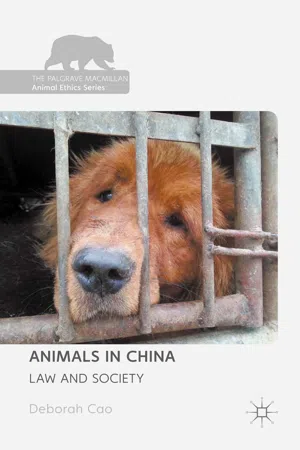
Just as China is called the world factory for manufactured goods, it is also a world factory for manufactured animal cruelty in a new phenomenon of globalized animal cruelty. Animals in China examines animal protection in China in its legal, social and cultural contexts.
Information
Topic
PhilosophySubtopic
Comparative Law1
When Animals and Humans Meet in the Middle Kingdom: Introduction
In 2007, a photo depicting a dozen caged monkeys awaiting their fate at a medical laboratory in China won the best-photo prize in the National Geographic Society’s Global Photography Contest. The homemade-looking structure of the cages and the horror of the monkeys’ captivity made up the sad photo.1 In 2013, Li Feng, the same Chinese photographer, won another prize for a series of photos about the same subjects – laboratory monkeys and their lives in cages in a research laboratory in Yichang, Hubei Province. The photos included monkeys huddled together to keep warm in winter in a glass house, a monkey with Alzheimer’s being tested and operated upon for a possible human cure for the disease, monkeys learning to be quiet and watching their own intravenous drips, a monkey whose heart stopped beating during an experiment, and a mother monkey with her tiny baby in a steel cage. Curiously, the winning photos were in the category of economy and science in the China International Press Photo Contest.2
In some ways, this encapsulates and symbolizes the different perspectives that people may have about other animals in general and, in particular, the different perspectives that people in China and in the West may have regarding animals. For some, those images represent sadness and cruelty – creatures being enslaved and experimented upon against their will and their lives terminated after they outlive their usefulness to humans. For others, they represent advances in medical science, economic opportunities and wealth creation and also a manifestation of humans’ dominance over other creatures. As is explained and extensively discussed throughout the book, the instrumental view and use of animals dominates in China and in Chinese culture, both historically and today. Animals of all kinds are resources to be exploited, tools to be used or food to be eaten. In such exploitation, use and eating, enormous suffering is being caused and inflicted. Anyone who has lived in China for an extended period of time knows that animal cruelty is widespread and often shocking, part of the everyday life, hard not to see. What is more worrying and more to our purpose, with an increasingly globalized economy and world, we now have globalized animal cruelty. China has been called the world factory for manufactured goods. Similarly, China is a world factory for manufactured animal cruelty and is exporting it.
For instance, laboratory animals, including non-human primates, are bred, raised and sold for experimental purposes in China and increasingly sold outside the country. Given the relatively low costs associated with raising such animals, China has become the world’s leading supplier of laboratory animals to companies and research institutions in Western countries. China sees this as a major scientific advancement on China’s part, a major economic opportunity and a growth industry (see Ch. 6). What remains largely unknown is how such animals are treated in China or after they are exported to other countries. In globalized collaboration or collusion, cruelty manufactured in China is being paid for, supported and consumed by Western countries as well as China.
Another example of globalized animal cruelty is China’s growing fur industry – which includes the breeding and slaughter of countless animals – to feed the world’s appetite for fur-trimmed fashion. China is now the world’s leading supplier of furs and fur garments. However, we have little idea about how such animals are treated and killed on Chinese fur farms except that every so often, graphic videos and photos of extreme animal cruelty obtained in private investigations are made public for all to see but then to be forgotten until the next video surfaces (see Ch. 6). Once again, Chinese manufactured cruelty is being paid for, supported and consumed by the Western fashion and fur industries and, ultimately, largely unsuspecting consumers. Still another instance of globalized animal cruelty is wildlife trafficking, transnational crimes that transcend national boundaries and link China with Africa and other countries in illegal activities, in particular the ivory and rhino horn trade, which has global ramifications that threaten to wipe out the elephant and rhino as species. African elephants and rhinos will become extinct in the next decade or so if the current poaching is allowed to continue to feed the insatiable greed for elephant and rhino body parts in China and if the current international trade ban of such animal products is to be lifted (see Ch. 3 and Ch. 4).
Conversely, the inhumane and cruel practices of intensive farming invented and promoted by Western companies have now been introduced to China and other developing countries in the name of modern advanced management practice for efficiency and cost-effectiveness. This is another adverse effect of globalized animal cruelty. Such cruelty used to be local – to a person, a group of persons, a community, an industry, a country. Now it is global and transnational. Many people across the globe have unwittingly become consumers or users of products tainted by or made via animal cruelty committed elsewhere – in this case in China, the focus of this book.
Throughout China’s long history, animals have always been very important to Chinese lives and integral to Chinese culture. One who travels in China sees animals everywhere: mostly dead ones – on dinner tables and in restaurants, as decorative pieces in people’s homes and in Chinese medicine invisible to the eye. Beautiful animal statues and carvings are found in old palaces, on gravestones, as symbols of cities, new and old, and as exquisite art of carvings made from ivory and other animal bones. Every Chinese person has an animal zodiac sign, and people would know a person’s age by simply knowing the person’s animal symbol. Women choose to have children and give birth just to have a particular animal symbol for their offspring. A most famous literary figure in China is the Monkey King, Sun Wukong, beloved by Chinese young and old throughout the ages. One of the most famous legends in China is ‘Wu Song da hu’, Wu Song being a legendary superhero who beats and kills a tiger with his bare hands. The Chinese language is full of idioms and sayings with animals, and many have negative connotations. The most famous sayings in contemporary China by Chinese political leaders employ animal metaphors: the black or white cat who catches mice,3 made popular three decades ago and beating ‘tigers’ and catching ‘flies’ used in the current anticorruption drives, a catchphrase that was revived from past usage.
As the authorities are busy beating ‘tigers’ figuratively, some Chinese, although only a small number of them, are catching real tigers. Having killed tigers in the wild to the brink of extinction, they now smuggle them into the country or trade and use them from legalized tiger-farming enterprises. They drink tiger blood and feast and gorge on the flesh, and then they sell the tiger bones and penises to make tonics and tiger pelts as adornments for luxury homes, extracting money from every fibre of the big cat. They do this to make money, to show off wealth and power as a trophy and symbol of success or allegedly to benefit their own health (see Ch. 4).
Chinese love animals – they love them to death, literally. They love to eat them, to kill them, to take them in medicine, to wear them, to watch them in entertainment, to make an exquisite art form of them in ivory and other carvings. In the process, they drive some animal species to extinction or to its brink. They also cause the living ones extreme pain and suffering before eating them. Unfortunately, this is part of China and Chinese culture, an otherwise great human civilization, a country with the longest continuous history on earth.
One may ask, what is so different between Chinese and other cultures in terms of using, eating and abusing animals? It is true that all human societies and cultures are cruel towards animals without exception, so in many ways it is a matter of degree. Given that people of all cultures enjoy eating animals, is this just a case of one man’s delicacy being another’s cruelty or one Chinese cure another’s death? Or is it that cruelty in one society is simply another way of life, a traditional or cultural practice?
One hundred years ago, an English judge found in an animal cruelty case, Waters v. Braithwaite, that unnecessary suffering caused to animals because done in pursuance of old custom or for commercial benefit cannot be justified or excused.4 Today, however, such suffering is routinely justified on various grounds in everyday life and in laws. In the West, the East and elsewhere, such acts of cruelty are often justified as being part of a certain cultural practice or tradition, of a heritage or religious faith.5 The fact is that animals endure pain from abuse and violence irrespective of human excuses. Animals feel and suffer in African jungles, Chinese food markets, European research laboratories and American intensive farming factories. Such sufferings are the legitimate and moral concern of all people, irrespective of culture, geographic location or legal jurisdiction. Different countries and cultures have their traditions and ways of doing things, but it is not logical to think that animal welfare is the exclusive domain of concern for only some peoples and some societies or that somehow some countries or peoples are too backward or too ignorant to concern themselves with such moral matters and issues of social justice. It would insult the intelligence and compassion of the good people in those cultures and countries. Hence, it is wrong to believe that all Chinese condone abuse of and violence against animals or all Chinese are cruel or oblivious to animal suffering. As a matter of fact, as the book describes in detail, there is an emerging grass-roots animal protection movement in China with many ordinary Chinese voluntarily rescuing and helping animals in distress. China is progressing, and many Chinese now find the animal cruelty and abuse widely accepted in the past to be unacceptable, uncivilized and barbaric (see Ch. 7).
In addition, a major difference in terms of animal cruelty between contemporary China and most Western countries is that in the last two hundred years, Western societies as a whole have accepted as a necessity and imperative the legal protection of animals against cruelty. As China has yet to reach this stage, it is about two hundred years behind the enlightened nations in this regard. Efforts are being made in this direction, but China still has a long way to go. A little-known fact is that imperial China had provisions in its law, starting in the Tang dynasty (618–907 AD), for the protection of certain working animals (see Ch. 2). It is also worth noting that wildlife protection laws do exist in China today. China has the world’s harshest penalties for offences against state protected wildlife species, but the law is a paper tiger, so to speak, and has failed to deter criminals and failed to protect the real tigers and many other endangered animals. Instead, one of the accomplishments of the wildlife protection law is active exploitation and farming of protected wildlife, legalizing animal exploitation for commercial purposes and shielding animal abuse with legal means. What’s needed in China is a fundamental change of attitude – among the authorities, the intelligentsia and ordinary people – regarding the conception of animals and their relationship with humans. Educating the general public and society as whole is vitally important.
Another important aspect of China’s relationship to animals is this: some Chinese, albeit a minority, eat just about any living creature, and some would go to any length to eat them, so much so that the Chinese legislature was recently compelled to take action to criminalize wildlife eating (see Ch. 3). In 2014, a Chinese man in southern Guangxi region was arrested and jailed for 13 years for organizing trips for buying and killing tigers for the purpose of eating tiger flesh at dinner parties for local businessmen (see Ch. 4).6 In August 2014, a man posted a photograph of himself on Chinese social media showing himself standing by the roadside, waving a knife and cutting the backside and penis off a live kiang, a highly endangered Tibetan wild donkey; he was killing the donkey to eat him.7 The two men involved were later convicted and jailed.8
Philosophically, there is another difference. Traditional Chinese philosophy does not make a clear distinction between humans and other animals as in Western philosophy. Unlike its Western counterpart, it recognizes both humans and animals as part of the moral universe; since ancient times, animal sentience has not been an alien concept to the Chinese. Nevertheless, animals did not and do not fare better in real life in China. There is a disconnect between ideals and actuality (see Ch.2). The destruction and abuse of animals that started many centuries ago continue in modern China.9 Some animal cruelty practices in China go back in history, as in the making of certain Chinese traditional medicines, tonics and food. They do not involve just killing animals and using their body parts but also torture and violence. When an animal species became exhausted or was on the brink of extinction, new methods of torture were invented or introduced to continue the tradition (one example is bear bile farming). The harmony between humans and nature that the Confucian concept of tian ren he yi advocates is achieved in a perverse way – humans and nature becoming one via humans eating animals: flesh, blood, bone, brain, bile, skin, horn, fin, hide, penis, nest and all. It may be that Chinese culture and the Chinese people are as fond of animals as an abstract notion as they are hostile and destructive to individual animals and animal species.
Stories were told some years ago. Westerners visiting a Hong Kong food market wanted to buy a cute little puppy as a pet. Before they realized what was happening, they were handed a bag of dog pieces freshly killed. This is not hearsay or fiction. Hong Kong outlawed the eating of cats and dogs a while back, but today in mainland China, the subject of this book, such practices are not uncommon in live animal food markets. In 2011, photos posted online showed small dogs, bound and gagged, placed in plastic basins in a food market in Nanjing, a major city in eastern China. Shoppers picked and chose, and the dogs chosen were chopped up on the spot for shoppers to take away. In Shanghai, the most glittering and cosmopolitan city in China, some residents today kill dogs, cats and other animals on major streets outside their homes, with blood splashing onto the streets and running down gutters before they eat them. I have written and commented on these incidents on many occasions in my Chinese writings and on Chinese social media. For many cat and dog owners in China, one of the worst nightmares of losing a beloved pet is the thought that their pet will be picked up by others and then bludgeoned to death and eaten. Such horrors are not uncommon. In October 2013, a series of photos went viral on Sina Weibo, the Chinese equivalent of Twitter. After a flood in the southern city of Ningbo, a dog was photographed sitting in the water and waiting for someone to take her away. She was indeed taken away – by a man who promptly butchered and skinned her. The subsequent photos showed the dog’s corpus, in the open in front of children and others, dripping blood. In another series of photos that went viral on Weibo and provoked outrage, in September 2014, a man in Shantou City in Guangdong Province tied a dog to the back of his car and dragged him along the street. Shortly after, the driver was identified. He defended his action by saying that the dog was a guard dog at his factory but was unfriendly and had bitten people. He said that he decided to kill him and later dumped him in some bush. But sleuthing bloggers discovered that the man actually took the badly injured dog to a restaurant and shared the flesh with his mates. In another widely publicized case in 2012, a man from the city of Yulin in southern China took one of his breeding dogs to be chopped up by a butcher because, he claimed, the dog was getting old. This person was then photographed walking home carrying the dog pieces in a bag. In November 2014, in the northeast city of Shuangyashan, Heilongjiang Province, a three-year-old golden retriever called Maomao was photographed being butchered alive on the street. Her legs were being sawed off; she was dismembered while alive. Maomao, a young mother, had been stolen from her owner and met her end at the hands of a dog butcher.10 No law prohibits such acts of cruelty in China. Nevertheless, many Chinese now find such behaviour offensive and barbaric, although many others would not be bothered. Ever more people, especially young and educated Chinese, find eating cats and dogs unacceptable, issues of extreme cruelty and illegality aside.
As described throughout this book, cruelty and violence against animals in China is serious, pervasive and large-scale. There are acts of cruelty by individuals against cats and dogs and other animals. There are acts of cruelty against large numbers of animals by state-approved enterprises or commercial operations for purposes related to the fur industry, zoos and circuses, traditional Chinese medicine, research facilities, farming and food industries, and brutal killing on a massive scale of homeless cats and dogs carried out by local authorities. All of these matters are covered in this book, except animals farmed as food.
This is not a book documenting animal cruelty in China. It is a book on the laws and regulations related to animals in contemporary China and the social and cultural context within which the laws and regulations do or do not operate. It is about law, but animal law is never just about law. It is more about people and human society. The book also offers a glimpse of the small but growing animal protection movement in China, with more Chinese becoming interested not just in animals as family pets but also in how animals can live a normal, dignified and cruelty...
Table of contents
- Cover
- Title
- 1 When Animals and Humans Meet in the Middle Kingdom: Introduction
- 2 Happy Fish and Royal Workers: Animals in Traditional Philosophy and Law
- 3 Pandamonium: Wildlife Law
- 4 Crouching Tiger Bones, Hidden Elephant Tusks: Wildlife Crimes
- 5 The F-Word of Cats and Dogs, Food or Friends: Companion Animals
- 6 Caged Monkey Kings, Naked Foxes and Screaming Bunnies: Working Animals
- 7 Chinese Animal Lib: An Emerging Social Movement
- 8 Last Words
- Appendix 1: List of Chinese Laws and Regulations
- Appendix 2: Texts Quoted in Original Chinese
- Appendix 3: List of Laboratory Primate Quotas
- Notes
- Selected Bibliography
- Index
Trusted by 375,005 students
Access to over 1.5 million titles for a fair monthly price.
Study more efficiently using our study tools.
Frequently asked questions
Yes, you can cancel anytime from the Subscription tab in your account settings on the Perlego website. Your subscription will stay active until the end of your current billing period. Learn how to cancel your subscription
No, books cannot be downloaded as external files, such as PDFs, for use outside of Perlego. However, you can download books within the Perlego app for offline reading on mobile or tablet. Learn how to download books offline
Perlego offers two plans: Essential and Complete
- Essential is ideal for learners and professionals who enjoy exploring a wide range of subjects. Access the Essential Library with 800,000+ trusted titles and best-sellers across business, personal growth, and the humanities. Includes unlimited reading time and Standard Read Aloud voice.
- Complete: Perfect for advanced learners and researchers needing full, unrestricted access. Unlock 1.5M+ books across hundreds of subjects, including academic and specialized titles. The Complete Plan also includes advanced features like Premium Read Aloud and Research Assistant.
We are an online textbook subscription service, where you can get access to an entire online library for less than the price of a single book per month. With over 1.5 million books across 990+ topics, we’ve got you covered! Learn about our mission
Look out for the read-aloud symbol on your next book to see if you can listen to it. The read-aloud tool reads text aloud for you, highlighting the text as it is being read. You can pause it, speed it up and slow it down. Learn more about Read Aloud
Yes! You can use the Perlego app on both iOS and Android devices to read anytime, anywhere — even offline. Perfect for commutes or when you’re on the go.
Please note we cannot support devices running on iOS 13 and Android 7 or earlier. Learn more about using the app
Please note we cannot support devices running on iOS 13 and Android 7 or earlier. Learn more about using the app
Yes, you can access Animals in China by Deborah Cao in PDF and/or ePUB format, as well as other popular books in Philosophy & Comparative Law. We have over 1.5 million books available in our catalogue for you to explore.