- English
- ePUB (mobile friendly)
- Available on iOS & Android
eBook - ePub
About this book
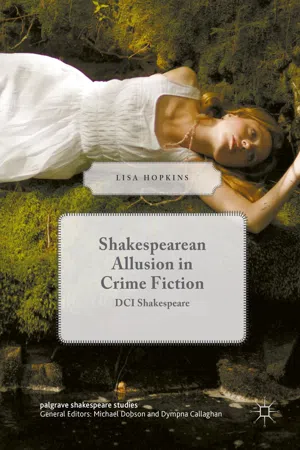
This book explores why crime fiction so often alludes to Shakespeare. It ranges widely over a variety of authors including classic golden age crime writers such as the four 'queens of crime' (Allingham, Christie, Marsh, Sayers), Nicholas Blake and Edmund Crispin, as well as more recent authors such as Reginald Hill, Kate Atkinson and Val McDermid. It also looks at the fondness for Shakespearean allusion in a number of television crime series, most notably Midsomer Murders, Inspector Morse and Lewis, and considers the special sub-genre of detective stories in which a lost Shakespeare play is found. It shows how Shakespeare facilitates discussions about what constitutes justice, what authorises the detective to track down the villain, who owns the countryside, national and social identities, and the question of how we measure cultural value.
Information
© The Editor(s) (if applicable) and The Author(s) 2016
Lisa HopkinsShakespearean Allusion in Crime FictionPalgrave Shakespeare Studies10.1057/978-1-137-53875-8_11. Introduction
Lisa Hopkins1
(1)
Faculty of Development and Society, Sheffield Hallam University, Sheffield, UK
In Ngaio Marsh’s Death in a White Tie, Marsh’s hero Alleyn tells his friend Lord Robert Gospel to observe a suspect ‘with the very comment of your soul—’ and Lord Robert interrupts with ‘Yes, yes, yes. Don’t quote now, Roderick, or somebody may think you’re a detective’ (28). In a much later Alleyn novel, Tied up in Tinsel, Alleyn responds to his wife’s attempt to tell him something with, ‘Speak, I am bound to hear’, and she says, ‘Rory! Don’t be a detective’ (514). Both quotations are of course from Hamlet, and Shakespeare is a pervasive presence in detective fiction. Sometimes he is merely touched on, or suggested by a detail; in John Bingham’s My Name is Michael Sibley, for instance, the narrator notes that ‘when evening came I wandered across to the Falstaff and had a couple of large whiskies’ (222). Sometimes Shakespeare is called in evidence as a guide to human nature, as in John Bude’s The Sussex Downs Murder where the detective, trying to decide on the degree of Janet Rother’s guilt, thinks, ‘Now what the devil was that bit from Shakespeare? About the apple. Ah—“a goodly apple rotten at the core”. Well, Janet Rother might quite easily be rotten at the core’ (155). The importance of Shakespearean allusion as a background element is neatly illustrated by Runa Fairleigh’s highly self-conscious An Old-Fashioned Mystery, which itself purports to be based on a manuscript of mysterious provenance and features just about every possible cliché of the genre, including a character whose main contribution to conversations is ‘I say!’, a girl who doesn’t know whether she has committed crimes or not, purloined letters, a locked room mystery and a whole host of secret passages, and ten people on an island who are killed one by one with no obvious perpetrator. Since no one has succeeded in solving the numerous murders, An Old-Fashioned Mystery concludes in an afterlife into which the characters are issued by Ronald Knox, a writer who famously deplored supernatural elements in crime fiction; a list of his ‘Ten Commandments of Detection’ given in a footnote (217) makes clear that every possible one of them has been broken. Officially the text makes no acknowledgement of Shakespeare beyond the bare fact of containing twins named Sebastian and Violet, but its opening epigraph is from King Lear (9), and at the end of the book the narrator pityingly tells the characters that this in itself really should have been enough to alert them to the fact that they were inhabiting a crime narrative (237).
Often, mention of Shakespeare is more sustained and substantial than this. R. S. White suggests that
when we look at cinematic crime thrillers, detective stories and films noirs in general, we can see the recurrence of at least some generic features drawn from Macbeth and Hamlet especially. The first provides the basis of a murderer’s guilt, a prevailing atmosphere of menace, and the most famous femme fatale in literary history – adding up to the ingredients for film noir; Hamlet provides the prototype for an investigative detective on the tracks of a murderer and becoming implicated himself, and also thread in ‘thrillers’ based on personal revenge for the death of a family member (wife in The Big Heat), a close colleague (The Maltese Falcon), or even a father-figure, if not always one so ghostly as Hamlet’s. (White, 6)
A number of writers and detective series show a sustained pattern of Shakespearean allusion, which may come from a wide range of plays. In the 1973 film Theatre of Blood a failed Shakespearean actor murders his critics using methods borrowed from plays including Julius Caesar (mass stabbing), Troilus and Cressida (being dragged by a horse), Cymbeline (beheading), The Merchant of Venice (cutting of a pound of flesh), Richard III (drowning in wine), Othello (pillow), Henry VI, Part One (burning at the stake), Titus Andronicus (eating of one’s ‘babies’, which are in this case dogs) and finally King Lear, as Diana Rigg’s dutiful daughter dies in her father’s arms after justice finally catches up with him; the glittering cast includes Renée Asherson, who played Katherine in the Olivier Henry V, and there is some obvious parody of Olivier’s style and mannerisms. Theatre of Blood is a particularly entertaining and self-conscious example of the genre, but it is by no means unique: a similar effect can be seen in a wide variety of writers. In this book, I explore some of the ways in which Shakespeare can feature in detective fiction and what effects this may have.
The Shakespearean Presence in Detective Fiction
Allusion to Shakespeare in detective fiction is a phenomenon that starts early in the development of the form; the principal change, as Susan Baker notes, has been that ‘the more recent the mystery, the more likely it is to identify the source of its Shakespearean citations’ (‘Comic Material’, 166). In Caroline Clive’s 1855 Paul Ferroll, Lady Lucy’s mad butler, Hamlet-like, thinks himself beckoned by a ghost whom only he can see (30), while Ferroll himself writes in his diary, ‘I went into Key’s district today, because he is ill and gone away. “Zounds! how has he the leisure to be sick, in such a justling time?”’ (42), asks ‘how’s Lancelot Gobbo; what do you call him—Caleb Balderstone?’ (66) and quotes Romeo’s ‘My bosom’s lord sits lightly on its throne’ (143). Most notably, Ferroll echoes Othello when he says in his diary that ‘dying together, and now, would be such a pleasure; we are so happy’ (39) and when he declares on New Year’s Eve that ‘I will put more logs on the fire, and the lamp has abundance of oil. It is only violence that could put out its light’ (155); if we had not already guessed that he himself was the murderer of his first wife we might do so now, but we could not yet divine that in fact the parallel is doubly apposite, because the revelation of his guilt will kill his second wife too. In Robert Barr’s 1906 The Triumphs of Eugène Valmont, ‘the utterances of an empty-headed ass dressed in a little brief authority, as the English poet says, were looked upon as the epitome of wisdom’ (11), Lord Chizelrigg’s uncle illegally sold ‘several priceless Shakespeares’ (91) and Lord Chizelrigg himself laments the lack of a ‘harmless, necessary hat-rack’ and refers to ‘my prophetic uncle’ (93) despite the fact that the uncle in question was not in the least prophetic. In E. C. Bentley’s 1913 Trent’s Last Case, classic literature initially seems to have no place given that in the library ‘Bound with a sober luxury, the great English novelists, essayists, historians, and poets stood ranged like an army struck dead in its ranks’ (37), but ‘Trent said to himself that the absurdity or otherwise of a lover writing sonnets to his mistress’s eyebrow depended after all on the quality of the eyebrow’ (70), the secrerary Marlowe was in OUDS and ‘played Bardolph Cleon and Mercutio’ (106) and Trent finds ‘in Marlowe’s bedroom a photograph of himself and two others in the costume of Falstaff’s three followers, with an inscription from The Merry Wives’ (106), while Trent writing to Marlowe wonders, ‘Shall I compare him to a summer’s day?’ (134) and notes that ‘The wine here … is almost certainly made out of grapes’ (167).
G. K. Chesterton is also a serial alluder. In ‘The Secret Garden’, one of the hobbies of an American millionaire, Julius K. Brayne, was ‘to wait for the American Shakespeare—a hobby more patient than angling’ (34) and ‘A low knocking came at the door, which, for some unreasonable reason, curdled everyone’s blood like the knocking in Macbeth’ (39). In ‘The Queer Feet’, Father Brown declares ‘every work of art, divine or diabolic, has one indispensable mark—I mean, that the centre of it is simple, however much the fulfilment may be complicated. Thus, in Hamlet, let us say, the grotesqueness of the grave-digger, the flowers of the mad girl, the fantastic finery of Osric, the pallor of the ghost and the grin of the skull are all oddities in a sort of tangled wreath round one plain tragic figure of a man in black’ (62). In ‘The Perishing of the Pendragons’, ‘Through a gap in the foliage there appeared for a moment one of those old wooden houses, faced with black beams, which are still to be found here and there in England, but which most of us see imitated in some show called “Old London” or “Shakespeare’s England”’ (228), and in ‘The Strange Crime of John Boulnois’ the would-be seducer casts the object of his schemes as Juliet to his Romeo.
In Dorothy Dunnett’s series of Johnson Johnson mysteries, one of the comic obituaries written by Charles in Roman Nights is
‘Full fathom five my father lies’‘He fell off in a tender’‘The herrings come up pickled there’‘On gin from father’s bender’ (11)
Later in the same book, we find ‘the disapproving presence of Innes listening to Johnson giving an excruciating performance in Englishman’s German of a complete bowdlerized version of Hamlet with all the speaking parts and most of the action’ (164), and ‘With all his Player King instincts Maurice plunged through a high arching hall lined with fragments of marble which proved to be the fastest way on to the stage’ (177); in another of the stories, Split Code, we hear of ‘the sad, floating Ophelia of Hugo’s mad poncho’ (122), while even though the dyslexic Rita in Tropical Issue is not well placed to quote or recognise Shakespeare, Johnson calls her ‘Cordella’ when she walks out onto the caldera in an attempt to save her father (she fails); later, he jokingly alludes to Hamlet when he calls her ‘my prosthetic soul’ (298).
A more modern writer, Val McDermid, is also fond of Shakespearean allusion. In The Torment of Others, the acknowledgements include ‘I am grateful to the Greenfield Girls for letting loose the dogs of narrative’ and one of the two epigraphs is from The Tempest. In The Grave Tattoo, Fletcher Christian’s narrative refers to Pitcairn as offering an opportunity ‘to build a brave new world on our Prospero’s Isle’ (387). In The Mermaids Singing, the serial killer reproaches one of his/her victims: ‘You didn’t have the nerve for a marriage of true minds and bodies, did you?’ (93); later the killer declares ‘Shakespeare got it right when he said, “The first thing we do, let’s kill all the lawyers”’ (183), and when s/he realises that one of his/her objects of desire is dating a lawyer fumes, ‘Frankly, I was with Shakespeare all the way’ (184), while Carol says, ‘the kills have to become more frequent. Shakespeare said it. “As if increase of appetite had grown by what it fed on”’ (224). In The Last Temptation, the narrator says of Tadeusz’s aristocratic grandmother, ‘she’d dressed up her irrational convictions in the fancy clothes of literary allusion. So, rather than teach the boy that troubles come in threes, she’d enlisted Shakespeare’s adage that “When sorrows come, they come not single spies, but in battalions”’ (6). In Star Struck, the narrator notes wryly that ‘There was nothing remotely glamorous about witnessing the seventh take of a scene that was a long way from Shakespeare to start with’ (4) and that ‘About ten per cent of the cast could play Shakespeare or Stoppard. The rest just roll up to the studios every week and play themselves’ (42). In The Wire in the Blood, the information that Donna Doyle had been ‘the Nurse in her form’s reading of Romeo and Juliet’ (5) subtly confirms that hers is a life worth saving, and in The Distant Echo, Hamlet is twice echoed as the wreaths sent by Rosie Duff’s son say ‘Rosemary for remembrance’ and ‘Lawson spun round, a guilty thing surprised’ (522), as indeed he is.
Shakespeare is also a recurrent presence in the TV series Inspector Morse and its spin-offs Lewis and Endeavour; Sarah Olive argues that ‘Shakespeare is only one of many icons used frequently in the Inspector Morse/Lewis franchise to denote quintessential Britishness’ (Olive, ‘Representations’, 9). In the Inspector Morse episode, a character quotes Macbeth when he says, ‘The wine of life is drawn and the mere lees is left this world to brag of’; in ‘The Wolvercote Tongue’, Morse quips, ‘All these Danes—you never meet one called Hamlet, do you?’; in ‘The Infernal Serpent’, ‘Who is Sylvia?’ is asked of Cheryl Campbell’s character and the other girl is called Imogen; in the Lewis episode ‘Your Sudden Death Question’, Hathaway suggests, ‘We could take Shakespeare’s advice and start by killing all the lawyers’, and Nicholas Farrell’s character says, ‘Methinks the lady doth protest too much.’ In ‘Old Unhappy Far Off Things’ we hear ‘Man delights not Diana—nor woman neither,’ while Hathaway, speculating on the killer’s motivation, says, ‘To be thus is nothing … But to be safely thus.’ The Morse episode ‘The Death of the Self’, set in Verona and Vicenza, has Morse saying ‘’Tis not so wide as a church door’ and then identifying the source to Lewis, while in the Endeavour episode ‘Trove’ the pathologist notes ‘Not how I’d my own quietus make’ and Bright says, ‘Once more unto the breach’, and in ‘Nocturne’ the book about the murders is called Plighted Cunning. In the Lewis episode ‘Music to Die For’ Hathaway says, ‘As he was valiant I honour him’; he also quotes Donne, and Lewis says, ‘Don’t give me William Shakespeare at this time of night.’ ‘Generation of Vipers’ opens with a lecture on Shakespeare’s women by a noted feminist scholar who subsequently commits suicide after it is revealed that she has posted a dating video online. She mentions ‘Cressida, who wished she was a man’, and we then see Ulysses’ degree speech being delivered as part of a project to record all of Shakespeare’s plays for the Internet, directed by a former student named Sebastian Dromgoole and including ‘Faithless Cressida, played by Mike’s tart of a girlfriend’. Later we keep hearing the beginning of the kissing scene. Infidelity and fears of it prove crucial threads in the storyline, including a false rumour spread 20 years ago by an anonymous student newspaper correspondent using the name ‘Thersites’. Surveillance is also important: Lewis’s and Hathaway’s glee at a TV report of their successful capture of a cannabis farmer is intercut with the don’s horror at her dating video being made public. As Sarah Olive notes of the Lewis episode, ‘Wild Justice’, which features references to a number of real and one faked Renaissance play, ‘the episode’s teasing invocation, and inversion, of authenticity offers complex pleasures for a wide-ranging audience, who even if they do not have all the cultural capital necessary to recognize the allusions and quotations precisely, can respond to the idea of intertextuality and metatheatricality’ (Olive, ‘Fabricated Evidence’, 84).
In E. W. Hornung’s Raffles stories, Raffles inagurates his relationship with the narrator Bunny in the very first story by asking ‘“Do you see what day it is?” …, tearing a leaflet from a Shakespearean calendar as I drained my glass. “March 15th. ‘The Ides of March, the Ides of March, remember’”’ (10), and this proves to be the first of a number of allusions he makes to Julius Caesar: in the story called ‘The Field of Philippi’, ‘“Then we meet again at Philippi,” cried Raffles in gay adieu’ (327) and Raffles, quoting some of Bunny’s own old verses about the play, says, ‘You may have forgotten your Shakespeare, Bunny, but you ought to remember that’ (334); on another occasion, when Bunny mistakes Raffles for a burglar and coshes him he says, ‘Et tu, Bunny!’ (351). Raffles also says of his meeting with Jacques Saillard on the balcony, ‘I don’t say that Romeo and Juliet were brother and sister to us. But you might have said so, Bunny!’ (217), while Bunny himself repeatedly boosts his stylistic credentials by Shakespearean allusion: ‘all I had to do was indeed to “smile and smile and be a villain”’ (88), Jacques Saillard looking from Raffles to her husband presented ‘the face of one glancing indeed from Hyperion to a satyr’ (216) and ‘Conscience had made a coward of me’ (331) all echo Hamlet; the Narrator’s Note to the second volume promises ‘all set forth (and nothing extenuated)’ (131), which is bookended by the summation of them as ‘these supplementary memoirs, wherein I pledged myself to...
Table of contents
- Cover
- Frontmatter
- 1. Introduction
- 2. Wild Justice: Mercy, Revenge and the Detective
- 3. Who Owns the Wood? Appropriating A Midsummer Night’s Dream
- 4. Border Patrol: Shakespearean Allusions and Social and National Identities
- 5. Stealing Shakespeare: Detective Fiction and Cultural Value
- Backmatter
Trusted by 375,005 students
Access to over 1.5 million titles for a fair monthly price.
Study more efficiently using our study tools.
Frequently asked questions
Yes, you can cancel anytime from the Subscription tab in your account settings on the Perlego website. Your subscription will stay active until the end of your current billing period. Learn how to cancel your subscription
No, books cannot be downloaded as external files, such as PDFs, for use outside of Perlego. However, you can download books within the Perlego app for offline reading on mobile or tablet. Learn how to download books offline
Perlego offers two plans: Essential and Complete
- Essential is ideal for learners and professionals who enjoy exploring a wide range of subjects. Access the Essential Library with 800,000+ trusted titles and best-sellers across business, personal growth, and the humanities. Includes unlimited reading time and Standard Read Aloud voice.
- Complete: Perfect for advanced learners and researchers needing full, unrestricted access. Unlock 1.5M+ books across hundreds of subjects, including academic and specialized titles. The Complete Plan also includes advanced features like Premium Read Aloud and Research Assistant.
We are an online textbook subscription service, where you can get access to an entire online library for less than the price of a single book per month. With over 1.5 million books across 990+ topics, we’ve got you covered! Learn about our mission
Look out for the read-aloud symbol on your next book to see if you can listen to it. The read-aloud tool reads text aloud for you, highlighting the text as it is being read. You can pause it, speed it up and slow it down. Learn more about Read Aloud
Yes! You can use the Perlego app on both iOS and Android devices to read anytime, anywhere — even offline. Perfect for commutes or when you’re on the go.
Please note we cannot support devices running on iOS 13 and Android 7 or earlier. Learn more about using the app
Please note we cannot support devices running on iOS 13 and Android 7 or earlier. Learn more about using the app
Yes, you can access Shakespearean Allusion in Crime Fiction by Lisa Hopkins in PDF and/or ePUB format, as well as other popular books in Literature & Literature General. We have over 1.5 million books available in our catalogue for you to explore.