eBook - ePub
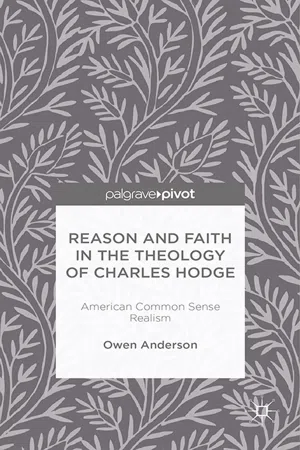
Reason and Faith in the Theology of Charles Hodge: American Common Sense Realism
American Common Sense Realism
- English
- ePUB (mobile friendly)
- Available on iOS & Android
eBook - ePub
Reason and Faith in the Theology of Charles Hodge: American Common Sense Realism
American Common Sense Realism
About this book
Charles Hodge engaged the leading thinkers of his day to defend the human ability to know God. This involved him in affirming the importance of both orthodoxy and piety in the life of a Christian. His work involved expanding on the insights of the Westminster Confession of Faith as it applied to the theory of salvation and the role of Christ.
Information
Topic
Theology & ReligionSubtopic
Modern History1
Introduction
Abstract: Milton begins his epic about the spiritual war between good and evil by focusing on the introduction of death and evil into the world at the Fall. This chapter presents Charles Hodge and states the purpose of this book as a study of how he understood the clarity of general revelation. His understanding of general revelation reverberates through his thinking about soteriology, and of good and evil.
Anderson, Owen. Reason and Faith in the Theology of Charles Hodge: American Common Sense Realism. New York: Palgrave Macmillan, 2014. DOI: 10.1057/9781137362902.0006.
Of Mans First Disobedience, and the Fruit
Of that Forbidden Tree, whose mortal tast
Brought Death into the World, and all our woe,
With loss of Eden, till one greater Man
Restore us, and regain the blissful Seat
Of that Forbidden Tree, whose mortal tast
Brought Death into the World, and all our woe,
With loss of Eden, till one greater Man
Restore us, and regain the blissful Seat
(Book 1)
The theology of Charles Hodge
Charles Hodge falls within the Reformed tradition that places its emphasis on knowing God and knowing the self. “Reformed theology, like Calvin’s Institutes invariably has begun the task of theological reflection with single-minded attention to the doctrine of God.”1 The knowledge of God and the knowledge of the self are intertwined because as one knows more about the self and the human condition one knows more about God, and as one knows more about God one knows more about the human condition. Hodge is arguably the best representative of this theology in American history, more so than Jonathan Edwards who gets much more attention. Where Edwards was influenced by idealism (the belief that ideas are real and the material world is not) and occassionalism (the belief that each moment is created by God) and made his own emphasis on religious experience (a non-cognitive experience rather than a knowing of God), Hodge worked within the Westminster tradition to articulate how God can be known, and be defended the Reformed soteriology and ordo salutus (order in which salvation is applied).
Hodge traces his Reformed heritage and his project of work in Christianity through the scriptures to:
The Augustinian scheme includes the following points: (1) That the glory of God, or the manifestation of his perfections, is the highest and ultimate end of all things. (2) For that end God purposed the creation of the universe, and the whole plan of providence and redemption. (3) That He placed man in a state of probation, making Adam, their first parent, their head and representative. (4) That the fall of Adam brought all his posterity into a state of condemnation, sin, and misery, from which they are utterly unable to deliver themselves. (5) From the mass of fallen men God elected a number innumerable to eternal life, and left the rest of mankind to the just recompense of their sins. (6) That the ground of this election is not the foresight of anything in the one class to distinguish them favorably from the members of the other class, but the good pleasure of God. (7) That for the salvation of those thus chosen to eternal life, God gave his own Son, to become man, and to obey and suffer for his people, thus making a full satisfaction for sin and bringing in everlasting righteousness, rendering the ultimate salvation of the elect absolutely certain. (8) That while the Holy Spirit, in his common operations, is present with every man, so long as he lives, restraining evil and exciting good, his certainly efficacious and saving power is exercised only in behalf of the elect. (9) That all those whom God has thus chosen to life, and for whom Christ specially save Himself in the covenant of redemption, shall certainly (unless they die in infancy), be brought to the knowledge of the truth, to the exercise of faith, and to perseverance in holy living unto the end. Such is the great scheme of doctrine known in history as the Pauline, Augustinian, or Calvinistic, taught, as we believe, in the Scriptures, developed by Augustine, formally sanctioned by the Latin Church, adhered to by the witnesses of the truth during the Middle Ages, repudiated by the Church of Rome in the Council of Trent, revived in that Church by the Jansenists, adopted by all the Reformers, incorporated in the creeds of the Protestant Churches of Switzerland, of the Palatinate, of France, Holland, England, and Scotland, and unfolded in the Standards framed by the Westminster Assembly, the common representative of Presbyterians in Europe and America.2
We see how it ends with the Westminster Confession of Faith as the high water mark of the Reformation. Coming at the end of the Reformation, the Westminster Confession summarized all that was best that had come before and contributed a doxological focus that points all of human life to the glory of God. It was received in the New England Colonies the same year it was finished (1648) and has had an immeasurable impact on American history. In England, the English Civil War led the Confession to be in many ways forgotten, except where it was taken to Scotland and then had renewed impact in the Colonies and United States through Scottish and Scots Irish immigrants.
Hodge himself was catechized as a young man in the Westminster Shorter Catechism. He speaks of how at college the students were expected to memorize in Latin the catechisms of their denominations (Presbyterian or Episcopalian). Since the Episcopalian catechism was shorter, Hodge notes humorously that some Presbyterian students passed themselves off as Episcopalians to avoid the harder memorization.
A significant amount of Hodge’s energy was spent on church governance matters and on debates about soteriology (the theory of salvation). The New England Theologians were in many cases becoming either Unitarian or Arminian, and this alarmed the Princetonians. Hodge was at the forefront of defending the Reformed Faith as expressed in the Westminster Confession.
Just as Hodge begins his overview by stating the glory of God is the highest purpose of creation, so too the Westminster Shorter Catechism begins with its first questions asking, “[W]hat is the chief end of man?” and answering, “[M]an’s chief end is to glorify God and enjoy him forever.”
The purpose of this book
The purpose of this book is to study the idea that there is a clear and full general revelation of God’s eternal power and divine nature. It focuses on Charles Hodge as arguably the leading American Reformed Theologian because of that tradition’s emphasis on the knowledge of God and glorifying God as the chief end of man. In a secondary way it is therefore also about the institution of Princeton Theological Seminary while Hodge was there. Institutions are physical embodiments of ideas, and the ideas that formed the founding of the Seminary, and that Hodge defended, may no longer be the ideas of Princeton Seminary. Did the seminary, or the Old School Theologians, build a lasting foundation by showing the inexcusability of unbelief?
We will consider how Hodge, with varying degrees of consciousness about his assumptions and consistency in applying them, argued that:
1Revealed religion and faith are needed to overcome what is insufficient in general revelation and reason; they are needed to give a more clear account of the nature of God; they are needed because humans are fallen.
2There is an empirical and deontological orientation to Hodge’s studies. He is sometimes called a Baconian empiricist, meaning he relies upon the scientific method of Francis Bacon and applies it to theology and scripture. His moral theory emphasizes duty in this life in order to be rewarded in the afterlife with the beatific vision.
3In some places Hodge works to show that reason and faith are not in tension, but in others he argues for the insufficiency of reason and general revelation and the necessity of scripture is based on this insufficiency. This is not what the Westminster Confession states. Rather, in 1.1 it says that there is a clear general revelation of God, and that scripture is needed not because general revelation is insufficient but because scripture is redemptive revelation explaining the means to salvation since humans have turned away from what is clear about God.
I am going to use the term “foundation” to refer to the answers given to the most basic questions that can be asked. These include questions about how we know, about what is real, and about what is of highest value. How a theologian understands knowledge, God, and the good, forms the foundation on which that theologian builds a system of theology. If the foundation contains errors, even errors otherwise mixed with truths, the foundational errors will infect the entire system. Here, I believe we will see errors about knowledge and about the highest good. A tension will be uncovered between Hodge’s emphasis on knowing the facts about God, and his belief in the beatific vision. If these are indeed errors then even though Hodge offers much else that is beneficial, his foundation cannot be built upon.
In his recent book Surrendra Gangadean argues for clarity against both skepticism and fideism. He argues that the basic things about God and man and good and evil are clear to reason, which is applied against the fideism implicit in much Reformed Theology and its otherworldly view of the good as heaven. His work falls within the tradition we are studying because he argues that God is not known directly, but is known as He reveals himself through His works of creation and providence. Furthermore, he argues that the purpose of human life is to know God, that this was the original purpose of humans before the Fall, and continues to be their purpose. This is in contrast to the belief that the purpose of human life is to have a beatific vision of God in heaven.
Professor Gangadean’s book is relevant to mention because rather than stating that the purpose of general revelation is to leave humans without excuse for their unbelief, he states that general revelation gives a full and clear revelation of the eternal power and nature of God. He begins his study by noting that some things must be clear, that the basic things are clear, that these basic things are clear to reason, and the basic things are about God and man, good and evil. By way of contrast, if nothing is clear then no distinctions can be made (between God and man, or good and evil, or even between the claims “there is something clear” and “there is nothing clear”). The result is nihilism.3
Professor Gangadean offers proofs to show that both God and the moral law are clear to reason. He agrees with the Westminster Confession of Faith that redemptive revelation is necessary because humans have rejected God’s revelation of Himself in the light of nature (reason), creation, and providence. Therefore, this view is neither rationalism nor deism (which we will consider through the arguments of Hodge in this book). Rather, he has called it rational presuppositionalism because by arguing from the most basic to what is less basic, we can come to know what is clear about God and the good. Dr. Gangadean’s position is an alternative to Hodge’s and he responds to challenges that have arisen since Hodge’s time. Part of this study will be to consider whether Hodge and those who influenced him believed that there is a clear general revelation of God’s eternal power and divine nature.
Reformed theology has mostly treated general revelation as a source of inexcusability for unbelief. The emphasis has been on soteriology. In strong reaction to the rationalists and deists, Reformed theologians have emphasized that redemptive revelation is necessary for humans to know God in their Fallen condition. This has led them to state that general revelation is not full and clear, it is not sufficient, but instead that redemptive revelation is the source of full and clear knowledge of God. This has then been coupled with the claim that the goal of redemption is a final heavenly state where God is seen directly. There is a tension here in Reformed theology since reformed theologians back to Calvin assert that God is not known directly but only through His works.
This is not a book about soteriology per se. Nor is it a history of American Presbyterians in the nineteenth century. Two recent biographies about the life of Ch...
Table of contents
- Cover
- Title
- 1 Introduction
- Index
Trusted by 375,005 students
Access to over 1.5 million titles for a fair monthly price.
Study more efficiently using our study tools.
Frequently asked questions
Yes, you can cancel anytime from the Subscription tab in your account settings on the Perlego website. Your subscription will stay active until the end of your current billing period. Learn how to cancel your subscription
No, books cannot be downloaded as external files, such as PDFs, for use outside of Perlego. However, you can download books within the Perlego app for offline reading on mobile or tablet. Learn how to download books offline
Perlego offers two plans: Essential and Complete
- Essential is ideal for learners and professionals who enjoy exploring a wide range of subjects. Access the Essential Library with 800,000+ trusted titles and best-sellers across business, personal growth, and the humanities. Includes unlimited reading time and Standard Read Aloud voice.
- Complete: Perfect for advanced learners and researchers needing full, unrestricted access. Unlock 1.5M+ books across hundreds of subjects, including academic and specialized titles. The Complete Plan also includes advanced features like Premium Read Aloud and Research Assistant.
We are an online textbook subscription service, where you can get access to an entire online library for less than the price of a single book per month. With over 1.5 million books across 990+ topics, we’ve got you covered! Learn about our mission
Look out for the read-aloud symbol on your next book to see if you can listen to it. The read-aloud tool reads text aloud for you, highlighting the text as it is being read. You can pause it, speed it up and slow it down. Learn more about Read Aloud
Yes! You can use the Perlego app on both iOS and Android devices to read anytime, anywhere — even offline. Perfect for commutes or when you’re on the go.
Please note we cannot support devices running on iOS 13 and Android 7 or earlier. Learn more about using the app
Please note we cannot support devices running on iOS 13 and Android 7 or earlier. Learn more about using the app
Yes, you can access Reason and Faith in the Theology of Charles Hodge: American Common Sense Realism by O. Anderson in PDF and/or ePUB format, as well as other popular books in Theology & Religion & Modern History. We have over 1.5 million books available in our catalogue for you to explore.