eBook - ePub
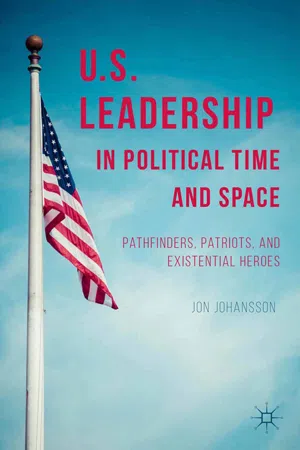
US Leadership in Political Time and Space
Pathfinders, Patriots, and Existential Heroes
- English
- ePUB (mobile friendly)
- Available on iOS & Android
eBook - ePub
About this book
Spanning the history of American leadership, the book examines all facets of American thought leaders and innovators along with the models of ethics and courage they've provided for the American consciousness. From Thomas Paine to Rosa Parks, the book provides a multi-faceted approach to American leadership studies.
Information
PART I
Americans as Free Artists of Themselves
CHAPTER 1
US Leadership in Political Time and Space
Adapting to Change: Introducing Political Time
The passage of time between President George Washington and President Barack Obama reveals how the ebb and flow of American politics has always involved a process of order and change. Presidents, like the citizens they lead, are embedded within this history. Occasionally presidents, when the situation is malleable, become the initiator of change; most other times they respond to change phenomena occurring elsewhere. During the revolutionary era—before the duly created constitutional architecture and the government institutions solidified into a workable, then resilient, political system—leadership was vital to make the constituent parts of a new American democracy work. Thus every act of President George Washington’s was a first, and he was hypervigilant about the precedent-creating potential of his every action, so the general’s “judicious and restrained hand” guided his nascent country, allowing the new Constitution to bed in with a constitutionally respectful, and bounded, president at the helm.1
The result was that an American tyrant did not replace a British one. The founders, in their construction of the presidency, may have relied too much upon the general’s discretion in forging the office, but their confidence in him was not misplaced. Washington, in this essential sense, became an order-creating president. Twelve years after Washington’s inauguration, however, America’s third president, Thomas Jefferson, would prove to be an order-shattering one, the first in the nation’s history. By repudiating his Federalist inheritance, Jefferson transformed what was meant by legitimate democratic government.2 Relationships between the three branches of government were still extremely fluid, however. Jefferson, as president, was able to make the Louisiana Purchase without appropriate congressional appropriation and then structure the new territory as he saw fit, without attracting any constitutional rebuke.
For Obama and his successors, these very same constitutional ingredients have matured and then rigidified over more than two centuries of practice and experience, through constitutional amendment and statute law, and by surviving periodic national tests and upheavals. Thus, while change is the only constant in politics and society, the political system’s ability to respond to it has become more difficult over time as sophisticated decision-making systems and institutions of ever greater complexity have complicated presidential leadership, most especially in the domestic sphere.3 Economic and social forces are never static, even when they appear so, because they continually evolve at different speeds and intensities as they respond to external shocks, internal contradictions, destructive forces as well as technological or other forms of innovation. American-style democracy thereby offers a competitive and dynamic system that requires leadership to adaptively respond to change stimuli, whether large or small.4
Historical progression is, therefore, accompanied by a rhythm. The beat of this rhythm changes as different situations occur and as resulting leadership responses either change the direction of politics or confirm paths already taken. We can label this beat political time. From the perspective of presidents, political time is their construction of their moment in history.5 According to Yale presidential scholar Stephen Skowronek, political time offers presidents different opportunities or constraints depending on whether they are affiliated with or opposed to the dominant regime and whether the underlying received commitments are resilient or vulnerable. These variables help to locate presidents during their moments in history. Each different beat imposes different demands, so Skowronek’s concept of political time is very insightful because it reinforces the extent to which a president’s agency is influenced by situational variables as well as deeper historical currents. When presidents have great scope to effect change, they nonetheless still need help to do so, as we shall discover in this study. Individuals and groups in Congress or in communities form part of the leadership process that then ensues. When a president has limited or no scope to effect change, then other Americans have even greater opportunity to force change, whether locally or on a national scale. Political time, therefore, reinforces crucial relationships between different levels of leadership flowing through the political system, but to what end?
Long-term historical trajectories in the physical realm and social, economic, and international environments, as well as technological and intellectual changes that impact on these variables, all run on different arcs so historical progression is a hugely dynamic and unpredictable process. These very same dimensions are defined here as “political space.” It is the interaction between political time and the resulting changes in the shape of political space that is one of the primary interests in this study, which analyzes leadership phenomena occurring at levels below that of presidents. An underlying foundation for the case studies that follow is, therefore, the notion that American-style democracy is an inherently leadership-driven system and also that it is an open, self-correcting system. While most American leadership studies focus, not unnaturally, on the president as the major agent of change, this study has a more open mind about where leadership may emerge from. Sometimes presidents effect big change, most especially in foreign policy or in the exercise of war making, where few constraints exist to restrict presidential choice or when situational crises send power flowing upward to the president. However, presidents are often limited in their effective action, especially in the domestic sphere. In these circumstances, leadership does not cease to exist, just the location of its origin and expression will change.
Political Space and Time
Political space can also be conceived of as the realm of human activity relating to politics, as well as the material resources with which that activity interacts.6 Political space also includes the representation of this human activity in the mind. It is, in this sense, both temporal and an expression of human imagination; so it is both mountain and metaphor. As an illustration, Meriwether Lewis’s story (chapter 4) canvasses different dimensions of political space, which include the physical space that was represented by Lewis’s great western traverse, codified through the cartography of Lewis’s co-leader, Captain William Clark, which was created by territorial space purchased by the United States from France, as well as by imaginative space—a Jeffersonian “empire of liberty”—that would grow over the centuries, greatly expanding upon the intellectual space of Thomas Paine (chapter 1) who coined, during the War of Independence, an idea called “The United States of America.” In chapter 6, by way of a further example, when looking at the leadership efforts of the first black baseballer to break the race barrier, Jackie Robinson, political space is concerned with one moment in political time in a, by then, 171-year struggle for equality, otherwise known as the civil rights movement, attempting to carve out an equal share of the personal and national space guaranteed to all Americans in the Declaration of Independence and to black Americans through constitutional amendment.
Political time is uninterrupted, but it has rhythms, and these rhythms can repeat themselves across time as historical cycles. It takes the wild card of human imagination to give this structure and its components their name. That is why political leaders are embedded in political time and space. And there is no escape for them from its effects. While those effects are variable there is latitude for human creativity to vary the trajectory of political time and with it the shape of political space. While it is impossible to escape political time it is possible, if sufficient skill exists, to borrow it from time to time and exploit it for adaptive purposes. Political space and time can be, however, deceptive. The Bush–Obama transition is a good example of this. Take this statement by Obama’s chief political strategist David Axelrod:
I think there’s no question that a verdict has been rendered on the policies of the past eight years and in many ways extending back to the governing philosophy that we’ve had for 30 years . . . and in 1980, the New Deal–Great Society epoch came to an end and it launched another era that I think history will say lasted for 28 years.7
Axelrod rightly looked at the collapse of the Bush presidency and the healthy mandate, underpinned by a 40-year surge in electoral participation, which swept Obama into office, as a sign that political space had opened up after the preceding 28-year direction of it had been repudiated. While it remains finely balanced, the first six years of Obama’s presidency suggest that the previous political space—seen as malleable and open to the possibilities of transformative leadership—was more resilient than it appeared at first blush.
Space can also disrupt the ability of political leaders to exploit political time by imposing limits upon their effective action. While political time waxes and wanes, or may even be in perpetual wane, sometimes it does afford opportunity to lead change. Sometimes it demands imagination to create more adaptive effects. Sometimes political time demands courage to prevent worse, maladaptive things from taking place. Sometimes it matters not whether action is taken, because nothing can withstand forces too large to combat, however heroic it might be to try. Leadership, in these different ways, is an instrument of social adaptation—comprising word or action—to create greater possibilities than those inherited. The working definition of leadership in this study, therefore, is this: leadership exploits political time to grow, defend, or defy political space. A successful leader can recognize their opportunities to alter political space in adaptive ways and possess the skills to exploit those opportunities. However, inertia is a constant force that if left unchecked produces entropy. Inertia builds up over political time. Political space can then become so cramped that it has the effect of making political time stand still. In these circumstances any creative response has little if any effect. And thus, when high-level leadership cannot change political space, adaptive cultural traits can serve as effective guides for leaders and individual citizens in their attempts to expand political space once more.
Political time and space are not dissimilar to their namesakes in the physical universe. When thinking about America, one might say that its big bang was on July 4, 1776. The special alchemy that created the conditions for America exploding into life was its repudiation of an intolerable status quo and a confidence to ignore limits, defy history, and create something new. After its birth, America experienced a rate of rapid expansion and then, over time, the chaos and fluidity of the earliest phases gave way to ever greater order, while the seeds of future rigidity were also established. In this way, the political realm, and the laws that both drive and shape politics, has structure, much like the solar system we live in. The structure is not always clear to us, but it is a structure, nevertheless: there are strong and weak forces (i.e., the economy versus local ballot initiatives, or, say, campaign finance versus electoral participation); gravitational movement, such as the action and reaction of policy initiatives; long-established relationships between different celestial bodies (i.e., Democrats and their constellation of orbiting interests, and the Republicans and their equivalents); black holes of maladaptive or misdirected action (i.e., slavery, segregation, the Vietnam and Iraq wars); and political voids (such as entitlement reform), and so on.
So, for a president, political space creates the boundary conditions for calculations about political time and how to exploit it. In Skowronek’s theory of structure and action, two order-affirming or two order-opposing types of political space emerged according to the dictates of political time.8 Each suggested different leadership strategies for presidents to be successful. The conception of political space offered here can also serve as a chain or liberator for a president—that is, it also creates their boundary conditions—but space is more expansively conceived than in Skowronek’s formulation. Thus, while the citizenry are bounded by political time, they are, also, part of a much wider leadership system—one called American democracy—and they, like their president, may also in the right contexts, and depending on their strategic location within the whole, have opportunities to disturb political space in adaptive ways.
Therefore, it is not just presidents who forge new worlds or remake old ones. It is all Americans and any American. Leadership has frequently emerged from the presidency, most especially during times of national or international crisis, but it can also be forged through the purposeful actions of suboptimal political actors or nonpolitical actors, particularly for those who reach into the deep cultural foundations of their country or those who exploit favorable situational dynamics. They can, through word or deed, lead in political time by breaking through blockages that political elites cannot surmount, for whatever constraining reasons. Suboptimal political actors or nonpolitical actors can also lead during political time by acting in ways not predicted by political elites to create a new political space. They can also lead by executing their political elites’ plans beyond that which was originally envisaged, or they can also come to embody political time through their actions, even if failure then ensues, to serve as an adaptive marker for later generations to learn from. We now turn to these three archetypes of individuals.
Pathfinders, Patriots, and Existential Heroes
In the United States the tradition of ignoring limits, to push ever outwards to forge new space, has been a cultural strength throughout its history. A pathfinder is therefore defined as someone who discovers a new path or way, a pioneer or explorer, in other words. Someone is also a pathfinder who seeks out or promulgates a new idea or an experimental or novel plan that changes political space in adaptive ways.9 The earliest notable pathfinder in prerevolutionary America was Benjamin Franklin. New ideas attributed to him include bifocal lenses, the lightening rod, most of the key terms now used in electricity, the Franklin stove, and the odometer. Franklin was also hugely influential in establishing the University of Pennsylvania, was at the forefront of demographic research, and was the first president of the American Philosophical Society. During his years as postmaster, Franklin essentially created America’s nascent communications network across its vast space and disparate communities. The Scottish philosopher David Hume described Franklin as America’s first philosopher, while biographer Walter Isaacson thought Franklin “laid the foundation for the...
Table of contents
- Cover
- Title
- Part I Americans as Free Artists of Themselves
- Part II Revolutionary Exemplars: Words as Action and Actions as Words
- Part III Our Better Angels: Reinvention and Moral Crises
- Part IV American Promise: One Voice Can Change a Room
- Appendices
- Notes
- Bibliography
- Index
Trusted by 375,005 students
Access to over 1.5 million titles for a fair monthly price.
Study more efficiently using our study tools.
Frequently asked questions
Yes, you can cancel anytime from the Subscription tab in your account settings on the Perlego website. Your subscription will stay active until the end of your current billing period. Learn how to cancel your subscription
No, books cannot be downloaded as external files, such as PDFs, for use outside of Perlego. However, you can download books within the Perlego app for offline reading on mobile or tablet. Learn how to download books offline
Perlego offers two plans: Essential and Complete
- Essential is ideal for learners and professionals who enjoy exploring a wide range of subjects. Access the Essential Library with 800,000+ trusted titles and best-sellers across business, personal growth, and the humanities. Includes unlimited reading time and Standard Read Aloud voice.
- Complete: Perfect for advanced learners and researchers needing full, unrestricted access. Unlock 1.5M+ books across hundreds of subjects, including academic and specialized titles. The Complete Plan also includes advanced features like Premium Read Aloud and Research Assistant.
We are an online textbook subscription service, where you can get access to an entire online library for less than the price of a single book per month. With over 1.5 million books across 990+ topics, we’ve got you covered! Learn about our mission
Look out for the read-aloud symbol on your next book to see if you can listen to it. The read-aloud tool reads text aloud for you, highlighting the text as it is being read. You can pause it, speed it up and slow it down. Learn more about Read Aloud
Yes! You can use the Perlego app on both iOS and Android devices to read anytime, anywhere — even offline. Perfect for commutes or when you’re on the go.
Please note we cannot support devices running on iOS 13 and Android 7 or earlier. Learn more about using the app
Please note we cannot support devices running on iOS 13 and Android 7 or earlier. Learn more about using the app
Yes, you can access US Leadership in Political Time and Space by J. Johansson in PDF and/or ePUB format, as well as other popular books in Politique et relations internationales & Histoire de l'Amérique du Nord. We have over 1.5 million books available in our catalogue for you to explore.