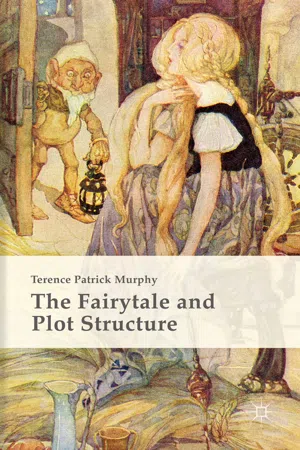
This book offers a detailed exploration of the plot genotype, the functional structure behind the plots of classical fairy tales. By understanding how plot genotypes are used, the reader or creative writer will obtain a much better understanding of many other types of fiction, including short stories, dramatic texts and Hollywood screenplays.
- English
- ePUB (mobile friendly)
- Available on iOS & Android
eBook - ePub
The Fairytale and Plot Structure
About this book
Information
Topic
LetteraturaSubtopic
Letteratura generale1
The Origins of Plot Analysis
In The Poetics, Aristotle suggests that a plot needs to have sufficient amplitude to allow a probable or necessary succession of particular actions to produce a significant change in the fortune of the main character.1 What this means for Aristotle is that in comedies, the main character moves from bad to good fortune, while in tragedies the main character moves from good to bad fortune. With these definitions, Aristotle commits himself to the view that all well-structured stories have something in common. But there is little sign that Aristotle ever considered that behind the extraordinary diversity of Greek drama, there might lurk a fundamental uniformity. For Aristotle, the plot—the actions, motifs and characters—was either well-made or otherwise. The audacious insight—that the plots of all well-made stories were, in effect, the same—was not to receive strong critical support until the middle years of the twentieth century.2
The first inkling of this idea can be traced back to the work of philologists like William Jones, Franz Bopp and Jacob Grimm, who posited the idea of the unity of the so-called Indo-European family of languages. After the publication of William Jones’s essay on the profound similarities in the sound systems of Sanskrit and Greek in 1786, it was not long before other theorists began to extend this idea to the world of story. In the second edition of Kinder-und Hausmärchen (1819), the Brothers Grimm first raised the issue of the similarities that existed in the stories of nations widely removed in distance and time. By 1856, in a last considered statement on this issue, Wilhelm Grimm noted that “the outermost lines are coterminous with those of the great race which is commonly called Indo-Germanic, and the relationship draws itself in constantly narrowing circles round the settlements of the Germans.”3
The theory of solar mythology
In Comparative Mythology (1856), the German-born Oxford scholar Friedrich Max Müller attempted to resolve the apparent mystery of the barbarous elements in Greek myth by suggesting that these myths were derived from an earlier set of Sanskrit originals. Müller’s major insight was the recognition of the philological connection between the Vedic sky god Dyậus and the Greek god Zeus. If these two gods were identical, Müller reasoned, then the whole pantheon of Vedic and Greek gods might be kin. At this point, Müller sought to demonstrate that “the marriage of Uranus and Gaea represents the union of heaven and earth” and that the “paternal cannibalism of Cronus originally signified the heavens devouring, and later releasing, the clouds,” while “the act of Zeus depicts the final separation of heaven and earth, and the commencement of man’s history.”4 By reading Greek mythology in terms of a set of analogies derived from solar mythology, Müller was able to explain to his own satisfaction the lingering barbarous elements that might be seen to mar the otherwise rationalist worldview of the Greeks. In India: What Can It Teach Us? (1883), Müller gave poetic expression to the expansive purview surveyed by solar mythology:
What we call Noon, and Evening, and Night, what we call Spring and Winter, what we call Year, and Time, and Life and Eternity—all this the ancient Aryans called Sun. And yet wise people wonder and say, How curious that the ancient Aryans should have had so many solar myths. Why, every time we say “Good Morning,” we commit a solar myth. Every poet who sings about “the May driving the Winter from the field again” commits a solar myth. Every “Christmas number” of our newspapers—ringing out the old year and ringing in the new—is brimful of solar myths.5
Later solar mythologists were to offer up related variants on these analogical themes, with the storm clouds, the wind and the sky alternately taking the more prominent role in the explanations of ancient myth.6 For all its exuberance, Müller’s work was nonetheless marked by an attention to philological detail that prevented his theorizing from becoming too ambitious. This scholarly attention, unfortunately, was not so prominent among his successors, some of whose lack of Sanskrit meant that they were more prone to the use of analogy without sound philological underpinnings to make a mythological connection. Müller’s own review of George W. Cox’s A Manual of Mythology, in the Form of Question and Answers (1867), for example, criticized the author, a disciple of the great German scholar, for his overreliance on analogy and his lack of substantive philological evidence.7 The theory of solar mythology illustrates two prominent dangers that a theory of the plot inevitably encounters: those of unlimited ambition and uncontrolled extension. In the end, solar mythology succumbed to these dangers. As its defenders were forced to draw on more and more unlikely analogies in support of their central thesis, the theory of solar mythology came under sustained and eventually fatal attack, with the theory overwhelmed by the weight of exceptions to its main postulates.8 Nonetheless, the efforts of the solar mythologists were not wholly in vain. In time, solar mythology helped give birth to an alternative theory that attempted to explain these extraordinary similarities in terms of a common origin in ancient ritual and ceremony.
Ritualism: the savage origins of the folktale
The beginning of the theory of the savage or ritualistic origins of the folktale can be traced back to the publication of Edward Burnett Tylor’s Primitive Culture (1871). Tylor was among the earliest anthropologists to draw sustained attention to the striking similarities among the great civilizational myths of the past. In the light of Tylor’s work, the first generation of the English Folk-lore Society, which included such luminaries as Marian Roalfe Cox, Alfred Nutt and Andrew Lang, attempted to extend this insight into the field of folklore and folktale research. In February 1883, the English Folk-Lore Society published guidelines for the proper analysis of the folktale. Using a variant of Cinderella, Alfred Nutt offered a model for how this work might be undertaken:
Analysis of Story
Generic Name of Story—(To be filled in by Folk-Tale Committee) Specific Name—The sharp (horned) grey sheep. Dramatis Personae—(1) King, (2) first queen, (3) first queen’s daughter=heroine, (4) second queen, (5) sheep, (6) henwife, (7) henwife’s daughter, (8) second queen’s daughter, (9) prince, (10) bird.
Thread of Story—King and queen have daughter—queen dies—king marries again—stepmother bad to daughter—latter comforted by sharp (horned) grey sheep—stepmother takes counsel with henwife—latter sends her daughter Ni Maol Charach to spy—heroine offers to dress her head—she sleeps with front eyes but sees with back ones the sheep bringing food—realizes what she has seen—sheep ordered to be killed, but directs heroine beforehand to gather up bones and roll them in her skin—latter does so but forgets one hoof and sheep comes alive but limps.—Prince notices heroine and loves her—henwife’s daughter relates this—stepmother sends own daughter to herd and puts heroine to kitchen work—latter receives shoes from prince and appointment to meet in church, goes thither, returns before others come out, loses shoe third time—owner of shoe to marry prince—stepmother by henwife’s advice mutilates own daughter to make shoe fit—betrayed thrice by bird on wedding day—third time prince listens, finds the report true, seeks heroine and marries her.9
Thread of Story—King and queen have daughter—queen dies—king marries again—stepmother bad to daughter—latter comforted by sharp (horned) grey sheep—stepmother takes counsel with henwife—latter sends her daughter Ni Maol Charach to spy—heroine offers to dress her head—she sleeps with front eyes but sees with back ones the sheep bringing food—realizes what she has seen—sheep ordered to be killed, but directs heroine beforehand to gather up bones and roll them in her skin—latter does so but forgets one hoof and sheep comes alive but limps.—Prince notices heroine and loves her—henwife’s daughter relates this—stepmother sends own daughter to herd and puts heroine to kitchen work—latter receives shoes from prince and appointment to meet in church, goes thither, returns before others come out, loses shoe third time—owner of shoe to marry prince—stepmother by henwife’s advice mutilates own daughter to make shoe fit—betrayed thrice by bird on wedding day—third time prince listens, finds the report true, seeks heroine and marries her.9
Over the course of the next ten years, The Folklore Journal ( 1883–1889), the publication of the English Folk-lore Society, and its successor publication Folklore (1890 onwards) followed up Nutt’s guidelines with a number of studies whose aim was to draw out the striking similarities of folktales around the world. In the special number for May 1889, for example, the entire issue was given over to folklore tabulation. The contributors, including Marian Roalfe Cox, Janet Key, Isabella Barclay and G. L. Gomme, tabulated a diverse set of folktales, using texts discovered in such collections as the Brothers Grimm’s Household Tales (1884), Busk’s Folklore of Rome (1874), Theal’s Kaffir Folktales (1882), Edward Steere’s Swahili Tales (1870) and Rink’s Tales and Traditions of the Eskimos (1875). The purpose of this work was to demonstrate how the striking similarities among these diverse source texts pointed to their common savage or ritualistic origin. This important phase of work culminated in the publication of Marian Roalfe Cox’s Three Hundred and Forty-five Variants of Cinderella, Catskin, and Cap O’Rushes, Abstracted and Tabulated, with a Discussion of Mediaeval Analogues and Notes (1893). Cox’s variant edition was “undertaken at the suggestion of its council, as a test case of their plans for classifying the incidents in folktales.”10 In this study, Nutt’s original test-case analysis of “The Sharp (Horned) Grey Sheep” was incorporated, with a certain amount of theoretical modification, as number 26 of the Cinderella Variants:
“The Sharp (Horned) Grey Sheep”
(1) Queen dies and king remarries.—(2) Stepmother ill treats heroine, and sets her to herd sheep without sufficient food.—(3) Heroine is fed by sheep.—(4) Stepmother wonders thereat, and consults henwife.—(5) Henwife sends her own daughter with heroine.—(6) Who sends her to sleep by dressing her head, but the eye in the back of her head remains open, and sees the sheep coming with meat.—(7) Report thereof is made and sheep is killed.—(8) But beforehand it advises heroine to gather bones in skin.—(9) Which heroine does, and she comes alive again, but halts, the heroine having forgotten the hooves.—(10) A prince passes and falls in love with heroine.—(11) Which is revealed by henwife’s daughter.—(12) Stepmother thereupon sends her own daughter to herd the sheep.—(13) But heroine slips out and receives golden shoes from prince and rendezvous at sermon.—(14) Which she attends after the others, as she is not allowed to leave the house.—(15) The third time this happens the prince runs after her and she loses a shoe in the mud.—(16) Fitting incident follows, and the stepmother by henwife’s advice cuts off her daughter’s toes.—(17) Wedding-day is fixed.—(18) But a bird betrays the secret thrice.—(19) The third time the prince returns and finds the true bride and wedding follows.11
The work of Marian Roalfe Cox clearly anticipated the focus on incident or motif that would eventually be taken up by the Finnish School of folktale analysis. In retrospect, however, there is also a strong indication of alternate routes that the English folklorist might have taken. For example, it is not only in Cinderella that the dissolution of an original family unit serves to set the plot in motion—or that a second marriage serves to terminate it. But nowhere does Cox offer any commentary regarding this important point. Very possibly this lacuna can be explained by the fact that this study of a single central tale and its many variants rendered Cox oblivious to the idea that what was being replicated here went well beyond the mere repetition of similar motifs in a single fairytale. In her Preface, Cox suggested that her principal aim was to examine “the several interesting questions which gather around folk-tales, especially the question of the origin, independent or otherwise, of stories similar in their incident and widespread in their distribution.”12 Cox’s stated interest in the savage origins of the fairytale appears to be the reason for her overlooking the striking resemblances among the plot motifs not just in the variants of Cinderella she chose to examine but even in the large variety of folktales and fairytales that had no obvious affinities with this most famous of European stories.
Migrationism: stable and variable elements in the folktale
A third theory that sought to explain the many similarities in the folktales of the world was the theory of migrationism. According to the migrationist school, the stories of India, Greece and Rome were similar because each variant of a particular tale had resulted from a gradual process of historical and geographical change away from a common original. The most prominent folkloric migrationist or diffusionist school, led by Theodor Benfey, for example, believed that all folktales originated in India.13 One method for developing the theory of folktale migration was to try to separate out what was essential in a folktale from what was the result of its subsequent retelling in a different culture or language. In 1875, Gaston Paris, one of Benfey’s French disciples, made the suggestion that it might be possible to distinguish between those elements that were essential folktale constituents and those elements that were merely accidental. Twenty years later, in his major study Les Fabliaux: études de literature populaire et d’histoire littéraire du Moyen Âge (1893), Joseph Bédier made a distinction between those elements that were necessary to the survival of the folktale, in the way that vital organs are essential to the functioning of the human body, and those that were not. He claimed that in each particular folktale there existed an organic immobile element that might be found in every version, whether past, present or future, and another element that was accessory.14 As his example Bédier took the French folktale “Souhaits Saint Martin.” In this folktale, Bédier suggests, a supernatural being gives to one or more mortals the gift of expressing one or more desires. But contrary to expectation, and to the cost of their authors, these gifts offer no advantage, when they do not actually lead to harm.15 He then draws up a list comparing the stories in terms of their modified elements:
a. one wish is granted to one man;
b. two wishes, one to each of two different persons;
c. the same gift granted to two persons, the first of whom turns this to good, the second to bad;
d. three wishes to three different persons;
e. th...
Table of contents
- Cover
- Title
- Copyright
- Contents
- List of Boxes
- Preface
- Acknowledgements
- About the Author
- Note on the Selection of the Texts
- 1 The Origins of Plot Analysis
- 2 Character Theory: From Aristotle to the Cambridge Ritualists
- 3 Plot Structure: From Aristotle to the Cambridge Ritualists
- 4 From Veselovskian Motif to Proppian Function
- 5 A Proppian Analysis of Charles Perrault’s Cinderella
- 6 False and Real Sequences in Ashputtel
- 7 The Robber Bridegroom: The Limits of Propp’s Analysis
- 8 Fitcher’s Bird: A Second Horrific Fairytale Genotype
- 9 The Frog Prince: The Doubled Pivotal Eighth Function
- 10 Beauty and the Beast: The Irresolute Nineteenth Plot Function
- 11 Puss-in-Boots: The Character of the Angelic Double
- 12 Tom-Tit-Tot: The Character of the Diabolic Double
- 13 Jack and the Beanstalk: The Hero’s Journey
- 14 Little Red Riding Hood: The Defeat of the Heroine in the Struggle
- 15 The Story of the Three Bears: A Very Short Fairytale
- 16 Conclusion
- Appendix 1: The Formal Representation of The Fox and the Crow
- Notes
- Bibliography
- Index
Trusted by 375,005 students
Access to over 1.5 million titles for a fair monthly price.
Study more efficiently using our study tools.
Frequently asked questions
Yes, you can cancel anytime from the Subscription tab in your account settings on the Perlego website. Your subscription will stay active until the end of your current billing period. Learn how to cancel your subscription
No, books cannot be downloaded as external files, such as PDFs, for use outside of Perlego. However, you can download books within the Perlego app for offline reading on mobile or tablet. Learn how to download books offline
Perlego offers two plans: Essential and Complete
- Essential is ideal for learners and professionals who enjoy exploring a wide range of subjects. Access the Essential Library with 800,000+ trusted titles and best-sellers across business, personal growth, and the humanities. Includes unlimited reading time and Standard Read Aloud voice.
- Complete: Perfect for advanced learners and researchers needing full, unrestricted access. Unlock 1.5M+ books across hundreds of subjects, including academic and specialized titles. The Complete Plan also includes advanced features like Premium Read Aloud and Research Assistant.
We are an online textbook subscription service, where you can get access to an entire online library for less than the price of a single book per month. With over 1.5 million books across 990+ topics, we’ve got you covered! Learn about our mission
Look out for the read-aloud symbol on your next book to see if you can listen to it. The read-aloud tool reads text aloud for you, highlighting the text as it is being read. You can pause it, speed it up and slow it down. Learn more about Read Aloud
Yes! You can use the Perlego app on both iOS and Android devices to read anytime, anywhere — even offline. Perfect for commutes or when you’re on the go.
Please note we cannot support devices running on iOS 13 and Android 7 or earlier. Learn more about using the app
Please note we cannot support devices running on iOS 13 and Android 7 or earlier. Learn more about using the app
Yes, you can access The Fairytale and Plot Structure by Terence Patrick Murphy in PDF and/or ePUB format, as well as other popular books in Letteratura & Letteratura generale. We have over 1.5 million books available in our catalogue for you to explore.