- English
- ePUB (mobile friendly)
- Available on iOS & Android
eBook - ePub
About this book
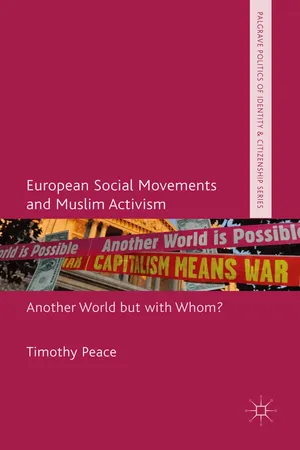
How do progressive social movements deal with religious pluralism? In this book, Timothy Peace uses the example of the alter-globalisation movement to explain why social movement leaders in Britain and France reacted so differently to the emergence of Muslim activism.
Information
Topic
Ciencias socialesSubtopic
Políticas europeas1
The Development of the Alter-Globalisation Movement
Introduction
In this chapter, I explain what I mean by the term ‘alter-globalisation movement’ and provide a history of its development. The first section of the chapter deals with the issue of its definition as this was a ‘movement of movements’ that acquired several different names. Having defined the object of study, I detail the specific history of the movement in Britain and France. This is necessary in order to understand how it differs slightly between the two nations. I then provide a brief overview of the participation within this movement by religious activists. By doing so, I wish to highlight their importance within the movement, something that has often been overlooked by many other scholars. I also outline the forms of participation within the movement by those from what we might term ‘Muslim majority countries’.
What is the ‘alter-globalisation movement’?
This book deals with a movement that most people are familiar with as the ‘anti-globalisation movement’. Yet this terminology is imprecise, as it does not accurately describe what the people involved were actually protesting against. They were, in fact, opposing neo-liberalism and what is known as ‘the Washington Consensus’. The International Monetary Fund (IMF) and the World Bank, the Washington-based international economic organisations (also known as the Bretton Woods institutions), represent the movement’s key symbolic opponents and targets. This opposition also extends to other symbols of trade liberalisation such as the World Trade Organization (WTO) as well as the leading industrial nations, incarnated by the Group of Eight (G8), which are perceived to benefit most from the current financial system at the expense of developing countries. This movement opposing neo-liberalism actually assumed different names according to different languages and territories. In French, it became known as le mouvement altermondialiste and the ideas associated with it as altermondialisme, which is usually translated into English as ‘alter-globalisation’. However, in the English-speaking world, the movement did not develop such an instantly recognised label. Indeed, a variety of alternative terms have been used by movement actors and academics alike; these include the ‘global resistance movement’ (Kingsnorth 2003), the ‘globalisation countermovement’ (Birchfield 2005), the ‘movement against corporate globalisation’ (Juris 2008), the ‘counter-global network’ (Featherstone 2008) or simply the ‘anti-capitalist movement’ (George et al. 2001, Callinicos 2003). Later the term ‘Global Justice Movement’ (GJM) became popular and was adopted by prominent academics who studied it (Della Porta 2007, Moghadam 2009, Eschle and Maiguashca 2010, Flesher Fominaya 2014). In this book, I have decided to use the terms ‘alter-globalisation movement’ and ‘global justice movement’ interchangeably, with the acronym GJM used for convenience. They refer to the same movement and this choice merely reflects the fact that in French-speaking countries the former is preferred while the latter is more common in the Anglophone world (Pleyers 2010).
Various definitions of the movement have been offered, but due to its nature as a ‘movement of movements’ most fall short of describing its complexity. What we can state, however, is that the unifying core of the alter-globalisation movement is opposition to neo-liberalism, and despite no unitary ideological position, it can be broadly placed on the left of the political spectrum. The main rallying events of the GJM are the World and European Social Forums, which are regulated by the Porto Alegre Charter of Principles. The goals of the movement are summarised in the Porto Alegre Manifesto. Therefore, I consider an organisation or individual activist to be part of the alter-globalisation movement if they have participated in, or at least identify with, either the World Social Forum (WSF) or the European Social Forum (ESF). By doing so, they (at least implicitly) subscribe to the Porto Alegre Charter of Principles and share the goals of the Porto Alegre Manifesto. What is more, I specifically chose to study organisations and activists that have been at the heart of the ESF process and closely identify with it.1 The key action repertoire that the movement developed was the concept of a counter-summit whenever institutions such as the G8 or WTO met for talks. This was invariably accompanied by large-scale public demonstrations. Sometimes these demonstrations turned violent and this generated media interest, although this coverage often obscured the movement’s actual purpose and demands.2
Despite the movement being global and transnational, it has developed from very different national histories and has specific characteristics in each country. If we limit our focus to the movement as it has emerged in Western Europe, we can trace its origins to previous movements of contention dating back to the 1960s and perhaps even beyond. However, the true beginnings of the movement, in terms of direct contestation of neo-liberalism, can be found in the mid-1980s. This is hardly surprising given that this was the era when such economic reforms were starting to be implemented. The movement slowly developed throughout the 1990s until it finally exploded on to the world scene with the protest against the WTO ministerial conference in November and December 1999, later dubbed the ‘battle of Seattle’. Gustave Massiah (2011), one of the key leaders in ATTAC, has identified three key phases in the development of the alter-globalisation movement:
1980–1989: Struggles against debt, famine and structural adjustment programs.
1989–1999: Contestation of international organisations connected to globalisation.
2000–2008: The development of the social forums and a worldwide movement.
Although the events of Seattle in 1999 remain key in the history of the GJM, the people and organisations involved did not really coalesce into a genuine and coherent world movement until the decision to create the WSF, which was first held in January 2001. This was initially conceived as simply another counter-summit, this time in opposition to the annual World Economic Forum that takes place in Davos. It nevertheless developed into the most important meeting of the movement and, perhaps more importantly, produced the documents that became its key reference points – the Porto Alegre Charter of Principles drawn up in 2002 and the Porto Alegre Manifesto signed during the 2005 WSF. It also developed what became known as the slogan of the movement – ‘another world is possible’. The success of the WSF inspired the creation of a number of other social forums around the world, most notably the ESF. Just like the WSF, the ESF became the meeting point of the various components of the alter-globalisation movement in Europe who use this event to discuss issues, coordinate their campaigns, share ideas and refine organising strategies (Della Porta 2009a). The ESFs were organised by leading activists through a series of transnational meetings known as the ‘European Preparatory Assemblies’ (EPAs). At the second WSF in Brazil, it was decided that the first two ESFs would be held in Italy and France in recognition of the strength of the movement in those two countries. Indeed, French and Italian activists have always remained the core of those organising the ESF. Since its inception, the ESF has taken place in Florence (2002), Paris (2003), London (2004), Athens (2006), Malmö (2008) and Istanbul (2010).3 Like most social movements, the GJM is composed of a number of social movement organisations (SMOs); however, ‘the unity of the movement should not be confused with the existence of a single organization encompassing its various components’ (Pleyers 2010: 11).
There are, of course, a myriad of competing interests within the movement, and each national alter-globalisation movement is typified by its own cleavages and idiosyncrasies. There is one major division in the movement, often referred to by activists as ‘horizontals’ versus ‘verticals’. The former are those who believe in the benefits of an absence of hierarchy between members and favour deliberative decision-making on a collective basis. The latter are characterised by clearer distinctions between rank and file activists and their leaders. They are more likely to employ practices that resemble traditional representative democracy.4 ‘Horizontals’ are usually part of smaller groups, often take part in direct action and put a great deal of emphasis on ‘autonomy’ and independence from organised structures. They tend to believe the way they take decisions should embody the democratic ideals of the movement itself, while ‘verticals’ are more interested in efficiency and results (Flesher Fominaya 2007). ‘Verticals’ are usually associated with left-wing parties and trade unions but could also include NGOs and other umbrella-type organisations such as the two SMOs studied in this book (ATTAC and Globalise Resistance). It should be stressed here that this study only concerns the ‘vertical’ tendency of the movement, as I was interested in formal organisations and their leaders. It also focuses on the period 2000–2008 which represents the high point of the movement. Since then, the Occupy movement and the various anti-austerity protests such as Indignados have taken on the baton, although they could equally be theorised as just the latest phase of the alter-globalisation movement. This is discussed further in the concluding chapter.
A history of the movement in Britain
The GJM in Britain has always been relatively small and never became as influential as its counterpart across the other side of the channel. It is worth remembering, however, that some of the first ever protest events that form the beginnings of the GJM actually took place in the United Kingdom. NGOs and charitable organisations form the first of three main strands that made up the movement in Britain. An important precursor was the anti-debt campaigns that started in the late 1970s and pressed for the reduction of the foreign debt of developing countries. The aim was to lobby Western governments and highlight the disproportionate burden placed on the poor by structural adjustment programs (SAPs), mandated by the IMF and the World Bank as conditions for debt rescheduling and reduction. The first ever counter-summit to oppose the meeting of the group of leading industrialised nations took place in London in July 1984 during the 10th G7 summit. This was known as TOES (The Other Economic Summit) and one of their main demands was debt relief. A number of figures involved in TOES went on to form the New Economics Foundation (NEF) in 1986. The NEF was one of the key players behind the development of Jubilee 2000, a campaign that called for the cancellation of the debt of the world’s poorest countries by the year 2000 (Mayo 2005). The idea for this campaign had been mooted at the beginning of the 1990s but was only set up officially in 1996. By the time of the next G8 summit in the United Kingdom in 1998, Jubilee 2000 was a well-organised and publicised campaign that involved churches and religious groups all over the country in conjunction with charities and NGOs such as Christian Aid, Oxfam and the World Development Movement (WDM). In the city of Birmingham, where the world’s leaders were meeting, Jubilee 2000 organised a human chain to encircle the city. The campaign achieved a certain amount of success when, at the following G8 summit in Cologne in June 1999, creditor governments accepted a substantial reduction in debt.
The second strand of the British GJM relates to the ‘autonomous’ direct action groups, whose politics is often influenced by anarchism. The first ever protests by this strand of the movement were the ‘Stop the city’ demonstrations that took place in 1983 and 1984, taking their inspiration from the Greenham Common Women’s Peace Camp. New forms of environmental protest also developed in this period, with the anti-roads movement being particularly successful. This was pioneered by a group called ‘Earth First!’ that was launched in 1991 (Wall 1999). Members of this group later went on to form Reclaim the Streets (RTS), which garnered much attention from 1995 onwards after a number of high-profile publicity stunts designed to disrupt urban areas with high levels of traffic. Their usual repertoire of action consisted of invading a road, occupying the space and holding ‘street parties’ with activists and the general public. Over the years, the group developed a more precise anti-neo-liberal and anti-capitalist agenda by opposing the policies of international bodies such as the IMF. They also aligned themselves with the Liverpool dockers labour dispute in a move which some have seen as one of the first examples of the kind of coalition building that became the hallmark of the GJM (Bradley and Knight 2004). In May 1998, when the G8 meeting came to Birmingham, RTS was one of the instigators of a protest called the ‘Global street party’ organised in a number of cities around the world. The largest protest took place in Birmingham itself and at this time the two strands of the emerging GJM came together, with both sets of activists involved in the human chain. The direct action movements organised another protest event the following year in order to coincide with the G8 meeting in Cologne. This became known as the ‘Carnival Against Capitalism’ (codenamed J18 because it took place on 18 June) and was modelled on the ‘stop the city’ demonstrations from the 1980s. The main demonstration in London surprised bystanders by the scale of the protest which at the time was quite unique in Britain. The following year another demonstration took place in London for the international May Day protests which famously resulted in the defacing of a statue of Winston Churchill in Parliament Square.
The third strand of the GJM in Britain is the socialist sector which is dominated by the Socialist Workers Party (SWP) but also involves some trade unions. There are tensions between the anarchists and socialists which often revolve around the role of the SWP (Ibrahim 2011). This party has been influential within the ESF process and played a major role in the organisation of the third ESF in London.5 They also enjoy transnational ties to other political parties that are involved in the alter-globalisation movement, such as their sister parties within the International Socialist Tendency (IST). The SWP domination of the movement in Britain has been lamented by many, but scholars do admit that the party has ‘undoubtedly contributed to the dynamism of the movement, as it has sought, by involving itself in campaigns, locally as well as nationally, to encourage popular mobilization and, by injecting a revolutionary socialist critique of capitalism, to move those campaigns toward the left’ (Rootes and Saunders 2007: 154). It is not just leaders within the SWP that are important, members of the party are active at the local level in a variety of GJM campaigns. ‘SWP activists are both more intensely, even exclusively, committed to their political work, deploy considerable energy and organisational skills and experience, and so make things happen that would not otherwise happen’ (Saunders 2008: 12).
Activists from the SWP arrived late on the scene but were active in J18 as well as the N30 protest in London on 30 November 1999.6 After the May Day protests in 2000, contacts were made between the direct action and socialist strands of the movement (although some anarchists decided to remain separate). They joined together for the protests against the World Bank and the IMF in Prague on 26 September 2000 (S26) in which three separate marches were organised – yellow, pink and blue (Chesters and Welsh 2004). It was after this event that the first idea of creating a single organisation to co-ordinate such protests in the United Kingdom was raised. In February 2001, a series of eight conferences were held around the country with speakers such as George Monbiot and Kevin Danaher. The success of this initiative led to the founding of Globalise Resistance (GR) which attempted to federate the three main strands of the movement. Not everyone, of course, neatly fitted into one of these three main strands. Some activists in Britain considered themselves part of the ‘independent left’, meaning they had no ties to a particular party or organisation. Red Pepper magazine, edited by Hilary Wainwright, is representative of this tendency. The focus in this book is on British activists and social movement leaders associated with the third strand of the movement and in particular those involved in GR.
The development of alter-globalisation in France
At the beginning of the 1970s, the Larzac plateau in southern France became the centre of non-violent protests against the French government’s decision to expand a military camp. The ensuing Larzac movement attracted activists from all over the country, including José Bové. He eventually set up home there as a producer of Roquefort cheese and, along with Bernard Lambert, became one of its most famous leaders. Their struggle is seen as an important precursor to the development of the mouvement altermondialiste in France (Alland 2001). Indeed, Bové later became the personification of alter-globalisation in France, and through the media he is ‘considered to speak for the movement as a whole, as though, indeed, he were the movement’s voice’ (Williams 2008: 65). Testament to the importance of the Larzac plateau as a site of historical memory for the movement in France was the organisation by Bové and the Confédération paysanne of the ‘Larzac 2003’ event which celebrated the 30th anniversary of a solidarity demonstration that took place there in 1973.7 However, the first kind of counter-summit event in France was organised in Paris during the 15th G7 summit in July 1989.8 Inspired by the experience of TOES in London, but also the demonstrations organised in Berlin one year earlier in September 1988 against the World Bank and IMF congress (the first large-scale GJM protest in Europe), activists from the Centre d’études et d’initiatives de solidarité internationale (CEDETIM) organised their own TOES (Agrikoliansky 2005). This was followed by the creation of the Comité pour l’annulation de la dette du tiers monde (CADTM) in March 1990.9 As in the United Kingdom, the anti-debt movement was an important catalyst for the alter-globalisation movement in France.
The strength of the movement in France and its emergence in the national consciousness at the end of the 1990s were closely linked to the creation of a whole host of new combative social movements earlier in the decade as well as important developments among French trade unions. These social movements included a range of groups that became known as les sans or the ‘have nots’, such as the unemployed (sans-emploi), undocumented migrants (sans-papiers), the homeless (sans-logis) and others who felt socially excluded (sans voix). At this time, new and more radical trade unions were also appearing and challenged the role of the traditional confederations that were legally recognised as ‘representative’ in France by calling for a new un...
Table of contents
- Cover
- Title Page
- Copyright
- Contents
- List of Tables
- Acknowledgements
- List of Abbreviations
- Introduction: Muslims and Social Movements in Europe
- 1. The Development of the Alter-Globalisation Movement
- 2. Muslim Political Participation and Mobilisation in Britain and France
- 3. Muslim Participation in the Alter-Globalisation Movement
- 4. Motivations for Participating in the Movement
- 5. Reactions to Muslim Participation
- 6. Outcomes and Consequences of Muslim Participation
- Conclusion: The Future of Muslim Political Activism in Europe
- Notes
- Bibliography
- Index
Trusted by 375,005 students
Access to over 1.5 million titles for a fair monthly price.
Study more efficiently using our study tools.
Frequently asked questions
Yes, you can cancel anytime from the Subscription tab in your account settings on the Perlego website. Your subscription will stay active until the end of your current billing period. Learn how to cancel your subscription
No, books cannot be downloaded as external files, such as PDFs, for use outside of Perlego. However, you can download books within the Perlego app for offline reading on mobile or tablet. Learn how to download books offline
Perlego offers two plans: Essential and Complete
- Essential is ideal for learners and professionals who enjoy exploring a wide range of subjects. Access the Essential Library with 800,000+ trusted titles and best-sellers across business, personal growth, and the humanities. Includes unlimited reading time and Standard Read Aloud voice.
- Complete: Perfect for advanced learners and researchers needing full, unrestricted access. Unlock 1.5M+ books across hundreds of subjects, including academic and specialized titles. The Complete Plan also includes advanced features like Premium Read Aloud and Research Assistant.
We are an online textbook subscription service, where you can get access to an entire online library for less than the price of a single book per month. With over 1.5 million books across 990+ topics, we’ve got you covered! Learn about our mission
Look out for the read-aloud symbol on your next book to see if you can listen to it. The read-aloud tool reads text aloud for you, highlighting the text as it is being read. You can pause it, speed it up and slow it down. Learn more about Read Aloud
Yes! You can use the Perlego app on both iOS and Android devices to read anytime, anywhere — even offline. Perfect for commutes or when you’re on the go.
Please note we cannot support devices running on iOS 13 and Android 7 or earlier. Learn more about using the app
Please note we cannot support devices running on iOS 13 and Android 7 or earlier. Learn more about using the app
Yes, you can access European Social Movements and Muslim Activism by Timothy Peace in PDF and/or ePUB format, as well as other popular books in Ciencias sociales & Políticas europeas. We have over 1.5 million books available in our catalogue for you to explore.