- English
- ePUB (mobile friendly)
- Available on iOS & Android
eBook - ePub
About this book
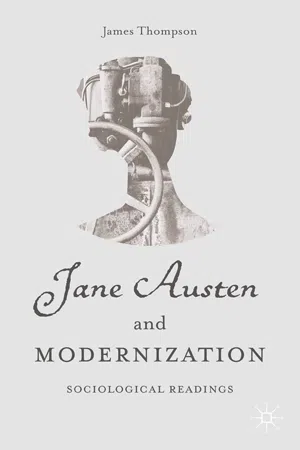
Jane Austen wrote when sociology was being established as the new discipline to understand social issues such as urbanization and industrialization. Drawing on landmark sociologists such as Durkheim and Bourdieu, this study argues that the novels of Austen were heavily influenced by these early developments in sociology.
Information
N O T E S
1 Introduction: Jane Austen and Modernization
1.Throughout this book, I will be referring to Jane Austen’s works with their abbreviations as follows: E—Emma; L—Letters; MF—Mansfield Park; NA—Northanger Abbey; P—Persuasion; PP—Pride and Prejudice; and SS—Sense and Sensibility.
2.R. W. Chapman, “Jane Austen’s Methods,” Times Literary Supplement (February 9, 1922), 82a.
3.In Jane Austen and the State (London: Travistock, 1987), p. 87, Mary Evans struggles to find, define, or explain “the state” in Austen’s novels, implicitly admitting that such a concept/structure is anticipatory if not entirely proleptic—a nineteenth-century, not a regency development.
4.R. W. Chapman, Jane Austen: Facts and Problems (Oxford: Clarendon P, 1948), p. 151.
5.Richard Handler and Daniel Segal, in their anthropological study, Jane Austen and the Fiction of Culture (Tucson: U of Arizona P, 1990) see Austen as an ethnographer, whose object of study is courtship and kinship: “Marriage ideally provides a regularized and perpetual transition between natural ties of family and humanly constructed connections, for in marriage two people are removed from their natural attachment to their families, and united in a selected attachment that will in turn generate new natural ties . . . In sum, marriage represents a claim to reproduce the natural order of society and the social order naturally.” (p. 39). See also Christopher Wilkes, Social Jane: The Small, Secret Sociology of Jane Austen (Cambridge: Cambridge Scholars Publishing, 2013), for an application of Pierre Bourdieu’s concept of habitus to Austen: “Austen saw and decoded social complexity” (p. 258). See also Gary Kelly, “Jane Austen’s Real Business: The Novel, Literature and Cultural Capital,” in Jane Austen’s Business, McMaster and Stovel, eds. London: Macmillan, 1996, 154–167 for an application of Bourdieu’s notion of social capital and Tony Tanner briefly uses Erving Goffman in his classic study, Jane Austen (1986, rpt. London: Palgrave, 2007), 123: writing of Pride and Prejudice and the characters’ self-awareness of their performance, “Such gestures are expressions of what Erving Goffman calls ‘role distance.’” As the title suggests, in Jane Austen’s Civilized Women: Morality, Gender and the Civilizing Process, Enit Karafili Steiner reads the novels from the perspective of Norbert Elias: “when she insists on an ongoing sociability which unfolds in domestic settings and permeates the public realm as well as on the impact of embodied socialization, introspection, and self-monitoring, far more is at stake than a proper lady’s sense of decorum.” (London: Pickering & Chatto, 2012), p. 2. See also Heather Love, “Close but not Deep: Literary Ethics and the Descriptive Turn.” New Literary History, 2010, 41: 371–391 for the use of Goffman with literature. Further along the social science scale is Michael Suk-Young Chwe’s intriguing Jane Austen, Game Theorist, who argues: “Jane Austen was not just singularly insightful but relentlessly theoretical. Austen starts with the basic concepts of choice (a person does what she does because she chooses to) and preferences (a person chooses according to her preferences). Strategic thinking, what Austen calls “penetration,” is game theory’s central concept when choosing an action a person thinks about how others will act.” (Princeton: Princeton UP, 2013), p. 1. As Chwe notes later (p. 28), Goffman was excited about game theory, and as we shall explore in chapter 3, Goffman’s whole concept of social interaction—face work—is essentially strategic.
6.B. C. Southam, Jane Austen: Cultural Heritage (London: Routledge & Kegan Paul, 1987), II, 2.
7.Kathryn Sutherland, Jane Austen’s Textual Lives (Oxford: Oxford UP, 2005), pp. 16, 48. There have been a number of studies in recent years that focus on the phenomenon of the fascination that Austen holds for her readers over the years. Several have been prompted by the flood of films from 1995 and after: Jane Austen in Hollywood, ed. Linda Troost and Sayre Greenfield (Lexington: U of Kentucky P, 1998); Jane Austen and Co., ed. Suzanne Pucci and James Thompson (Albany: SUNY P, 2003); and John Wiltshire, Recreating Jane Austen (Cambridge: Cambridge UP, 2001). More pertinent to this study are those studies that explore the way Jane Austen’s reputation was shaped over the years, including Sutherland, Rachel Brownstein, Why Jane Austen? (New York: Columbia UP, 2011); and Claudia Johnson, Jane Austen’s Cults and Cultures (Chicago: U of Chicago P, 2012).
8.For the chronologically opposite approach, focusing on Austen contemporary and early readers, see William Galperin, “Austen’s Earliest Readers and the Rise of Janeites,” in Diedre Lynch, ed., Janeites (Princeton: Princeton UP, 2000), pp. 87–114, William Galperin, The Historical Austen (Philadelphia: U of Pennsylvania P, 2003), p. 44–81.
9.Johnson, Jane Austen’s Cults and Cultures, p. 127.
10.Mary Poovey writes of Pride and Prejudice, “Marriage remains for Austen the ideal paradigm of the most perfect fusion between the Individual and society.” Proper Lady and the Woman Writer (Chicago: U of Chicago P, 1984), p. 203.
11.Alistair Duckworth, The Improvement of the Estate (Baltimore: Johns Hopkins UP, 1971), p. 20.
12.See Marilyn Butler, Romantics, Rebels and Reactionaries (Oxford: Oxford UP 1981), pp. 97, 102: “The tendency of her fiction is to rebuke individual self-assertion . . . [She] held old-fashioned notion of social cohesion and obligation.” So too, David Monagham, Jane Austen-Structure and Social Vision (London: Macmillan, 1980), p. 7. “Jane Austen’s thesis [is] that the fate of society depends on the ability of the landed classes to live up to their concern for others, and on the willingness of the other groups to accept this ideal.” The most elegant expression of this balance comes, naturally from Lionel Trilling: “The great charm, the charming greatness, of Pride and Prejudice is that it permits us to conceive of morality as style. The relation of Elizabeth Bennet to Darcy is real, is intense, but it expresses itself as a conflict and reconciliation of styles: a formal rhetoric, traditional and rigo...
Table of contents
- Cover
- Title
- One Introduction: Jane Austen and Modernization
- Two Authority in Mansfield Park and Persuasion: Durkheim, Weber, and Parsons
- Three Emma , Simmel, and Sociability
- Four Pride and Prejudice , Goffman, and Strategic Interaction
- Five Northanger Abbey , Sense and Sensibility , and Frame Analysis
- Six Conclusion: History, Sociology, and Literature
- Notes
- Works Cited
- Index
Trusted by 375,005 students
Access to over 1.5 million titles for a fair monthly price.
Study more efficiently using our study tools.
Frequently asked questions
Yes, you can cancel anytime from the Subscription tab in your account settings on the Perlego website. Your subscription will stay active until the end of your current billing period. Learn how to cancel your subscription
No, books cannot be downloaded as external files, such as PDFs, for use outside of Perlego. However, you can download books within the Perlego app for offline reading on mobile or tablet. Learn how to download books offline
Perlego offers two plans: Essential and Complete
- Essential is ideal for learners and professionals who enjoy exploring a wide range of subjects. Access the Essential Library with 800,000+ trusted titles and best-sellers across business, personal growth, and the humanities. Includes unlimited reading time and Standard Read Aloud voice.
- Complete: Perfect for advanced learners and researchers needing full, unrestricted access. Unlock 1.5M+ books across hundreds of subjects, including academic and specialized titles. The Complete Plan also includes advanced features like Premium Read Aloud and Research Assistant.
We are an online textbook subscription service, where you can get access to an entire online library for less than the price of a single book per month. With over 1.5 million books across 990+ topics, we’ve got you covered! Learn about our mission
Look out for the read-aloud symbol on your next book to see if you can listen to it. The read-aloud tool reads text aloud for you, highlighting the text as it is being read. You can pause it, speed it up and slow it down. Learn more about Read Aloud
Yes! You can use the Perlego app on both iOS and Android devices to read anytime, anywhere — even offline. Perfect for commutes or when you’re on the go.
Please note we cannot support devices running on iOS 13 and Android 7 or earlier. Learn more about using the app
Please note we cannot support devices running on iOS 13 and Android 7 or earlier. Learn more about using the app
Yes, you can access Jane Austen and Modernization by J. Thompson in PDF and/or ePUB format, as well as other popular books in Literature & Literature General. We have over 1.5 million books available in our catalogue for you to explore.