eBook - ePub
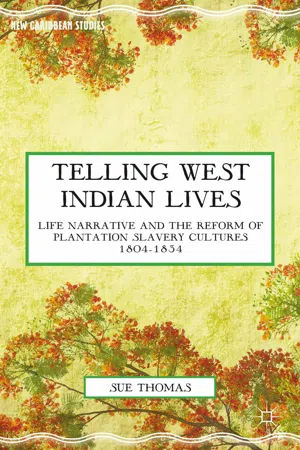
Telling West Indian Lives
Life Narrative and the Reform of Plantation Slavery Cultures 1804–1834
- English
- ePUB (mobile friendly)
- Available on iOS & Android
eBook - ePub
Telling West Indian Lives
Life Narrative and the Reform of Plantation Slavery Cultures 1804–1834
About this book
Telling West Indian Lives: Life Narrative and the Reform of Plantation Slavery Cultures 1804-1834 draws historical and literary attention to life story and narration in the late plantation slavery period. Drawing on new archival research, it highlights the ways written narrative shaped evangelical, philanthropic, and antislavery reform projects.
Information
CHAPTER 1
Anne Hart Gilbert and John Gilbert: Creole Benevolence and Antislavery, 1815–1834
Ageneration after their deaths, Anne Gilbert, née Hart, and John Gilbert were remembered in Antigua as the true consolidators of Methodism in Antigua, rather than John Gilbert’s uncles Nathaniel Gilbert, who established the first Methodist Society outside Britain in 1760, and Francis Gilbert.1 Anne, though, even then was not remembered as the first known published Anglophone African Caribbean woman writer. My discussion of Anne draws on a far wider and richer range of primary sources than those known to other scholars in the field and broader archival research.2 Her genres were the biographical tract, memoir, personal letters, conversion narrative, local religious history, poetry, and co-authored annual reports of charities with a collective autobiographical subject. Her writing had a local and transatlantic reach; after 1825 some of her co-authored reports achieved wide circulation and influence in Britain through the activism of female antislavery societies. What Anne Gilbert’s pious network in Antigua called affecting anecdotes and happy deaths (Christian death-bed scenes, a stock evangelical genre) were texts extracted from personal letters to William Dawes, her brother-in-law, and Grace Dawes, née Gilbert, her sister-inlaw, and incorporated in their correspondence. William Dawes and Grace Dawes, William’s second wife, had settled in Antigua in 1813. The wider circulation of the affecting anecdotes furthered Anne’s political and spiritual causes. Ferguson’s collection The Hart Sisters: Early African Caribbean Writers, Evangelicals, and Radicals contains only parts of Memoir of John Gilbert, Esq. Late Naval Storekeeper at Antigua. To Which Are Appended, A Brief Sketch of His Relic, Mrs. Anne Gilbert, by the Rev. William Box, Wesleyan Missionary. And a Few Additional Remarks by a Christian Friend (1835): Anne’s memoir of her husband John and, as separate appendices, William Box’s eulogy for Anne (the “Brief Sketch”) and the remarks. John had died in 1833, Anne in 1834. Ferguson’s editing is not sympathetic to the complexity of the interplay of voices, to a reading of the Memoir as a portrait of a marriage, or to the mix of autobiographical and biographical genres. The “Christian Friend” and editor, not identified by Ferguson, is Grace Dawes. She reports that John had begun writing his memoir after his retirement in 1832 “at the entreaty of his sisters” (her and Martha Gilbert, M, 1). His narrative breaks off shortly after his review of marrying Anne in 1798 in defiance of white hostility to the legitimation of their cross-racial union and a scene of him proudly taking her arm to walk “arm-in-arm” with her from chapel services braving public opinion and potential public insult (M, 26). Grace Dawes added Anne’s completion of John’s memoir after his death, an unsigned biographical account of John that Grace had written, John’s memorial requesting a pension from the Office of Lord High Admiral, three spiritual letters by John, a letter about John by Daniel Garling, Box’s eulogy, and Grace’s “remarks.” Anne had, Box notes, “destroyed all the documents which had reference to her religious progress” (M, 76). Grace Dawes edited the volume as a tribute to John and Anne, and the shared ethos of benevolence that sustained their marriage, their faith, and their community leadership roles.3 Her editorial decisions, grounded in consciousness of a family and Methodist tradition of life writing, implicitly place the lives in a generational progression from those of John’s and her uncle and aunt, Francis and Mary Gilbert. A cross-generational and comparative approach to its field of cultural production and to its intimacies of affect4 allows its cultural politics and Creole poetics to become intelligible.
In an 1804 letter to the Methodist missionary Richard Pattison, Anne Gilbert highlights the work of a colored and a black woman, Sophia Campbell and Mary Alley, respectively, in leading the fledgling Methodist Society after the deaths of Nathaniel Gilbert (c. 1721–1774) and Francis Gilbert (c. 1724– 1779). In his funeral sermon for Nathaniel, Francis Gilbert took as his text “Mark the perfect Man, and behold the upright: for the End of that man is Peace” (Psalms 37:37), and praised his “good works,” “great integrity, humanity and universal benevolence.”5 For John Wesley, universal benevolence was a sign of the true Christian who modeled his or her love on God’s love, “embracing neighbours and strangers, friends and enemies … every child of man, of whatever place or nation,”6 and provided the justification for missionary enterprise. Sylvia Frey and Betty Wood argue that Alley and Campbell “were the real missionaries to the Africans outside of the Gilbert household” and that they “devised a sphere for women … providing financial and institutional support to the revival ministry.”7 Anne and John Gilbert, and Anne’s sister Elizabeth and her husband Charles Thwaites, worked to extend this sphere of Creole benevolence on cross-racial, cross-gender, cross-denominational lines to support and sustain local communities. Anne Gilbert’s benevolent projects were inspired by spiritual and temporal concerns: a religious sublime focused on salvation of souls and a vision of national modernization focused on the fostering of “a race of creditable, though humble, and industrious young people … in these Colonies,” through regulating moral conduct, through setting the example of “the spiritualizing influence of [Protestant] religion,”8 and through othermothering, a form of African and African diasporic community activism. Race here refers to West Indians in general. For her the luxury, licentiousness, and selfishness of the plantocratic elite were setting immoral and false standards of aspiration that were economically and socially unsustainable, and an ethic of care toward others in need, especially women and children, was a crucial basis of community and individual responsibility. She represents the foundations of early Methodism in Antigua as having been akin to “the Primitive Church” (HS, 62), a reference to Wesley’s conceptualization of the values of the early Christian Church— “holy living,” “asceticism,” rejection of “materialism” and idolatry of wealth, “speech … for God’s glory,” “[t]he apostolic virtue of suffering and persecution,” the expression of communal “Love” through “a disciplined habit of giving to the poor”—providing models of religious, social, and moral reform and mission practice.9
In 1804 the missionary John Baxter gave the scale of the Methodist congregation in Antigua as 3,516 “blacks and colored” and 22 “whites.”10 The blending of cultural heritages—diasporic African and Christian—was producing a creolized church among the laity. Descriptions of Antiguan congregations from the turn of the eighteenth century11 suggest that they were what is termed “shouting Methodists,” practicing a creolized style of worship structured around oral interaction between preacher and audience, and emotive, embodied performance of the power of God descending upon them,12 which manifested the “ecstatic qualities” of African religious observances.13 Gilbert’s writing also affirms a creolization of African and Methodist philosophy. For her, “creative power” is of the spirit, although she names the power in Methodist terms “enthusiasm”14 rather than Ashe.15 Paget Henry draws attention to African ideas of the “ ‘ontic unity’ of the self … as a cosmogonic challenge that was analogous to the creating of society out of the wilderness,”16 an idea manifested in a creolized Christian form in Gilbert’s writing.
The moral sensibility through which Anne Gilbert maps cultural and historical geography in her writing helped make English Harbour, “where vice of every kind” reportedly “held its undisturbed dominion” in 1803 (M, 30), habitable for her, and energized her benevolence and writing. David Lambert and Alan Lester have argued for sustained study of the “historical geographies of imaginative and material connection” that underpinned what they term “colonial philanthropy.”17 While they highlight the increasing global reach of colonial philanthropy, conceptualizing it as a network or web, its center for them is Britain. Rather, I focus on the historical and literary geographies of Creole benevolence, with a colonial hub, and the ways in which Anne Gilbert’s articulation of the difficult emotions to which her charitable work gives rise evoke her embodied experience of place and time. Her literary geography of Antigua from 1815 to 1834 takes in such sites as Sunday schools, schoolrooms, foster homes, benevolent meetings and exhibitions, the seedier streets of English Harbour, hovels, death beds, her home, the dockyard, Islamic networks, the class structures of Antigua’s plantation slavery culture, and the journeys of the poor.
Creole Benevolence
John and Anne Gilbert’s funeral sermons were preached on the theme of salvation, “Blessed are the dead which die in the Lord from henceforth: Yea, saith the Spirit, that they may rest from their labours; and their works do follow them” (Rev. 14:13, chosen by Anne for John);18 and “The righteous hath hope in his death” (Prov. 14:32, chosen for Anne).19 English Harbour was the primary scene of their pious labors, and what Anne would describe as their “renunciation of self, and entire dependence on the atonement of our blessed Saviour” (M, 41). The labors focused largely on Creole benevolent enterprises, at least two of them established by Anne: the cross-denominational Protestant multiracial English Harbour Sunday School, the first Sunday School in the West Indies, in October 1809 with help from her sister Elizabeth Hart Thwaites, and the Female Refuge Society. The latter was conceived in 1815, but seemingly began charitable work in 1816 with a donation of £100 from the Church Missionary Society toward it and the English Harbour Sunday School Society’s schools at English Harbour and Bethesda.20 Anne Gilbert was Agent of the Female Refuge Society (except for a brief period when John Gilbert was not employed at the English Harbour Naval Dockyard) and Superintendent of the Girl’s Department of the English Harbour Sunday School.
Bishop of London Beilby Porteus in his 1808 Letter to the Governors, Legislatures, and Proprietors of Plantations in the British West-India Islands advocated moral regulation of what he read as black male polygamy; the Female Refuge Society targeted social problems arising from what it read as cross-racial and cross-class male profligacy supported by the institution of concubinage, the local justifying myth that “vicious degradation is … the natural consequence of poverty,”21 and a racist gap in the provision of parochial relief to the destitute. Porteus’s diocese of London also included the West Indies. The Female Refuge Society’s work was “to rescue from vice, want, and ruin, free Girls of colour, from six to twelve years of age, being the illegitimate children of fathers who have departed this life, or have abandoned them and quitted the country.”22 Their parents were often a formerly enslaved woman and a manager or overseer, the father having bought “the Mother’s freedom before their birth, or if after, … theirs also.”23 The mothers were in West Indian parlance “housekeepers” for their partners. “Housekeeping” was a prevalent social institution; Gilbert terms it concubinage or “illicit connexion,” insisting that it corrupts the social body, and suggests through allusion that its pernicious effect was a form of racialized sexual enslavement for which destitute young women were seasoned, just as slaves fresh from Africa were trained (seasoned) for the labor regimes of plantation cultures.24 In Antigua, as in other West Indian colonies, the children of a freed female slave inherited her freedom. Only destitute white people in Antigua were eligible for parochial relief; in 1830 free colored people “petitioned the British Parliament directly for a redress” of this and other inequities.25 An 1816 article in the Missionary Register, based around a letter of William Dawes, outlines the community needs addressed by the Female Refuge Society. Dawes points out that the “duration” of concubinage “is always precarious,” especially around a n...
Table of contents
- Cover
- Title Page
- Copyright
- Contents
- Abbreviations
- Acknowledgments
- Introduction
- 1. Anne Hart Gilbert and John Gilbert: Creole Benevolence and Antislavery, 1815–1834
- 2. William Dawes in Antigua
- 3. Methodist Life Narrative
- 4. Robert Wedderburn and “the cause of humanity”
- 5. The History of Mary Prince, a West Indian Slave, Related by Herself
- Conclusion
- Note
- Select Bibliography
- Index
Trusted by 375,005 students
Access to over 1.5 million titles for a fair monthly price.
Study more efficiently using our study tools.
Frequently asked questions
Yes, you can cancel anytime from the Subscription tab in your account settings on the Perlego website. Your subscription will stay active until the end of your current billing period. Learn how to cancel your subscription
No, books cannot be downloaded as external files, such as PDFs, for use outside of Perlego. However, you can download books within the Perlego app for offline reading on mobile or tablet. Learn how to download books offline
Perlego offers two plans: Essential and Complete
- Essential is ideal for learners and professionals who enjoy exploring a wide range of subjects. Access the Essential Library with 800,000+ trusted titles and best-sellers across business, personal growth, and the humanities. Includes unlimited reading time and Standard Read Aloud voice.
- Complete: Perfect for advanced learners and researchers needing full, unrestricted access. Unlock 1.5M+ books across hundreds of subjects, including academic and specialized titles. The Complete Plan also includes advanced features like Premium Read Aloud and Research Assistant.
We are an online textbook subscription service, where you can get access to an entire online library for less than the price of a single book per month. With over 1.5 million books across 990+ topics, we’ve got you covered! Learn about our mission
Look out for the read-aloud symbol on your next book to see if you can listen to it. The read-aloud tool reads text aloud for you, highlighting the text as it is being read. You can pause it, speed it up and slow it down. Learn more about Read Aloud
Yes! You can use the Perlego app on both iOS and Android devices to read anytime, anywhere — even offline. Perfect for commutes or when you’re on the go.
Please note we cannot support devices running on iOS 13 and Android 7 or earlier. Learn more about using the app
Please note we cannot support devices running on iOS 13 and Android 7 or earlier. Learn more about using the app
Yes, you can access Telling West Indian Lives by S. Thomas in PDF and/or ePUB format, as well as other popular books in Literature & Military & Maritime History. We have over 1.5 million books available in our catalogue for you to explore.