This book features ten critical essays on ecodocumentaries written by eminent scholars from India, USA, Ireland, Finland and Turkey in the area of ecocinema studies. Situating social documentaries with explicit ecological form and content, the volume takes relational positions on political, cultural and conservational aspects of natures and cultures in various cultural contexts. Documentaries themed around issues such as electronic waste, animal rights, land ethics, pollution of river, land grabbing, development and exotic plants are some of the topics ecocritiqued in this volume.
Rayson K. Alex and S. Susan Deborah (eds.)Ecodocumentaries10.1057/978-1-137-56224-1_2
Begin Abstract
In God’s Land: Cinematic Affect, Animation, and the Perceptual Dilemmas of Slow Violence
Salma Monani1
(1)
Department of Environmental Studies, Gettysburg College, 300 N. Washington Street, Gettysburg, PA 17325, USA
End Abstract
For his 2009 documentary, Seeds of Dissent, Pankaj Rishi Kumar accompanied the Indian environmentalist Dr. Anil Joshi and his team on a bicycle journey in winter 2008. The “Agri-Cycle Yatra” intended to raise awareness about India’s farmers, ran 3800 km from India’s southern tip in Kanyakumari, Kerala, to its northern regions in the Himalayas. In the trip’s early stages, the crew stopped in the Tirunelveli district of southern Tamil Nadu. Though its southern border flanks the Bay of Bengal, most of Tirunelveli’s geography resembles the barren, rocky, dry lands of the Deccan region.
As Kumar put his documentarian eye to work, he noticed a large sign in the semi-arid, rural landscape announcing that a tract of land equivalent to 2500 acres (approximately 10 km2, or the area of a small township) had been set aside as a Special Economic Zone (SEZ). Designed to encourage economic development, SEZs are controversial entities. Forwarded by a neoliberal government agenda, SEZs across the country are lauded for their corporate friendliness in a country where bureaucracy stifles economic progress, even as they are faulted for social and environmental injustices (Levien; Anwar; Kannan).
Kumar’s gut reaction to the SEZ was curiosity. Why here, in this “god-forsaken landscape?” (personal communication).1 Kumar decided to leave the cycle team for a few days and investigate. One of the first things Kumar learned was that the local Vanamamalai temple (which worships a version of the Hindu god, Lord Vishnu) had sold the 2500 acres to the federal government for the SEZ allotment. Following up on this lead, Kumar interviewed a local priest, who explained that the temple was pleased to help benefit the government as well as the people of the area.
As Kumar describes, he was personally amazed at the quiet reallocation of so much land—“wow, 2500 acres in India, and no conflict?” (personal communication). At the same time, he was fascinated by what the development of this land would mean for the primarily rural, semi-arid region and its inhabitants. Kumar decided to document the changes to the area as the SEZ developed. It was only on a later visit that Kumar learned that the “SEZ wasn’t as clean as it first appeared” (personal communication).
The resulting documentary production, In God’s Land (hereafter IGL) aka Kadavulin Nilathil (2012), has screened at various venues, from the Indian cable television station NDTV, to independent film festivals such as tiNai, to academic screenings in India’s universities, as well as in classrooms in the USA. At 72 minutes, it captures a sense of the simmering conflict that surrounds the SEZ and delves into a long history of tenuous existence for Tirunelveli’s poorest inhabitants—its subsistence farmers and goat herders.
In describing the film, Kumar is categorical in stating that it is not “anti-SEZ.” Instead, Kumar wished to take up a bigger cinematic challenge. In my interview with him, he explains:
It is very easy to land in a conflict zone, like an anti-dam or an anti-nuclear event. There are two parties; somebody doing something and it is a power game so the conflict is apparent. In this situation, on the face of it, nothing is happening. What happens on a day-to-day basis for the villagers is not visible. For me, that is much more challenging: how can I capture this scene of violence and this madness? (Personal communication)
In effect, Kumar’s challenge falls within the realm of representing what postcolonial literary scholar Rob Nixon calls “slow violence.” As Nixon, Nixon writes that such violence is out of sight and attritional; it also does not lend itself to easy representation, “never materializing in one spectacular, explosive, cinematic scene” (14). Instead, as Nixon suggests, slow violence is much like Johan Galtung’s concept of structural violence, which draws attention to complex, deep-seated, systemic forms of violence. What distinguishes slow violence is its particular attention to the “temporalities of place” (18). It is interested in how time generates a distinct socio-ecological disadvantage for the economically poor and disenfranchised: “What does it mean for people declared disposable by some ‘new’ economy to find themselves existing out of place in place, as, against the odds, they seek to slow the ecological assaults on inhabitable possibility?” (19). Violence towards the poor is thus not simply of one moment—like the development of the SEZ—but of long, attritional injustices that exacerbate such moments and leave communities living with long-term ecological aftermaths.
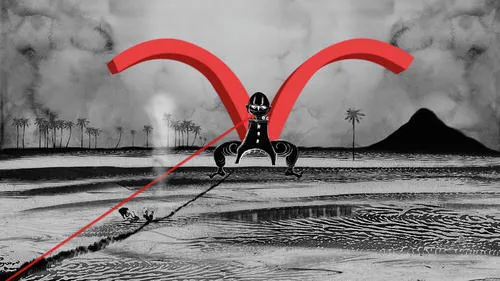
In this chapter, I am interested in how a documentary venture like IGL can capture such long-term and seemingly invisible violence. How does it “plot and give figurative shape to formless threats whose fatal repercussions are dispersed over space and time” (Nixon 10)? Thus, below, I extend Nixon’s analysis of literary texts to cinema. Whereas Nixon’s primary preoccupations are with postcolonial writing (such as by Arundhati Roy, V.S. Naipaul, Jamaica Kincaid, and Ken Saro-Wiwo), here I am interested in how the “aesthetic strategy” (32) of a postcolonial filmmaker might mediate socio-environmental injustices that are not spectacular but instead accumulate over long periods of time. Specifically, I suggest that IGL’s blend of animation and live action illuminates what Banu Subramanian has called “archaic modernity”—the pervasive way religion and science and technology meld in modern India (Subramanian)—and thus, the destructive nuances of slow violence in India (Fig. 1).
Fig. 1.
Artist Aditi Chitre’s animation generates a spectacle of violence that threatens the lives of the villagers. In her animation, she incorporates the red arches of the Special Economic Zone’s gate to also recall the religious markings of the Hindu tilak. This image is not in the final cut of In God’s Land, but is used in the film’s promotional materials. Source: Courtesy of Pankaj Rishi Kumar.
In turning to cinema, I also suggest that IGL’s “aesthetic strategies” further eco-film scholarship’s recent interests in animation. Despite the growing interest in animation by ecocritics, two characteristics do mark most of the studies so far. First, the predominant focus has been on either Western or Japanese animation (see, e.g., Heise; Murphy; Murray and Huemann; Brereton; Pike; Starosielski; Whitely). Second, animation’s eco-potential is usually chalked to what Heise describes as its “combination of serious engagement with a playful style” (Heise para 1). “Play,” or what I will call animation’s “feel-good affect,” is a common theme in current eco-animation studies.
By paying attention to affect, the bodily response a film invites, and emotion, the cognitive awareness of this response (Weik von Mossner 1), in IGL, I argue for animation’s potential outside of this feel-good affect. Specifically, I show that in illuminating slow violence, a non-playful affect can be equally worth our ecocritical consideration. I draw attention to IGL’s hybrid of dark, discordant animation spectacle interspliced in the documentary live action to articulate my argument. Ultimately, IGL not only draws attention to animation’s non-playful affect—its potentials and dilemmas—but I also suggest that reading such a film adds postcolonial understandings of cinema beyond the Western/Japanese centre on which eco-animation scholars have so far focused.
“Nothing Is Happening”: Live Action and Slow Violence’s Unspectacular Affect
The initial minutes of IGL herald Kumar’s embedding the story of the SEZ in its bigger spatio-temporal context. The opening title credit of IGL is superimposed over a charcoal-toned, black-and-white landscape drawing. All light and shadows, the drawing’s composition cuts the frame horizontally in half. Objects that appear to be tree trunks stripe the upper half, as their shadows reach vertically along the ground in the lower half of the frame. Behind them, in the upper half of the frame, are what appear to be distant hills and a hazy sky through which the sun penetrates.
With a crack of muffled thunder, the credit transitions to a close-up of green stalks in muddy water. To the diegetic sound of falling rain, the camera lingers before cutting to three more equally lingering close-ups. On the last close-up, the subtitle appears, “A devout farmer spreads out his paddy to dry in the sun.” The following sequence of four shots, each pulling out further and infused with the sound and presence of falling rain, reveals a verdant, rice-paddy landscape. The final shot of the sequence is of a lone coconut tree foregrounded in the rich green of the paddy fields and backgrounded by the sweep of an imposing hill, recalling the black-and-white landscape drawing of the title credit shot.
The subtitles locate this landscape in myth by recounting the story that resulted in the naming of the region as Tirunelveli, the “sacred hedge paddy” of a devout farmer. However, by immediately transitioning to an aerial view of a Google Maps satellite image, IGL transitions us to the technological present. The subtitle “Imam Alungulam is a small village in the Tirunelveli District, Tamil Nadu” accompanies the image of a small green section in the satellite image’s lower left, which is outlined in black. Then, as a red-hatched boundary appears on the map, encircling a large brown section of the map and the green area of the village, Kumar’s voice-over explains, “The Nanguneri Special Economic Zone was one of the earliest SEZs to be planned. It’s been ten years now…”
Kumar’s voice-over further explains that as he filmed, “[t]ruth became stranger as days passed. The government, the Vanamamalai temple, and villagers of Imam Alungulam narrated what the SEZ meant to them. Yet, one question remained, why are the gods lying?” As Kumar speaks, the buzz of a helicopter intrudes onto the soundscape, growing louder until it is all that remains to accompany the flashing red boundary on the satellite shot, which then cuts away to a moving car’s street view of the SEZ’s barbed boundary and its entrance of imposing red, curved, double arches.
These first few minutes of the film, with their extreme close-ups progressively zooming out to the panoptic scale of a satellite shot, and Kumar’s juxtaposition of mythological time with the technologically present, clearly herald the film’s preoccupation with embedding the contemporary moment into broader sweeps of space and time. At the heart of the SEZ land acquisition is an old tension between the upper-caste Brahmanic Vanamamalai temple and the lower-caste farmers and goat herders of the Imam Alungulam village. Though denied by the temple swami in his on-screen interview, this tension is amply clear in many testimonies by the local villagers, who are angry and worried that the land from which they earn their livelihood has been claimed by the temple and sold as part of the SEZ.
In multiple on-screen interviews, elderly villagers recount temple authorities’ insistence that the villagers are tenant farmers who must pay rent for the land or describe how villagers are restricted from entering the Vanamamalai temple and humiliated by Brahmins, who demand obsequiousness. Villagers’ anxiety is revealed in one dramatic live-action moment of a local festival—a temple representative, body painted with turmeric, ash, and vermilion to signify his divinely possessed state, dances with his entourage of drum beaters and devotees through the village streets. Meant to be out blessing the village folk, he is instead accosted by a village woman who berates him and vehemently yells, “How can you show your face here? How can you be so merciless? Aren’t you God?”
With these moments, Kumar highlights the Hindu caste system as a key component of Tirunelveli’s landscape. While the scholarship on alliances between politics and religion in India is rich (see, e.g., Bhatt; Hansen; Jaffrelot; Van der Veer), scholars such as Madhav Gadgil and Ramachandran Guha, as well as Emma Mawdsley, have also pointed to the intersections between politics, religion, and the environment. In the case of Tirunelveli, historian David Ludden’s Peasant History of South India, a work that Kumar accessed while doing research for his film, offers the most comprehensive look at how religion is deeply embedded in the socio-environmental lives of the region’s inhabitants. Tracing Tirunelveli’s history back to medieval, tenth-century Hindu nations, Ludden writes that “four types of social network shape the peasant’s world: kinship, religion, state, and market interactions” (9). While each can be considered discrete, the “four networks are woven together so tightly that change in one necessarily involves the others”; for example, “worship [religion] involves loyalty [kinship] and authority [state]”2 (10). Ludden’s thesis helps trace the roots of contemporary land rights issues. The political tensions between the region’s stratified communities are intrinsically eco-social entanglements, where ecological rights and privileges are woven into the social fabric of the caste system.
Following Ludden’s insights, Kumar highlights four key constituents in Tirunelveli’s contemporary landscape: the temple representatives, local political campaigners, the SEZ entrepreneurs, and the villagers. Each group deliberately corresponds to a caste in the Hindu hierarchy: Brahmins (religious caste), who are the temple representatives; Kshatriyas (ruler/political caste), who are the local politicians; Vaishyas (merchant caste), who are the SEZ entrepreneurs; and Shudras (servant/peasant caste), who are the villagers. Their contemporary linkages illustrate Banu Subramaniam’s concept of India’s “archaic modernity,” in which traditional Hindu power structures continue to influence a modern scientific, technological, and capitalist state.
Specifically, IGL presents the temple swami insisting that economic development is important in the local community despite contradictory testimonies from lower-caste villagers, who will be displaced. It captures live footage from local political campaigns where politicians are bedecked with garlands of flowers, which to an Indian audience makes easily apparent the allusion to gods (and religious hierarchy). Similarly, to many in Indian audiences, the sense of corruption in such politics is also evident in the scenes Kumar provides of politicians wooing voters with television sets, free eggs, and promises of gold. Not only do politicians don godly vestiges,3 but they also use economic goods as favours to maintain power.
While such moments suggest the complicity of temple authorities and politicians, who use economic logic to justify maintaining long-held positions of power, IGL also captures the voices of SEZ entrepreneurs. During a fortuitous invitation Kumar received to accompany a group of visiting entrepreneurs to an on-site meeting in the SEZ, he captures the businessmen chatting and being friendly with each other. Honestly discussing the challenges of setting up business here, they share their various concerns, including those of labour costs, where they dismiss the local farmers as unsuitable. “You cannot employ them. We will have to depend on outsiders,” a businessman explains, suggesting that the villagers receive “Rs. 200 per day” from a new government scheme where “they don’t have to do anything. Just sit for three hours, sign, and go back.”
Pitted against the villagers’ own voiced concerns of hardship and dispossession, such words seem callous. Yet Kumar admits that, like his entrepreneur interviewees, many in his Indian audiences, steeped in age-old legacies of India’s hie...
Table of contents
Cover
Frontmatter
Introduction: The Ethics of Relationships in Social Documentaries
1. Land, Food, Ethics
2. Development, Waste, Ethics
3. Tree, River, Ethics
Backmatter
Trusted by 375,005 students
Access to over 1.5 million titles for a fair monthly price.
Study more efficiently using our study tools.
Frequently asked questions
Yes, you can cancel anytime from the Subscription tab in your account settings on the Perlego website. Your subscription will stay active until the end of your current billing period. Learn how to cancel your subscription
No, books cannot be downloaded as external files, such as PDFs, for use outside of Perlego. However, you can download books within the Perlego app for offline reading on mobile or tablet. Learn how to download books offline
Perlego offers two plans: Essential and Complete
Essential is ideal for learners and professionals who enjoy exploring a wide range of subjects. Access the Essential Library with 800,000+ trusted titles and best-sellers across business, personal growth, and the humanities. Includes unlimited reading time and Standard Read Aloud voice.
Complete: Perfect for advanced learners and researchers needing full, unrestricted access. Unlock 1.5M+ books across hundreds of subjects, including academic and specialized titles. The Complete Plan also includes advanced features like Premium Read Aloud and Research Assistant.
Both plans are available with monthly, semester, or annual billing cycles.
We are an online textbook subscription service, where you can get access to an entire online library for less than the price of a single book per month. With over 1.5 million books across 990+ topics, we’ve got you covered! Learn about our mission
Look out for the read-aloud symbol on your next book to see if you can listen to it. The read-aloud tool reads text aloud for you, highlighting the text as it is being read. You can pause it, speed it up and slow it down. Learn more about Read Aloud
Yes! You can use the Perlego app on both iOS and Android devices to read anytime, anywhere — even offline. Perfect for commutes or when you’re on the go. Please note we cannot support devices running on iOS 13 and Android 7 or earlier. Learn more about using the app
Yes, you can access Ecodocumentaries by Rayson K. Alex, S. Susan Deborah, Rayson K. Alex,S. Susan Deborah,san Susan Deborah in PDF and/or ePUB format, as well as other popular books in Media & Performing Arts & Film & Video. We have over 1.5 million books available in our catalogue for you to explore.