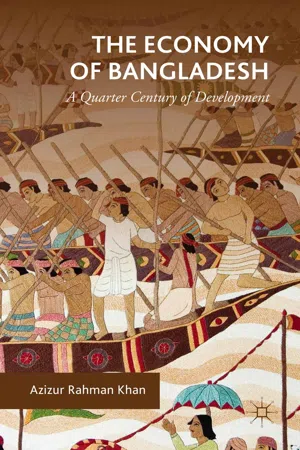
- English
- ePUB (mobile friendly)
- Available on iOS & Android
eBook - ePub
About this book
In the quarter century since its emergence from military rule and integration into the global economy, Bangladesh's economy has achieved high growth, reduced aid dependence and made remarkable improvement in social indicators while at the same time it continues to suffer from increasing inequality. This book analyses these successes and failures.
Information
1
Introduction
The context
Bangladesh has an estimated population of approximately 156 million (in 2014) which makes it the 8th largest nation on earth. Its economic and political influence in the world is nothing commensurate to its population size and perhaps not even proportionate to its rank among nations according to the size of its economy – 57th in nominal dollar value and 41st in purchasing-power-parity dollar value as estimated by the World Bank for the year 2013. It is not a supplier of energy or of any other commodity critical to the world economy, and its location does not currently endow it with significant geopolitical importance.
Its population, 2.16 percent of world’s total, is squeezed into 0.11 percent of world’s surface area, giving it a human density of 2,737 per square mile, one of the highest in the world.1 The frequency of natural disasters – flooding, cyclones and incursion of sea water in tidal waves – is one of the highest among nations.
The independence of the country in 1971 came after a bloody, armed conflict. The country adopted a constitution enshrining secular parliamentary democracy, raising the hope that the nearly universal linguistic and cultural homogeneity of the people would help in the implementation of the constitutional principles and in the building of a strong nation state. These hopes proved false. A major famine occurred in 1974, and in 1975 the democratic constitution was replaced by one that instituted a one-party rule. In the summer of that year a section of the army assassinated the president, who had led the movement for independence, and a series of coups resulted in the establishment of military rule which continued until 1990. Following prolonged mass movement, the country reverted to parliamentary democracy in 1991. With the exception of an interregnum of unelected civilian rule backed by the army between January 2007 and January 2009, the country has nominally been under multi-party democratic rule ever since.
The restoration of the democratic parliamentary constitution in 1991 did not quite mean a return to the post-independence system. The unqualified secularism of the first constitution has come to be replaced by the retention of an amendment during the military rule that pledged that “Absolute trust and faith in the Almighty Allah shall be the basis of all actions”. Today most international and domestic observers view Bangladesh as a “moderate Islamic state”, in which the population and the state are committed to a Muslim identity while rejecting Islamic militancy. The degree of commitment to Islam remains a contentious issue with continued uncertainty about the legitimacy of political parties based on religion; a Supreme Court ruling in 2012 that such parties were unconstitutional remains unimplemented.
The degree to which democratic principles have permeated political institutions and practices is also open to serious questions. Beyond the quinquennial electoral plurality as sanction for the right to govern, the broader principles of parliamentary democracy have failed to take root. In the struggle to dislodge the party in power, the floor of the national parliament, the Jatio Shangshad, has not featured as a battleground. Opposition parties have chosen to boycott the parliament and resort to mass violence in order to dislodge from power the ruling parties who, in their turn, appeared to hamper the transparency of the electoral process. The period since the restoration of democracy has been characterized by body fight between the two main blocks of parties to capture and remain in power.
The phenomenon reflects the fact that direct or indirect access to political power has become the principal determinant of enrichment. The use of political power to appropriate rent is nothing new in the history of Bangladesh, of developing countries and of capitalism. Bangladesh and its predecessor state Pakistan have had plenty of experience of appropriating surplus by using state power in a variety of ways, ranging from the so-called primitive accumulation at the hands of an emerging domestic trading and entrepreneurial class under import-substituting industrialization, to kickbacks in exchange of entitlements to rents created by arbitrary regulations instituted at all levels of the economy.
In the decade preceding the restoration of democracy in Bangladesh the world economy experienced a wave of globalization in the wake of which developing countries gradually moved away from import-substituting industrialization and much of the policies of direct control and regulations. It was hoped by many analysts that one of the benefits of these pro-market reforms would be a reduction in rent seeking. This prognosis turned out to be wrong. Governments in the developing countries demonstrated that state power could be used to create new sources of rent.2 Reforming a rent-seeking society is not simply a matter of prohibiting certain given policies and regulations; it requires basic changes in the character of institutions and norms that guide public policy.
As this study will argue, In the case of present-day Bangladesh the use of state power to enrich those who exercise it, and their associates, appears to have reached a predatory height. The high material return to state power is the obvious incentive for the extreme fist fight to grab it. Not only is this unjust, it is also contrary to the pursuit of economic growth and efficiency. Choice of investment projects is guided more by the closeness to political power of the local agents of the suppliers of alternative techniques and blueprints than considerations of return to the society. Pursuit of enrichment at the top gets transmitted to the cadres at lower levels, those whose muscle power is essential for survival in the power struggle. These lower-level cadres have instituted a system of levies and extortions which seriously hamper growth of business, especially the smaller ones. Perhaps even more damagingly, scarce talent is diverted to the pursuit of a role in rent seeking rather than engaging in legitimate entrepreneurial activity.
Successes and failures
Despite these problems and obstacles the country has continued to progress during nearly the quarter century since its emergence from 15 years of military rule. Although the focus of this book is the performance of the economy during the period since the emergence from military rule, it is useful to recognize that this temporal dividing line does not constitute a point of discontinuity in trend for most economic and social variables. Many of the major changes can be traced back to years prior to 1990 without significant discontinuity, and the book often looks at the earlier years for explanation of changes. Still this period can be characterized as somewhat different from the prior years from several perspectives. One has already been mentioned: the emergence from military rule significantly changed the domestic political rules of the game. Internationally this was the period of the triumph of globalization. Again, the process of integration into the global economy had started earlier in Bangladesh, but the 1990s heralded a decisive change in the rules guiding the country’s global links.
The brief catalogue of performance in major economic and social areas listed here contrasts with the pessimism that international observers often expressed at the time of the country’s emergence and early years of existence. In several areas of social development, the country has come to be cited as an example of outstanding success for other countries with comparable levels of economic development.
The growth in GDP has steadily accelerated during the period under review, reaching the annual average rate of 6 percent in the most recent decade. With the population growth, reflecting the continuation of the demographic transition that started soon after independence, down to approximately 1.4 percent, the growth in per capita income has been one of the higher ones among the developing countries. Bangladesh has, however, not succeeded in improving its rank among countries in South Asia in terms of per capita income, Nepal being the only country in the region which is poorer.3
Along with growth, the economy has experienced significant structural change in the composition of GDP. Agriculture’s share of GDP has fallen by more than half at current prices since 1990, crop production accounting for a mere 10 percent of GDP by 2011/12. The share of manufacturing has increased but is still only 17 percent of GDP. The shares of construction, transport, trade and other services have increased modestly. Agriculture’s share of total employment has, however, shown no commensurate decline: its share of employment remains more than two and a half times its share of GDP. Since the beginning of the period under review, the ratio of agriculture’s share of employment to its share of GDP has increased, indicating a worsening of the productivity gap between agriculture and the rest of the economy.
Manufacturing industries have grown at an apparently decent rate, and its share of GDP has increased by 30 percent. But at 17 percent its share of GDP is still lower than the average for the developing countries, and at 12.4 percent its share of employment has proved too low to meaningfully begin to relieve the burden of underemployment in agriculture. Construction, transport, trade and other services have increased their shares of GDP and employment, but at rates that are too modest to make a dent in the labor surplus in agriculture.
Even with a decent rate of agricultural growth it would be against all historical experience to expect that its share of GDP will not fall further. Thus for the country to attain dynamic growth, structural transformation needs to be accelerated by a higher GDP-elasticity of manufacturing and services together with high output-elasticity of employment in these sectors.
There has also been significant structural change in the expenditure account of GDP, the structure of demand. Gross domestic investment increased from about 17 percent of GDP in 1990/91 to close to 27 percent in 2011/12. Domestic savings, the difference between GDP and consumption, has grown by much less, from 14.5 percent of GDP in 1990/91 to 19.3 percent of GDP in 2011/12. Indeed, as a proportion of GDP it has shown no increase during the past decade. Yet this has been a period of steady reduction in dependence on foreign capital inflow. The explanation is the sharp increase in net unilateral transfer, more than all of it being accounted for by the increase in remittances by Bangladeshis working abroad. In recent years remittances have amounted to 10 percent of GDP. Indeed, remittances have exceeded the entire investment-savings gap by such a large margin that it is hard to explain the excess of remittance over this gap by other components such as accumulation of foreign reserves. The riddle of Bangladesh’s continued and substantial dependence on foreign aid clearly needs an explanation.
By 2010, 59.3 percent of the population above 15 were in the labor force, 82.5 percent of males and 36.1 percent of females. These rates have slowly increased over time, even though the change in the rate for female labor force participation has to be qualified due to frequent changes in the definition of female labor in successive labor force surveys. Labor force and employment have grown somewhat faster than population. Change in the sectoral composition of employment has, as hinted earlier, lagged far behind the change in the sectoral composition of GDP. Agriculture’s share of employment has fallen very slowly, from 50.8 percent in 1990 to 47.5 percent in 2010. Over the same period, the share of manufacturing in employment has increased from 9.5 percent to 12.4 percent. Of the 3.3 percentage points of employment that moved out of agriculture, all but 0.4 percentage points were absorbed by manufacturing. The point, however, is that the gap between agriculture and the rest of the economy with respect to the share of GDP and the share of employment has vastly widened, resulting in a widening of productivity and living standard between the two. No doubt the reality has been less extreme because employment is estimated by the “principal occupation” of a person. It is quite common for a person principally employed in agriculture to have multiple occupations and it is possible, perhaps likely, that the proportion of employment in agriculture, measured by time or income, for such persons has fallen over time. Be that as it may, this study will argue that the increase in the gap between agriculture and the rest of the economy with respect to the ratio of the share of employment to the share of GDP has been a major source of increased inequality of income distribution in the country.
Even before the period under review Bangladesh had been reforming its trade regime and related policies under the auspices of the IMF and the World Bank. These reforms continued during the 1990s and beyond. Bangladesh has by and large dismantled the quantitative controls on trade and sharply reduced the rates of tariff. Over the period, trade as proportion of GDP more than doubled, exports reaching 21 percent of GDP and imports 29 percent. Current account balance was nevertheless positive during much of the period due to the large unilateral transfer in the form of remittances. One of the odd characteristics of export growth has been its extreme lack of diversity: garments and knitwear have accounted for more than 80 percent of merchandize exports. If trade reforms carried out over past three decades indeed successfully dismantled the import-substituting industrialization regime and shifted incentives towards neutrality between import substitution and exports, one would expect much broader export growth than what the country has experienced. The impediments to broader export growth needs to be understood together with the biases that are still embodied in the trade regime.
In recent years Bangladesh has attained success in improving indicators of well-being disproportionate to its level of economic development, a phenomenon that has attracted international recognition and admiration.4 These indicators include: life expectancy at birth; infant and child mortality rates; access to improved sanitation; average years of schooling; female and male literacy rates; stunting and wasting among children under five; and child immunization rates. In these indicators Bangladesh has overtaken India, a country with nearly twice the per capita income in purchasing power parity dollar (PPP$). Bangladesh has also achieved a significant reduction in the incidence of poverty; but according to internationally comparable measurements, for example, World Bank’s estimate of those below PPP$ 1.25 per capita per day, it still has a higher incidence of poverty than Nepal which has a much lower income per person. This last point indicates that inequality in Bangladesh is higher than in Nepal. Indeed the inequality in the distribution of income, as captured by the household surveys covering selected years over two decades ending in 2010, has sharply increased and is among the higher ones observed in the developing world. The evidence on distributional performance is thus somewhat paradoxical: a society that has succeeded in promoting widespread improvement in the average quality of life of the masses has failed to contain the surge of inequality which usually works against improvement in mass welfare.
Bangladesh suffers from a severe inadequacy of infrastructure, both physical and social. It is heavily dependent on imported energy. There are questions about the appropriate management and use of domestic gas reserves. In recent years coal mining has added a second primary energy source, but the ambitious plans for the construction of power plants based on coal has led to controversy on their feasibility and opposition from environmental groups. In recent years the problems of severe urban power blackout and the consequent unrest have been ameliorated by resorting to high-cost generating units using imported oil. There are far too many unresolved and/or controversial issues about the right combination of energy supply and the use of domestic energy sources. Transport is another major infrastructural bottleneck impeding the movement of goods. Of particular concern is the inner-city transport bottlenecks. Communication infrastructure is too weak to support a thriving information technology (IT) sector. Productive efficiency is also seriously impeded by the weak educational infrastructure. Educational standard has deteriorated during the period under review at all levels. In particular, the low quality of higher education and the failure to maintain proficiency in English have proved serious obstacles to competitiveness in the production and export of IT services.
Protecting the environment is an area in which Bangladesh has performed poorly. At the most obvious level, the country has suffered an unacceptable rate of depletion of its meager forestry resources. Neither this nor the loss and degradation of land quality have been reflected in estimates of GDP and its growth. Air and water quality has rapidly deteriorated increasing the incidence of respiratory and other diseases. Underground sources of water have suffered arsenic contamination over large tracts. Over...
Table of contents
- Cover
- Title
- 1 Introduction
- 2 Growth and Structural Change: An Overview
- 3 Macroeconomic Accounts: The Structure of Demand
- 4 The Emerging Pattern of Structural Change
- 5 Agriculture: Past Success and Future Prospects
- 6 Structure, Growth and Direction of Manufacturing Industries
- 7 Trade and Global Links
- 8 Infrastructure and Environment
- 9 Income Distribution, Poverty and Living Standard
- 10 Conclusion: Credits, Constraints and Prospects
- Annex to Chapter2 and 3: Bangladesh National Accounts
- Annex to Chapter9
- Notes
- Bibliography
- Index
Trusted by 375,005 students
Access to over 1.5 million titles for a fair monthly price.
Study more efficiently using our study tools.
Frequently asked questions
Yes, you can cancel anytime from the Subscription tab in your account settings on the Perlego website. Your subscription will stay active until the end of your current billing period. Learn how to cancel your subscription
No, books cannot be downloaded as external files, such as PDFs, for use outside of Perlego. However, you can download books within the Perlego app for offline reading on mobile or tablet. Learn how to download books offline
Perlego offers two plans: Essential and Complete
- Essential is ideal for learners and professionals who enjoy exploring a wide range of subjects. Access the Essential Library with 800,000+ trusted titles and best-sellers across business, personal growth, and the humanities. Includes unlimited reading time and Standard Read Aloud voice.
- Complete: Perfect for advanced learners and researchers needing full, unrestricted access. Unlock 1.5M+ books across hundreds of subjects, including academic and specialized titles. The Complete Plan also includes advanced features like Premium Read Aloud and Research Assistant.
We are an online textbook subscription service, where you can get access to an entire online library for less than the price of a single book per month. With over 1.5 million books across 990+ topics, we’ve got you covered! Learn about our mission
Look out for the read-aloud symbol on your next book to see if you can listen to it. The read-aloud tool reads text aloud for you, highlighting the text as it is being read. You can pause it, speed it up and slow it down. Learn more about Read Aloud
Yes! You can use the Perlego app on both iOS and Android devices to read anytime, anywhere — even offline. Perfect for commutes or when you’re on the go.
Please note we cannot support devices running on iOS 13 and Android 7 or earlier. Learn more about using the app
Please note we cannot support devices running on iOS 13 and Android 7 or earlier. Learn more about using the app
Yes, you can access The Economy of Bangladesh by Azizur Rahman Khan in PDF and/or ePUB format, as well as other popular books in Business & International Business. We have over 1.5 million books available in our catalogue for you to explore.