Bringing together three generations of scholars, thinkers and activists, this book is the first to trace a genealogy of the specific contributions Indo-Caribbean women have made to Caribbean feminist epistemology and knowledge production. Challenging the centrality of India in considerations of the forms that Indo-Caribbean feminist thought and praxis have taken, the authors turn instead to the terrain of gender negotiations among Caribbean men and women within and across racial, class, religious, and political affiliations. Addressing the specific conditions which emerged within the region and highlighting the cross-racial solidarities and the challenges to narratives of purity that have been constitutive of Indo-Caribbean feminist thought, this collection connects to the broader indentureship diaspora and what can be considered post-indentureship feminist thought. Through examinations of literature, activism, art, biography, scholarship and public sphere practices, the collection highlights the complexity and richness of Indo-Caribbean engagements with feminism and social justice.
eBook - ePub
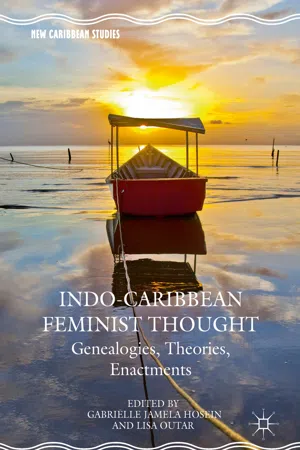
Indo-Caribbean Feminist Thought
Genealogies, Theories, Enactments
- English
- ePUB (mobile friendly)
- Available on iOS & Android
eBook - ePub
Indo-Caribbean Feminist Thought
Genealogies, Theories, Enactments
About this book
Information
© The Author(s) 2016
G. J. Hosein, L. Outar (eds.)Indo-Caribbean Feminist ThoughtNew Caribbean Studieshttps://doi.org/10.1057/978-1-137-55937-1_11. Introduction: Interrogating an Indo-Caribbean Feminist Epistemology
Gabrielle Jamela Hosein1 and Lisa Outar2
(1)
Institute for Gender and Development Studies, The University of the West Indies, St. Augustine, Trinidad and Tobago
(2)
Independent Scholar, New York, NY, USA
Keywords
Indo-Caribbean feminist thoughtFeminist navigationsPost-indentureship feminismsScholarshipFeminist epistemological traditions
Fig. 1.1
“Walking in the Lotus Room” by Danielle Boodoo-Fortuné, specially commissioned for Indo-Caribbean Feminist Thought
Over thirty years after Caribbean feminists first began theorizing Indo-Caribbean gender relations, there has not been a systematic examination of an Indo-Caribbean feminist intellectual tradition, its discursive practices, and its relationship to Caribbean feminist theory and activism as well as to Caribbean scholarship and society. While we draw on literature, activism, art, biography, and public sphere practices as sources of knowledge in this collection, in this introduction, we primarily treat scholarship as our cultural and political text and as our site for examining Indo-Caribbean feminist praxis and its politics of knowledge production. Indeed, scholarship has become one of those key sites for another generation to understand what constitutes Caribbean feminist praxis. Thus, the first aim of the collection is to deepen understanding of this underexplored Caribbean feminist intellectual trajectory (Fig. 1.1).
We specifically highlight Indo-Caribbean feminist thought as traced through antecedents to scholarship, in a range of writings and forms of public engagement, including in art and literature, as well as in the emergence of later scholarly conceptual contributions, debates, and critiques. Our emphasis on scholarship is a way of pushing further the significant body of work on gendered aspects of Indo-Caribbean women’s and men’s domestic relations, bodily performances, cultural crossings, literary production, and political engagements, and their implications for Indo-Caribbean feminist epistemology. Therefore, the second aim of the collection is to advance the conceptual terrain offered by an Indo-Caribbean feminist epistemological tradition.
For the purposes of this collection, Indo-Caribbean feminist thought therefore refers to intellectual trajectories that include gender analysis, both creative and scholarly, produced by Indo-Caribbean feminist activists, scholars, writers, and artists. It includes analysis produced, regardless of the national, ethnic, and sex/gender identities of those speaking/writing, to make visible and interrogate Indo-Caribbean women’s and men’s gender negotiations and feminist navigations over Caribbean history. It is defined by analysis which draws on Indo-Caribbean diasporic cosmologies, artifacts, archetypes, myths, and symbols, engagements with embodiment, popular cultural expressions, the sacred and sexual, and intellectual traditions and concepts to articulate a feminist praxis where Indian gendered experiences in the Caribbean are not marginal, while being understood in ways centered in a politics of solidarity across ethnicity, class, gender, sexualities, and nation. It is characterized by epistemological approaches that problematize myths of Indian authenticity, respectability, and purity, recognizing convergence and dissimilarities with other streams of Caribbean feminist thought.
Indo-Caribbean feminist thought can therefore be understood overall as work that has advanced theorizing of the intersections of Indianness, Caribbeanness, gender, and feminism, with a view toward transforming gendered political, sexual, and knowledge economies and their implications for inequities in the region. Further, we argue that Indo-Caribbean feminist thought is centered in conceptual approaches that consider the transoceanic dimensions of indentureship and post-indentureship, allowing for comparative feminist theorizations and solidarity across borders.
Working with this definition, this project theorizes the gendered experiences of Indians in the Caribbean to interrogate the scholarship that exists, assess its usefulness, track the emergence of divergent feminist epistemologies, and highlight the tensions and intersections of local, regional, diasporic, and transnational politics. Therefore, a third aim is to more widely explore the relationship among Indo-Caribbean feminist theory, Caribbean scholarly writing, and feminist enactments of postcolonial relationality, difference, and solidarity.
To demarcate a tradition that we are naming Indo-Caribbean feminist thought is not to remove ourselves from the larger framework of Caribbean feminisms, though it is necessary to actively engage the inclinations toward a celebratory creolization discourse that tends to elide or misread the specific experiences of Indo-Caribbean women and men. In this sense, the book articulates particularities of feminisms in the Caribbean by claiming Indianness as multiple, ambiguous, ambivalent, and cross-pollinated, rather than leaving it in the domain of the “pure.” Thus, fourth, we want to be clear that the collection engages a politics of knowledge production that builds on embodiment and particularity, but that does not advocate a “separate but equal” feminism. We operate within a recognition of the openness of Caribbean feminist thought, with its multiple epistemological and political traditions.
Rather than merely burdening bodies with ethnicity, the collection explores Indo-Caribbean particularities as a basis for connection. We argue that embodiment is a site for knowing and politics, and see evidence daily that phenotype matters, forcing recognition of the privilege or burden than comes from occupying certain bodies. Within the context of the Caribbean, we recognize the ways in which black bodies are policed and criminalized in relation to Indian and other non-black bodies as well as the ways in anti-black and anti-Indian discourses circulate in explosive ways, demonizing Indianness as another site of anti-black sentiment. Here, we want to emphasize that our continual encounters with expressed fear that we will be coopted into an Indian cultural nationalist and political agenda, or remain trapped within identity politics, is also a distrust of Indo-Caribbean feminist thought and doesn’t accurately reflect decades of its politics. In such instances, there is sometimes an assumption that Afro-Caribbean feminism has already cleared space for Indian women and a suspicion of Indian women calling for greater particularity even while there are few attempts at explicitly addressing Indians within an overarching umbrella of consideration of non-white bodies.
What must also be addressed openly is the spoken and unspoken anxiety that Indian women’s voices are now dominating conversations about Caribbean feminisms. We suspect this is part and parcel of a sense that Indians in the Caribbean should have assimilated by now and that Indians are taking over economically and politically. Instead of being on a terrain that is about correcting for elision of Indo-Caribbean issues, we have found ourselves coming up against a resistance to too much Indianness, whatever its politics. Nonetheless, we press on with a goal of continuing the conversation about Indian feminisms in the Caribbean, meaning feminist consciousness that is also conscious of an Indian history and presence in Caribbean gender relations. And, we remain cautious of theorizing that positions Indian women’s sexuality, politics, and epistemological production as a tool for various political projects and agendas, whether nationalist or ethnic, with implications for their particularities of expression, whether bodily and scholarly or cultural and familial.
From such a critical position, this collection focuses on the interventions in feminist discourses (Caribbean and otherwise) that Indo-Caribbean scholars, writers, activists, and artists have tried to make. It especially examines historical antecedents to these interventions and how they are important for the feminist scholarship that ensued, particularly looking at the cultural underpinnings and discourses of “difference” that have shaped Indo-Caribbean women’s approaches to and articulations of feminism. Resisting a tidy narrative of teleological progression, we theorize and frame the impact of political and economic relations as well as transnational movements and intersections (both new and old) on Indo-Caribbean organizing and politics. Finally, the conceptual terrain available for contemporary theorizing, including the scholarship on Indo-Caribbean masculinities, is examined for the questions and directions it suggests. Throughout the chapters in the collection therefore, you will find engagement with the influential concepts that have emerged from this field of scholarship such as “gender negotiations,” “dougla poetics,” “kala pani poetics,” “bhowji feminism,” a “jahaji bhain principle,” “matikor,” and “bindi” (as theorized by Rosanne Kanhai), “carnival feminism,” “coolitude,” and so on. The collection reflects a coming of age in Indo-Caribbean feminist thought where we examine contemporary feminist navigations by critically drawing on and extending the last thirty years of Indo-Caribbean feminist scholarship and its conceptual contributions.
We have been attentive to differences across language and geography as well as those reflective of the experiences and perspectives of ethnically mixed Indo-Caribbeans, keeping in mind that even the term “Indo-Caribbean” is a transnational one that many of Indian ancestry do not use to name themselves and their positionality within and outside the region. We have also been reflexive about the ways in which working-class women versus educated women’s voices are received and generational shifts in the ways in which relationships to the self, body, community, and politics are imagined. We emphasize the importance of paying attention to the legitimacy of multiple forms of resistance. We see education for example as a significant space of claiming agency, one that allowed women to be feminist while also meeting family aspirations, allowing navigation of values of both autonomy and belonging. In bringing together three generations of scholars to explore a range of personal and intellectual genealogies, we hope the collection thus links to the idea that Rosanne Kanhai puts forth in “The Masala Stone Sings,” that “creativity is developing in an environment of social justice” (Kanhai 1999, 211) and with the work Joy Mahabir and Mariam Pirbhai have done in their book Critical Perspectives on Indo-Caribbean Women’s Literature where they track “models of feminist activism that [are] deeply embedded in women’s plantation histories” (Mahabir and Pirbhai 2012, 40) and “feminist revisioning of the historical and genealogical record” (Mahabir and Pirbhai 2012, 37).
With these foci in mind, we hope that this collection complements those publications that we have drawn on over the last three decades, including Matikor: The Politics of Identity for Indo-Caribbean Women (1999), edited by Rosanne Kanhai; Halima Kassim’s Ph.D. dissertation on education, community organizations, and gender among Trinidad’s Indo-Muslims (1999); Sheila Rampersad’s Ph.D. dissertation on douglarization and the politics of Indian-African relations in Trinidad (2000); Gender Negotiations among Indians in Trinidad, 1917–1947 (2002), by Patricia Mohammed; Diasporic (Dis)locations: Indo-Caribbean Women Writers Negotiate the Kala Pani (2004), by Brinda Mehta; Bindi: The Multifaceted Lives of Indo-Caribbean Women (2011), edited by Rosanne Kanhai; Critical Perspectives on Indo-Caribbean Women’s Literature (2012), edited by Joy Mahabir and Mariam Pirbhai; the Caribbean Review of Gender Studies Special Journal Issue, “Indo-Caribbean Feminisms: Charting Crossings in Discourse, Geography and Politics” (2012), edited by Gabrielle Hosein and Lisa Outar; Coolie Woman: The Odyssey of Indentureship (2013) by Gaiutra Bahadur; and Islam and the Americas (2015), edited by Aisha Khan. As with our work here, these collections bring together the historical and contemporary, and the region and its diaspora, in ways that portray neither the region nor the past as backwards when it comes to feminist goals nor the site of real authenticity. In adding to this intellectual legacy, we similarly see ourselves as building a complex field, rather settling definitions and boundaries.
Feminist Navigations
Our contribution is underscored by two overall conceptual contributions to the field of Indo-Caribbean feminist thought. The first is the concept of feminist navigations, and the second is that of post-indentureship feminisms. For us, the collection is a generational example of both at work.
We suggest the concept of feminist navigations as a complement to the concept of “gender negotiations” as Patricia Mohammed has conceptualized it (2002). Mohammed examined how women “strategize” within constraints determined by patriarchal gender ideologies. In her study of Indo-Trinidadians in the immediate post-indentureship period, Mohammed argued that Indo-Trinidadian women “colluded” with attempts to re-establish the “classic patriarchy” (Mohammed 2002, 32–33) while also challenging the emerging gender system “through their new wage earning status and their sexuality” (Mohammed 2002, 33). Noting the ways in which “patriarchy also smothers masculinity” (Mohammed 2002, 266), she conceptualized gender negotiation as an accretional process of compromises, arguments, collusions, compromises, resistance, and subversions over time, changing circumstances, sites of contestation, and sources of power available to Indo-Trinidadian women and men. The concept of gender negotiations makes sense in the context of the first half of the twentieth century, when feminist ideas were not as widely circulated among women and men and negotiations were by those seeking to make the most of their and their children’s lives, “flaunting or following rules when they had to” (Mohammed 2003, 8). This is not to say that a feminist consciousness, that is, active challenges to patriarchal definition and discipline of girls and women’s options and lives, was unknown among early Indo-Caribbean women as the work of Rhoda Reddock, Gaiutra Bahadur, Halima Kassim, Lisa Outar, and others makes clear. We are decidedly not painting a teleological narrative where past generations were less feminist but rather excavating the multiple forms that feminist thinking took then and now.
However, in her 2003 article, “Like Sugar in Coffee,” Mohammed writes about an emerging feminist wave in the Caribbean, resulting from the efforts of second-wave feminism, which “is no longer a concentrated set of ideas shared by specific groups and individuals who advocated rights for women, but a consciousness of gender which has been internalized more universally and individually and has dissolved like sugar in coffee, throughout society” (Mohammed 2003, 5). As she explains, “Unlike three or four decades ago, a gender consciousness, if not a feminist consciousness has filtered throughout society. I locate a gender consciousness here as the self-awareness and confidence of one’s rights and privileges as a ‘female’ or ‘male’ in society as well as the limits or oppressiveness which being male or female still imposes on the individual to realize their potential” (Mohammed 2003, 6).
Mohammed argues that many young Caribbean women are aware of and openly express gendered rights within both personal and professional spaces and that we can define third-wave feminism in the Caribbean as “equally the adjustments or retaliations being made by masculinity and men” (Mohammed 2003, 14), but that we are also facing a problem of a “lack of a feminist consciousness. To admit or embrace a feminist consciousness, by definition, one has to work actively and consciously at dealing with the problem, not just acknowledging it. More to the point to admit a feminist consciousness requires moving beyond the clichéd ideas of supporting gender equity and equality, to more informed and articulated ideas of how these may be achieved” (Mohammed 2003, 23–24).
A feminist consciousness, not just a gender consciousness, defines this collecti...
Table of contents
- Cover
- Front Matter
- 1. Introduction: Interrogating an Indo-Caribbean Feminist Epistemology
- Part I. Tracing the Emergence of Indo-Caribbean Feminist Perspectives
- Part II. Transgressive Storytelling
- Part III. Art, Archives, and Cultural Practices
- Part IV. Dougla Feminisms
- Part V. New Masculinities and Femininities
- Back Matter
Trusted by 375,005 students
Access to over 1.5 million titles for a fair monthly price.
Study more efficiently using our study tools.
Frequently asked questions
Yes, you can cancel anytime from the Subscription tab in your account settings on the Perlego website. Your subscription will stay active until the end of your current billing period. Learn how to cancel your subscription
No, books cannot be downloaded as external files, such as PDFs, for use outside of Perlego. However, you can download books within the Perlego app for offline reading on mobile or tablet. Learn how to download books offline
Perlego offers two plans: Essential and Complete
- Essential is ideal for learners and professionals who enjoy exploring a wide range of subjects. Access the Essential Library with 800,000+ trusted titles and best-sellers across business, personal growth, and the humanities. Includes unlimited reading time and Standard Read Aloud voice.
- Complete: Perfect for advanced learners and researchers needing full, unrestricted access. Unlock 1.5M+ books across hundreds of subjects, including academic and specialized titles. The Complete Plan also includes advanced features like Premium Read Aloud and Research Assistant.
We are an online textbook subscription service, where you can get access to an entire online library for less than the price of a single book per month. With over 1.5 million books across 990+ topics, we’ve got you covered! Learn about our mission
Look out for the read-aloud symbol on your next book to see if you can listen to it. The read-aloud tool reads text aloud for you, highlighting the text as it is being read. You can pause it, speed it up and slow it down. Learn more about Read Aloud
Yes! You can use the Perlego app on both iOS and Android devices to read anytime, anywhere — even offline. Perfect for commutes or when you’re on the go.
Please note we cannot support devices running on iOS 13 and Android 7 or earlier. Learn more about using the app
Please note we cannot support devices running on iOS 13 and Android 7 or earlier. Learn more about using the app
Yes, you can access Indo-Caribbean Feminist Thought by Gabrielle Jamela Hosein, Lisa Outar, Gabrielle Jamela Hosein,Lisa Outar in PDF and/or ePUB format, as well as other popular books in Literature & Literary Criticism. We have over 1.5 million books available in our catalogue for you to explore.