- English
- ePUB (mobile friendly)
- Available on iOS & Android
eBook - ePub
About this book
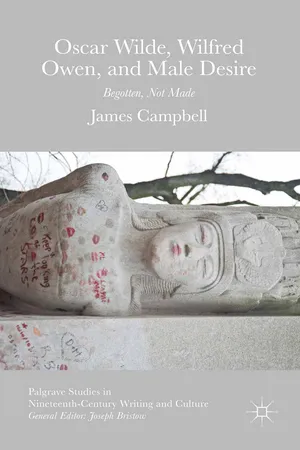
This book reads Oscar Wilde as a queer theorist and Wilfred Owen as his symbolic son. It centers on the concept of 'male procreation', or the generation of new ideas through an erotic but non-physical connection between two men, and it sees Owen as both a product and a continuation of this Wildean tradition.
Information
1
Sexual Gnosticism: Male Procreation and ‘The Portrait of Mr W. H.’
‘You must believe in Willy Hughes. I almost do myself.’
(Wilde in conversation with Helena Sickert)1
In Sodom on the Thames, an exploration of late-Victorian male same-sex love through its legal manifestations leading up to the Wilde trials, Morris B. Kaplan dedicates considerable space to the homoerotic coterie surrounding William Johnson Cory, author of the foundational Uranian poetry text, Ionica (1858, revised 1891). As William Johnson, he had been one of the leading masters at Eton from 1845 to 1872, when he resigned under a cloud of scandal and adopted a new surname. Among his pupils was Reginald Brett, an aristocrat who was to attain immense political influence in the first two decades of the twentieth century. Brett allows Kaplan to trace Johnson’s influence because Brett preserved a lifelong correspondence with a group of friends centering largely on the twin themes of remembrances of Johnson and amorous adventures with boys. In 1892 Brett wrote to a fellow old boy about ‘Teddie’, a fifteen-year-old Etonian for whom Brett had developed considerable affection. I will use Kaplan’s description of the relationship:
[Brett] entertains the youth at home with his wife and family; Teddie visits with the approval of his parents and of the Eton authorities. [Brett’s] love for Teddie has important paternal and pedagogical aspects, but it is also intensely erotic. The sentiments and practices of love between them are not easily translated into contemporary terms.2
This is something of an understatement. Early twenty-first-century culture’s passion for the child as victim and the pedophile as ravening predator would suspect Brett’s motives from the beginning. What surprises us about this relationship is how above-board it is: in correspondence Brett is nervous, not that he will be caught in a sexually compromising position with Teddie, but that his letters to the boy might be read by unintended readers and the depth of his emotional attachment exposed. While our culture is apprehensive that pedagogy will spill over into pedophilia, late-Victorian culture seems to operate more from the assumption that pedagogy without philia is hollow. That this love-as-philia could also participate in love-as-eros is testified to by Johnson Cory’s loss of position and change of name.3
Critics since Michel Foucault have, of course, come to be careful about assuming that pre-twentieth-century sexualities can easily be fitted into the standard gay/straight dichotomy of later culture. Whether one agrees with Alan Sinfield’s argument that Oscar Wilde is the template on which twentieth-century gay identity and sensibility are built,4 constructing Wilde unproblematically as a gay man is a trap into which we have become less likely to fall. But this creates another problem: if Wilde was not gay, what was he? What did he think he was? Without the gay/straight dichotomy, how do we negotiate his sexuality and his construction of his and others’ sexuality? In a culture in which Regy Brett can at eleven o’clock at night go upstairs in his own house and gently caress fifteen-year-old Teddie’s head, knowing and recording it as a profound emotional experience, and do so with the apparent knowledge both of Teddie’s parents and Brett’s own wife, what does and does not constitute homoeroticism?
I propose to address this question through the Wildean text that I find most directly confronts sexual identity: ‘The Portrait of Mr W. H.’ (1889, revised ca. 1891). I will explore the internal logic of its theory of male procreation and demonstrate how it is based on an analogy with sexual reproduction. Beyond this, I also want to investigate how both the story and the theory are inflected through gnosis, or the idea of a secret, nonobvious meaning that lurks beneath the more readily apparent. The story operates simultaneously as theory, fiction, and quasi-religious text in which belief is frustratingly at once desirable and impossible.
Initiation rites: texts and codes
The story is also one of Wilde’s most narratologically complex pieces and has, with the possible exception of the prison letter/De Profundis, the most convoluted textual history. It was written in the first four months of 1889 and was rejected by the Fortnightly Review. It first appeared in print in Wilde’s second choice of venue, Blackwood’s, in July. Apparently, it made something of an impact, though not enough to warrant much of a mention during Wilde’s first trial, at which Edward Carson used The Picture of Dorian Gray (1890, revised 1891) and ‘Phrases and Philosophies for the Use of the Young’ (1894) as evidence for Wilde’s putatively unnatural beliefs and behaviors.5 Like the more famous and legally more damning Dorian, ‘Mr W. H.’ exists in two versions. But the publication history of the story presents a kind of reverse image of that of the novel, in that where Dorian’s second and lengthier version is in many ways quite a bit tamer than its initial appearance in Lippincott’s, the expanded version of ‘Mr W. H.’ pushes to their cultural extremes ideas that are left merely implicit in the initial version.6 Significantly, the longer ‘Mr W. H.’ was a posthumous publication, only seeing print in 1921 following an extended and inadequately explained loss of the manuscript.
Wilde worked on the text for some time. He began writing on the central idea, a theory of the homoerotic meaning of Shakespeare’s sonnets, as early as 1887, though it seems that he conceived of the piece as an essay rather than a story at this early stage. Its publication two years later was only a midpoint in its development, as Wilde continued to expand the story even as it appeared in Blackwood’s. Within weeks of its appearance, Wilde attempted to convince William Blackwood to publish a small volume containing a version of the story expanded by some 3,000 words, specifying only that ‘I have many more points to make’ (WCL, p. 407). Wilde even went so far as to have Charles Ricketts paint a portrait of Willie Hughes for a frontispiece for the expanded book; it was sold for a guinea at Wilde’s post-trial bankruptcy auction and subsequently disappeared (WCL, p. 412). Horst Schroeder, who has written extensively on the textual history of several of Wilde’s texts, sums up the story’s post-publication life thus:
I assume therefore, first, that in the autumn of 1889, i.e., before The Picture of Dorian Gray was written (1890–91) and before Wilde met ‘Mr. W. H. redivivus,’ as Shaw once characterized Alfred Douglas (1891), an enlarged version of Mr. W. H. already existed, and second, that this version already showed the distinctive features of the enlarged story as we know it today, viz. the exposition of the Platonism of the Renaissance, the chapter on the Dark Lady, and the discussion of the boy actors of the Elizabethan and Jacobean stage.7
The version to which Schroeder refers is not the final, posthumous version we have, which must date from 1891 or later, but it is close to it.8 At the time of the breakup of the Bodley Head, the publishing partnership of John Lane and Elkin Mathews, in late 1894, Wilde expressed a desire that Mathews publish the story (WCL, p. 604), which he declined to do ‘at any price’ (WCL, p. 607). Lane was tentative about taking on the book, while Wilde understood him to be under the obligation of honoring a previous agreement. Unsuccessful negotiations continued until the legal debacle of early 1895 nullified the matter (though not before Wilde had his revenge by naming the butler in The Importance of Being Earnest ‘Lane’). The manuscript eventually turned up in the hands of Lane’s former office manager, Frederic Chapman.9
The story of ‘Mr W. H.’ is tightly constructed. The unnamed first-person narrator relates his discussions of literary forgeries with an old friend named Erskine. Late at night, Erskine tells the narrator about his college friend Cyril Graham, a beautiful effeminate figure who specialized in playing women’s roles in Cambridge productions of Shakespeare. Cyril, relates Erskine, had committed a forgery in order to provide material proof for a theory of Shakespeare’s sonnets in which he claimed to believe. The Cyril Graham Theory of the Sonnets postulates that they were written to a young actor in Shakespeare’s company named Willie Hughes. Hughes was a young man who, like Cyril, brought life to feminine roles: ‘the boy-actor for whom he [Shakespeare] created Viola and Imogen, Juliet and Rosalind, Portia and Desdemona, and Cleopatra herself’.10 Hughes functioned as both inspiration and instrument to Shakespeare, inspiring him to his greatest creations and embodying them onstage. The sonnets chronicle Shakespeare’s love for the boy, his theory of artistic creation, and the interruption of his love by the Dark Lady, who temporarily inserts herself into the masculine relationship. The only problem with the theory is its complete lack of extratextual support: there is simply no record of a Willie Hughes in Shakespeare’s company. So Cyril Graham hires a painter to fake an Elizabethan portrait of Mr W. H., which convinces Erskine of the theory’s validity until he stumbles across the painter himself. He extracts a confession from Cyril, who claims he still believes in the theory without proof but had the painting forged to convince Erskine. That night, Erskine relates, Cyril killed himself as an act of faith in the theory. Wilde’s narrator is ‘converted at once’ (p. 42) by Cyril’s tale of art and pathos, and he devotes himself to poring over the sonnets and expanding the theory’s applications and subtleties. Having perfected the theory, he finally overcomes Erskine’s doubts, only to lose confidence in his own explanations. The newly devoted Erskine apparently replays the fate of his young friend, sending the narrator a suicide note from the Continent, where he has gone to do further research. When the narrator arrives, however, he learns that Erskine had known he was dying of consumption and attempted to forge his own death into martyrdom for the cause.
This plot sketch applies equally to the Blackwood’s and the posthumous version; Wilde’s additions to the text do little to expand its storyline. Almost all of them concern the narrator’s ruminations and expansions on Cyril Graham’s basic ideas. Most of these, in turn, focus on the intellectual justification of male homoeroticism in terms of neoplatonism. It is thus quite easy to conflate Wilde and his narrator: just as his character in the story, Wilde himself pored over the sonnets and made them the catalyst for his expanding ideas on male same-sex love. The text of ‘The Portrait of Mr W. H.’ became the receptacle for Wilde’s thoughts about the matter that would land him in prison. Unlike such late-Victorian contemporaries as John Addington Symonds and Edward Carpenter (and even, in his own way, Lord Alfred Douglas), Wilde left no sustained text theorizing his view of homoerotic love. Symonds, for instance, wrote two privately printed tracts on male–male love that Wilde may or may not have read;11 Carpenter’s output on homoerotic love largely postdates Wilde’s criminal conviction, though Carpenter’s pamphlet Homogenic Love and Its Place in a Free Society (1894) was withdrawn by its publisher at the time of the Wilde trials.
Rather than explicate his theories of male same-sex love in a nonfiction text that would need to be published discretely and would appeal only to a very select audience, Wilde chose to hide in plain sight. Blackwood’s was a solidly conservative literary forum, albeit one with a background in literary controversy dating back to its publication of Shelley. And ‘Mr W. H.’ engages with homoeroticism on a blatant, though platonically disembodied, level. It is ironically much less oblique on this matter than the passages from the Lippincott’s version of Dorian Gray on which Edward Carson seized during the first trial while pleading justification for the Marquess of Queensberry’s accusation that Wilde was posing as a sodomite. The passages from Dorian were subject to a hermeneutics of suspicion not only by Carson but also, for instance, by the author of a negative review in the Scots Observer that implicitly pegged the novel as homoerotic by linking it to the 1889 Cleveland Street male prostitution scandal through a mention of ‘outlawed noblemen and perverted telegraph boys’.12 But the same type of hermeneutics was perhaps operative in the novel’s role in initiating the relationship between Wilde and Bosie Douglas: when Lionel Johnson lent his copy of Dorian to Bosie, the latter became entranced with it and soon arranged to be introduced to Wilde at his home.13 As Douglas Murray’s biography makes clear, Douglas experienced both emotional and physical erotic relationships with other young men at Winchester and Oxford prior to meeting Wilde and was thus open to understanding Dorian as a coded text.14 It was possible, in other words, to read between the lines of Dorian for a novel about homoeroticism, whether the reader was sympathetic to or appalled by the results. But ‘Mr W. H.’ does not require this kind of code breaking.
This is not to say that the text presents no hermeneutical problems. We do not have to decode a love that dare not speak its name lurking in the interstices of the unsaid. Nonetheless, we are offered the possibility that the text means more than it at first says. As I will develop momentarily, its construction of male homoeroticism is resolutely neoplatonic, which is to say, ultimately disembodied. Yet the concern of the text is love, a love that participates in both philia and eros. One of the primary cruxes of the text is how it plays with the body, both as symbol and as material reality. This is, after all, a narrative about same-sex love that develops from a physical analogy.
The physical analogy in question is reproduction: sexual intercourse, fertilization (or ‘begetting’), pregnancy, and delivery. The discovery (or invention) of this interpretation is perhaps the narrator’s primary contribution to the Willie Hughes theory and represents his breakthrough in expanding what Cyril Graham has left him. Graham’s interpretation does not clarify why Shakespeare wants the young man of the sonnets to marry and father children; the narrator’s solution is to interpret the children as nonphysical entities, ‘immortal children of undying fame’ (p. 53). Instead of the production of bodies through physical intercourse, Wilde’s theory promotes a ‘marriage of true minds’ that will produce ideas through mental intercourse. Although this initially sounds like a parodic version of physical procreation, once the reader understands the importance that Wilde and his narrator make the analogy bear, the reverse seems truer: the physical production of additional human beings is a pale imitation of the actual creative process, which is thoroughly intellectual, deeply erotic, and exclusively male.
Most immediately, the theory is illustrated by Willie Hughes fathering, or begetting, Shakespeare’s art, which gives birth to not so much the sonnets that express this idea as the characters within the plays that immortalize Shakespeare and are constitutive of his ideas. But the enthusiasm of Wilde’s narrator transforms this procreative code into more than an explanation for the birth of the sonnets and/or the homoerotic inspiration of Shakespeare’s drama; the relationship between Willie Hughes and Shakespeare becomes the locus classicus for the secret engine that drives cultural progress. The Renaissance is sired by Greek platonism on the minds of sixteenth- and seventeenth-century artists in the same way that Willie Hughes sires Shakespeare’s plays. Masculine homoerotic relationships produce cultural change: the 1484 translation of Plato’s Symposium by Marsilio Ficino begat the Renaissance and thus continued the lineage of what Wilde calls ‘the Romantic Movement in English Literature’ (p. 69), of which he co...
Table of contents
- Cover
- Title
- Copyright
- Dedication
- Contents
- Acknowledgements
- A Guide to Abbreviations
- Introduction
- 1 Sexual Gnosticism: Male Procreation and ‘The Portrait of Mr W. H.’
- 2 Shades of Green and Gray: Dual Meanings in Wilde’s Novel
- 3 Love of the Impossible: Wilde’s Failed Queer Theory
- 4 Oscar and Sons: The Afterlife of Male Procreation
- 5 Priests of Keats: Wilfred Owen’s Pre-War Relationship to Wilde
- 6 OW/WH/WO: Wilfred Owen as Symbolic Son of Oscar Wilde
- Afterword
- Notes
- Bibliography
- Index
Trusted by 375,005 students
Access to over 1.5 million titles for a fair monthly price.
Study more efficiently using our study tools.
Frequently asked questions
Yes, you can cancel anytime from the Subscription tab in your account settings on the Perlego website. Your subscription will stay active until the end of your current billing period. Learn how to cancel your subscription
No, books cannot be downloaded as external files, such as PDFs, for use outside of Perlego. However, you can download books within the Perlego app for offline reading on mobile or tablet. Learn how to download books offline
Perlego offers two plans: Essential and Complete
- Essential is ideal for learners and professionals who enjoy exploring a wide range of subjects. Access the Essential Library with 800,000+ trusted titles and best-sellers across business, personal growth, and the humanities. Includes unlimited reading time and Standard Read Aloud voice.
- Complete: Perfect for advanced learners and researchers needing full, unrestricted access. Unlock 1.5M+ books across hundreds of subjects, including academic and specialized titles. The Complete Plan also includes advanced features like Premium Read Aloud and Research Assistant.
We are an online textbook subscription service, where you can get access to an entire online library for less than the price of a single book per month. With over 1.5 million books across 990+ topics, we’ve got you covered! Learn about our mission
Look out for the read-aloud symbol on your next book to see if you can listen to it. The read-aloud tool reads text aloud for you, highlighting the text as it is being read. You can pause it, speed it up and slow it down. Learn more about Read Aloud
Yes! You can use the Perlego app on both iOS and Android devices to read anytime, anywhere — even offline. Perfect for commutes or when you’re on the go.
Please note we cannot support devices running on iOS 13 and Android 7 or earlier. Learn more about using the app
Please note we cannot support devices running on iOS 13 and Android 7 or earlier. Learn more about using the app
Yes, you can access Oscar Wilde, Wilfred Owen, and Male Desire by James Campbell in PDF and/or ePUB format, as well as other popular books in Literature & Literature General. We have over 1.5 million books available in our catalogue for you to explore.