eBook - ePub
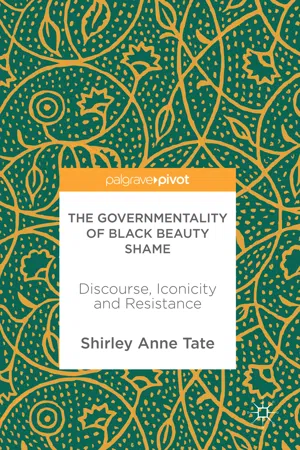
The Governmentality of Black Beauty Shame
Discourse, Iconicity and Resistance
- English
- ePUB (mobile friendly)
- Available on iOS & Android
eBook - ePub
About this book
This book uses the experiences and conversations of Black British women as a lens to examine the impact of discourses surrounding Black beauty shame. Black beauty shame exists within racialized societies which situate white beauty as iconic, and as a result produce Black 'ugliness' as a counterpoint. At the same time, Black Nationalist discourses present Black-white 'mixed race' women as bodies out of place within the Black community. In the examples analysed within the book, women disidentify from both the iconicities of white beauty and the discourses of Black Nationalist darker-skinned beauty, negating both ideals. This demonstration of Foucaldian counter-conduct can be read as a form of disalienation from the governmentality of Black beauty shame. This fascinating volume will be of interest to students and scholars of Black identity, Black beauty and discourse analysis.
Information
© The Author(s) 2018
Shirley Anne TateThe Governmentality of Black Beauty Shamehttps://doi.org/10.1057/978-1-137-52258-0_11. Introduction: Developing a Black Decolonial Feminist Approach to Black Beauty Shame
Shirley Anne Tate1
(1)
Carnegie School of Education, Leeds Beckett University, Leeds, UK
Abstract
This introduction constructs a Black decolonial feminist approach to Black beauty shame. Black feminisms-US, UK, Caribbean, Indo-Caribbean, African and Latin American—illustrate that intersectional racism/racialization matter for theorizing which centres Black women. A Black decolonial feminist approach to beauty and ugliness draws on Wynter, Espinosa Miñoso, Glissant, Césaire and Oyĕwùmi in thinking from/through Black women’s experiences, their affective lives, and their becomings.
Keywords
Black decolonial feminismAffectShameBeautyUglinessIntersectionalRacismThis book aims to develop a Black decolonial feminist approach to Black beauty shame. As such it begins from a perspective which does not deny that intersectional racism and racialization matter for Black women’s experiences of being looked upon as beautiful or ugly . That is, beautiful and ugly are not seen as judgements which are neutral and inconsequential for Black women’s lives. Rather, beauty and ugliness impact all of our psyches, our affective lives, our possibilities of being and extend to and through society, culture and political economy . Beauty and ugliness are socioculturally constructed and as such are raced, gendered, sexualized, classed, abled and aged in a multitude of ways. This is why it is important and necessary to think these categories intersectionally. As intersectional categories ‘Black beauty/ugliness’ and ‘Black beauty shame’ drag coloniality with them into the twenty-first century. As such, Black beauty/ugliness and Black beauty shame always already demand a Black decolonial feminist analysis. Such an analysis would be one that takes on board the coloniality of power, being, knowledge and affect as integral to the very construction of these categories, as well as theorizing how it is that we can build Black beauties anew through Black decolonial feminist thought and practice.
Are We All Black Decolonial Feminists yet?
For Jamaican feminist philosopher and cultural theorist, Sylvia Wynter OJ
You cannot solve the issue of ‘consciousness’ in terms of their body of knowledge. You just can’t. Just as within the medieval order of knowledge there was no way in which you could explain why it is that certain planets seemed to be moving backwards. Because you were coming from a geocentric model, right? So you had to ‘know’ the world in that way. Whereas from our ‘Man-centric’ model, we cannot solve ‘consciousness’ because Man is a purely ontogenetic/purely biological conception of being, who then creates ‘culture’. So if we say consciousness is constructed who does the constructing? You see? (Thomas 2006: 2)
Wynter highlights first, who constructs consciousness and culture and second, Man as synonymous with Western Man racialized as white who creates culture. If we begin from the position of white Western Man, then we can see how it is that we still struggle within feminism over the construction of Black women’s consciousness as well as what counts as Black decolonial feminist knowledge in the academy and beyond. We can see the very coloniality of Man in its raced, gendered, heteropatriarchal, ableist and classed modalities in academic life in other words. Black feminist thought in the UK academy still struggles to be perceived as theory as is also the case in the USA where for Ann Ducille (1994) Black feminist theory is not seen as a ‘serious’ academic endeavour. This erasure ensures that Black feminism is not seen as a discipline with a history, distinguished scholars and rigorous scholarship, but rather a buffet where Black feminist theory can be picked at by white feminists and discarded as easily as a half-eaten sandwich or relegated to the dustbin of the easy to forget, the inconsequential, even whilst it is an essential part of the epistemological toolkit of Black feminists.
One example of this is Kimberlé Crenshaw ’s (1993) theorization of ‘intersectionality ’ so key to feminist theory in general. Through lack of proper citation, Crenshaw ’s work at one time within European academic feminism was transformed into appearing to be a white woman’s invention so much so that various feminist scholars had to reassert its origins (Brah and Phoenix 2013; Erel et al. 2010) . Crenshaw had mysteriously disappeared from the genealogy of this approach to feminist theory and with it all of the precursors of this within the long tradition of Black US-based feminists attempting to account for Black women’s multiple positionalities because of the simultaneity of oppression or the interlocking of oppressions (cf Combahee River Collective 1983; Davis 1981; hooks 2000). These accounts were essential in thinking Black women’s lives because they enabled us to see racialization as intersectional when we viewed it as an object of knowledge. These accounts enabled an analysis of how racialization interfaced and continued to interface with gendered racialized violence, feminist politics, dehumanization and de-womanization . That is, intersectionality enabled us to look at wide-ranging anti-Black African descent women’s oppression rather than just being focused on difference.
If we go back to Wynter ’s quote and its focus on the human as white liberal subject, we can see that Black feminist theory must essentially continue its thinking through oppressive hierarchies as well as the contestation produced by intersectionality . Further, Black feminist theory as a decolonial project must construct new forms of becoming which are not focused on Man as a position from which Black women would know the world or be known by that world. Wynter also reminds us that there are modes of knowledge which are liminal, erased or subjugated in the academy because they stand outside of the hegemonic text of white Western epistemologies. Responding to white feminism from a Black decolonial feminist perspective, Wynter (2001) has said repeatedly that her focus is not on gender but on ‘genres of Man’. She asserts this as her position because in her view focusing only on gender leaves Man intact and this cannot then lead to women’s emancipation. Therefore, for her, placing gender at the centre of Black decolonial feminist theory will not be the root of Black women’s liberation. However, critiques built on gender, race, other intersections and coloniality enable feminism to liberate Black women.
Rather than solely Wynter ’s Man, here we should probably also put (Wo)Man under our critical gaze because in academia in the Global North West the only feminist theory which prevails is white feminist theory. Within the academy, white feminist theory still seems to be applicable to everyone, to be universal, whilst that from Black feminists is seen to be particularistic. Of course, this continues to elevate white feminist theory to the detriment of Black feminist theory which still is not seen as capable of occupying the ‘proper place’ of theory because it is seen to be very narrowly only based on ‘Black women’s experience’. The error here, of course, is in seeing white women’s universal feminist theory as not speaking from a particularistic position which is itself racialized as white (Alexander and Mohanty 1997). Thus, white feminist theory remains transposable to limitless contexts in its very invisible racialization as white. The Black decolonial feminist answer to this deracinating attempt to universalize white feminist theory has been to change ‘woman’ into a heuristic rather than an essentialist [white] fait accompli (Spivak 1993; Lorde 1984; Davis 1981; Collins 1990). This went some way to countering the past and future life of woman as white fait accompli through the violence of dehumanization , de-womanization and erasure of Black women and women of colour by decolonizing the category ‘woman’.
This decolonization continues to be theoretically important, perhaps more so than ever. This is the case because in times of Trump, BREXIT, #Black Lives Matter and Fallism, for example, we need to take account of gender, race, sexuality, disability, class and other intersections as constitutive in establishing the borders of who can be ‘woman’. A question which the analysis of Black beauty shame addresses in this book has long been a Black feminist theme and continues to be an essential Black decolonial feminist one. That question is what we do in terms of a politics of liberation in a profoundly anti-Black African descent woman world where she continues to be seen as only flesh ?
The Body and the Flesh : What Are We to Do in a Profoundly Anti–Black Woman World?
Sylvia Wynter draws on Frantz Fanon’s (1986) work to assert that we live in a sociogenetic world in which we have converted the social construct ‘race’ into flesh . Thus, it is that white (Wo)Men see themselves as being outside of race and racialization, whilst Black (wo)men are its very embodiment, the absolute limit of race itself. As a result of the fact that they have been constructed as inherently pathological Black women’s bodies have to be abjected (Kristeva 1982) from the white body politic including feminism and feminist theory.
At the level of theory, within academic life Black women can be seen to be too critical of and in contradiction to, the taken for granted of the disciplines when they are conceptualized as only speaking from other, quantitatively and qualitatively unverifiable knowledge bases. This can open up subjugated knowledge such as Black feminist knowledge to censure and the very live possibility of erasure (Collins 2015). Within white epistemic domination which does not acknowledge its hegemony , Black feminist thought can be accused of being too political, be r...
Table of contents
- Cover
- Frontmatter
- 1. Introduction: Developing a Black Decolonial Feminist Approach to Black Beauty Shame
- 2. The Governmentality of Silence and Silencing and Black Beauty Shame
- 3. Reading Black Beauty Shame in Talk: An Ethnomethodologically Inclined Discourse Analysis
- 4. Black Beauty Shame: Intensification, Skin Ego and Biopolitical Silencing
- 5. White Iconicity: Necropolitics, Disalienation and Black Beauty Shame Scripts
- 6. The Shame of ‘Mixedness’: Black Exclusion and Dis/alienation
- 7. Conclusion: Post-Racial Black Beauty Shame’s Alter/Native Futures: The Counter-Conduct of ‘Race’ Performativity
- Backmatter
Trusted by 375,005 students
Access to over 1.5 million titles for a fair monthly price.
Study more efficiently using our study tools.
Frequently asked questions
Yes, you can cancel anytime from the Subscription tab in your account settings on the Perlego website. Your subscription will stay active until the end of your current billing period. Learn how to cancel your subscription
No, books cannot be downloaded as external files, such as PDFs, for use outside of Perlego. However, you can download books within the Perlego app for offline reading on mobile or tablet. Learn how to download books offline
Perlego offers two plans: Essential and Complete
- Essential is ideal for learners and professionals who enjoy exploring a wide range of subjects. Access the Essential Library with 800,000+ trusted titles and best-sellers across business, personal growth, and the humanities. Includes unlimited reading time and Standard Read Aloud voice.
- Complete: Perfect for advanced learners and researchers needing full, unrestricted access. Unlock 1.5M+ books across hundreds of subjects, including academic and specialized titles. The Complete Plan also includes advanced features like Premium Read Aloud and Research Assistant.
We are an online textbook subscription service, where you can get access to an entire online library for less than the price of a single book per month. With over 1.5 million books across 990+ topics, we’ve got you covered! Learn about our mission
Look out for the read-aloud symbol on your next book to see if you can listen to it. The read-aloud tool reads text aloud for you, highlighting the text as it is being read. You can pause it, speed it up and slow it down. Learn more about Read Aloud
Yes! You can use the Perlego app on both iOS and Android devices to read anytime, anywhere — even offline. Perfect for commutes or when you’re on the go.
Please note we cannot support devices running on iOS 13 and Android 7 or earlier. Learn more about using the app
Please note we cannot support devices running on iOS 13 and Android 7 or earlier. Learn more about using the app
Yes, you can access The Governmentality of Black Beauty Shame by Shirley Anne Tate in PDF and/or ePUB format, as well as other popular books in Languages & Linguistics & Linguistics. We have over 1.5 million books available in our catalogue for you to explore.