This book analyses post-migration social networks via the notion of superdiversity. Approaching diversity as relational and complexly configured through multiple migration-related differentiations, it challenges us to rethink how we talk about and classify migrant networks. Based on research in two cities of migration - London and Toronto - the author investigates how we can use a superdiversity lens to discuss migrant networks in urban contexts. Focusing on the personal networks of Pacific Islanders and New Zealand M?ori, she sheds light on the sociality practices of relatively small groups of migrants, the members of which are nonetheless differentiated in terms of superdiversity. Using cluster analytic pattern detection to explore alternative ways of describing migrant networks, she brings into play multifaceted descriptions such as city-cohort, long-term resident, superdiverse and migrant-peer networks. Visualising complex patterns of diversity, thisbook therefore contributes to theoretical debates by proposing a relational understanding of diversity rather than one based on the enumeration of (ethnic) categories. This book will appeal to sociologists, political scientists and all scholars interested in urban diversity, migration and diasporas.
eBook - ePub
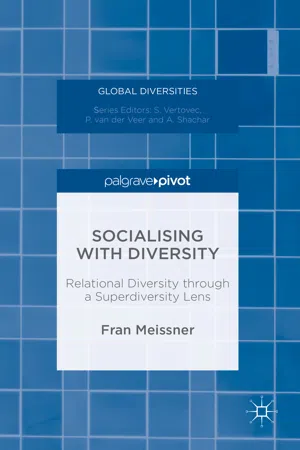
Socialising with Diversity
Relational Diversity through a Superdiversity Lens
- English
- ePUB (mobile friendly)
- Available on iOS & Android
eBook - ePub
About this book
Information
© The Editor(s) (if applicable) and The Author(s) 2016
Fran MeissnerSocialising with DiversityGlobal Diversities10.1057/978-1-137-47439-1_11. Introduction—Socialising with Diversity
Fran Meissner1
(1)
Urban and Regional Sociology, University of Kassel, Kassel, Germany
Abstract
Meissner commences her book by presenting social connectivities as central to urban migration-driven diversities. This focus moves away from the dominant view of diversity as little more than a compendium of ever more categories of difference. She embeds her discussion within research on superdiversity to move beyond origin specificities as the primary concern in analysing network patterns. Meissner also emphasises the importance of conducting research not only amongst migrants with large origin groups at destination but also those whose number of co-migrants is relatively small. Small migrant groups unsettle many of the common assumptions about ethnic networks that habitually drive quantitative explorations of migrant networks. This sets the scene for the remainder of the book and a brief summary of each chapter is offered.
Keywords
Small migrant groupsDiversification of diversityMigrant networksMigration-driven diversities contribute to the dynamics of urban social landscapes. Social connections are forged and disbanded as people arrive and leave the city. The implications of this can no longer be thought about through models that assume large, mostly homogenous migration streams from few places to few places (Gamlen 2010; Vertovec 2007), nor can ideas about migration-driven diversities. We need to rethink and replace older models with those that help us address social complexities. These are most imminently evident where people from everywhere live in relative proximity. If it is assumed that diversity implies continuous negotiations of difference, rather than necessarily a homogenisation of differences, then the contemporary city is a central hub and locus of an abundance of processes of diversification. Can we make social connectivities a central concern in how we think about urban migration-driven diversities?
This book builds on original research conducted in London (UK) and Toronto (Canada) focused on the sociality practices of Pacific migrants and New Zealand Māori migrants. Both London and Toronto are ‘cities of migration’—their social fabric is wrought with the implications of international movement and the different patterns of diversity this implies. Clearly both cities are home to people from virtually everywhere in the world—each city in its own way is a world in one city. This dominant way of describing diversity as a multiplicity of origin, cultural, and linguistic groups is only part of the story of talking about migration-driven diversified diversity. Focusing on variety too often neglects dynamic changes that go hand in hand with population turnover. Making strong headway the superdiversity notion challenges us to consider a multidimensionality of differentiations and to include aspects such as migration, legal status, and labour market trajectories in our analysis (Vertovec 2007). Centring research on social connectivities and trajectory-based differentiations removes some of the rigidity evident in enumerating difference through statically defined categories.
This raises many questions. Those that remain at the heart of this book link to ideas about post-migration networks maintained in cities. For example, in a city where a substantial proportion of the population is from somewhere else—who should one be social with? For Ravi, one of my respondents in London, the answer to this question seemed clear. Examining his ‘network map’—the piece of paper on which he had just arranged the names of his social contacts—he said: ‘Mind you, looking at this, I can honestly say, I need to get more English friends.’ 1 Ravi, who is from Fiji, had been living in London for over ten years. He had named social contacts from more than six countries, including three different Pacific Island Nations, and three continents, contacts who worked in low and high-skilled occupations and who he was able to draw on for social support on various issues. Many of the individuals who I interviewed in the course of my research associated ideas about desirable post-migration social networks with the necessity of forging contacts with English people or, in Toronto, with Canadians—with sometimes explicit assumptions about what it means to be Canadian or English. Given the active promotion of both cities as multicultural and as bringing people from everywhere together, I noted, that whilst taking pride in their cosmopolitan outlook, few respondents commented on this as an objective of their social engagement in the city. Rarely if ever were other migration-related differentiations deemed important. In other words, desirable networks were framed in terms of socialising with diversity in only a very narrow sense.
Exclamations such as Ravi’s are unsurprising. They reveal deep-seated ideas about what matters for post-migration social engagements and how networks ought to be patterned in striving for social cohesion (cf. Dobbernack 2014). Static conceptions of categorical diversity and linear models of migrant integration, fuelling those ideas, need to be challenged as they do not leave enough room to consider and better understand the dynamics of diversity. If those ideas about the configurations of migration-driven diversity translate into policies, these often prescribe measures for generating social contacts between people who are culturally different (Amin 2002; Vermeulen 2007). We know from a plethora of research that positively altering the urban social fabric is not a simple task. Many factors play into how social interactions pan out amongst a diverse urban population. Indeed it can be noted how incredible it is that despite high levels of difference—by and large—most cities are not hot beds of violent social conflict (Magnusson 2011). Shifting away from static and unidimensional ideas about migration-driven diversity then opens a better lexicon for discussing and making sense of the social complexities and dynamics of diversity. One of the issues with diversity research remains that we lack different ways of describing, measuring, and simply talking about migration-driven diversity and its implications to fully move away from static and unifocal ideas.
It follows that while we live in an ‘age of diversity’ (Vertovec 2012:287) there is still ample scope for critically and empirically investigating its wider implications. The notion of superdiversity (Vertovec 2007) emphasises, as noted, the multidimensional ways in which migration diversifies (city) populations and it serves in this book as a starting point for exploring alternative ways of thinking about diversity that go beyond the enumeration of difference. If contexts of urban diversity are those that provide at least the potential for people of various backgrounds to socially engage—people who have moved to the city from various places, via different migration, legal status, and labour market trajectories—then we need to better understand those multiplicities of difference in social patterns.
Diversity is too frequently talked about in terms of a proliferation of categories—as though it is possible to identify a clear taxonomy of differences that can be broken down to its constituent parts. The sum of those parts then becomes the most important characteristic of diversity. This neglects how those differences are relevant for patterns of sociality. Sociality describes those ‘dynamic social processes in which any person is inevitably engaged’ (Toren 2005:61–62). It refers to a ‘relational matrix’ (Strathern 2005:53)—a matrix onto which, using network analytic approaches, we can map categorical diversity—an approach which I develop in this book. This is done to operationalise relational diversity. Visually representing data in ways that show but also help grasp social complexities then becomes an important component in moving forward with understanding the dynamics of diversity (throughout this book you can use the QR Code reprinted at the end of this chapter in Fig. 1.2 to access detailed online versions of figures).
Social relations forged exemplify different configurations of similarity and difference between people, and the central argument of this book is that they can be used as a proxy to describe diversity in relational rather than just taxonomic terms—to feasibly see diversity as being more than the sum of its parts. Diversity can then usefully be thought about and measured by paying attention to patterns of sociality. In the course of this book it will become clear how I put this into practice by using novel combinations of data collection and analysis techniques. Patterns of sociality emerge from practices of being social—the practices of forging and maintaining social ties and groups. I demonstrate empirically that such an approach allows for a better or at least a more nuanced discussion of diversity. By analysing multidimensional differences in relational configurations, we can engage with a so far empirically neglected way of thinking about and measuring diversity as continuously emergent and dynamically anchored in changing urban social landscapes.
Empirical Focus of the Book
With this book I offer both a critical discussion and an empirical operationalisation of relational diversity through a superdiversity lens. I contend that patterns of sociality are best studied by eliciting information about social relations and seeking to find how configurations of difference and similarity can be read in those social relations. During the fieldwork for this book I employed the still relatively novel technique—in the field of studying urban diversity at least—of collecting information by means of personal network interviews. I combined this with the more established research method of participant observation. Through this I am able to draw a differentiated picture of the social interactions and relations by simultaneously taking multiple differences into account. I do however primarily focus on how patterns of sociality can be gleaned from analysing quantitative personal network data. The book thus adds to studying the dynamics of diversity by using an analytical approach that continues to lag behind the more rapidly growing field of ethnographic accounts of superdiverse contexts (for some exceptions see: Aspinall 2012; Nathan 2011; Stringer and Martin 2014).
Specifically I provide an empirical analysis of the social networks of Pacific people and NZ Māori living in London and Toronto. Superdiversity stresses looking beyond simple ethnic explanations in the emergence of social patterns in cities. Superdiversity also shines a particular light on recognising smaller groups as part of diversity. How a regional origin focus was part of developing a concrete and innovative approach to account for both of these objectives is detailed in a later chapter. In more abstract terms, the remainder of this introduction explains why the small group focus of the empirical material is particularly well suited for recasting ideas about how we analyse post-migration networks.
Migrant Networks and a Small Group Focus
When I started the research for this book I had one central q...
Table of contents
- Cover
- Frontmatter
- 1. Introduction—Socialising with Diversity
- 2. Exploring Superdiversity and Relational Diversity
- 3. How and Where to Point a Superdiversity Lens?
- 4. Visualising Relational Diversity—Finding Difference in Similarity
- 5. Disentangling Multidimensional Homophily and Describing Migrant Networks in Contexts of Superdiversity
- 6. Concluding Socialising with Diversity
- Backmatter
Trusted by 375,005 students
Access to over 1.5 million titles for a fair monthly price.
Study more efficiently using our study tools.
Frequently asked questions
Yes, you can cancel anytime from the Subscription tab in your account settings on the Perlego website. Your subscription will stay active until the end of your current billing period. Learn how to cancel your subscription
No, books cannot be downloaded as external files, such as PDFs, for use outside of Perlego. However, you can download books within the Perlego app for offline reading on mobile or tablet. Learn how to download books offline
Perlego offers two plans: Essential and Complete
- Essential is ideal for learners and professionals who enjoy exploring a wide range of subjects. Access the Essential Library with 800,000+ trusted titles and best-sellers across business, personal growth, and the humanities. Includes unlimited reading time and Standard Read Aloud voice.
- Complete: Perfect for advanced learners and researchers needing full, unrestricted access. Unlock 1.5M+ books across hundreds of subjects, including academic and specialized titles. The Complete Plan also includes advanced features like Premium Read Aloud and Research Assistant.
We are an online textbook subscription service, where you can get access to an entire online library for less than the price of a single book per month. With over 1.5 million books across 990+ topics, we’ve got you covered! Learn about our mission
Look out for the read-aloud symbol on your next book to see if you can listen to it. The read-aloud tool reads text aloud for you, highlighting the text as it is being read. You can pause it, speed it up and slow it down. Learn more about Read Aloud
Yes! You can use the Perlego app on both iOS and Android devices to read anytime, anywhere — even offline. Perfect for commutes or when you’re on the go.
Please note we cannot support devices running on iOS 13 and Android 7 or earlier. Learn more about using the app
Please note we cannot support devices running on iOS 13 and Android 7 or earlier. Learn more about using the app
Yes, you can access Socialising with Diversity by Fran Meissner in PDF and/or ePUB format, as well as other popular books in Social Sciences & Emigration & Immigration. We have over 1.5 million books available in our catalogue for you to explore.