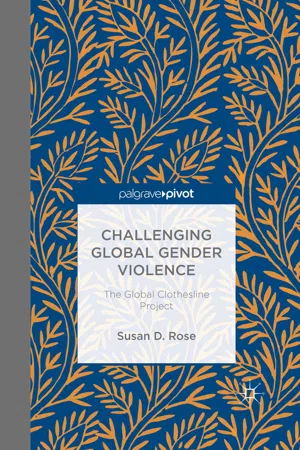
eBook - ePub
Challenging Global Gender Violence: The Global Clothesline Project
The Global Clothesline Project
- English
- ePUB (mobile friendly)
- Available on iOS & Android
eBook - ePub
Challenging Global Gender Violence: The Global Clothesline Project
The Global Clothesline Project
About this book
Challenging Global Gender Violence provides a qualitative and comparative analysis of women's experiences of violence, healing, and action across cultures. Gender violence is the most pervasive human rights violation affecting women and children across both the developed and developing world. While the specific cultural contexts and acts of violence vary, the feelings that women express about their experiences of abuse are strikingly similar. So are the images, colors, and words they use to express those feelings. Hearts - bruised, broken, and torn; black and red; NO! and No Más! are frequently found on shirts contributed to the Global Clothesline Project. While providing a theoretical analysis of trauma, Susan D. Rose grounds the discussion in the lived experiences and stories of women across cultures. Featuring women's stories, artwork, and voices as they speak about their experiences of violence and healing, this brief volume examines the relationship between gender inequality and gender violence, the health impacts of gender violence, and strategies being used to reduce violence against women.
Information
Topic
PsychologiePart I
Gender Violence across Cultures
1
Gender Violence: The Problem
Abstract: This chapter examines the problem (definitions, prevalence, and consequences) of gender violence. Long a significant cause of female morbidity and mortality, gender violence has increasingly become recognized as a human rights and public-health issue, especially within the last three decades. Still, it continues to be a pervasive danger to women and children in both developing and developed societies as data from multi- and cross-national studies indicate. Female infanticide and femicide, domestic violence, rape, mutilation, sex trafficking, dowry deaths, honor killings, incest, and breast ironing—all of which constitute gender violence—are part of a global pattern of violence against women, a pattern supported by educational, economic, and employment discrimination.
Keywords: abuse in pregnancy; domestic violence; family violence; femicide; honor killings; intimate partner violence; rape; sexual violence
Rose, Susan D. Challenging Global Gender Violence: The Global Clothesline Project. New York: Palgrave Macmillan, 2014. DOI: 10.1057/9781137388483.
Violence is every bit as much a public health issue for me and my successors in this century as smallpox, tuberculosis, and syphilis were for my predecessors in the last two centuries.
C. Everett Koop, M.D., Former Surgeon General of the United States (1984)
Violence against women is the most pervasive human rights violation which continues to challenge every country in the world. While laws, policies and resources are crucial to address this phenomenon effectively, these efforts must be coupled with actions to combat its structural and systemic causes.
Rashida Manjoo, Special Rapporteur for the UN Human Rights Commission on violence against women (2011)
The United Nations’ Universal Declaration of Human Rights proclaims that “all human beings are born free and equal in dignity and rights,” yet women’s freedom, dignity, equality, and health are persistently compromised by law, custom, and religious tradition in ways that men’s are not (Bunch, 1995, p. 14). Female infanticide and femicide, domestic violence, rape, mutilation, sex trafficking, dowry death, honor killings, incest, and breast ironing—all of which constitute gender violence—are part of a global pattern of violence against women, a pattern supported by educational, economic, and employment discrimination. The effects of violence can be devastating to a woman’s reproductive health as well as to other aspects of her physical and mental well-being. In addition to causing injury, violence increases women’s long-term risk of a number of other health problems, including chronic pain, physical disability, drug and alcohol abuse, skin complaints, gastric ulcers, sleep disturbances, depression, and suicide (Meshkat and Landes, 2011; WHO/UNAIDS, 2010; Krug et al., 2002; Te Awatea, 2010; Robertson and Oulton, 2008). Women with a history of physical or sexual abuse are also at increased risk for unintended pregnancy, sexually transmitted infections, and adverse pregnancy outcomes (Sakar, 2008; Ending Violence, 2006).
Within the last three decades, gender violence, long a significant cause of female morbidity and mortality, has increasingly become recognized as a human rights and public-health issue. Still, it continues to be pervasive in both developing and developed societies. The World Bank report “Violence Against Women: The Hidden Health Burden” (Heise et al., 1994) examined the implications of gender violence for health and socio-economic development, estimating that gender-based victimization is responsible for one out of every five healthy years of life lost to women of reproductive age. The report concludes: “Female-focused violence also represents a hidden obstacle to economic and social development. By sapping women’s energy, undermining their confidence, and compromising their health, gender violence deprives society of women’s full participation” (p. ix).
Resistance to change is strong, however, especially when it comes to challenging deeply held beliefs and values about gender roles, statuses, and power. Violence against women is a complex phenomenon, deeply rooted in gender-based power relations, sexuality, gender roles, and identity that are embedded in cultural values and institutional practices as well as in individual beliefs and behavior. Efforts to eliminate or ameliorate gender violence must therefore confront underlying cultural beliefs and social structures that reinforce and perpetuate it.
Definition, types, and prevalence of gender violence
According to the first official UN definition of gender violence (1993b), violence against women includes “any act of gender-based violence that results in, or is likely to result in, physical, sexual, or psychological harm or suffering to women, including threats of such acts, coercion or arbitrary deprivations of liberty, whether occurring in public or private life.” The UN Beijing Declaration and Platform for Action of 1993a further clarified that:
Violence against women both violates and impairs or nullifies the enjoyment by women of their human rights and fundamental freedoms . . . In all societies, to a greater or lesser degree, women and girls are subjected to physical, sexual, and psychological abuse that cuts across lines of income, class, and culture.
Violence against women and girls includes physical, sexual, psychological, and economic abuse. It is often referred to as “gender-based” violence because it derives in part from women’s subordinate status in society. Many cultures have beliefs, norms, and social institutions that legitimize and therefore perpetuate violence against women. The same acts that would be punished if directed at an employer, a neighbor, or an acquaintance often go unchallenged when men direct them at women within the family or within intimate partner relationships.
Statistics paint a bleak picture of the social and health consequences of gender violence. Violence against women is a major cause of death and disability for women in the age group of 16–44 worldwide (UNIFEM, 2007). Roughly 60 million women who should have been alive today are “missing” because of gender discrimination, predominantly in South and West Asia, China, and North Africa. In India, more than 5,000 women are killed each year because their in-laws consider their dowries inadequate (Bunch, 1997). Surveys from around the world indicate that half of the women who die from homicides are killed by their current or former husbands (Krug et al., 2002; UNIFEM, 2007). Among women aged between 15 and 44, acts of violence cause more death and disability than cancer, malaria, traffic accidents, and war combined (UNIFEM, 2011). According to the U.S. surgeon general, domestic violence is the leading cause of injury to women in the United States.
A strong co-occurrence of spousal abuse and child abuse exists (Sousa et al., 2011; Appel and Holden, 1998). Results of a 2003 UNICEF study of child maltreatment deaths in rich countries in the 1990s showed that New Zealand had the third highest child maltreatment death rate (UNICEF, 2003; Social Report, 2010). In a study of 29 OECD countries, only the U.S. (ranked #1) and Mexico (ranked #2) had higher rates of annual child deaths due to negligence, maltreatment, and abuse (Social Report, 2010). While not all of these homicides are the result of familial abuse, many are. It is striking to compare the data from 2001–2008 of the 12,180 children in the U.S. who are reported to have died as a result of abuse and neglect with the combined total of U.S. fatalities for the same time period due to 9/11, Hurricane Katrina, the Iraq War, and the Afghanistan War: 9,664. A study of the exposure of children to physical and sexual violence (PV and SV, respectively) in five African countries “found strong associations between exposure to PV, SV or both and multiple adverse health behaviors during childhood” (Brown et al., 2009).
Data from a variety of sources indicate the degree to which women and girls are in danger across both the developed and developing worlds (Anderson and Sidel, 2011; Parrot and Cummins, 2006; Watts and Zimmerman, 2002; Campbell, 2002). Several studies have shown that there are links between violence against women and HIV/AIDS, especially in countries where women are not allowed to “say no” to their husbands or demand that a condom be used if a husband is HIV positive. A survey among 1,366 South African women indicated that women who were beaten by their husbands were 48 percent more likely to be infected with HIV than those who were not (Women and HIV/AIDS, 2004). In terms of sexual violence, it is estimated that one in five women worldwide becomes a victim of rape or attempted rape in her lifetime (UNFPA, 2005). UNICEF (2013) estimates that human trafficking yields $32 billion in profits yearly. This includes both labor and sex trafficking. While numbers vary, a reasonable estimate is that each year more than two million children are exploited in the global commercial sex trade, many of them trapped in prostitution (Trafficking, 2008). The World Health Organization (2006) reports that 150 million girls experienced forced sexual intercourse or other forms of sexual violence in 2002 (CDC, n.d.).
Some groups working with runaways in the U.S. estimate that one in three young people is solicited for sex within 48 hours of running away from home or becoming homeless (UNICEF, 2013). According to U.S. Health and Human Services sex trafficking in the U.S. includes 1.39 million victims each year with the majority being young girls between the ages of 9 and 19. The average age of the victim is 13. In an investigation of human trafficking, U.S. federally funded task forces opened 2,515 suspected incidents between January 2008 and June 2010, classifying 8 in 10 of the cases as sex trafficking (Banks and Kyckelhahn, 2011).
Pornography, a $13.3 billion industry in the U.S. and a $97 billion industry worldwide (Internet Filter Review, n.d.), helps fuel the sex trafficking industry, increases demand for violent sex, and affects intimate partner relationships—both in terms of how time is spent and what may come to be expected. Pornography is significant in shaping people’s expectations and desires and is becoming increasingly violent (Dines, 2011). At a 2003 meeting of the American Academy of Matrimonial Lawyers, two-thirds of the 350 divorce lawyers who attended said the Internet played a significant role in divorces in the past year, with excessive interest in online porn contributing to more than half such cases (Internet Filter Review, n.d.). Pornography is not a victimless crime: as of 2005, child pornography was a $3 billion annual industry. Gail Dines, sociologist and author of Pornland: How Porn Is Hijacking Our Sexuality (2011), argues that pornography—not comprehensive sexuality education or abstinence-only programs—has become the major form of sex education today, affecting people across their life span.
Intimate partner violence
While it is very important to recognize mass-marketed and extreme forms of violence that gain international attention, such as the brutal and ultimately fatal gang rape of a 23-year-old woman on a bus in New Delhi, India, it is also critical to recognize the everyday, “ordinary” enactment of violence against women that occurs in very similar ways across societies. The most endemic form of violence against women is intimate partner violence (IPV; Ending Violence, 2006; Silverman et al., 2001). The Family Violence Prevention Fund (2008) defines intimate partner violence “as physical, sexual or psychological harm by a current or former intimate partner or spouse; it includes a pattern of coercive or manipulative behaviors perpetrated by one intimate partner against the other in order to gain or maintain control in the relationship. These behaviors include psychological, verbal, financial, physical and/or sexual abuse concurrently or alone.”
Studies from 35 countries indicate that between one-fourth and one-half of women report having been physically abused by a present or former partner. An even larger percentage has been subjected to on-going emotional and psychological abuse (Heise et al., 1994, p. 4).
A WHO multi-country study on women’s health and domestic violence estimated the extent of physical and sexual intimate partner violence against women in 15 sites in ten countries: Bangladesh, Brazil, Ethiopia, Japan, Namibia, Peru, Samoa, Serbia and Montenegro, Thailand, and the United Republic of Tanzania. Using standardized population-based household surveys conducted between 2000 and 2003, women aged 15–49 years were interviewed; those who had ever had a male partner were asked in private about their experiences of physically and sexually violent and emotionally abusive acts. In total, 24,097 women completed interviews, with approximately 1,500 interviews per site. The reported lifetime prevalence of physical or sexual partner violence, or both, varied from 15 percent to 71 percent, with two sites having a prevalence of less than 25 percent, seven between 25 and 50 percent, and six between 50 and 75 percent. Men who were more controlling were more likely to be violent against their partners (Garcia-Moreno et al., 2006; see also Dahlberg and Krug, 2002).
At its most extreme, intimate partner violence leads to death. Studies of femicide in Australia, Canada, Israel, South Africa, and the U.S.A. indicate that 40–70 percent of female murder victims were killed by their husbands or boyfriends (Ending Violence, 2006, p. 44). In a U.S. study, murder was the second leading cause of death for girls aged 15–18, and 78 percent of homicide victims in the study were killed by an acquaintance or an intimate partner (Coyne-Beasley et al., 2003). In Colombia, every six days a woman is reportedly killed by her partner or former partner (Ending Violence, 2006, p. 44). Other less severe but common forms of IPV used to control partners include isolating their partners from friends or family, taking their partner’s money and giving them an “allowance,” and taking away car keys, continually criticizing or demeaning their partner in front of friends, or the threat of or actual physical or sexual assaults.
The 2010 WHO Multi-cultural study on women’s health and domestic violence against women found that between 6 and 59 percent of women reported experiencing sexual violence by an intimate partner in their lifetime, with figures for most sites falling between 10 and 50 percent. Population-based studies from various countries indicate that 10–69 percent of women aged 15–49 years experience physical abuse by a male intimate partner at least once in their lifetime, while 6–47 percent of women report attempted or actual forced sex by an intimate partner in their lifetime (Heise et al., 1999; Heise and Garcia-Moreno, 2002; Jewkes et al., 2002; Garcia-Moreno et al., 2006). Sexual violence can have major implications for victims’ physical, psychological, social, and spiritual health, including serious physical injuries, sexually transmitted infections, pregnancy, depression, suicidal behavior, ostracism, isolation, and posttraumatic stress disorder (Robertson and Oulton, 2008; Herman, 1992b; Frazier and Berman, 2008; Jewkes et al., 2002; Martin et al., 2007a, b).
Spousal violence has ramifications for the reproductive health of women. In the U.S., it is estimated that one in five to one in six pregnant women is in an abusive relationship (Sarkar, 2008; Chang et al., 2005; Newberger et al., 1992). Both physical and emotional abuse can have negative impacts on the health of the mother and fetus; these include vaginal/cervical/kidney infections, vaginal bleeding, abdominal trauma, hemorrhage, delayed prenatal care, miscarriage, stillbirth, low birth weight babies or premature delivery, complications during labor, fetal, bruising, fractures, and hematomas, infection or rupture of the mother’s membranes, abruption of placenta, chronic illness in the mother or baby, and death (Koenig et al., 2006; Samandari, 2010; Newberger et al., 1992). Some studies based in health facilities indicate a relationship between intimate partner violence and death during pregnancy. For example, a study of 400 villages and seven hospitals in rural western India found that 16 percent of all deaths during pregnancy were the result of partner violence (Ending Violence, 2006, p. 58).
Intimate partner violence in sub-Saharan Africa is increasingly being recognized as an important public-health issue (Garcia-Moreno et al., 2006; Bowman, 2003), with about half of African women reporting abuse by their partners (Watts and Mayhew, 2004). Research on the effects of spousal violence on women’s health show a link between exposure to domestic violence and adverse birth outcomes (Boy and Salihu, 2004; Silverman et al., 2007), including the risk of fetal loss in this region (Jones and Horan, 1997), where the rate of fetal death is the highest in the world (Alio et al., 2009). Analyzing data from the 2004 Cameroon Demographic Health Survey administered to 2,570 women, Alio, Nana, and Salihu (2009) investigated the effect of physical, sexual, and emotional violence on potentially preventable single and recurrent spontaneous fetal loss. In the violence module of this survey, women were questioned about their experience of physical, emotional, and sexual violence inflicted by their spouses, and about any stillbirths and spontaneous abortions. Of the 2,562 women who responded to the violence module, those exposed to spousal violence (n = 1,307) were 50 percent more likely to e...
Table of contents
- Cover
- Title
- Part I Gender Violence across Cultures
- Part II Telling Lives: Women’s Stories from the Global Clothesline Project
- Part III Gender In/Equality: Reaching toward Ending Gender Violence
- Bibliography
Trusted by 375,005 students
Access to over 1.5 million titles for a fair monthly price.
Study more efficiently using our study tools.
Frequently asked questions
Yes, you can cancel anytime from the Subscription tab in your account settings on the Perlego website. Your subscription will stay active until the end of your current billing period. Learn how to cancel your subscription
No, books cannot be downloaded as external files, such as PDFs, for use outside of Perlego. However, you can download books within the Perlego app for offline reading on mobile or tablet. Learn how to download books offline
Perlego offers two plans: Essential and Complete
- Essential is ideal for learners and professionals who enjoy exploring a wide range of subjects. Access the Essential Library with 800,000+ trusted titles and best-sellers across business, personal growth, and the humanities. Includes unlimited reading time and Standard Read Aloud voice.
- Complete: Perfect for advanced learners and researchers needing full, unrestricted access. Unlock 1.5M+ books across hundreds of subjects, including academic and specialized titles. The Complete Plan also includes advanced features like Premium Read Aloud and Research Assistant.
We are an online textbook subscription service, where you can get access to an entire online library for less than the price of a single book per month. With over 1.5 million books across 990+ topics, we’ve got you covered! Learn about our mission
Look out for the read-aloud symbol on your next book to see if you can listen to it. The read-aloud tool reads text aloud for you, highlighting the text as it is being read. You can pause it, speed it up and slow it down. Learn more about Read Aloud
Yes! You can use the Perlego app on both iOS and Android devices to read anytime, anywhere — even offline. Perfect for commutes or when you’re on the go.
Please note we cannot support devices running on iOS 13 and Android 7 or earlier. Learn more about using the app
Please note we cannot support devices running on iOS 13 and Android 7 or earlier. Learn more about using the app
Yes, you can access Challenging Global Gender Violence: The Global Clothesline Project by S. Rose in PDF and/or ePUB format, as well as other popular books in Psychologie & Persönlichkeit in der Psychologie. We have over 1.5 million books available in our catalogue for you to explore.