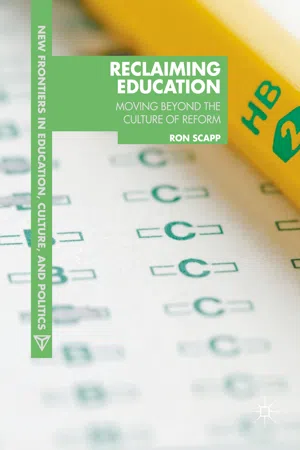
This book is an appeal to those directly and indirectly involved in education reform to reconsider the very nature of education as a process of transformation and not, as the neoliberal corporate model insists upon, as a "product." By using Paulo Freire's fundamental principle of understanding "education as the practice of freedom," and expanding upon it with bell hooks' own spiritual understanding of that principle, this book offers readers the opportunity to rethink what education is, and what it is not. Utilizing the work of diverse thinkers and critics, the book lays out a criticism of neoliberalism's profound influence on education reform and our culture generally. It reaffirms the political and ethical import of education for individuals and for our nation as a whole.
- English
- ePUB (mobile friendly)
- Available on iOS & Android
eBook - ePub
About this book
Information
Topic
EducationSubtopic
Education Administration© The Author(s) 2016
Ron ScappReclaiming EducationNew Frontiers in Education, Culture and Politics10.1057/978-1-137-38843-8_11. Introduction: Reclaiming Education
Ron Scapp1
(1)
College of Mount Saint Vincent, Riverdale, New York, USA
There is no question that our nation is in the throes of an education crisis, however real or imagined. 1 Whether it is the call for national standards, a renewed commitment to science, technology, engineering, and math (commonly known as the STEM initiative), or the apparently universal demand for better-trained teachers, critics from both the left and the right seem in agreement that unless the United States rethinks and restarts its education system, our nation will find itself at a profound disadvantage both economically and politically.
We have been put on notice by some of the biggest names in business and philanthropy—Bill Gates, Michael Bloomberg, and former President Bill Clinton among them. They have warned us that our country will no longer be competitive or the world leader it has been if the education problem is not solved, and solved quickly.
According to the cable networks CNN, MSNBC, and Fox News, all of whom have been hosting education forums and summits, the continuing emergence and expansion of China’s economy, coupled with the volatility of the current US debt situation and the concomitant failed efforts to remedy our nation’s out-of-control spending, have only exacerbated the education crisis: it is clear that analysts and pundits alike from all quarters are pressing the panic button. The resulting alarm is causing politicians, business people, and educators to take particular notice of the relationship existing among teaching, politics, and the push for reform, nationally and globally.
In this book, I want to address this important relationship from a perspective that will ask all of us to reconsider what education is fundamentally. I will discuss the status of education in the United States today and some of the various strategies to reform it. More importantly, I will challenge some of the givens about school reform, challenge, if you will, the very “culture of reform,” including the much vaunted, if lately somewhat hackneyed, notion of “school choice,” and the various corporate and business models and metaphors being touted as the only effective tools and language to move our nation’s education system forward.
In short, I intend to offer a different view of education—what it is, and what it is not. As I do so, I will also present some opinions about the nature of power and leadership that relate to education. What I want to offer will prove, I believe, to be more of an invitation (actually an appeal) for us, as a nation, to begin a new dialogue that has us considering and reconsidering the nature of teaching and its relationship to politics and school reform. Many others have weighed in on this important issue as well. I will specifically use and quote their good work, and disagree with those of whom I believe have it wrong, and evoke the spirit of Mark Edmundson’s book, Why Teach: In Defense of Real Education—agreeing with him that it is a “real” or genuine education that holds such promise for those who pursue it, and holds such promise for our nation as well. I am also aware that numerous other humanities professors such as Andrew Deblanco in his book College: What it Is, Was and Should Be and Michael Berube in his contribution to this debate, What’s Liberal about the Liberal Arts, have offered substantive and interesting arguments for and about “the liberal arts.” In chapters 6 and 7, I specifically refer to Martha C. Nussbaum’s perspective as presented in her book Cultivating Humanity: A Classical Defense of Reform in Liberal Education. But my approach and intention differ from these works primarily in that I am attempting to offer a critique of the influence that the policies and strategies of neoliberalism have had on education reform. Thus, unlike the works just mentioned, I am admittedly pursuing an explicitly political critique of the status of education in the United States today, and I do so from the perspective and tradition of “critical pedagogy.” 2
I would like to begin by identifying a few positions, claims, and propositions that very much form the foundation of this book. I will lay them out along with some explanation and description of what they mean and ought to suggest. I offer them to serve as guideposts and anchors, as it were, in order to give us both direction and a foundation for what follows. In a sense, I would like the Introduction to function in a manner not unlike the way the Dutch philosopher Benedict de Spinoza employed his “geometrical method” in his Ethics, and his work generally. His approach was to present propositions and axioms that set up his analysis. And, while I am stating the propositions and positions listed below, I will not assume that they are axiomatic for those reading them for the first time, although I do take them as axioms; that is, I take them to be self-evident, if not obvious to all, and true. The rest of the book will read differently in that while I allude to these positions and propositions, I let the chapters develop on their own, and I do not attempt to fully explicate or define these claims as such, even though they will be evoked. It is my hope that the force and value of these positions will become more attractive as each chapter is read. I want these seven claims to frame the rationale, trajectory, and impetus for our reclaiming education:
- 1.Education is neither a business nor a product. It is a process—a process that begins before children ever set foot in a school, and with luck a process that continues long after a student graduates from school.
- 2.Education is, by nature, not competitive.
- 3.Because many people wrongly understand education as competitive, they often strive for perfection (or the appearance of it) with respect to academic endeavors in order to get into the best schools, and so on. This competitiveness actually undermines much of the educative process that would otherwise flourish in settings that foster dialogue and collaboration—settings that develop the spirit of inquiry—and enhance our understanding that something can be truly excellent and not nearly perfect. In addition, we should consider the possibility that we do not always even need something excellent; we should consider the notion that sometimes good enough is good enough!
- 4.Rigidity is not rigor.
- 5.Information is not knowledge and knowledge is not wisdom. While it is true that one needs information to gain knowledge, and knowledge to gain wisdom, they are not the same.
- 6.Power is both good and bad.
- 7.Leadership may be different things at different times, but it strikes me that it is almost always some expression of the ability to negotiate and navigate through conflict and calm, through scarcity and abundance.
Position One: Education is neither a business, nor a product. It is a process—a process that begins before children ever set foot in a school, and with luck a process that continues long after a student graduates from school.
I will say more about Position One than about any of the other positions because it is the one position that really is at the heart of the debate and this book. I state Position One, despite the fact that it may be obvious to many who read it, because, in my opinion, sadly and to the detriment of students, teachers, administrators and parents, the single major force behind school reform in the United States today is the neoliberal position that we must follow and abide by “market forces.” 3 As a result the way in which much, if not all, of the conversation and debate over school reform gets framed is the following: we need to rely on the corporate notions and metaphors of accountability, efficiency, and quality control. (Of course, this is championed despite all the repeated incidents of corporate corruption, mismanagement, and lack of productivity—we can go back a long way and provide ourselves with a litany of examples. But, in order not to take up the remaining space of this book identifying the all too many corporations that would make our list so long, suffice it to say that AIG, Lehman Brothers, the busting of the housing bubble, the bundling of subprime mortgages, derivative, and insider trading are names and practices that should not only make us all squirm but also wonder out loud as to how anyone could point to corporate America as the foundation on which to build school reform—or any reform movement, for that matter.)
So, right from the start there is an issue concerning leadership—a big concept in today’s education reform debate. Instead of allowing educators to do their work, business leaders are taking charge, “taking command,” 4 of school reform: again, Bill Gates, Jack Welch of GE fame, and, more frighteningly, Wall Street speculators with their political as well as financial support of charter schools. We see more and more hedge-fund managers, who are now manipulating the charter school movement in numerous scary ways—specifically in ways that allow people to “invest in education,” literally, and to profit from school reform, not unlike the role many of these same investors played in bundling, speculating, and making huge profits from subprime mortgages. I will address this issue in Chapters 3 and 4; however, the point I want to make here is that school leadership, and therefore school authority, that is, power, have been taken away from schools and educators and placed in the hands of “money makers” (aka capitalists) posing as philanthropists and socially conscious individuals interested in school reform and our nation’s well-being. 5
Despite the clear evidence, however, that the corporate model of following the ebbs and flow of the market is flawed at best, we find ourselves nevertheless being “sold” a package that includes educational policies and approaches that view education as a business. According to the neoliberal model alluded to above, education needs to be revamped within the framework of a business. We are immediately reminded that businesses need to be efficient in the delivery of their products to their customers. We are then told what this means and how it translates into the current debate over school reform: education is the product and students are the customers.
As I will discuss in Chapters 3, 4, and 5 in detail, this is problematic for a number of reasons, but for the moment I just want to emphasize the fact that this model turns natural learners (students) into customers and therefore into “consuming subjects,” or what Henry A. Giroux and others have called, “consumer subjectivities.” And, along with this come all the strategies of marketing and advertising that are second nature to corporations (implemented consciously or not, but certainly mostly done so consciously and with great determination)—thus we get the “school choice” movement. This is so because the question that typically gets formulated within the corporate framework is: what do the consumers deserve (and want)? The answer, of course, is “choice!” We are led to believe that if schools compete, that is, compete for (your) business, then, just as is the case in the marketplace, the product will be more efficiently manufactured, more cheaply delivered, and will be of a better quality than if no competition were at play.
Many people have offered important critiques of this model and strategy, including Paulo Freire, Henry Giroux, Bell Hooks, Stanley Aronowitz, and many others involved in the “critical pedagogy” movement. There are many problems with the corporate model of school reform, but I would like to call attention to just a few that connect with teaching, politics, and the culture of reform.
By viewing education and school reform within the context of a business model, one then understands educational leadership within the context of a corporate framework of authority. It is no accident that one of the biggest words in education today, after choice, is “assessment.” It is also no accident that there are many for-profit companies selling products and services to school districts and to institutions of higher education to help them assess everything.
I too am a firm believer in evaluating and assessing, and allowing students many opportunities to demonstrate what they know and what they have learned. But when the means of assessment are essentially determined by “market forces” alone, a number of interesting and disturbing things can and should be noted.
First, the instruments of assessment start to dictate “what gets assessed.” If you observe the various organizations across the country that accredit institutions of higher education, you will see that more and more of them dictate the language and categories of things that must be assessed, and the very manner in which they are to be documented and/or cataloged. This should trouble us for a number of reasons, but mostly because it assumes that educators are unable to appropriately assess the learning of their students, and are not to be trusted with examining their own productivity, whether it is scholarly or success in the classroom (and such success is also “scholarly” activity, though often not considered so).
In addition to the things that we can say and debate about it all, one thing we should note is the ever-increasing attempt to tie good teaching (especially at the primary and secondary levels) with grades—grades that the teacher ultimately does not give, but are rather rendered by virtue of high-stake testing (testing that is developed not by the local educators but by educational entrepreneurs). Or, as in the case of many institutions of higher education, there is more and more frequently a mandated “acceptable” grade distribution, as determined by the administration or some academic integrity committee, and enforced by rank and tenure committees when considering tenure and promotion decisions.
This in turn is tied to the problematic “need” to continuously develop and market new product—this is why schools across the country are completely changing curricula and pedagogical strategies approximately every four years (coincidently overlapping many election cycles and inventory distribution strategies). Ask any longtime school teacher and she or he will tell you, “one year it is the whole language movement then the next it is the ramp up program, and before that success for all.” 6 All these “products” (along with the accompanying tests) are tied to grading that is, in turn, tied to assessment predicated on grades generated from such products (curricular and pedagogical), and disturbing for many reasons, some obvious, others not.
I am neither against change and innovation nor am I opposed to individuals and groups, even for-profit ones, offering goods and services to schools, students, and educators, but I am opposed to their “dictating” what the goods and services are by virtue of forcing out any meaningful input from the students and teachers who will need to work with these so-called innovations, and by not offering enough real support to make them effective, in the long term. 7
It is also worth noting that while the trend for primary and secondary education is focusing on “increasing grades and scores” and tying “merit” pay and teacher evaluation to such scores, in hig...
Table of contents
- Cover
- Frontmatter
- 1. Introduction: Reclaiming Education
- 2. The Culture of Reform
- 3. Getting Down To Business
- 4. The Product: Education
- 5. More Than Competition, More Than Information
- 6. Becoming Knowledgeable and the Search for Wisdom
- 7. Politics and Education
- 8. Education as the Practice of Freedom
- Backmatter
Trusted by 375,005 students
Access to over 1.5 million titles for a fair monthly price.
Study more efficiently using our study tools.
Frequently asked questions
Yes, you can cancel anytime from the Subscription tab in your account settings on the Perlego website. Your subscription will stay active until the end of your current billing period. Learn how to cancel your subscription
No, books cannot be downloaded as external files, such as PDFs, for use outside of Perlego. However, you can download books within the Perlego app for offline reading on mobile or tablet. Learn how to download books offline
Perlego offers two plans: Essential and Complete
- Essential is ideal for learners and professionals who enjoy exploring a wide range of subjects. Access the Essential Library with 800,000+ trusted titles and best-sellers across business, personal growth, and the humanities. Includes unlimited reading time and Standard Read Aloud voice.
- Complete: Perfect for advanced learners and researchers needing full, unrestricted access. Unlock 1.5M+ books across hundreds of subjects, including academic and specialized titles. The Complete Plan also includes advanced features like Premium Read Aloud and Research Assistant.
We are an online textbook subscription service, where you can get access to an entire online library for less than the price of a single book per month. With over 1.5 million books across 990+ topics, we’ve got you covered! Learn about our mission
Look out for the read-aloud symbol on your next book to see if you can listen to it. The read-aloud tool reads text aloud for you, highlighting the text as it is being read. You can pause it, speed it up and slow it down. Learn more about Read Aloud
Yes! You can use the Perlego app on both iOS and Android devices to read anytime, anywhere — even offline. Perfect for commutes or when you’re on the go.
Please note we cannot support devices running on iOS 13 and Android 7 or earlier. Learn more about using the app
Please note we cannot support devices running on iOS 13 and Android 7 or earlier. Learn more about using the app
Yes, you can access Reclaiming Education by Ron Scapp in PDF and/or ePUB format, as well as other popular books in Education & Education Administration. We have over 1.5 million books available in our catalogue for you to explore.