eBook - ePub
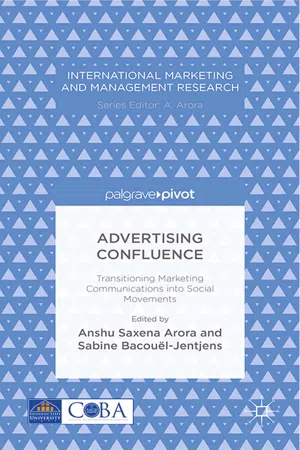
Advertising Confluence
Transitioning Marketing Communications into Social Movements
- English
- ePUB (mobile friendly)
- Available on iOS & Android
eBook - ePub
Advertising Confluence
Transitioning Marketing Communications into Social Movements
About this book
Advertising Confluence offers a unique blend of both traditional and contemporary social media thinking about advertising and integrated brand promotions throughout the world. Dr. Arora Anshu and Dr. Sabine Bacouel-Jentjens bring together articles that analyze creative social advertising in US, France, and Tunisia and offer a wide spectrum of advertising confluence from both the developed and emerging world. Contributors focus on both empirical studies with practical application as well as examinations of theoretical and methodological developments in the field of advertising studies. In all, they examine the wide range of global and local advertising strategies, the depth of integrated marketing communications, and the future of social media advertising.
Information
1
From Lipophilia to Lipophobia: The Role of Moral Entrepreneurs
Anne-Sophie Bacouël and Sabine Bacouël-Jentjens
Abstract: In the last decades, in most developed countries, fat has progressively been banished from both our plates and our bodies. Lipophobia is now growing in affluent societies, in striking contrast to traditional societies, where lipophilia prevails. In the last 30 years scientific, medical, and public health interest in obesity has skyrocketed. Increasingly the term “epidemic” is being used in the media to describe the current prevalence of corpulence in modern societies. To understand the phenomenon of increasing lipophobia and related issues, this paper focuses on how the standards toward fat evolved and on how moral entrepreneurs impact the perception of fat in Western societies via the use of media.
Keywords: lipophilia; lipophobia; media; moral entrepreneurs
Arora, Anshu Saxena and Sabine Bacouël-Jentjens. Advertising Confluence: Transitioning Marketing Communications into Social Movements. New York: Palgrave Macmillan, 2015. DOI: 10.1057/9781137492265.0008.
Introduction
In the 1980s, the French Prime Minister Jacques Chirac revealed that he always perceived his lean physical appearance as a handicap in his political career. According to him, the voters always preferred the “chubby” politician (Fischler, 1987). This assertion is confirmed by empirical data collected from several countries, providing evidence that people with a more corpulent appearance were generally perceived as having a more amiable attitude and more open to communication and to empathy than people having a lean appearance (Fischler, 1987). Three decades later, however, France’s current president, François Hollande, restrained to lose weight during his election campaign to qualify for the French presidentials (Grangeard, 2012). Therefore, the image of the body and the perception of weight seem to have changed, at least in France. However, when we look beyond borders, we notice that in other countries, the body mass does not influence the image of a politician in the same way. The current German government, for example, is more corpulent compared to the French. The image of corpulence thus seems to vary according to countries and cultures. However, the topic of obesity has gained importance in public discussion to the point of speaking about a worldwide epidemic.
According to the World Health Organization (2014), worldwide obesity has nearly doubled since 1980. In 2008, more than 1.4 billion adults were overweight and 500 million of these were obese (WHO, 2014). Obesity particularly affects contemporary societies in the developed world, and these societies seem to be turning lipophobic, that is, to be developing a marked aversion to fat. A corpulent body increasingly tends to be regarded as unaesthetic and unhealthy, while a lean body is apparently considered as a goal which is worth effort and cost (Fischler, 1992). The progression of lipophobia can be observed on three fronts: medicine and public health, fashion and corporal aesthetics (body image), and finally food consumption and eating habits.
To understand the current discussion about obesity and growing lipophobia, particularly in Western societies, our research concentrates on the perception of corpulence over time and strives to answer the following questions:
—How did the standards toward fat evolve in societies?
—Who are the moral entrepreneurs impacting the perception of fat in Western societies?
—How do moral entrepreneurs use media in the context of obesity?
First, we shortly describe the evolution of fat perception over centuries and across cultures. Second, we analyze the factors leading to contemporary societies becoming increasingly lipophobic. In this context we will try to elaborate the influence of moral entrepreneurs such as the fashion, pharmaceutical, and food industry on obesity perception and their use of media to push forward their respective interests.
Lipophilic and lipophobic societies over the centuries
Fat has not always been a plague in the eyes of men; in fact it was considered as an ally in difficult times. It seems that in prehistoric societies, excessively corpulent mothers did not displease, as numerous statuettes such as the Venus of Willendorf testify. On the contrary, they represented fertility (Fischler, 1990: 342). While corpulence was valued in prehistoric societies, thinness was deprecated, representing exposure to the cold, disease, and famine (Ky et al., 1996). Under the Roman Empire fat was praised alike. Banquets were very frequently celebrated by the patricians, the elite of the Roman society, following the example given by the Roman emperors. Corpulence was a sign of wealth, attracting respect and authority (Ky et al., 1996). In medieval times, a reserve of fat was essential to survive in periods of famine or epidemics. But fat was also a symbol of pleasure and power reserved to the Lords (Ky et al., 1996). Later, during the Renaissance, the likeable women possessed full breasts, fleshy arms, a roundish chin, and a fat and round bust (Ky et al., 1996). This vision of the ideal body is illustrated by the Rubens paintings, where corpulent women are predominantly represented.
Today, in many societies different from the western ones, fat is often still positively considered, or at least was, until the western culture had its influence. Generally, African ideals of beauty are closer to stoutness than to thinness. Corpulence is valued, because it represents powerful position, social success, as well as health and fertility. Since the epidemic of AIDS, thin bodies are automatically linked to the disease. In Niger, girls take medications to increase their appetite, while in Mauritania they are fed in great quantities with sweet goat cream (Cohen et al., 2010; Effiong, 2013). In India, fat has been for a long time a symbol of success: corpulent people possessed enough money to afford food in abundance, to avoid manual labor, and to be loved and cherished by their peers. Stoutness was necessarily bound with happiness. Sridevi, the key Indian actress of the 1980s, had many curves and was nicknamed “Thunder Thighs” in reference to her voluminous thighs. Nowadays, it is the middle class that is increasingly becoming obese, thereby changing the image of obesity from prosperity and beauty to epidemic (Ranjani, 2011). In Tahiti, until the end of the 19th century, corpulence was the sign of upper-class membership. Even though the right of fattening in upper society is not practiced nowadays, Tahitians find corpulent people more attractive. The valuation of corpulence is a phenomenon still present in Tahiti, in spite of the strong influence of the thinness cult of western societies, communicated through the media (Prentice, 2006; Serra-Mallol, 2008).
In contrast, certain civilizations in the past can be described as lipophobic. In ancient Egypt, for instance, thinness was a fashion. Many ointments that refined the body tissue or eliminated weight were developed, and women were advised to avoid births too close together. Egyptians regularly practiced intestinal cleansing, intended to avoid obesity (Ky et al., 1996). In ancient Greece, beauty was mostly defined by symmetry with bulging muscles and athletic members. Being overweight was considered redundant and as a sign of decay of the body. Sports were very important to the Greeks. Even old Socrates invested in sport “to reduce his belly sticking out the right measure” (Ky et al., 1996). Baths in cold water were preferred because they were supposed to tone muscles and help avoid a protruding belly (Ky et al., 1996). One can also notice a certain food sobriety: the Greeks ate dried fruit, olives, and fish and avoided meat and large meals. In the 19th century, pale and thin women represented a certain ideal of beauty. Morbid femininity became fashion as Alexandre Dumas’ “Lady of the Camellias”: sunken eyes, hollow cheeks, thin body, and slender chest (Ky et al., 1996).
We were able to observe that the vision of and attitude toward fat have changed through the centuries, but also according to the cultural spheres. According to Sobal (2001), a person’s cultural context is likely to be the most powerful influence on eating patterns, activity levels, and, therefore, body weight. Depending on the historical and geographical context, lipophilia is related to a need to survive, an image of good health, fertility, or the demonstration of wealth and power. In today’s abundant societies, these values do not need to be demonstrated anymore by body shape. As a matter of fact, health, wealth, and power in those societies are nowadays more frequently symbolized by the ability to take care of one’s body.
How have standards toward fat changed?—the role of moral entrepreneurs
One may wonder how the views of society have changed so fundamentally from praising to cursing fat. The progression of lipophobia can be observed on three fronts: fashion and corporal aesthetics (body image), food consumption and eating habits, and medicine and public health. In each of these spheres, the so-called moral entrepreneurs set and push forward new standards, which are followed by the masses, and sanction those who do not or cannot respect these norms.
The objective existence of an obviously harmful condition such as obesity does not, by itself, constitute a social problem (Becker, 1966). Social problems may be looked at as constructed phenomena. In other words, what constitutes a problem is the concern that segments of the public express about a given condition. Definitions of social problems are produced by specific cultural circumstances, groups and categories, social structures and societies, historical eras, individuals, and/or classes (Goode & Ben-Yehuda, 1994).
Becker (1963; 1985) distinguishes two types of “moral entrepreneurs”: those who create new standards and those who enforce them. The creator of standards is not satisfied with current laws or a certain type of behavior and considers them as personally offensive. The creators can be politicians, do-gooders, or activists who push for a given cause which might lead to a “crusade for moral reform” in order to obtain a change, for instance in legislation. This crusade can generate a moral panic, where reactions to a certain condition are out of proportion to the real and present danger that a given threat poses to the society. The notion of an obesity epidemic can be identified as a moral panic. In response to this exaggerated concern, deviant stereotypes which are said to be at the source of the threat, are created and identified as an official enemy. The crusade can succeed and lead to the creation of a new law or globally accepted norm, or fail and lead to the dissolution of the group of moral entrepreneurs or its reconversion (Goode & Ben-Yehuda, 1994). But once the moral reform is successful, its continuance must be ensured. It is the second type of moral entrepreneurs who are responsible for enforcing standards. These can be, for example, specially created institutions to sanction any breach of the law or norm (Becker, 1985). The most widely used perspective on moral panics has been the interest group approach. In this perspective, professional associations, media and other groups, and organizations are able to engage in collective action to generate and sustain moral panics which result in an increase of their wealth (Goode & Ben-Yehuda, 1994).
An important instigator of today’s lipophobic standards was the US insurance industry. At the end of the 19th century, a new flourishing market for life insurances was born in the United States. In 1890, New York Life, an insurance company, searched for health indicators to assess the risk factors for each client in a better way. By analyzing statistics, the company realized that there was a correlation between premature death and weight of the insured. In 1942, the Metropolitan Life Insurance Company provided a table of ideal weights (Fischler, 2004), defining overweight as 10 per cent above the ideal body weight and obesity as 20–30 per cent higher than the ideal. According to Metropolitan, the mortality rate of obese men was 70 per cent and for women 61 per cent higher compared to people with “normal” weight (Fischler, 1990). These studies quickly became the basis of insurance companies to encourage their customers to lose weight. Later, it was proven that the statistics were misleading as most weights were self-reported by the policyholders and were not rechecked. In addition, the tables did not take the aging process and related weight gain into account: the table stated the ideal weight for 25-year-old individuals only. However, the elderly could not achieve the same weight due to changing conditions. Nevertheless, the US insurance lobby impacted public opinion and vilified obesity (Fischler, 1990). This triggered lipophobia in a way that it is nowadays perceived. For the insurance companies, the introduction of new weight standards generated higher premiums as a response to a supposedly higher risk. In the following section, we will discuss the role of medicine and public health sector, the body image industry (fashion and corporal aesthetics), and finally the food industry as moral entrepreneurs and discuss their actions in the light of the group interest approach. We will see that media play an important role for moral entrepreneurs to generate and sustain moral panic.
Boero’s (2007) analysis of articles, published in the New York Times over a decade, shows that the term “epidemic” is increasingly being used not only in the media but also in medical journals and public health policy literature, when describing the current prevalence of corpulence in North America. Newspapers and magazines are filled with discussions of obesity and the health problems and associated risks. Simultaneously, the same media offer a vast array of advertising promoting ideal body shape and the appropriate products to achieve or maintain this condition.
Medicine and sciences
Doctors and obesity researchers are the fundamental moral entrepreneurs. They have the authority and their statements, made over the media, often influence the public. In 1998, due to the influence of these moral entrepreneurs, the US government decided to lower the threshold at which the individual is regarded overweight, from a body mass index of 27 down to 25. Thus, 25 million Americans, who were still in the normal weight category, became overweight overnight resulting in the perception of an obesity epidemic (Warren & Smalley, 2013).
Up until the last decades of the 20th century, moderate corpulence was considered attractive and healthy in most modern societies. A reasonably corpulent figure indicated good body management, and corpulence evoked sound financial assets (Schwartz, 1986; Seid, 1989). This lipophilic view of fat seems to have then been shared by most members of the medical profession (Schwartz, 1986). After World War II, the medical profession, influenced by the new insurance standards, took up an increasingly lipophobic stance. Corpulence came to be considered not only as an individual problem but also as a collective one, even a social one. Overweight and obesity were displayed as the consequences of overeating and unhealthy diets in a plethoric society. Obesity came to be regarded as one of the major factors in many modern pathologies, particularly coronary heart disease and diabetes (Prentice, 2006).
Today, a significant amount of research is published about obesity. However, many, if not most, of the obesity researchers are prominent consultants of the slimming, food, and phar...
Table of contents
- Cover
- Title
- 1 From Lipophilia to Lipophobia: The Role of Moral Entrepreneurs
- 2 Creative Advertising Appeals on Global Cultural Spectrum
- 3 Polysemy in Advertising: A Study of the Effects of Advertising Messages on Decision Making
- 4 Does the Country of Origin Matter for Cosmetics The Made in France Argument
- 5 Brand Diffusions and Brand Naming Strategies
- 6 Say It without Saying It: How Consumers Interpret Tropes in Advertising and Its Impact on Campaign Success
- 7 How True Are Stereotypes The Role of Stereotypes in Advertising
- 8 The Value of Social Networks in the World of Advertising
- Afterword
- Index
Trusted by 375,005 students
Access to over 1.5 million titles for a fair monthly price.
Study more efficiently using our study tools.
Frequently asked questions
Yes, you can cancel anytime from the Subscription tab in your account settings on the Perlego website. Your subscription will stay active until the end of your current billing period. Learn how to cancel your subscription
No, books cannot be downloaded as external files, such as PDFs, for use outside of Perlego. However, you can download books within the Perlego app for offline reading on mobile or tablet. Learn how to download books offline
Perlego offers two plans: Essential and Complete
- Essential is ideal for learners and professionals who enjoy exploring a wide range of subjects. Access the Essential Library with 800,000+ trusted titles and best-sellers across business, personal growth, and the humanities. Includes unlimited reading time and Standard Read Aloud voice.
- Complete: Perfect for advanced learners and researchers needing full, unrestricted access. Unlock 1.5M+ books across hundreds of subjects, including academic and specialized titles. The Complete Plan also includes advanced features like Premium Read Aloud and Research Assistant.
We are an online textbook subscription service, where you can get access to an entire online library for less than the price of a single book per month. With over 1.5 million books across 990+ topics, we’ve got you covered! Learn about our mission
Look out for the read-aloud symbol on your next book to see if you can listen to it. The read-aloud tool reads text aloud for you, highlighting the text as it is being read. You can pause it, speed it up and slow it down. Learn more about Read Aloud
Yes! You can use the Perlego app on both iOS and Android devices to read anytime, anywhere — even offline. Perfect for commutes or when you’re on the go.
Please note we cannot support devices running on iOS 13 and Android 7 or earlier. Learn more about using the app
Please note we cannot support devices running on iOS 13 and Android 7 or earlier. Learn more about using the app
Yes, you can access Advertising Confluence by A. Arora, S. Bacouël-Jentjens, A. Arora,S. Bacouël-Jentjens in PDF and/or ePUB format, as well as other popular books in Business & Business Communication. We have over 1.5 million books available in our catalogue for you to explore.