Puritanism has a reputation for being emotionally dry, but seventeenth-century Puritans did not only have rich and complex emotional lives, they also found meaning in and drew spiritual strength from emotion. From theology to lived experience and from joy to affliction, this volume surveys the wealth and depth of the Puritans' passions.
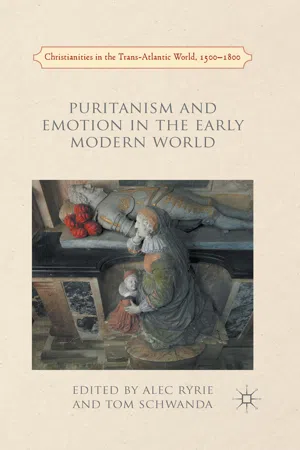
eBook - ePub
Puritanism and Emotion in the Early Modern World
- English
- ePUB (mobile friendly)
- Available on iOS & Android
eBook - ePub
Puritanism and Emotion in the Early Modern World
About this book
Information
Topic
PhilosophySubtopic
British History1
‘Light Accompanied with Vital Heat’: Affection and Intellect in the Thought of Richard Baxter1
Keith Condie
Should we value emotions or treat them with caution? Humanity has wrestled with this question since the time of antiquity, and the ambivalent answers that emerged continued in the early modern world. On the one hand, most conventional treatments affirmed that the passions performed an essential function in motivating behaviours that were necessary to human survival and flourishing. On the other hand, there was an alertness to the dangers they posed, that to grant the passions a free hand could enslave or corrupt the soul and thereby undermine well-being and morality.2 Central to these discussions was the place of reason in moderating the passions and promoting virtue. The Stoics held that the good life was a state of ataraxia, or tranquillity, attained when all passion was overcome by reason. For the Aristotelians, the passions contributed to virtue, but required the direction of reason to restrain them and ensure they responded appropriately to their objects. Then there was the perspective of the Platonists, who believed that some emotional responses should be intense while others should not be felt at all.3 Philosophical enquiry in the early modern period drew upon this classical heritage, but made various modifications in the light of ongoing intellectual developments.4
Perspectives on emotions in the history of Christian thought
Christian doctrine played a central role in this refashioning of traditional understandings of emotions and rationality and their significance for the virtuous life. Rejecting the Stoic binary opposition of passion and reason, Augustine affirmed that the goodness or the otherwise nature of affections was determined by the state of the will.5 When the will loves in a rightly ordered and directed manner, that is, in accordance with the ends for which God created human beings, then the various affections that follow are fitting and praiseworthy:
the citizens of the holy city of God, who live according to God in the pilgrimage of this life, both fear and desire, and grieve and rejoice. And because their love is rightly placed, all these affections of theirs are right.6
This voluntarist strain of spirituality, acknowledging the importance of the human will and the affections, particularly love, in the pursuit of the godly life, influenced Christian thought and practice in subsequent centuries. At the theological level, this Augustinian emphasis came to be particularly associated with Duns Scotus, who believed that the will was the noblest of the human faculties and that final blessedness was an act of will – loving the God who is the greatest good (summum bonum) of the human soul. Such an approach resisted theological speculation and viewed theology as primarily a matter of practice, since its aim was to move people to love God. This voluntarist position can be contrasted with the intellectualism of Thomas Aquinas, who granted the intellect precedence over the will on the grounds that the true end of humankind is the intellect’s vision of God in all his truth and glory. The consequence of intellectualism is a more theoretical and contemplative theology.7 However, neither reason nor affection was shunned by either of these perspectives; yes, the Thomists stressed the knowledge of God over the love of God, and the Scotists vice versa, but both systems were attuned to a necessary role for both thought and sensibility in the lives of the upright.
The theologians associated with the Protestant Reformation and its ongoing development engaged with these medieval traditions and, generally speaking, affirmed that theology ‘was both theoretical and practical, both intellectual and voluntary, with the emphasis on the practical or voluntary element’.8 What ultimately mattered was that hearts regenerated by a gracious divine work should live for the glory of God and enjoy his blessedness forever. What, then, did this mean for the place of emotion and reason in early modern Protestant practice and, in particular, for that species of Protestant spirituality known as Puritanism?
However one chooses to resolve the vexed problem of defining ‘Puritanism’,9 many historians would acknowledge that heightened emotional states were a characteristic of this movement. For some time, scholarship has distanced itself from suggestions that Puritans were stunted in emotional expression.10 On the contrary, contemporaries of the Puritans identified this group as the ‘hotter sort of Protestants’,11 while recent writers have noted the ‘intensity’12 of their religious experience. This focus on emotion, however, was never at the expense of vigorous intellectual endeavour. In the words of John Spurr: ‘Puritans built their religion on head and heart.’13
The significance of Richard Baxter
The point can be simply illustrated with an example from the work of the seventeenth-century Puritan divine Richard Baxter. Baxter believed that certain emotional responses were of the esse of authentic Christian living. When outlining the marks of spiritual maturity in his treatise The Life of Faith, he claimed that:
in the affections there must be vivacity and sober fervency, answering to all those motions of the will: in love, delight, desire, hope, hatred, sorrow, aversation, and anger; the complexion of all of which is godly zeal.14
Yet to affirm the emotional was not to deny the intellectual. The same outline of graces and duties found in The Life of Faith that are indicative of a ‘complete and entire’ believer and grants such weight to the affections also affirms the necessity of knowledge and understanding.15 For Baxter, the rational nature of Christian faith and experience must never be disregarded. ‘God hath made reason essential to our nature’, he maintained: ‘It is not our weakness, but our natural excellency, and his image on our nature.’16
Baxter’s acknowledgement of a role for both ‘head and heart’ in religious expression matches the common understanding held not only by mainstream Puritans, but also by sixteenth- and seventeenth-century Protestant thought more generally. Divergent opinions did exist. As we shall see, there were Protestant ‘Enthusiasts’ who marginalised the role of reason, while the Latitudinarianism that emerged in post-Restoration England trod warily when it came to emotional expressions of faith. Baxter, however, sat with the majority in drawing upon scholastic and other treatments and affirming a place for both reason and affection. Although his intellectual convictions at this point may not have been novel, he does provide a particularly helpful window into the nature of Puritan and early modern Protestant sensibility, for two reasons.
First, Baxter was a key leader within Puritanism. His life (1615–91) and ministry traversed the dramatic political, religious and social upheavals that marked seventeenth-century England.17 While his initial pastoral impact was localised – serving as a chaplain for the parliamentary forces during the Civil War and ministering in the village of Kidderminster, Worcestershire throughout the years of the Interregnum – the reach of his pastoral expertise, ministerial methodology and theological understanding was soon extended by means of correspondence, published writings and association with other pastors. This more indirect pastoral work and consequent influence continued post-Restoration after Baxter entered the ranks of nonconformity when, as a matter of conscience, he was unable to assent to the religious settlement of 1662. Even though he had declined a bishopric in 1660, his natural leadership abilities could not be restrained by lack of official position. Writing in the early eighteenth century, the English clergyman Stephen Nye noted: ‘He found himself Archbishop of a whole Party, and therefore (I think) cared not to be Bishop only of a Diocess.’18 In short, Baxter was an influential figure who shaped thinking, practice and debate over many decades. His analysis of the emotional dimension in human and religious experience is therefore worthy of careful consideration.
Second, Baxter’s vast literary deposit19 provides more detailed information regarding Puritan and early modern perspectives on emotionality than much of the other literature of the time. There were some Puritan and other Protestant treatises that addressed the specific topic of the affections.20 But the greater part of the Puritan writing bequeathed to later generations is of a devotional nature, being published sermons and other such texts seeking to promote godly living. As Perry Miller noted, psychological processes tended to be assumed rather than articulated within these texts.21 Although Baxter’s reputation has been built primarily on practical writings of a similar nature, the full breadth of his literary corpus ranges across a variety of genres.22 Baxter believed that Christian practice derived from Christian doctrine. So too did all Puritan divines. But whereas the theological and philosophical presuppositions informing their treatises were often covert, the theoretical foundations for Baxter’s pastoral ministrations were often foregrounded, not only in his explicitly doctrinal treatises, but also in his more practical works. Furthermore, Baxter engaged with the breadth of the Western intellectual tradition. Although an autodidact, in the field of theology he claimed to ‘have read most of the Writers of great note’.23 He made a similar assertion regarding philosophical enquiry: ‘I have read almost all the physics and metaphysics I could hear of.’24 The extent of Baxter’s personal library25 and the level of scholarly engagement within his books and letters suggest this is not simply overstatement. The import of all this is that Baxter provides a rich resource for studying the place of emotion ...
Table of contents
- Cover
- Title Page
- Copyright
- Contents
- List of Figures
- List of Contributors
- Introduction
- 1. ‘Light Accompanied with Vital Heat’: Affection and Intellect in the Thought of Richard Baxter
- 2. Thomas Goodwin and the ‘Supreme Happiness of Man’
- 3. The Saints’ Desire and Delight to Be with Christ
- 4. ‘Milke and Honey’: Puritan Happiness in the Writings of Robert Bolton, John Norden and Francis Rous
- 5. Affliction and the Stony Heart in Early New England
- 6. Piety and the Politics of Anxiety in Nonconformist Writing of the Later Stuart Period
- 7. Resting Assured in Puritan Piety: The Lay Experience
- 8. Emotions and the Development of Virtue in Puritan Thought: An Investigation of Puritan Friendship
- 9. Puritan Emotions in Seventeenth-Century Dutch Piety
- Index
Trusted by 375,005 students
Access to over 1.5 million titles for a fair monthly price.
Study more efficiently using our study tools.
Frequently asked questions
Yes, you can cancel anytime from the Subscription tab in your account settings on the Perlego website. Your subscription will stay active until the end of your current billing period. Learn how to cancel your subscription
No, books cannot be downloaded as external files, such as PDFs, for use outside of Perlego. However, you can download books within the Perlego app for offline reading on mobile or tablet. Learn how to download books offline
Perlego offers two plans: Essential and Complete
- Essential is ideal for learners and professionals who enjoy exploring a wide range of subjects. Access the Essential Library with 800,000+ trusted titles and best-sellers across business, personal growth, and the humanities. Includes unlimited reading time and Standard Read Aloud voice.
- Complete: Perfect for advanced learners and researchers needing full, unrestricted access. Unlock 1.5M+ books across hundreds of subjects, including academic and specialized titles. The Complete Plan also includes advanced features like Premium Read Aloud and Research Assistant.
We are an online textbook subscription service, where you can get access to an entire online library for less than the price of a single book per month. With over 1.5 million books across 990+ topics, we’ve got you covered! Learn about our mission
Look out for the read-aloud symbol on your next book to see if you can listen to it. The read-aloud tool reads text aloud for you, highlighting the text as it is being read. You can pause it, speed it up and slow it down. Learn more about Read Aloud
Yes! You can use the Perlego app on both iOS and Android devices to read anytime, anywhere — even offline. Perfect for commutes or when you’re on the go.
Please note we cannot support devices running on iOS 13 and Android 7 or earlier. Learn more about using the app
Please note we cannot support devices running on iOS 13 and Android 7 or earlier. Learn more about using the app
Yes, you can access Puritanism and Emotion in the Early Modern World by A. Ryrie, Tom Schwanda, A. Ryrie,Tom Schwanda in PDF and/or ePUB format, as well as other popular books in Philosophy & British History. We have over 1.5 million books available in our catalogue for you to explore.