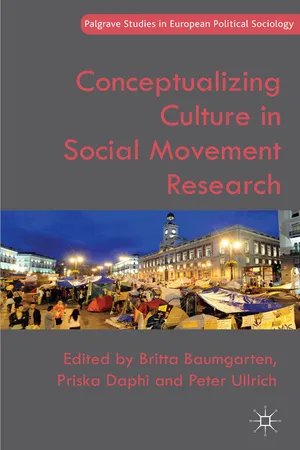
eBook - ePub
Conceptualizing Culture in Social Movement Research
- English
- ePUB (mobile friendly)
- Available on iOS & Android
eBook - ePub
Conceptualizing Culture in Social Movement Research
About this book
This volume introduces and compares different concepts of culture in social movement research. It assesses their advantages and shortcomings, drawing links to anthropology, discourse analysis, sociology of emotions, narration, spatial theory, and others. Each contribution's approach is illustrated with recent cases of mobilization.
Information
1
Protest and Culture: Concepts and Approaches in Social Movement Research – An Introduction
Peter Ullrich, Priska Daphi, and Britta Baumgarten
Culture has become a very prominent concept in social movement research. Despite its omnipresence, however, the concept of culture is often employed in an unsystematic and unnecessarily limited fashion. This is crucially due to the fact that culture is frequently used as a simple addition to existing models rather than as an approach in its own right. Recent approaches have started to address some of these shortcomings but remain marginal. This volume aims to systematize the different concepts of culture in social movement research by comparing approaches, assessing (theoretical) shortcomings, and presenting new ways of cultural analysis in the study of social movements and protest.
Movements and culture – A long journey
There is a long tradition of including culture in social movement research. One of the earliest sociological theories, the mid-19th-century Marxist class theory already constituted a theory of social movements and culture – though it assigned culture a secondary role. The predominant reading of Marx and Engels sees ideologies, forms of group consciousness, and other aspects of the social superstructure (i.e., culture) as derivatives of the economic base (although potentially fostering mobilization). Early 20th-century Marxist theories, for example by Gramsci and Lukács, assigned a larger role to culture as a force in its own right which shapes social reality, for example through the production of hegemonic meanings in civil society. They theoretically addressed the relations between social movements, social change, and culture. Since that time, addressing these relations has certainly lost none of its significance, although the degree of attention given to them in academic protest research has varied significantly over time.
Culture has recently been among those fields of research which have remarkably and constantly gained in strength and importance. This is true for the social sciences in general as well as the humanities, where we can discern a wide institutionalization of scientific institutions on culture (institutes, university courses, journals, conferences). An important factor in this development, of course, was the “cultural turn” of the social sciences (cf. Chaney 1994; Reckwitz 2000). This turn also applies to research in the field of social movements, protest, and contention, where culture is on the rise again.
The introduction of culture in social movement research from the 1980s onwards led to a range of innovative concepts that have influenced literature on social movements considerably. Especially, the framing approach (Snow et al. 1986; Snow and Benford 1988; Gamson and Modigliani 1989; Oliver and Johnston 2000), New Social Movement Theory (Dalton, Kuechler, and Bürklin 1990; Offe 1985; Eder 1986; Calhoun 1993), and collective identity (Melucci 1989, 1996; Touraine 1981; Taylor and Whittier 1992; cf. Daphi 2011) are cultural approaches that belong to the core of current social movement theory. They address questions of how people make sense of their world and actions, how they render cultural products meaningful, and how they interpret their grievances as political for themselves and others. These distinct cultural approaches to social movements have produced a number of empirical contributions (e.g. Gamson and Modigliani 1989; Johnston 1991; Gerhards and Rucht 1992; Taylor and Whittier 1992; Eder 2000; Haunss 2004; Flesher Fominaya 2010; Daphi 2013). In addition, existing models, such as the political opportunity structures (POS) approach, included cultural factors with respect to “cleavage structures” (e.g. Kriesi et al. 1995; Hutter 2014) and “cultural” or “discursive opportunity structures” (e.g. McAdam 1994; Koopmans and Kriesi 1997; Koopmans and Statham 2000; Goldberg 2001; Ferree et al. 2002; Ullrich 2008).
On the conceptual level of defining culture,1 the existent cultural approaches within this mainstream of current social movement theory vary greatly (Hamm 2011). They apply Weberian concepts of culture as values and beliefs (many approaches of the New Social Movement Theory, see above) – culture as a readily available set of usable practices (most prominently in Anne Swidler’s toolkit metaphor of 1986) or culture as organizing schemata of cognitions in the framing approach (see above) and the cognitive approach (Eyerman and Jamison 1991).2 Only a few of the attempts to date, such as anthropological approaches (Salman and Assies 2007), apply a broad cultural science-based concept of culture, which Reckwitz defines as a complete “cultural research programme” beyond disciplinary boundaries, taking a “total” and not “partial” perspective on culture, allowing the researcher to analyse “each subject matter of the arts and humanities [ … ] as a cultural phenomenon” (Reckwitz 2004:1). With this broad cultural research programme in mind, many shortcomings of the current social movement theory become apparent, which we will outline in the following.
Conceptual shortcomings
Despite the considerable advances which the aforementioned literature represents, in several respects the use of concepts of culture in social movement research has remained limited and fragmented. This is mainly due to three tendencies of dealing with culture, which will be elaborated below: First, a focus on certain dimensions of culture; second, a narrow definition of culture; and third, a misleading opposition drawn between culture and structure. In all three of these tendencies, the persistence of existing models of social movements – which are very limited with respect to culture – plays an important role.
One-dimensionality of culture
Research on movements and culture often focusses on particular dimensions of culture only. This means that other dimensions as well as links between the dimensions are often ignored. In this vein, in particular, the focus on culture in terms of values, frames, or media discourses means that cognitive aspects are often favoured over emotional, ritual, habitual, and not least collective dimensions of culture. Connected to the latter, there is also a bias towards a strategic concept of culture in social movement research. These biases partly have to do with the fact that scholars only gradually – and often cautiously – incorporate developments of cultural approaches in anthropology, cultural studies, (post-)structuralism, German Kulturwissenschaften (cultural science), or Western Marxism (see Nash and Cox, this volume).
Culture is often considered in cognitive terms. The cautious cultural turn in social movement studies was characterized by a neglect of other dimensions like emotions (Jasper 1998; Aminzade and McAdam 2001; Goodwin and Pfaff 2001). Crucially, this is linked to the predominance of frame analysis approaches in cultural research on social movements (Benford 1997). Also, this is often connected to a focus on the individual rather than the collective level of culture, locating culture in the participants’ heads and reducing it to a cognitive category, or at least a category with a cognitivist bias. Yet much cultural theorizing emphasizes aspects which cannot be attributed to individuals or the aggregation of their actions and cognitions. Artefacts and symbols, for example, have not only subjective but also intersubjective meanings attached to them. Hence language, discourse, and other symbolic systems of meaning can and should be researched as collective phenomena without attributing them to individual actions and views.
Connected to the cognitive bias, another obvious and challenging aspect is the “instrumentalist-structuralist lens” (Johnston 2009:3; see also Pettenkofer 2010), which often guides cultural approaches in social movement research and therefore addresses mainly strategic questions of movement success and effectiveness. Ann Swidler’s (1986:277) oftencited phrase “People know more culture than they use” (our emphasis) is prototypical of that view. Movements may use culture, but movements also have culture without always strategically applying it. As rationalistic and positivist approaches, “resource mobilization” and “political opportunity structures” have dominated movement research since the 1980s (at least in the United States) and have not been overcome or complemented by cultural approaches. Cultural approaches rather came in the shape of culturally enriched variants of them, sharing the basic focus of their forerunners: They were still dominantly interested in questions of movement success and were elaborated, focussing on a certain type of movement typical of the United States (Eyerman and Jamison 1991:27). Also, research following the very prominent framing approach – though conceptually not necessarily focussed on strategy – often focusses on the more or less efficient use of framing strategies (Snow et al. 1986; Klandermans 1988; Snow and Benford 1988; Gerhards and Rucht 1992) for which “collective action frames are ideological tools” (Babb 1996:1033). While success, strategies, and tactics are important aspects of social movements, cultural dimensions beyond the realm of explicit intentions and instrumentalization need to be taken into consideration too.
Narrow definition of culture
Culture is often also restricted to certain societal subsystems or spheres of social life (cf. Reckwitz 2004:6 ff.). On the one hand, the term “culture” may be employed to denote a particular area of society such as theatre, painting, music, and so on. This constitutes a narrow, sectoral application of the concept of culture, sometimes restricted to “high culture”. Many studies on movement culture employ a similar notion of culture, focussing on so-called cultural movements (e.g. Paris 2000) concerned with “identity politics” (Darnovsky, Epstein, and Flacks 1995; cf. Haunss 2004). The term “cultural movements” has been coined by the literature on New Social Movements (see Buechler 2000:45 ff.), highlighting that certain movements follow different logics of action and are primarily concerned with issues of lifestyle, identity, or self-expression.
On the other hand, there are broad notions of culture. These broad notions do not limit culture to a certain area of society but claim that it underlies all social actions. They draw, for example, on Max Weber’s notion of meaningful action (Weber [1922] 1978:§1). Weber’s stress on meanings as causes for human behaviour was taken up by Clifford Geertz (1973) in his argument for the methodological premise of thick description. In this regard, Geertz famously stated: “Man is an animal suspended in webs of significance he himself has spun, I take culture to be those webs, and the analysis of it to be therefore not an experimental science in search of law but an interpretive one in search of meaning” (1973:5). Hence, the concept of culture is applied to all areas of society, because everything in society is symbolically mediated. As narrow definitions of culture prevail in social movement research, this broad notion is employed only very marginally.
Culture vs structure?
Culture is often misleadingly presented as a counterpart of structure. Many scholars antagonistically distinguish between structural approaches dealing with material resources, organizations, and institutions and cultural approaches dealing with issues of reception and interpretation (e.g. Smith and Fetner 2007). Hence, the structural and structuring character of culture is marginalized. This antagonistic labelling ignores key cultural theorists’ insights about emergent structures of meaning as entities influencing social action in their own right, such as Berger and Luckmann’s (1967) “symbolic universes”, Clifford Geertz’s (1973) “webs of meaning”, or Foucault’s (1969) concepts of “episteme”, “archive”, and “discourse”. These are of high importance for the formation of social relations, subjects, institutions, and also collective actors like social movements. Such theories all stress that actors are motivated or restricted not only by material or hard incentives but by culture too, which they take into account as a heavy argument against the idea of free actors (Melucci 1989; Polletta 2006; Baumgarten and Ullrich 2012). Therefore, these theories have great potential for social movement research, as will be shown in this volume.
Addressing lacunas
In this short discussion of the literature, it has become apparent that social movement scholars often use culture as a “soft concept”, filling in for questions left unanswered and restricting it to certain spheres. Particular aspects of culture are simply added to existing models, leaving their theoretical core untouched (e.g. through enriching political opportunity structures with cultural opportunities). In contrast, the cultural paradigm aims at analysing the dependency of all social practices and artefacts of a contingent symbolic order. Recently, some social movement scholars have also started addressing culture in such a more comprehensive way – including aspects that so far have been largely overlooked, such as rituals, emotions, and memories. These contributions, however, have so far only met with little interest and remain largely unconnected to mainstream social movement research. We invited some of the respective scholars to contribute to this volume.
The aim of this volume is to systematize the concepts of culture in social movement research – with respect to both established approaches to culture and more recent developments. In this way, this volume provides an overview on the state of the art of research on culture in social movements. This includes not only a recapitulation of approaches but also the systematic search for their shortcomings, blind spots, and contradictions, as well as the introduction of recent developments in cultural approaches to social movements that address these shortcomings. The volume contributes to the systematization of recent and not so recent cultural approaches in social movement research in three ways.
First, the contributions in this volume all have a strong conceptual focus. In contrast to other collections of studies of movement culture, which largely focus on presenting empirical studies (Laraña, Johnston, and Gusfield 1994; Darnovsky, Epstein, and Flacks 1995; Johnston and Klandermans 1995; Jasper 1997; Meyer, Whittier, and Robnett 2002; Johnston 2009), this volume focusses on theory. With this in mind, each of the contributions answers critical questions about the conceptualization of culture, which allows the different approaches to be systematically compared and connected. These questions include: (1) How is culture defined and how does it relate to other existing approaches to culture? (2) Which questions can be answered with the specific approach of each contribution and which questions would be better dealt with in another approach? and (3) Which aspects of culture are highlighted in this approach and why? Contributors have elaborated these questions during a series of authors’ workshops in order to fine-tune the differentiations and connections between the volume’s individual chapters. Within this framework of a thorough analysis of theories and concepts, empirical examples from a variety of countries and types of movements are employed as a means of illustration.
Second, while all may agree on the structuring character of culture, authors still represent different traditions of cultural research. Some approaches focus more on the analysis of culture as a macro-phenomenon, and others on the micro-practices of the production of culture. The volume thus includes contributions that address the different possible relations between culture and movements resulting from this: Culture as a framework or formative condition of social movements (Part II); social movements’ internal culture – both influencing movement actions and being shaped by them (Part III); and culture and cultural change as a result of social movement activity (Part IV). Addressing all three relations allows an integral insight into culture’s different roles in social movements.
Third, within each part of the volume, each contribution addresses different aspects of culture and different fields for the empirical application of the concepts.
After an introduction to each chapter below, we provide three criteria for distinguishing cultural approaches with respect to the aspects, location, and awareness of culture addressed. Each criterion of distinction will be elaborated in detail, helping to distinguish the approaches to culture presented in this volume as well as others.
The volume’s structure
The volume is divided into four parts. The first provides a conceptual introduction and an overview of existing research. Building on that analytic base, the following parts elaborate on the three levels of relations between culture and movements.
Theorizing culture from different perspectives beyond the mainstream (Part I)
Contributions in the first part assess mainstream approaches to movements and culture, identifying several conceptual shortcomings by juxtaposing them with major cultural theories that so far have largely failed to enter social movement research, in particular Western Marxism, anthropology, and the sociology of emotions.
James Jasper examines the role of emotions in culture as a particular form of what he calls “feeling-thinking”. He shows that while the literature on social movement research has begun to address emotions, its relation to culture remains obscure. Defining culture as meanings shared by individuals, he argues that emotions are key to how meanings operate – they are a form of thinking rather than its opposite. He shows how emotions influence social movement culture with respect to internal dynamics such as collective identification, external engagement, including strategic decision making and recruitment, and morality.
Laurence Cox points to the neglect of Western Marxist writing within research on movement culture. He explores the merits of Western Marxist theories in examining movement culture with respect to their consideration of three propositions: The everyday, the processual, and the dialogical (conflictual) nature of movements, which make them an expression of popular culture.
June Nash analyses movement culture from an anthropological perspective – the discipline par excellence for cultural theory. Exploring mechanisms of cultural change, she shows how social movement studies can learn from anthropology’s notion of culture and its methodological perspective that cultural change is not simply a one-way absorption but a process of both change and a...
Table of contents
- Cover
- Title Page
- Copyright
- Contents
- List of Figures and Tables
- Notes on Contributors
- Acknowledgements
- 1. Protest and Culture: Concepts and Approaches in Social Movement Research – An Introduction
- Part I: Theorizing Culture from Different Perspectives beyond the Mainstream
- Part II: Culture as a Framework for Movement Activity
- Part III: Internal Movement Culture
- Part IV: Impact of Social Movements on Culture
- Index
Trusted by 375,005 students
Access to over 1.5 million titles for a fair monthly price.
Study more efficiently using our study tools.
Frequently asked questions
Yes, you can cancel anytime from the Subscription tab in your account settings on the Perlego website. Your subscription will stay active until the end of your current billing period. Learn how to cancel your subscription
No, books cannot be downloaded as external files, such as PDFs, for use outside of Perlego. However, you can download books within the Perlego app for offline reading on mobile or tablet. Learn how to download books offline
Perlego offers two plans: Essential and Complete
- Essential is ideal for learners and professionals who enjoy exploring a wide range of subjects. Access the Essential Library with 800,000+ trusted titles and best-sellers across business, personal growth, and the humanities. Includes unlimited reading time and Standard Read Aloud voice.
- Complete: Perfect for advanced learners and researchers needing full, unrestricted access. Unlock 1.5M+ books across hundreds of subjects, including academic and specialized titles. The Complete Plan also includes advanced features like Premium Read Aloud and Research Assistant.
We are an online textbook subscription service, where you can get access to an entire online library for less than the price of a single book per month. With over 1.5 million books across 990+ topics, we’ve got you covered! Learn about our mission
Look out for the read-aloud symbol on your next book to see if you can listen to it. The read-aloud tool reads text aloud for you, highlighting the text as it is being read. You can pause it, speed it up and slow it down. Learn more about Read Aloud
Yes! You can use the Perlego app on both iOS and Android devices to read anytime, anywhere — even offline. Perfect for commutes or when you’re on the go.
Please note we cannot support devices running on iOS 13 and Android 7 or earlier. Learn more about using the app
Please note we cannot support devices running on iOS 13 and Android 7 or earlier. Learn more about using the app
Yes, you can access Conceptualizing Culture in Social Movement Research by B. Baumgarten, P. Daphi, P. Ullrich, B. Baumgarten,P. Daphi,P. Ullrich in PDF and/or ePUB format, as well as other popular books in Politics & International Relations & Politics. We have over 1.5 million books available in our catalogue for you to explore.