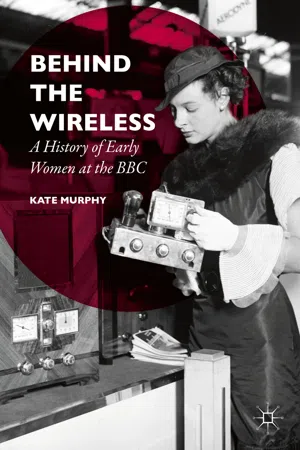
Behind the Wireless tells the story of women at the BBC in the 1920s and 30s. Broadcasting was brand new in Britain and the BBC developed without many of the overt discriminatory practices commonplace at the time. Women were employed at all levels, except the very top, for instance as secretaries, documentary makers, advertising representatives, and librarians. Three women held Director level posts, Hilda Matheson (Director of Talks), Mary Somerville (Director of School Broadcasting), and Isa Benzie (Foreign Director). Women also produced the programmes aimed at female listeners and brought women broadcasters to the microphone. There was an ethos of equality and the chance to rise through the ranks from accounts clerk to accompanist. But lurking behind the façade of modernity were hidden inequalities in recruitment, pay, and promotion and in 1932 a marriage bar was introduced. Kate Murphy examines how and why the interwar BBC created new opportunities for women.
- English
- ePUB (mobile friendly)
- Available on iOS & Android
eBook - ePub
About this book
Information
© The Author(s) 2016
Kate MurphyBehind the Wireless10.1057/978-1-137-49173-2_11. Introduction
Kate Murphy1
(1)
Bournemouth University, Poole, UK
‘Miss Sprott (of the BBC) takes Lunch in Hull’ trumpeted the Daily Mail on 31 March 1939.1 The venue for the BBC’s Women’s Press Representative, the local paper informed its readers, was the Women’s Luncheon Club and her lecture on ‘Broadcasting of Today and Tomorrow’ had attracted a large audience. As an avid motorist, Elise Sprott would have invariably driven from London (avoiding main roads wherever possible) perhaps taking with her the MBE she had been awarded for services to broadcasting the previous year.2
Ever since I first came across the beguilingly named Elise Sprott in 2002, I have been captivated by her.3 She was a BBC stalwart. Her first association with the British Broadcasting Company, as it was then called, was in June 1924, when she came before the microphone to give a short talk on ‘Continental Fashions in Food’. The following year she was offered a £3.15s a week staff job as an Assistant in the Talks Department, where she would make her mark developing household programmes for women. Moved to the role of Women’s Press Representative in 1931, she would spend the rest of her BBC career promoting the Corporation, informing women about its work (as she did in Hull) as well as telling the world about the women who worked for the BBC.
There is much about Miss Sprott that encapsulates women at the BBC in the interwar years—the subject of this book. An indomitable woman, she was in the vanguard of those whose lives had been transformed by the First World War. She started her BBC career at Savoy Hill (Head Office until the move to Broadcasting House in 1932), and then worked her way up the ranks to the senior salaried grades commanding by 1939 the generous salary of £600 a year. Without her, it is doubtful this book could have been written, or certainly much of the colour would be gone. It was her intrepidity that ensured, from late 1931, that a constant stream of features and news stories about ‘The Silent Women of the BBC’ appeared in the British press.4 The hundreds of cuttings she generated, carefully catalogued at the BBC Written Archives Centre at Caversham, have provided a vital part of the jigsaw puzzle of research.5
Yet despite Miss Sprott’s best efforts to put women in the picture, they have largely been left out of the historiography of the BBC. In fact it was a tantalising paragraph in the second volume of Asa Briggs’ monumental History of Broadcasting in the UK that whetted my appetite for this project.6 Here, in a few lines, Briggs touched on the ‘key part’ women played in the daily running of the organisation before the Second World War, including a fleeting reference to Elise Sprott.7 Briggs was right, women worked in the interwar BBC at all levels, apart from the very top: as charwomen and kitchen hands; as secretaries and clerks; as drama producers, press officers, advertising canvassers and Children’s Hour Organisers. They headed the Reference Library and the Registry; they ran the Duplicating Section and the Telephone Exchange, and, in the role of BBC Cashier, ensured wages were paid. Three women held Director-level posts: Hilda Matheson (Director of Talks, 1927–1932), Mary Somerville (Director of School Broadcasting, 1931–1947) and Isa Benzie (Foreign Director, 1933–1938) while Gweneth Freeman (always known as Miss Freeman) had responsibility for all female secretarial and clerical staff. Women were everywhere: at the staff dance, on the netball court and in the restaurant queue; their shingled hair, smart clothes and lipstick smiles a symbol of the modernity of the BBC.8
The BBC had been established in 1922, an auspicious time for women. The vote had been won in 1918 (or at least the partial vote, for those aged over 30) and the 1919 Sex Disqualification (Removal) Act had enabled entry to most professions. The First World War had changed the landscape in terms of women’s employment and the climate of the times was one of new opportunities, particularly for the middle classes. The BBC tapped into this fresh resource. Most of the BBC’s female staff were London-based (though not necessarily London-born) and those who worked at Savoy Hill/Broadcasting House are predominately the ones we shall meet in this book. After the First World War, the metropolis became the centre of Britain’s economic growth and home to countless new industries, including the BBC.9 As Sally Alexander, Selina Todd and others have shown, young women were the main beneficiaries of these industrial changes, with the middle classes now joining their working-class sisters in the labour force looking for employment that was appropriate and respectable, particularly work that was office-based.10 The BBC with its central location, good pay and good working conditions, touched by both celebrity and grandeur, was a highly desirable place to be, at least from the mid-1920s once its status was assured. It meant, too, that the BBC could pick and choose female staff.
The BBC also attracted the unconventional. As a contributor to the staff journal Ariel commented, there were ‘more people to the square inch who have had queer jobs at one time and another than there are in any other organisation’.11 Elise Sprott was one of these. Aged 39 when she joined the BBC staff, she had been born into a Cumbrian ship-owning family and had attended private school, but not university. She then worked in motor engineering, joined a Voluntary Aid Detachment during the First World War and afterwards was appointed to the staff of Herbert Hoover’s American Relief Administration, European Children’s Fund.12 It was as she began broadcasting on the BBC that she changed her name from Elsie to Elise, possibly an indication of aspiration.
In their introduction to Women and Work Culture: Britain 1850–1950 Krista Cowman and Louise Jackson pinpoint ‘social aspiration’ as one of the meanings of work for women and how this could be viewed also in terms of economic necessity, self-fulfilment, vocation, duty and service, with the definition of ‘skilled’ or ‘professionalism’ adding to its status.13 Apart from ‘duty’ all these motivators are apparent in the interwar BBC. Undoubtedly economic necessity was an imperative for most, if not all, female employees. Elise Sprott as a spinster, for example, had to support herself financially. But one of the most notable features of women’s employment in the interwar years was its transience, a trait echoed at the BBC. This was because in the 1920s and 1930s there was a widely held assumption that once married, a woman would leave the workplace, either by custom or compulsion. Alice Head, the indomitable Managing Editor of Good Housekeeping magazine (which was founded the same year as the BBC) made the stark claim that it was ‘perfectly easy to pick out’ amongst the young women who worked in their offices, ‘the ones who are filling in time until they get married, and those who are ambitious, keenly interested and anxious to make careers for themselves’.14 At the BBC, a similar belief in ‘two classes of women’ would become an unspoken criterion for advancement as well as the stimulus behind a marriage bar that was introduced in 1932. However, unlike teaching, the Civil Service and banking (amongst many others professions and workplaces), where being single was a condition of continued employment, married ‘career’ women at the BBC were rarely forced to resign.15
As Britain’s first broadcasting industry, the BBC’s ‘unique composition’ offered the possibility of creative, administrative and technological careers, while its rapid growth meant the potential for increased responsibilities for those with the requisite drive and skills.16 Hilda Matheson wrote of how the BBC had instigated many ‘new professions’, and not just for men.17 Whether it was Kathleen Lines’ innovations in the Photographic Library, Mary Candler’s expanding work in radio copyright, Florence Minns’ growing role as an auditioner and booker of ‘talent’ or, indeed, Elise Sprott’s originations in Morning Talks, in the early years women grabbed openings for development and advancement. While the majority of BBC women were employed in the weekly paid secretarial and clerical grades, there was always the possibility of promotion to the salaried ranks where seniority brought with it improved conditions of service as well as an observable rise in prestige. This was important at a time when there were frequent warnings from the likes of Ray Strachey, Vera Brittain and Winifred Holtby, well-known (and prolific) feminist writers, about the dangers of ‘dead-end’ jobs.18
Britain was excessively class conscious in the interwar years and the BBC encapsulated the attitudes and aspirations that prevailed.19 Because it employed women and men from all social classes it provides a backdrop from which to consider issues such as social mobility and appropriate spheres of work and to make gender comparisons. Working-class women and men at the BBC, for example, worked as cleaners, kitchen hands and house staff. All other waged positions required a good level of training and/or experience and there was an expectation that the BBC’s office-based employees would be educated at least to School Certificate level. In consequence, it was those from aspiring working-class and lower middle-class backgrounds that predominated in weekly-paid clerical, secretarial and technical roles. The salaried grades, on the other hand, were filled by those from well-educated and wealthy backgrounds. The timbre of the BBC was overwhelmingly metropolitan and middle-class. It was also undoubtedly male-dominated, but women edged their way into many key posts and areas of work, negotiating their way around the ‘public school’ atmosphere and ‘old boys’ networks that they would have found.
One of the ways the BBC expressed its modernity was through an ethos of equality of opportunity. A non-gendered grading system operated from the start offering, in principle, equal pay and equal promotional chances. In April 1926 Reith robustly expressed his view that women Assistants should ‘rank on the same footing as men’.20 The BBC’s ethos of equality appears to have existed at a handful of other forward-looking organisations in the interwar years, such as the John Lewis Partnership and the London School of Economics (LSE) and it was also apparent in professions such as advertising.21 One of the key areas this book will address is how the newness and modernity of the BBC set it apart from traditional professions in which educated women were clustered, such as teaching and the Civil Service, where discrimination was entrenched.
This is not to say that sexual discrimination did not exist at the BBC. Practices such as the gender stereotyping of roles as well as segregation, which were the norm at this time, were evident amongst secretarial and clerical staff. F...
Table of contents
- Cover
- Frontmatter
- 1. Introduction
- 2. ‘Growing Like a Young Giant’: The BBC as a Place to Work
- 3. ‘Women Who Oil the Wheels’: Waged Women at the BBC
- 4. ‘Only an Exceptional Woman’: Married Women at the BBC
- 5. ‘New and Important Careers’: Salaried Women at the BBC
- 6. ‘Women Who Rule at the BBC’: Four Elite Women
- 7. ‘When They Have Their Cup of Tea’: Making Programmes for Women
- 8. ‘You Feel Their Personal Touch’: Women Broadcasters
- 9. Conclusion
- Backmatter
Trusted by 375,005 students
Access to over 1.5 million titles for a fair monthly price.
Study more efficiently using our study tools.
Frequently asked questions
Yes, you can cancel anytime from the Subscription tab in your account settings on the Perlego website. Your subscription will stay active until the end of your current billing period. Learn how to cancel your subscription
No, books cannot be downloaded as external files, such as PDFs, for use outside of Perlego. However, you can download books within the Perlego app for offline reading on mobile or tablet. Learn how to download books offline
Perlego offers two plans: Essential and Complete
- Essential is ideal for learners and professionals who enjoy exploring a wide range of subjects. Access the Essential Library with 800,000+ trusted titles and best-sellers across business, personal growth, and the humanities. Includes unlimited reading time and Standard Read Aloud voice.
- Complete: Perfect for advanced learners and researchers needing full, unrestricted access. Unlock 1.5M+ books across hundreds of subjects, including academic and specialized titles. The Complete Plan also includes advanced features like Premium Read Aloud and Research Assistant.
We are an online textbook subscription service, where you can get access to an entire online library for less than the price of a single book per month. With over 1.5 million books across 990+ topics, we’ve got you covered! Learn about our mission
Look out for the read-aloud symbol on your next book to see if you can listen to it. The read-aloud tool reads text aloud for you, highlighting the text as it is being read. You can pause it, speed it up and slow it down. Learn more about Read Aloud
Yes! You can use the Perlego app on both iOS and Android devices to read anytime, anywhere — even offline. Perfect for commutes or when you’re on the go.
Please note we cannot support devices running on iOS 13 and Android 7 or earlier. Learn more about using the app
Please note we cannot support devices running on iOS 13 and Android 7 or earlier. Learn more about using the app
Yes, you can access Behind the Wireless by Kate Murphy in PDF and/or ePUB format, as well as other popular books in Technology & Engineering & Social History. We have over 1.5 million books available in our catalogue for you to explore.