eBook - ePub
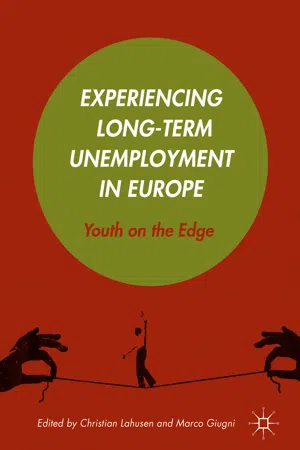
Experiencing Long-Term Unemployment in Europe
Youth on the Edge
- English
- ePUB (mobile friendly)
- Available on iOS & Android
eBook - ePub
Experiencing Long-Term Unemployment in Europe
Youth on the Edge
About this book
This book examines the everyday-life patterns of young adults under circumstances of vulnerability and precariousness. Its main focus is on the web of social relations that structure the everyday life of young people, for instance by providing resources and tools of solving problems, exerting pressures and voicing expectations, and shaping the person's self-conception, identity, and well-being. Based on more than 120 in-depth interviews with young long-term unemployed in six European countries, this book puts social support and the young jobless' webs of social relations at center stage. It expands knowledge by raising awareness of the multidimensionality and complexity of the social conditions of young jobless, drawing, on the one hand, a more differentiated picture of unemployment, vulnerability and social exclusion amongst young people and, on the other hand, taking a close look at the social reality of young adults' unemployment in different European cities.
Information
© The Author(s) 2016
Christian Lahusen and Marco Giugni (eds.)Experiencing Long-Term Unemployment in Europe10.1057/978-1-137-50487-6_11. Experiencing Long-Term Unemployment in Europe: An Introduction
Christian Lahusen1 and Marco Giugni2
(1)
Department of Social Sciences, Universität Siegen, Adolf-Reichwein-Str. 2, 57068 Siegen, Germany
(2)
Department of Political Science and International Relations, University of Geneva, Boulevard du Pont-d’Arve 40, 1211 Geneva, Switzerland
Youth Facing Long-Term Unemployment
This book examines the everyday life patterns of young adults under circumstances of vulnerability and precariousness. Its main focus is on the web of social relations that structure the everyday life of long-term unemployed young people. In particular, the contributors are interested in knowing whether these informal contacts provide resources and tools of solving problems, whether they are a source of pressures and expectations, and in how far they shape, in general terms, the person’s self-conception, identity and well-being. The social sciences provide ample evidence about the precarious living situation of young jobless people in Western societies. Many studies have documented that unemployment, especially when it is sustained over time, brings difficulties and hardships to those affected by it, and these problems reach far beyond the immediate deprivations attributed to the loss of income. In fact, unemployment is not only associated with financial hardship; unemployed people are also confronted with social isolation owing to the loss of work-related contacts and difficulties in maintaining social relations with friends and acquaintances (Gallie et al. 2003; van Oorschot 2006), which in turn ends up reducing social capital and breaking those ‘weak ties’ that have been shown to be so important to get a job (Granovetter 1973). Jobless people have to struggle with the annihilation of a meaningful day structure, and leisure time becomes a tragic gift because the use of time loses purpose and direction (Jahoda et al. 1971 [1933]; Wanberg et al. 1997). At the same time, people affected by unemployment develop feelings of uselessness and dependence, are confronted with a loss of job-related identifications and personal identities (Joelson and Wahlquist 1987; Winkelmann 2009) and display lower levels of well-being. This is not an exhaustive list; many other implications could be added.
Scholarship has stressed that these issues are true for young unemployed too (Kieselbach et al. 2001; Hammer 2003), but seem to affect them particularly deeply, given the fact that young adults are in a stage of their biographical development where they are not yet fully integrated into social life as independent citizens and autonomous individuals. Processes of socialization and individuation thus evolve within a social context defined by limitations, deprivations and stigmatizations. This necessarily has an impact on the social characteristics of this group of people, that is, their social position and status, their social relations and roles, their beliefs and behaviors, their values and identities. Scholarly writing has provided many insights into these youth-related problems, particularly by highlighting ‘scarring effects’, that is, long-term consequences of unemployment on the future life course of the young unemployed. We know, for instance, that experiences of unemployment among school leavers tend to increase the risks of exclusion from the labor market at later stages of their lives (Gregg 2001; Cockx and Picchio 2012). Unemployed youth might be as motivated as their more privileged peers to look for work, but they are less optimistic to find a job and get ahead in life, and their life-satisfaction is affected in the long run even by past exposure to unemployment (Clark et al. 2001; Goldman-Mellor et al. 2016). In line with these observations, evidence highlights that extended joblessness increases the risks of being exposed to mental health problems sooner or later (Hammer 2000; Strandh et al. 2014). Overall, prolonged joblessness increases the exposure to the experiences of marginalization, stigmatization and discrimination, and this condition provokes feelings of dissatisfaction, boredom, uselessness, shame, resignation and distress—with detrimental effects on the person’s self-conception and identity.
Long-term unemployment, however, does not produce these effects automatically and deterministically. Research has highlighted that joblessness is harmful especially in conjunction with other social traits that might involve deprivations as well (e.g., social class, ethnic background, single parenthood, gender). At the same time, we know that long-term unemployment does not generate harmful and scarring effects inescapably, because these effects may be moderated by certain factors. For example, young jobless people are less affected by unemployment related risks (e.g., poverty, mental disorders, isolation) when equipped with higher educational credentials and qualifications, a secure financial situation, institutional support, and/or higher rates of self-esteem (Kieselbach 2003; Broman et al. 2001). In this regard, scholarly writing has recurrently addressed the importance of social support (Gore 1978; Jackson 1988; Beck et al. 2005; Lorenzini and Giugni 2011; Huffman et al. 2015). Relatives, friends and acquaintances are important pillars of the jobless’ everyday life because they provide assistance in emotional, financial and material terms. Peer groups, local communities and neighborhoods offer young jobless a sense of home and an arena of communication and activity. And voluntary associations (sport or leisure clubs, welfare associations and the like) provide opportunities for recreation, networking, information and active involvement in community affairs or political matters.
Social support is therefore an important topic when addressing youth unemployment as an individual reality and collective problem. Most studies devoted to the analysis of youth unemployment have dealt with this topic in some way, thus corroborating the significance of this aspect of young people’s lives (Jahoda et al. 1971; Kronauer 1998; Kieselbach et al. 2001; Hammer 2000; Beck et al. 2005). This book puts social support and the young jobless’ webs of social relations at center stage. This is necessary to unfold the topic in its inherent complexity and richness. Several research questions will be addressed: In how far does social support attenuate the detrimental effects of unemployment, and which kind of social relations are of particular importance? Do social support networks suffer in case of extended exposure to unemployment, and how do young jobless cope with shrinking webs of social relations? Are networks of social support equally important in different countries, and are they exposed to similar challenges everywhere? Are all young jobless adults in a similar position, or can we identify differences between various groups when considering gender, class, household structure and other features?
Unemployment, Social Relations and Social Support
The relationship between unemployment and social support is a complex one, and a closer look at this relationship uncovers a number of interrelations and interactions that require in-depth analysis. On the one hand, it is true that social support is a factor that moderates the harmful effects of unemployment on the jobless’ daily lives (Gore 1978; Thoits 1995; Kieselbach 2003; Broman et al. 2001; Lorenzini and Giugni 2011; Huffman et al. 2015). Family members, friends and acquaintances are very often a source of resources that enable young unemployed to live a decent, possibly also normal, life. Families, peer groups or neighborhoods reproduce a feeling of belongingness, and thus offer an important antidote or vaccine to social isolation, psychological distress and a worsening outlook on the future. On the other hand, joblessness does have detrimental effects on young people’s social relations, too. The risk of social isolation seems to be particularly pronounced in the period of transition from youth to adulthood. Young people are in a process of transition between school and work, between their family of origin and their own web of social relations (peers, partnership, parenthood, etc.). Under these circumstances, long-term unemployment impedes the enlargement of social networks into the area of work-related contacts and acquaintances. At the same time, unemployed young adults report about the loss of social activities within their immediate social environment, owing to the lack of resources or shame, and this withdrawal decreases the number of contacts to peers, friends and acquaintances. In this situation, the family is very often the most persistent bulwark against social isolation. However, while most young people count on the help of their families, this support is not only experienced as a blessing but also as a problem of dependence, which can inhibit personal development. Moreover, the erosion of social relations and the dependence on restricted social networks can go hand in hand with lower levels of trust in public authorities, local communities or one’s fellow citizens. If unemployment and deprivation are a collective experience within family networks, peer groups or neighborhoods, their marginalizing impact might even have an imperative quality.
Overall, these findings and observations attest considerable problems and hardships related to long-term unemployment. Scholars have proposed various theoretical concepts to better understand the patterns and dynamics associated to this situation; for instance, by treating joblessness as an aspect of social deprivation or marginalization (Townsend 1987; Gallie 2004). Since the 1990s, researchers have adopted the concept of social exclusion in order to describe the underlying social condition unemployed people are exposed to (Atkinson and Davoudi 2000; Kronauer 1998; Welshman 2007; Kieselbach et al. 2001; Giugni and Lorenzini 2013). The concept has two merits. On the one hand, it allows us to subsume the various problems and hardships associated with unemployment under one overarching concept. On the other hand, it enables us to understand the situation of deprivation in its structural relations towards society. Social exclusion entails a limited access to valuable resources (schools and education, jobs and income, cultural institutions and goods, etc.) and a restricted participation in societal life. Scientists usually subdivide the notion of exclusion into a number of different fields, within which these resources are distributed: the labor market (employment), the economy (money and consumption), public institutions (educational credentials), culture (shared norms and lifestyles), social life (contacts), politics (political interest representation) and others (Kronauer 1998; Kieselbach 2003). These scholars take up a basic idea of differentiation theory and argue that exclusion is patterned according to the various sectors or fields of society (educational system, labor market, institutionalized politics, civil society, culture, etc.). These observations raise our awareness for limited and insulated forms of deprivation (e.g., joblessness amongst privile...
Table of contents
- Cover
- Frontmatter
- 1. Experiencing Long-Term Unemployment in Europe: An Introduction
- 2. Youth Long-Term Unemployment in France: Challenging Common Trends
- 3. Being Long-Term Unemployed in Germany: Social Contacts, Finances and Stigma
- 4. Long-Term Unemployed Youth in Switzerland: Coping with Exclusion from the Labor Market in a Country with Low Unemployment
- 5. The Everyday Life of Young Long-Term Unemployed in Sweden: Coping with Limited Participation and Feelings of Inferiority
- 6. Youth Long-Term Unemployment and Its Social Consequences in Italy: ‘In a World That Does Not Belong to Me’
- 7. Coping with Long-Term Unemployment in Poland: Faces of Joblessness in a Regional Centre
- 8. Experiencing Long-Term Unemployment in Europe: A Conclusion
- Backmatter
Trusted by 375,005 students
Access to over 1.5 million titles for a fair monthly price.
Study more efficiently using our study tools.
Frequently asked questions
Yes, you can cancel anytime from the Subscription tab in your account settings on the Perlego website. Your subscription will stay active until the end of your current billing period. Learn how to cancel your subscription
No, books cannot be downloaded as external files, such as PDFs, for use outside of Perlego. However, you can download books within the Perlego app for offline reading on mobile or tablet. Learn how to download books offline
Perlego offers two plans: Essential and Complete
- Essential is ideal for learners and professionals who enjoy exploring a wide range of subjects. Access the Essential Library with 800,000+ trusted titles and best-sellers across business, personal growth, and the humanities. Includes unlimited reading time and Standard Read Aloud voice.
- Complete: Perfect for advanced learners and researchers needing full, unrestricted access. Unlock 1.5M+ books across hundreds of subjects, including academic and specialized titles. The Complete Plan also includes advanced features like Premium Read Aloud and Research Assistant.
We are an online textbook subscription service, where you can get access to an entire online library for less than the price of a single book per month. With over 1.5 million books across 990+ topics, we’ve got you covered! Learn about our mission
Look out for the read-aloud symbol on your next book to see if you can listen to it. The read-aloud tool reads text aloud for you, highlighting the text as it is being read. You can pause it, speed it up and slow it down. Learn more about Read Aloud
Yes! You can use the Perlego app on both iOS and Android devices to read anytime, anywhere — even offline. Perfect for commutes or when you’re on the go.
Please note we cannot support devices running on iOS 13 and Android 7 or earlier. Learn more about using the app
Please note we cannot support devices running on iOS 13 and Android 7 or earlier. Learn more about using the app
Yes, you can access Experiencing Long-Term Unemployment in Europe by Christian Lahusen, Marco Giugni, Christian Lahusen,Marco Giugni in PDF and/or ePUB format, as well as other popular books in Economics & Labour Economics. We have over 1.5 million books available in our catalogue for you to explore.