eBook - ePub
Katherine Mansfield and Continental Europe
Connections and Influences
- English
- ePUB (mobile friendly)
- Available on iOS & Android
eBook - ePub
About this book
Information
1
Introduction
Janka Kascakova and Gerri Kimber
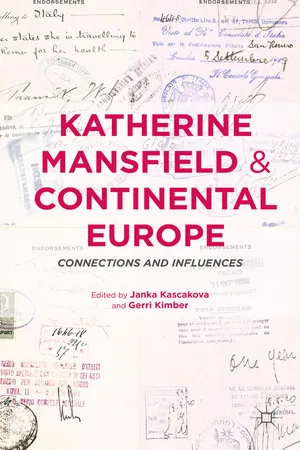
The detail of Katherine Mansfield’s passport on the cover of this volume is a fitting illustration of how – although it was for London and England that she set out on her journey from her New Zealand home in 1908, a journey she believed to be crucial for her life as a writer – she eventually spent a significant amount of time on the Continent, where she also found her final resting place.
While initially travelling for pleasure and in search of adventure, Mansfield’s Continental journeys soon became the means of escaping from difficult situations or people, and were later transformed into an increasingly desperate and vain hunt for a cure for her fatal illness. The resonances of this constant travelling can be seen in both her personal writing and her creative endeavours, and, as this volume illustrates, the impact these had on her proved comparably important to the influence her writing would go on to exert on the Continent, long after her untimely death. Thus, this volume seeks to explore the dualistic aspect of Mansfield’s relationship with the Continent, and to highlight not just her constant physical travelling, but also the influence of the Continent and its artists, revealing how these factors would come to shape and inform her own writing, and how eventually the various representations of her persona and body of work would go on to inspire literary production in a number of European countries.
The first section, entitled ‘Reception’, opens with Maurizio Ascari’s analysis of the response to Mansfield in Italy between 1922 and 1952. Ascari reveals how Mansfield’s reception was influenced by her personal writings and the cult originating in France, and subsequently illustrates how later translations of her stories into Italian engendered a rich and heterogeneous debate. In the context of another Continental country, Hungary, and taking into account the particular cultural context of the period from post-World War I up until the early communist era, Nóra Séllei exposes how Mansfield’s work was often used to promote the different aesthetic and literary agendas of various Hungarian authors and, as a consequence, it was attributed values quite alien to her own motivations as a writer. Janka Kascakova discusses Mansfield’s reception in the former Czechoslovakia and its succession countries, revealing how Mansfield – although obviously admired by individual intellectuals to the extent of engendering infrequent but nevertheless steady appearances in various publications – never reached the level of fame and appreciation found in France, Italy or even Hungary.
The second section encompasses Mansfield’s connections to two European countries that played an important part in her personal and artistic life: Germany, where she underwent one of the most difficult experiences of her life, and Poland, introduced to her in the person of her erstwhile lover Floryan Sobieniowski. In her essay, Gerri Kimber charts the relationship between Mansfield and Sobieniowski, reconsidering their time spent together in Bavaria. Kimber argues for a re-interpretation of this relationship as being more complex than previously thought, and suggests that Mansfield might have visited Poland with Sobieniowski; she offers as possible proof the poem ‘To God the Father’, which uncannily echoes in its descriptions the celebrated Polish artist Stanisław Wyspiański’s stained glass window of the same name in a Krakow church. In a different take on Mansfield’s Polish connection and its influence, Mirosława Kubasiewicz explores affinities between Mansfield and Wyspiański, offering a discussion of his work as a means of enabling the understanding of her enthusiasm for him. Kubasiewicz discusses their common interest in the metaphysical coexistence of life and death, in the role of the past in the formation of artistic identity, their focus on nature in their artistic endeavours and their exceptional portrayals of children. Delia da Sousa Correa revisits the theme of Mansfield’s relationship with Germany, reflected mostly in the German Pension stories, offering a fresh approach. She investigates Mansfield’s satirical responses to German life beyond the biographical and historical circumstances, but rather via her knowledge of the satirical representations of German Romanticism in Victorian literature, and proposes that satire was integral to Mansfield’s response to German culture, well before her own personal encounter with Bavaria in 1909.
The third section, entitled ‘Connections with Other Authors’, comprises essays linking Mansfield with three very different authors, who were either from Continental Europe themselves (Koteliansky), or who, just as in the case of Mansfield, came from the colonies (von Arnim and Rhys) and addressed the questions of travel, displacement and the position of colonial outsiders in their works. The section opens with Claire Davison’s analysis of Mansfield and S.S. Koteliansky’s co-translations, challenging the conventional idea – frequently extended to his cooperation with other modernists as well – that she was merely helping out a friend earn his living by polishing his imperfect English. Davison convincingly demonstrates that their cooperation was much more than this, and that their shared translation experience brought them into translation networks that marked the new modernist shift towards translation construed as an innovative, experimental engagement, where the poetic and political alliances of continental Europe could be safeguarded. Following her extensive research on the relationship between Mansfield and her cousin and writer Elizabeth von Arnim, Jennifer Walker discusses their common Beauchamp family origins, highlights themes fundamental to the creativity of both writers, with an emphasis on the importance of music in both their lives. Analysing Jean Rhys’s Good Morning, Midnight and Mansfield’s ‘An Indiscreet Journey’, and ‘Miss Brill’, Angela Smith points out the parallels between the two writers’ presentation of British subjects travelling or settled in Europe and argues that the position of Mansfield and Rhys as colonial modernists enables them to reveal ‘the other side’ of their characters to the reader.
The section on ‘Identity, the “Self” and “Home”’ presents three essays exploring the aforementioned themes via a close analysis of several of Mansfield’s ‘Continental’ stories. Erika Baldt discusses how Mansfield’s work is preoccupied with the way national identity is perceived and manipulated. Incorporating Laura Mulvey’s interpretation of the cinematic [male] gaze, this essay explores the correlation between one’s ability to look a specific national part and one’s ability to be the part. Kathryn Simpson applies Julia Kristeva’s theories to two of Mansfield’s stories: ‘Carnation’ and ‘Summer Idylle’, arguing that via Mansfield’s experimental modernist techniques, narratives of sexual awakening, unconscious drives and repressed desires come to the surface, disturbing any sense of unified, coherent identities. Patricia Moran’s essay explores Mansfield’s representations of ‘home’ against the backdrop of her literal homelessness. She proposes that Mansfield exemplifies the post-colonial subject who is never ‘at home’ anywhere, whilst arguing that the category of ‘home’ functions not only as a geographical and social concept, but as a psychological marker of personal, cultural and national identity.
The concluding section of the volume offers two reassessments of Mansfield’s fiction by Janet Wilson and C. K. Stead. Both essays engage with the so-called European stories, that is, those that were not only written on the Continent but whose settings, themes and ambience are closely connected to it. Wilson discusses the concepts of the child, the childish and the adolescent in stories written between 1909 and 1914, arguing that Mansfield’s travelling in Continental Europe enabled her exploration of new artistic freedoms, reworking earlier themes of romance, betrayal and disillusion in love. Stead reconsiders the question of whether the usual assumption that Mansfield’s New Zealand stories are ‘better’ than her European ones is a valid one. Through an analysis of some of her stories situated in Continental Europe, he concludes that they most certainly can stand alongside their more famous New Zealand counterparts.
This volume, then, is another step towards a better understanding of Katherine Mansfield and her work, focusing on the hitherto rather neglected aspect of her Continental travels and subsequent influences and connections. As the following pages demonstrate, the topic is a rich and rewarding one, offering analyses of previously untrodden paths and dark corners of Mansfield’s life and artistic endeavours.
I
Reception
2
An ‘utterly concrete and yet impalpable’ Art: The Early Reception of Katherine Mansfield in Italy (1922–1952)
Maurizio Ascari
In the years following the death of Katherine Mansfield, the critical appreciation of her works was deeply influenced by the romantic appeal of her tragically short and intense life story, thanks also to the large number of letters and private writings that were made available to the public. I am of course referring to John Middleton Murry’s editions of Mansfield’s Journal (1927), Letters (1928), Scrapbook (1939) and Letters to John Middleton Murry (1951),1 but I am also thinking of the many biographical works that were published in the same period.2
This widespread interest in Mansfield’s life inevitably influenced the reception of her work, and in particular inviting biographical readings. The autobiographical element is indeed pervasive in Mansfield’s stories, since her own experience fuelled much of her inspiration, but it also contrasts with the highly impersonal narrative techniques Mansfield utilised, pivoting on her ‘virtuoso’ use of focalisation.3 In the eyes of Jan Pilditch, the appearance of Mansfield’s private writings shed new light on her fiction, compensating for the distance her impersonality created between author and readers and thus re-establishing an affective bond.4 Mansfield often wore a mask when relating events that occupied a central place in her life, but the posthumous publication of her private writings enabled her readers to perceive her true visage, or at least gave them that illusion.
The Italian Reception
One cannot approach the reception of Mansfield in Italy without taking into account a complex web of transnational exchanges, since various Italian critics approached Mansfield through French criticism and translations, although others read her directly in English, while others still relied on the Italian editions of her works. As a result, to understand this phenomenon we have to take into consideration not only the dates of publication of Mansfield’s fictional and non-fictional texts, notably after her death, but also the dates of publication of the French and Italian translations of these texts.
Although I have done my best to map this territory, there may well be other reviews and essays which I have not been able to trace.5 The materials I have studied include not only the articles and reviews that appeared in literary journals, but also the critical apparatuses that accompany the Italian editions of Mansfield’s works. On the other hand, due to the large amount of criticism I have taken into consideration, I will not discuss the aesthetic and ideological coordinates of Mansfield’s translations, although a translation can be regarded as a critical statement in itself, as Gerri Kimber has shown in her excellent study of Mansfield’s reception in France.6
When I started studying the reception of Mansfield in Italy during the fascist period, I thought this would offer several clues to the conflicting ideological dimension Anglo-Italian cultural relations took on in those years. Yet that was not the case. Did the intimate quality of Mansfield’s writing distance her from the political arena? Or was she appropriated by fascists and their allies? As Kimber argues, the French version of the Mansfield legend was forged almost exclusively by Catholics and reactionaries;7 however, the situation in Italy seems more complex, although the author was widely discussed in literary journals which were inevitably controlled by the regime.8
The truth is that in the 1920s the cultural and political agenda of Italian Fascism was still rather uncertain, since Fascism had many components, ranging from ex-socialists and revolutionary syndicalists, to Monarchists and Catholics, who greeted the 1929 Lateran Treaty between Italy and the Vatican as the long sought-for solution to the Roman question. It was only in the 1930s that Fascism increasingly acquired a precise political profile, due in part to the influence of Nazism.
An Anglophile Pioneer
This critical journey starts with the untitled review Emilio Cecchi publishes in the Roman newspaper La Tribuna (The Tribune) on 14 April 1922, whilst Mansfield is still alive.9 Cecchi’s knowledge of the English literary world is not mediated by translation. He opens his article by claiming that he has decided to attract the attention of Italian readers to a writer whose name is ‘possibly not even known’10 in Italy because of two texts which have recently appeared in the Nation – ‘The Doll’s House’ (4 February 1922) and an article where Murry compares Mansfield to Joyce and Proust (1 April 1922).11
Repeatedly quoting from Murry, Cecchi explains that in Great Britain fiction is in a state of transition since the former interest for plot has been superseded by a form of veiled autobiography, as shown by the works of Dorothy Richardson and James Joyce. Cecchi locates Mansfield in between the two extremes of Proust’s super-subtle psychologism and various forms of social realism. He presents her as the latest expression of a literary genealogy embracing both Baudelaire and Chekhov and which aims to turn reality into a symbol of the essence of our life experience. The last part of the essay focuses on Bliss and Other Stories (1920), which in Cecchi’s eyes exemplifies Mansfield’s ability ‘to trace distinctions as an impeccably Freudian psychoanalyst, only to relate the results of this psychoanalysis to the ironic concept that rules her restricted but harmonious vision of reality and art’.12
Two events take place in the months following the publication of Cecchi’s article. The Fascists march on Rome in October 1922 and Mansfield dies in January 1923. In March 1923 Cecchi publishes another article on Mansfield, this time in a literary journal,13 reviewing Bliss and Other Stories and The Garden Party and Other Stories, together with David Garnett’s Lady into Fox (1922). The growing fame of Mansfie...
Table of contents
- Cover
- Title
- Copyright
- Contents
- List of Illustrations
- Acknowledgements
- Notes on Contributors
- 1 Introduction
- I Reception
- II Poland and Germany
- III Connections with Other Authors
- IV Identity, the ‘Self’ and ‘Home’
- V Reassessing the Fiction
- Select Bibliography
- Index
Trusted by 375,005 students
Access to over 1.5 million titles for a fair monthly price.
Study more efficiently using our study tools.
Frequently asked questions
Yes, you can cancel anytime from the Subscription tab in your account settings on the Perlego website. Your subscription will stay active until the end of your current billing period. Learn how to cancel your subscription
No, books cannot be downloaded as external files, such as PDFs, for use outside of Perlego. However, you can download books within the Perlego app for offline reading on mobile or tablet. Learn how to download books offline
Perlego offers two plans: Essential and Complete
- Essential is ideal for learners and professionals who enjoy exploring a wide range of subjects. Access the Essential Library with 800,000+ trusted titles and best-sellers across business, personal growth, and the humanities. Includes unlimited reading time and Standard Read Aloud voice.
- Complete: Perfect for advanced learners and researchers needing full, unrestricted access. Unlock 1.5M+ books across hundreds of subjects, including academic and specialized titles. The Complete Plan also includes advanced features like Premium Read Aloud and Research Assistant.
We are an online textbook subscription service, where you can get access to an entire online library for less than the price of a single book per month. With over 1.5 million books across 990+ topics, we’ve got you covered! Learn about our mission
Look out for the read-aloud symbol on your next book to see if you can listen to it. The read-aloud tool reads text aloud for you, highlighting the text as it is being read. You can pause it, speed it up and slow it down. Learn more about Read Aloud
Yes! You can use the Perlego app on both iOS and Android devices to read anytime, anywhere — even offline. Perfect for commutes or when you’re on the go.
Please note we cannot support devices running on iOS 13 and Android 7 or earlier. Learn more about using the app
Please note we cannot support devices running on iOS 13 and Android 7 or earlier. Learn more about using the app
Yes, you can access Katherine Mansfield and Continental Europe by Gerri Kimber,Janka Kascakova in PDF and/or ePUB format, as well as other popular books in Literature & Literature General. We have over 1.5 million books available in our catalogue for you to explore.