eBook - ePub
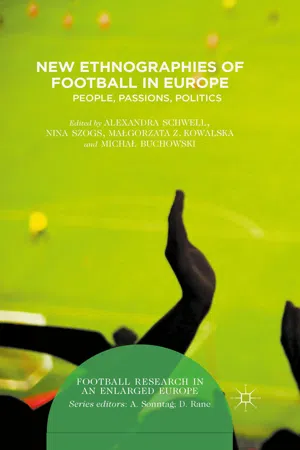
New Ethnographies of Football in Europe
People, Passions, Politics
- English
- ePUB (mobile friendly)
- Available on iOS & Android
eBook - ePub
New Ethnographies of Football in Europe
People, Passions, Politics
About this book
Football has emerged as an important symbolic field through which various social, cultural, political, economic, and historical dimensions and antagonisms are negotiated. This volume covers a variety of themes illuminating the multiple ways that football impacts on people's everyday lives. Using anthropological research methods and data collected from ethnographic fieldwork, the contributors scrutinize not only the social fields of football fans and the specific socio-cultural contexts in which they are embedded, but also other actors beyond the pitch, and the possibilities for both agency and subversion. Taking into account processes of Europeanization, globalization, commercialization and migration, the collection offers fresh insights into fan identity formations and practices and highlights the importance of anthropology's self-reflexive and actor-centred perspective.
Information
Print ISBN
9781137516961
Subtopic
Politics1
Introduction
People, Passions and Much More: the Anthropology of Football
Michał Buchowski, Małgorzata Z. Kowalska, Alexandra Schwell and Nina Szogs
Football: a complex transnational phenomenon
Football has acquired an enormous transnational popularity, of which, it seems, we do not have to convince anybody. Football is one of these phenomena such as reality shows, soap operas, Sudoku, Rubik’s cube, pop songs, food-to-go, Pepsi or Coca-Cola, hot-dogs, pizza and sushi, that in many respects meet the basic requirements for becoming globally diffused: ‘little culturally specific knowledge’; ‘an emotional, sensory or intellectual appeal which transcends local concerns’; something that ‘is effectively marketed transnationally’ (Eriksen, 2007, p. 156).
The first point in particular emphasises that the content of this knowledge should be easily communicable and understandable for the ‘masses’, popular and accessible like a driving licence. This makes a given phenomenon so ‘easy’ that virtually everybody has something to say about it as an ‘expert’, equal to anybody else. Whether football is popular globally, however, is questionable, despite its Eurocentric image. It is difficult to have a conversation about football on the streets of New Delhi, where most people you will talk to are able and eager to discuss cricket. New Zealanders are keen to comment on rugby rather than football. In their home country, Finnish footballers can only dream about the salaries and popularity of hockey players. In the last case, players of the national team in hockey play for leading and rich clubs in the US, Russia and Canada, while members of the national football team are usually secondary players dispersed across the continent in clubs ranging from (rarely) top leagues to (mainly) meagre ones. The salary of the best paid hockey player in 2013, Mikko Koivu ($7.3 million/year) from Minnesota Wild (Bhandari, 2013), is hardly comparable to, for instance, the salary of one the top Finnish footballers of today, Mikael Forssell, formerly playing for Chelsea, Birmingham, Leeds and now VfL Bochum (currently in the 2nd Bundesliga). In short, we have to realise that there are parts of the world, and even countries in Europe, where football is not the dominant discipline that preoccupies minds and hearts of the majority of sport followers and enthusiasts. This is the main reason why we opt to call this popular game called football, and everything that surrounds it, a transnational rather than a global phenomenon.
There is another, in fact partly sad, reason to take a restrained attitude towards football’s assumed dominant place in ordinary people’s symbolic universe and emotional reality. It is generally being taken for granted that all humanity has access to live coverage of major football events; but this is wishful thinking or a kind of imaginary imperialism. In many regions of the world whole populations do not even have access to electricity, let alone TV sets or broadcasters showing football games. Even if, as it was the case, the clasico between FC Barcelona and Real Madrid on 22 March 2015 was watched by four hundred million people around the world, it comprises ‘barely’ 17–18 per cent of the world population. Of course, this is an impressive number for any kind of event, but claims that all people on earth are interested in, have the possibility to watch or are actually willing to watch football, are vastly exaggerated.
Still, the name of the game is probably one of the most popular words in the world, present in many languages in a literal translation from its original English meaning. Just a few examples: Fußball in German, fotbal in Czech, fotboll in Swedish, fotball in Norwegian and fodbold in Danish. The name of the game may sound more ‘odd’ in some non-Anglo-Saxon European languages such as piłka nożna in Polish, nogomet in Croatian, calcio in Italian, jalgpall in Estonian, jalkapallo in Finnish or labdarúgás and foci in Hungarian. Its designations may appear even more ‘exotic’ to any European language speaker if we go elsewhere – zúqiú in Chinese, soccer in American English or paanv se khelne ka gend in Hindi. But there is nothing strange about the fact that one deals with a phenomenon which has many names, especially when they sound similar or mean the same when translated. We could use Ferdinand de Saussure’s (1931) old and celebrated scheme about the relationship between ‘object in the world’ and ‘sound image’ in order to interpret this in terms of structural linguistics.
However, it is not the contributors’ aim of this volume to delve into the linguistics of the word ‘football’. As social scientists, we are fully aware that there does not exist a single, ‘unified’ phenomenon in the world ‘out there’, which may be called differently in various languages, but essentially means ‘the same’ thing. This is not to imply that we deny the existence of a set of practices habitually called ‘football’ in English, or, in order to be more inclusive and cover a wider area of social life, ‘football-related-phenomena’.
Certainly, football exists as a team sport that has its basic rules, which have been changing in details and interpretation over decades. But, more importantly for us anthropologists, as a game football is played every day by tens of millions of people of divergent skills, age, gender, social status, ethnicity and religion, both as amateurs and as professionals. The latter category implies that football has become a form of vocation, a job, an occupation for hundreds of thousands of people around the world – players, managers, coaches, physical education teachers, physicians, psychologists, and in some countries even sorcerers and priests. With people ‘working in football’, it has become an industry, a business, a branch of the economy; as an industry it responds to market demands as well as to desires, both of which have to be produced and kept alive. The market also involves advertising and raising consumption needs; consumers’ needs are therefore served not only by footballers and staff from the clubs and leagues, but also by journalists, marketing specialists, stadium builders and many others. The end consumers are football fans who watch the game live or on screen. The game’s enormous popularity makes ‘football’ and ‘football-related-phenomena’ integral parts of popular culture. By engaging people it forges social relations and mobilises communities, and such mobilisation requires and engenders identities based on inclusion and exclusion. We can go further in expanding this list of facts and occurrences that are more or less closely connected with this contemporary worldwide practice and well-known game called football. Nevertheless, the aim of this exercise is merely to show how complex these football-related phenomena are, and, eo ipso, how difficult it is to study such their intricate social and cultural complexity.
The anthropology of football
It is no wonder that such a multifaceted and transnational phenomenon is a subject of study of many long-established disciplines, such as sociology and political sciences (see Bora and Senyuva, 2011; Brand et al., 2010; Dietschy et al., 2009; King, 2003; Roose et al., 2010), media and cultural studies (see Sandvoss, 2003; Marschik, 2006), and gender studies (see Dietze, 2012; Erhart, 2011; Nuhrat, 2013; Selmer and Sülzle, 2010). One may even say that a new field of ‘football studies’, bringing together experts from various disciplines, has emerged.1 The book series, of which this volume is a part, gives evidence to this fact. This volume, however, is about the sociocultural anthropology of football. We have already mentioned how complex such culturally popular phenomena are – not only do they transgress the borders of states and continents, but moreover they are deeply embedded in social life to influence grass-roots-level behaviours, habits and customs. Football-related events, facts, images and practices seem to be ‘natural’ candidates for anthropological investigations – or, as the famous football anthropologist Christian Bromberger concluded at the Kick-off conference of the FREE Project in 2012, ‘I still think football is a precious gift to anthropologists. I sometimes even wonder if it was not invented to please them!’
Several reasons inevitably come to mind. Firstly, football bears striking parallels to one of the classical objects of anthropological concern: ritual performances. In this respect, there are contradictory currents present in both ritual and in sport: formalisation and rigidity on the one hand, and spontaneity on the other. Football, both on the pitch and among spectators and distant viewers, is about rules and tactical discipline, but at the same time improvisations are highly valued and expected – an extraordinary strike reminding one of a kung-fu kick (in the style of Zlatan Ibrahimović) or even an unexpected funny slogan, like the one displayed by Lech Poznań fans at the Legia Warsaw stadium on 27 September 2014: ‘Warsaw is the Radom of Europe’ (Radom being a small city in Poland, a popular Polish icon of parochialism and backwardness). The football game resembles a ritual with a prescribed scenario, and a person who attends games systematically can have the impression that s/he participates in a weekly religious service – raising hands, singing the club’s anthem, shouting slogans, jumping up, and whistling or clapping (see Bromberger, 1995a). There are actors and spectators, leaders and followers, engaged participants, aloof watchers and cold experts. As a kind of a ritual act the game shows features of rigidity, formality and redundancy. In a sense it is a ‘drama itself that can be analysed with methods that are appropriate for studying theatrical performances’.
Rituals are not only routinised acts with a margin for impulsiveness, but can also have certain social functions, such as celebrated rituals of rebellion, a term coined by Max Gluckman. In his two major publications on South African tribes he provided two different understandings of these rituals. Initially (1954), he understood these rituals to be just superficially rebellious, while in fact being conservative, renewing and in effect strengthening the status quo. In the introduction of his next publication, however, Gluckman (1963) admitted that such rebellions could eventually lead to social splitting and divisions – in his words, revolutions. In any case, we do not have to be concerned here with the classification of social functions, whether they are merely unruly, but conformist acts or world-shattering enactments. More importantly for us, several behavioural patterns of football fans that are understood as rituals could be read as challenging political and cultural hegemony, the existing social order. Football games give an opportunity for staging carnivals, and openly repudiating mainstream values and established hierarchies (see Pearson, 2012). Often, football supporters ostensibly and deliberately express standards and morals that are generally repudiated or even condemned by the dominant majority. It was Pierre Bourdieu who perceived spectators as caricature of militancy, since their participation in the sport field is only imaginary. This is true, since their knowledge has been appropriated by the coaches, journalists and bureaucrats (Bourdieu, 1984, p. 185), as well as, we may add, more recently by scholars such as ourselves, working on sport. However, Eduardo Archetti rightly notes that Bourdieu’s ‘hypothesis was [ … ] advanced before football hooliganism became [ … ] an acute social problem in England and other European countries’ (Archetti, 1999, p. 92).
Beyond hooliganism, in many countries on the Old Continent football fans persistently resist existing cultural hegemony and social order. They can also act as important agents in the political scene. It was the Zvonimir Stadium in Zagreb during the game between Crvena Zvezda Belgrade and Dinamo Zagreb on 13 May 19902 where the first sparks of the bloody conflicts in Yugoslavia occurred (see also Đorđević and Žikić, Chapter 3 in this volume; Hodges and Stubbs, Chapter 4 in this volume). The role of football fans in the Arab Spring has now been fully acknowledged (see Poupore, 2014; Ranc and Alpan 2015, p. 20). Joint political action of the three big Istanbul clubs was aptly presented in the documentary ‘Istanbul United’, directed in 2013 by Farid Eslam and Oliver Waldhauer.3 Polish fans, divided in many ways in antagonistic, hostile factions and alliances, nevertheless are capable of forming a united ‘patriotic’ front against the government, rallying on the streets of Warsaw each year on the national holiday (see Niezależny, 2011). More recently, we have also been witnessing a systematic rise in the importance of fans as active agents in the organisation and functioning of football clubs (see Garcia and Welford, 2015, pp. 20–21). In sum, football supporters are not at all devoid of their agency, but quite the contrary – they are anything but passive viewers. Last but not least, this view can be supported by an obvious commercial reason: the so-called popular modern football cannot simply function in the capitalist economy without consumers ready to watch it and pay for watching it.
The second aspect of all football-related practices that makes them ‘natural’ candidates for anthropological investigations is the ways in which they create group identities. Modes of inclusion and exclusion are multifarious and occur on different levels, they crisscross and cut through the social strata. This aspect of football fans’ lives, especially so-called football hooliganism, issues of tribalism, loyalties and community formation, has already been extensively researched. Let us underscore here two questions, one of which has at least become partly forgotten. Many sports practices, and football-related practices in particular, should be treated, inter alia, as tools of indoctrination. Some scholars (such as Hargreaves, 1986) claim that sport, either consciously or unintentionally, establishes certain lifestyles, values, a simultaneous spirit of rivalry and cooperation; it creates role models and shapes attitudes to life, peers, community and others. Some among these values are characteristic of capitalist society, while others feed social tribalism that can take the shape of nationalism or even chauvinism.
The latter two have already been addressed in the literature. Football teams are often treated as representations of national groups, which supporters aim at strengthening, and with whom they emotionally identify. Analytically, on the one hand, a given team and its national fans are treated as a metaphor of the state or nation. In such a symbolically permeated perception based on James Frazer’s ‘Law of Similarity’ (1963, pp. 12–14), this relationship assists a more ‘relaxed attitude’ to the question of nation and nationalism. For instance, it is a joyful expression of national belonging when fans across the world watch contemporary mega-events such as the World Cup and support their national teams. This is what all of the authors of this introduction observed during the European Championship (Euro 2012) in Poznań, among the Irish fans in particular (see Buchowski and Kowalska, 2014). On the other hand, national teams can be perceived as metonyms of the nation where the Frazerian ‘Law of Contagion’ is at work. The national team then figures as pars pro toto of the nation itself. In such a context the game becomes a question of honour, almost a matter life and death. A defeat of ‘our’ team is regarded almost literally as a shame to all of ‘us’, while victory proves our superiority. The qualifier between the national teams of Croatia and Serbia held shortly after the Yugoslav wars, presented in the documentary The Last Yugoslav Football Team directed by Vuk Janić in 2000, is a telling example. It is pivotal to keep in mind that in practice metonymic and metaphoric associations often go hand-in-hand. Metaphor easily transforms into metonym, and vice versa; frequently they merge and form a sort of palimpsest (see Buchowski, 1996).
Anthropological studies on football
There is no doubt that so far we could indicate only some selected items of anthropological interest in football, and some of them have already been covered by ethnographic research. The following short overview of these studies can only complement the previous part of this text and illustrate when a...
Table of contents
- Cover
- Title Page
- Copyright
- Contents
- Foreword
- Series Editors’ Preface
- Notes on Contributors
- 1. Introduction: People, Passions and Much More: the Anthropology of Football
- Part I: Beginnings
- Part II: The Political Field
- Part III: Agency
- Part IV: Embodiment
- Part V: Mobility and Transnationalism
- Afterword
- Index
Trusted by 375,005 students
Access to over 1.5 million titles for a fair monthly price.
Study more efficiently using our study tools.
Frequently asked questions
Yes, you can cancel anytime from the Subscription tab in your account settings on the Perlego website. Your subscription will stay active until the end of your current billing period. Learn how to cancel your subscription
No, books cannot be downloaded as external files, such as PDFs, for use outside of Perlego. However, you can download books within the Perlego app for offline reading on mobile or tablet. Learn how to download books offline
Perlego offers two plans: Essential and Complete
- Essential is ideal for learners and professionals who enjoy exploring a wide range of subjects. Access the Essential Library with 800,000+ trusted titles and best-sellers across business, personal growth, and the humanities. Includes unlimited reading time and Standard Read Aloud voice.
- Complete: Perfect for advanced learners and researchers needing full, unrestricted access. Unlock 1.5M+ books across hundreds of subjects, including academic and specialized titles. The Complete Plan also includes advanced features like Premium Read Aloud and Research Assistant.
We are an online textbook subscription service, where you can get access to an entire online library for less than the price of a single book per month. With over 1.5 million books across 990+ topics, we’ve got you covered! Learn about our mission
Look out for the read-aloud symbol on your next book to see if you can listen to it. The read-aloud tool reads text aloud for you, highlighting the text as it is being read. You can pause it, speed it up and slow it down. Learn more about Read Aloud
Yes! You can use the Perlego app on both iOS and Android devices to read anytime, anywhere — even offline. Perfect for commutes or when you’re on the go.
Please note we cannot support devices running on iOS 13 and Android 7 or earlier. Learn more about using the app
Please note we cannot support devices running on iOS 13 and Android 7 or earlier. Learn more about using the app
Yes, you can access New Ethnographies of Football in Europe by Alexandra Schwell, Micha? Buchowski, Malgorzata Kowalska, Nina Szogs, Alexandra Schwell,Micha? Buchowski,Malgorzata Kowalska,Nina Szogs in PDF and/or ePUB format. We have over 1.5 million books available in our catalogue for you to explore.