- English
- ePUB (mobile friendly)
- Available on iOS & Android
eBook - ePub
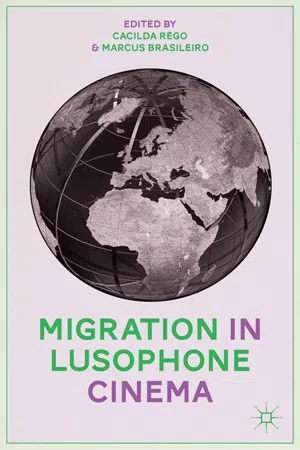
Migration in Lusophone Cinema
About this book
With more than 250 million speakers globally, the Lusophone world has a rich history of filmmaking. This edited volume explores the representation of the migratory experience in contemporary cinema from Portuguese-speaking countries, exploring how Lusophone films, filmmakers, producers, studios, and governments relay narratives of migration.
Information
Subtopic
Art General1
IMAGINING MIGRATION: A PANORAMIC VIEW OF LUSOPHONE FILMS AND TABU (2012) AS A CASE STUDY
Carolin Overhoff Ferreira
INTRODUCTION
Intricate reasons have motivated movements, resettlements, and relocations between Portugal and its former colonies—Brazil, African Countries with Portuguese as Official Language (PALOP), Timor, Goa, and Macao—over a little more than five centuries and established a dense network of historical, cultural, and sociopolitical relationships. After decolonization, the ongoing emigrational fluxes between the members of what is now the supranational Community of Portuguese-Speaking Countries (CPLP) keep changing according to the needs and opportunities of our globalized world.
Hamid Naficy (2007: xiii) calls attention to the fact that today “globalization and displacement are the Janus faces of our contemporary late-modern condition; one necessitates the other. We are living in an interrelated world that increasingly favours horizontality over verticality, multiplicity over singularity, routes over roots, and network over nation.” Interrelations that the author pays special attention to are traceable in the works of diasporic and exilic filmmakers from previous colonies, which he denominates “accented” cinemas (Naficy 2001). The author also foregrounds the connection between the question of migration in the real world and the possibility of traveling in the imaginary by means of the diverse media that we now have at our disposal:
Globalization and mediation are another Janus-faced feature of our contemporary times, one necessitating the other. While the means of transportation generally take us away to other lands, the communication media reconnect us to earlier places and times, connect us to new places and times, and help us re-imagine new possibilities. (Naficy 2007: xiv)
This intriguing liaison between the fluctuation from one country or region to another—during colonialism and in its aftermath—and the construction of cinematic imaginaries within the Lusophone world are the focus of this chapter. I argue that the mythical imaginary around the concepts of Lusophony and Luso-tropicalism has persisted so far in films on migration, and that a recent film, the much-praised Tabu/Taboo (2012) by Miguel Gomes, finally points toward a necessary shift in the mediated depiction of migration in Portuguese-speaking cinema. I make this apparent in two steps. First, I draw a historical panorama of the migrational flows that involved Portugal, the PALOP, and Brazil1 and sketch how they have been portrayed in national and transnational contemporary films. My main interest in this first part is to present my earlier research findings on the insistence in the key myths just mentioned.
Lusophony and Luso-tropicalism deserve special attention since they have been substantial in the development of an imaginary of the Lusophone world that advocates a “soft” colonialism, and which distinguishes itself strongly from the aggressive Spanish, the brutal Belgian, the segregationist British and Dutch, and the paternalistic French forms of European expansionism. As I have stated elsewhere (Ferreira 2012: 19–20), Luso-tropicalism can be defined as propagating Portugal’s outstanding accomplishments—the discoveries of sea routes, islands, and continents—as a consequence of the country’s desire to convert the world to Christianity in a peaceful manner.
Trying to distinguishing itself from the Spanish conquerors, Portugal’s colonialization process has been interpreted as guided by religious instead of material interests and understood to have been nonviolent by engaging, living, and mixing with the most diverse cultures and ethnicities from the Southern Hemisphere. Luso-tropicalism is, in fact, based on the idea that the Portuguese people, due to their own cultural miscegenation that suffered influences from Europe and the North of Africa, are transnational in their essence. The Brazilian sociologist, Gilberto Freyre (n.d.), is considered the concept’s spiritual father in an attempt to tighten and pacify the Luso-Brazilian bonds. This concept regained importance in the 1950s when the Portuguese empire was under threat from the decolonization processes in the Anglophone and Francophone colonies.
Lusophony, on the other hand, is a product of the same moment but entered the Lusophone stage permanently as a concept after Portugal finally let go of its colonies in Africa in the early 1970s, which brought a feeling of severe loss to the Portuguese nation. It also advocates the belief of a harmonious transnational community in the colonies and aims to guarantee its survival after the end of the empire by identifying the Portuguese language as a metaphor for a shared culture. To do so, it ignores regional and national linguistic, cultural, and historical differences and uses Portuguese as the cornerstone of a common cultural identity, which—due to its transnational dimension—is considered superior to any national identity. Both concepts are powerful tools that convert the colonial history into a collective cultural history.
Only in the last decade or so have Portuguese literary critics and social scientists started to translate the insights from postcolonialism and the awareness of a postcolonial national identity crisis into the critical assessment of these and other concepts and ideas associated with Portugal’s supposedly humanistic colonialism. As I have noted in a different place (Ferreira 2012:19), scholars such as Eduardo Lourenço (1999a, 1999b), Boaventura Sousa Santos (2001), Margarida Calafate Ribeiro (2004), and José Gil (2004), among others, question the national predisposition for transnationality and the celebration of its postcolonial cultural legacy and thus help to lay bare Luso-tropicalism’s and Lusophony’s intent to camouflage difference by acknowledging that they were designed to maintain the imaginary of Portugal as a great nation.
In contemporary films, as I argue later on, it is still common to take this mythical imaginary at face value and construct narratives around it. Even though it has been challenged before, Tabu is a particularly interesting example, since it engages with the construction of ideas regarding colonialism and postcolonialism, while also dealing with the existing visual and audiovisual imaginary. Accordingly, I discuss Gomes’ film in the second step, demonstrating how it reconnects in an innovative manner to the past and its places. The filmmaker shows as much the longing for the colonial past, as postcolonialism’s insistence in its most negative side: the master-servant relationship. Tabu explicitly does not shy away from the nostalgia that involves remembrance of Portugal’s recent colonial history, but stands out in present film production by confronting viewer expectations usually aroused in European films that express nostalgia for lost empires.
LUSOPHONE MIGRATIONAL FLOWS AND IMAGINARIES IN NATIONAL AND TRANSNATIONAL FILMS
BRAZIL
Colonial enterprise sits at the beginning of the Lusophone migrational flows, triggering off sea voyages from the “metropolis” Portugal to new places around the globe. Brazil stands out in this context because of its profuse resources and the comparably little resistance of the native population. As I have cited elsewhere (Ferreira 2011a), the migration of adventurers, colonizers, settlers, and missionaries from Portugal to the lands of “Vera Cruz” (the true cross) has been divided into three main events: First, during the formation of the patriarchal slave society in the sixteenth and seventeenth centuries; second, the emigrational flow between 1700 and 1760 when the gold and diamond mines were discovered and the country’s south received a vast amount of settlers; and third, the migration of young clerks who moved temporarily to Brazil at the end of the eighteenth and the beginning of the nineteenth century—even after Brazil’s independence in 1822—in order to make money in the commercial establishments and then return well-off to Portugal (Rowland 2002: 375–376).
Part of the first and second events was the exploration of the interior of the country in search of areas to settle and precious gem stones and metals. Even though, as the third occasion proves, Brazil never ceased to be attractive for Portuguese migrants (another significant event occurred at the end of the African wars of independence in 1974), it is worth noting that nowadays Brazil’s developing economy is appealing for Portuguese professionals with university degrees in what might be called a fourth—if not fifth—wave.
BRAZILIAN NATIONAL FILMS
Brazilian national cinema already looks back on a tradition of critically examining colonial history, first established during the Cinema Novo in the 1960s and 1970s. Especially after the military coup in 1964, this “modern cinema” looked at historical episodes and characters, reread famous texts of the period, or used colonialism as an allegory of current political affairs. The most notorious movies in this context are Terra em Transe/Land in Anguish (1967) by Glauber Rocha, which discusses populism and the failure of left-wing intellectuals in the context of the military coup, Como era gostoso o meu francês/How Tasty Was My Little Frenchman (1971) by Nelson Pereira dos Santos, an anthropophagic reading of sixteenth-century travel literature, and Anchieta, José do Brasil (1977) by Paulo Cesar Saraceni, which reconstructs the life-story of the famous Jesuit priest José Anchieta and turns him into a “true” Brazilian.
Contemporary films still engage with the colonial past and the encounter between natives and Portuguese characters that cross the Atlantic, but not with the same intensity or investigative outlook. Nonetheless, the first film of the so-called Retomada, the film Renaissance in the 1990s that followed years of production crisis, was a piece on colonial history, Carlota Joaquina (1995), by Carla Camurati. Interpreted as a satire on the Portuguese colonialists by most critics, it is rather an interrogation of present-day politics and the role of corrupt politicians, who are allegorized by means of the former Portuguese monarchs (Ferreira 2011b). Movies on the encounter of colonialists and the native population now tend to recycle Luso-tropicalism. This might come in the form of weak literary adaptations of a classic—for example, O Guarani (1996), based on the famous love story between a native and the daughter of a rich settler, written by José Alencar and directed by Norma Bengell—or as harmless comedy with an inverted love story between a Portuguese and a lovely native girl, such as Caramuru—A Invenção do Brasil/Caramuru—The Invention of Brazil (2001) by Guel Arraes.
LUSO-BRAZILIAN COPRODUCTIONS2
The interest in Luso-Brazilian cinematographic collaboration has a long history but needed a kick start. This changed when the two governments formalized a protocol in 1981, and following the Brazilian financial crisis in the early 1990s that turned coproductions into a necessity. Nonetheless, Luso-Brazilian films on the subject of migration are still rare, although the protocol foresees narratives on the common cultural heritage (Ancine 1996).
There are in fact only four films that tell stories on migration to Europe: Terra Estrangeira/Foreign Land (1995), by Walter Salles and Daniela Thomas, in which three Brazilian main characters feel alienated in the Portuguese capital and thus challenge the idea of brotherhood; Tudo isto é Fado/Fado Blues (2003), by Portuguese Luís Galvão Teles, in which a Brazilian and an Angolan immigrant have a merry encounter with a writer of police novels and his daughter in Lisbon and celebrate not only Lusophony but also Luso-tropicalism; and Um Tiro no Escuro/A Shot in the Dark (2005), by Portuguese Leonel Vieira, in which a Brazilian woman has to become a criminal in order to reencounter her kidnapped daughter. The case of Antônio José da Silva, a Brazilian-born Jew who became Portugal’s most celebrated playwright of the eighteenth century and was then sentenced to death by the Inquisition in O Judeu/The Jew (1995), by Brazilian filmmaker Jom Tob Azulay, is the only example set during colonialism.
Symptomatically, Luso-Brazilian coproductions all deal with crimes, echoing either playfully or with a somber tone the shared colonial history and its abuses. Only once, in Fado Blues, are the different cultures and languages portrayed as being compatible and the migrant characters successful in striving for a better life in Portugal. Linguistic and cultural differences are mentioned in A Shot in the Dark and explored in Foreign Land and The Jew, but shatter Lusophony’s dream of a shared cultural history by indicating a deep divide between Brazil and Portugal.
A slightly larger number of coproductions, five to be precise, focus on the inverted route...
Table of contents
- Cover
- Title
- Introduction
- 1 Imagining Migration: A Panoramic View of Lusophone Films and Tabu (2012) as a Case Study
- 2 Thinking of Portugal, Looking at Cape Verde: Notes on Representation of Immigrants in the Films of Pedro Costa
- 3 Outros Bairros and the Challenges of Place in Postcolonial Portugal
- 4 Deterritorialization Processes in the Portuguese Emigratory Context: Cinematic Representations of Departing and Returning
- 5 Performing Criminality: Immigration and Integration in Foreign Land and Fado Blues
- 6 Two Hungaries and Many Saudades: Transnational and Postnational Emotional Vectors in Contemporary Brazilian Cinema
- 7 Reverse Migration in Brazilian Transnational Cinema: Um passaporte húngaro and Rapsódia Armênia
- 8 Otherness and Nationhood in Tizuka Yamasaki’s Gaijin I and Gaijin II
- 9 Cinema, Aspirins, and Vultures: A Double Escape from a Global Conflict
- 10 European Immigrants and the Estado Novo in Contemporary Brazilian Cinema
- 11 The Migrant in Helena Solberg’s Carmen Miranda: Bananas Is My Business
- Filmography
- Notes on Contributors
- Index
Trusted by 375,005 students
Access to over 1.5 million titles for a fair monthly price.
Study more efficiently using our study tools.
Frequently asked questions
Yes, you can cancel anytime from the Subscription tab in your account settings on the Perlego website. Your subscription will stay active until the end of your current billing period. Learn how to cancel your subscription
No, books cannot be downloaded as external files, such as PDFs, for use outside of Perlego. However, you can download books within the Perlego app for offline reading on mobile or tablet. Learn how to download books offline
Perlego offers two plans: Essential and Complete
- Essential is ideal for learners and professionals who enjoy exploring a wide range of subjects. Access the Essential Library with 800,000+ trusted titles and best-sellers across business, personal growth, and the humanities. Includes unlimited reading time and Standard Read Aloud voice.
- Complete: Perfect for advanced learners and researchers needing full, unrestricted access. Unlock 1.5M+ books across hundreds of subjects, including academic and specialized titles. The Complete Plan also includes advanced features like Premium Read Aloud and Research Assistant.
We are an online textbook subscription service, where you can get access to an entire online library for less than the price of a single book per month. With over 1.5 million books across 990+ topics, we’ve got you covered! Learn about our mission
Look out for the read-aloud symbol on your next book to see if you can listen to it. The read-aloud tool reads text aloud for you, highlighting the text as it is being read. You can pause it, speed it up and slow it down. Learn more about Read Aloud
Yes! You can use the Perlego app on both iOS and Android devices to read anytime, anywhere — even offline. Perfect for commutes or when you’re on the go.
Please note we cannot support devices running on iOS 13 and Android 7 or earlier. Learn more about using the app
Please note we cannot support devices running on iOS 13 and Android 7 or earlier. Learn more about using the app
Yes, you can access Migration in Lusophone Cinema by C. Rêgo, M. Brasileiro, C. Rêgo,M. Brasileiro in PDF and/or ePUB format, as well as other popular books in Media & Performing Arts & Art General. We have over 1.5 million books available in our catalogue for you to explore.