eBook - ePub
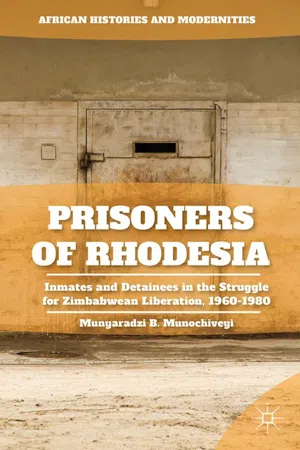
Prisoners of Rhodesia
Inmates and Detainees in the Struggle for Zimbabwean Liberation, 1960-1980
- English
- ePUB (mobile friendly)
- Available on iOS & Android
eBook - ePub
Prisoners of Rhodesia
Inmates and Detainees in the Struggle for Zimbabwean Liberation, 1960-1980
About this book
During the Zimbabwean struggle for independence, the settler regime imprisoned numerous activists and others it suspected of being aligned with the guerrillas. This book is the first to look closely at the histories and lived experiences of these political detainees and prisoners, showing how they challenged and negotiated their incarceration.
Information
C H A P T E R 1
Introduction: Suffering for the Nation: The Prison as a Site of Struggle during Zimbabwe’s Liberation War
During conversations with former African political prisoners of the Rhodesian1 colonial regime, “we suffered for this nation” was a common reflective phrase that informants used in order to claim their place within the narrative of Zimbabwe’s anti-colonial struggle in the late-twentieth century. Indeed, “suffering” is a dominant analytical trope for most liberation struggle participants in Zimbabwean history. However, in the dominant narratives of this history, both popular and sometimes academic, the suffering of others is more visible and audible in comparison to other historical subjects’ histories. This is not surprising because over the years, and since Zimbabwe attained political independence from colonial rule in 1980, those with politically legitimate and authorized claims to suffering have had unfettered access to both political and economic power in postcolonial Zimbabwe. The writing of Zimbabwean history, particularly nationalist history, has been in constant evolution and has demonstrated that it is indeed an intense exercise in inclusion and exclusion. The subjects of this study have lived on the fringes of this history for a long time, and this book seeks to tell the story of colonial Rhodesia’s political captives, stories that have remained in the shadows of dominant nationalist and state narratives.
Between the early 1960s and 1979, African nationalists engaged in a protracted guerrilla war that ultimately ended white colonial rule in Rhodesia. The settler regime responded by imprisoning a large number of activists and those whom it suspected of being aligned with the guerrillas. However, to date, scholars, journalists, activists and partisans of the triumphant ZANU guerrilla movement who have studied Zimbabwe’s liberation struggle have focused almost exclusively on the guerrilla war itself. In this book, I am particularly interested in the histories and lived experiences of African political detainees and prisoners whose experiences and contributions towards the liberation struggle have been rendered invisible by dominant historical and state narratives. In fact, this is the first monograph to consider political prisoners and detainees as crucial historical subjects in the telling of Zimbabwe’s liberation struggle history. As one historian noted about histories of political imprisonment in Vietnam, it may be that the capacity of prison walls to convey an illusion of isolation and separation from the wider community has discouraged historical investigations of political prisoners as crucial historical subjects.2 But in the Zimbabwean scenario, it goes beyond the mere illusion of the prison as isolative: it is the dominance of the guerrilla narrative that has skewed histories of Zimbabwean nationalism to consider only a narrow set of historical subjects germane to this history.
Evidence gathered for this study suggests that the social composition of people who were imprisoned by Rhodesian security forces during the liberation struggle was quite diverse. Those detained ranged from guerrilla militants and political organizers, to ordinary men and women who were suspected of sympathizing or collaborating with the liberation movement. Through documenting the stories and histories of these incarcerated people, their experiences in Rhodesian jails, and the ways in which they struggled and coped in some of the most brutal detention centers of the Rhodesian regime, this book argues that detainees were important historical actors whose encounters and experiences with one of Rhodesia’s repressive apparatuses—the prisons—deserve to be documented.
This book’s central argument is that although political imprisonment during Zimbabwe’s liberation struggle was an extreme version of the colonial experience that combined spatial confinement with curtailed freedoms, racialized abuse, racial segregation, and heightened repression, the prison was also a terrain of struggle, by which I mean that it was doubly a space of repression and subversion, and that political prisoners were capable of challenging and negotiating their incarceration. Three broad and interrelated questions frame this study: Firstly, in what ways did the Rhodesian regime frame and justify the political detention and imprisonment of Africans? Secondly, considering the brutal nature of Rhodesian incarceration during the liberation war, in what ways did incarcerated Africans cope and adapt to the different conditions of Rhodesian jails and detention centers, and how did they seek to mitigate some of the devastating consequences of imprisonment and detention? Lastly, what was the cumulative effect of imprisonment and detention on incarcerated Africans, their families, and their lives in general? Whereas the first question seeks to understand why the colonial regime resorted to the penal option as a style of governance and as a repressive apparatus, the other questions focus on the penal experience itself. I seek to establish that although the Rhodesian prisons were centers of brutality, political detainees were not passive recipients of state penal terror as they actively negotiated, challenged, and subverted oppressive penal regulations. I also argue that, as political hostages of the Rhodesian regime, detainees played a crucial role towards dislodging colonial rule both as producers of powerful critiques of the colonial regime from inside the prison confines and as symbols of African resistance.
This book is mainly based on the experiences of political prisoners and detainees in Rhodesia’s main prisons and detention centers, which included institutions such as Khami Maximum Security Prison, Chikurubi Maximum Security Prison, Salisbury Prison, Gwelo Prison, Gonakudzingwa Detention Center, Sikombela Detention, and Wha Wha Prison (see map 1). I suggest at the onset that writing about the experiences of those detained and imprisoned because of the liberation struggle is an important task because this adds to the multiplicity of historical subjects germane to the history of Zimbabwe’s liberation struggle. With regard to Zimbabwe’s liberation struggle histories, scholars have noted the propensity of nationalist histories to suppress, marginalize, and silence other historical subjects while at the same time reifying the historical role of other (mostly elite) historical subjects.3 Prisoners and detainees of the Rhodesian regime have suffered this fate both in Zimbabwe’s liberation war historiography and in the public memories of the liberation war in post-colonial Zimbabwe.4 This is perhaps because it has been difficult thus far to historicize political prisoners’ contribution to the liberation struggle because as imprisoned people, they were supposedly “cut off” from the struggle for liberation. This study challenges this supposition because by introducing the prison as another terrain of struggle apart from guerrilla or combat zones, my work draws attention to an arena that historians had never considered as a space of resistance, confrontation, and negotiation in the telling of liberation struggle histories.
Historical Context
From the late 1950s to 1979, political imprisonment in colonial Zimbabwe was a consequence of the colonial Rhodesian authorities’ high-handed response to Africans’ nationalist and liberation struggles, whose foremost agenda was to dislodge white settler colonial rule. Although there were notable moments of anti-colonial struggles in the decades preceding the 1960s,5 the mass-based African nationalism that seriously threatened to end colonial domination in Rhodesia emerged in the second half of the twentieth century. Furthermore, although the Rhodesian colonial authorities had always used imprisonment as part of colonial repression since the establishment of Rhodesia as a colony in the 1890s, widespread political imprisonment, detention, and intensified state repression of Africans occurred between the 1960s and 1970s, the period of the nationalist and liberation struggles.
In colonial Zimbabwe, like elsewhere in colonial Africa, the ideas behind African nationalism, such as African/black majority rule, self-rule, and independence, politically inspired African men and women from diverse social backgrounds to take part in all aspects of anti-colonial activities in both rural and urban Rhodesia.6 In the late 1950s, the political geography of Rhodesia changed radically as young and educated Africans in Rhodesia’s urban areas formed vibrant political parties that encouraged anti-colonial politics through mass-mobilization. Examples of such political parties in Rhodesia included the Southern Rhodesia African National Congress (1957–1959), the National Democratic Party (1960–1961), the Zimbabwe African People’s Union (ZAPU), and the Zimbabwe African National Union (ZANU). Although a small group of the African educated elite led these parties, it was the political activities of African urban workers, rural peasants, men and women, old and young, that were at the center of the growth of mass-based nationalism and liberation struggles in Zimbabwe.
Drawing upon their own individualized anti-colonial politics, African youths, workers, and peasants in urban and rural Rhodesia joined these new political parties in record numbers. As members of these political parties, Africans thronged numerous political rallies and gatherings particularly in urban Rhodesia, where African political leaders politicized their partisans with fine-tuned anti-colonial rhetoric. In the late 1950s and early 1960s, such political gatherings and rallies punctuated the everyday life of urban Africans. In Rhodesia’s main urban areas, places such as Salisbury’s Mai Musodzi Hall in Mbare African Township, Cyril Jennings Hall in Highfield Township, or Stanley Square in Bulawayo’s Makokoba Township, all became popular public spaces for African political rendezvous.7 It was at these political gatherings and rallies that most Africans found resonance and meaning for their own anti-colonial ideas. Listening to the political rhetoric of their leaders inspired insurgent and anti-colonial political sentiments among the Africans and fired people’s political imaginations. Furthermore, the political parties themselves encouraged people to join communities of political activists fighting against Rhodesian colonial rule and the political intransigence of the leaders of the Rhodesian regime who were averse to African majority rule.
It was within these communities of activists that politically committed Africans began challenging repressive Rhodesian policies. In urban areas such as the townships of Salisbury, Bulawayo, and Umtali, African political activists turned the once-tranquil urban environment into spaces of militant politics and civic disobedience. Activists protested against the constant proscription of African political parties by the Rhodesian authorities, and increasingly, African political meetings ended in violent clashes between African political activists and the Rhodesian police. In Salisbury’s townships, occasionally the air was thick with tear gas, which the Rhodesian police used to disperse political gatherings of Africans. Stone-throwing youths frequently engaged in running battles with the Rhodesian police, whom they saw as symbols of Rhodesian repressive rule. Sporadic and spontaneous urban demonstrations erupted on a frequent basis in the African townships, and sometimes morphed into large-scale national defiance demonstrations, such as the Zhii demonstrations in urban Bulawayo that eventually spread to all major urban centers in Rhodesia. More seriously, African defiance in the urban spaces acquired the sophistication of organized militant attacks on symbols of Rhodesian rule. Groups of trained saboteurs, who were mostly youths and students, utilized a wide range of weapons such as petrol bombs or hand grenades, to attack Rhodesian buildings and infrastructure.
By the mid-1960s, it was clear that Rhodesia would never be the same peaceful colony that its white settler leaders touted it to be. The colony was on the verge of one of the bloodiest anti-colonial struggles in African history. Concerning Africans’ 1960s urban protests and civic disobedience, Rhodesian authorities’ reaction was swift and repressive. Rhodesian authorities, led by the ultra white supremacist Rhodesia-Front government, came up with a cocktail of repressive legislation and organized various regiments of the regime’s police and military into a single unit called “Security Forces,” all designed to crack down on African political activists. Specifically, in the 1960s, the Rhodesian regime resorted to political confinement as a style of governance. Hundreds of African activists, after enduring sessions of state-sanctioned police torture, found their way into specially designated prisons and detention centers across Rhodesia. Their crimes ranged from belonging to a banned political party, participating in acts of civic disobedience and attacking the Rhodesian police or infrastructure, to making “subversive” speeches.
Rhodesian authorities anticipated that arresting and detaining the most vocal and active African political figures would work to intimidate African communities into submission and thus eradicate political dissent. However, the Rhodesian authorities underestimated African people’s impatience with colonial domination. From the early 1970s onwards, the struggle against Rhodesian white minority colonial rule shifted from the urban to the rural areas. African militants, who thronged guerrilla bases within and outside Rhodesia, engaged the Rhodesian authorities through a protracted guerrilla war that rural peasants overwhelmingly supported. Rural men and women, young and old, drew upon their own traditions of resistance and traditional beliefs in African spirit mediums to encourage the guerrillas to intensify their military assaults on the Rhodesian forces.8 Most importantly, rural peasants became the bedrock of guerrilla survival as peasant communities sheltered the guerrillas and provided them with valuable war intelligence about the movements of Rhodesian forces. Inevitably, like their urban counterparts, rural peasants also became victims of Rhodesia’s confinement policies. In addition to the hundreds of thousands of rural inhabitants who were herded into so-called “Protected Villages,” which were concentration camp-style spaces of confinement, many rural peasants also found their way to Rhodesian prisons and detention centers. Rhodesian authorities variously charged arrested peasants for “harboring terrorists,” “cooking for terrorists,” or “failing to report the presence of terrorists.”9
Indeed, within the context of African nationalist histories, political confinement was certainly not a uniquely Rhodesian phenomenon. In many colonies across the continent, but particularly in settler colonies such as Rhodesia, Kenya, South Africa, and Algeria, colonial authorities deployed political incarceration as a style of governance in order to deal with the threat of African nationalist movements. In these colonies, African political activists were variously criminalized as terrorists (Rhodesia and South Africa), “spivs” or agitators (Kenya), or as bandits (in the case of Algeria’s la guerre révolutionnaire). Buttressed by specially crafted sets of draconian security laws, colonial authorities deployed the prison as a technology of control. In Rhodesia, the Law and Order Maintenance Act (1960) emerged as the principal security law that was responsible for the incarceration of thousands of ordinary African political activists. In South Africa, it was mainly the Terrorism Act (1967), in Kenya it was the Emergency Powers Act (1953), whilst in Algeria it was the Special Powers Act (1953). However, whereas colonial authorities in Kenya criminalized and detained whole communities of the indigenous Kikuyu ethnic group during the Mau Mau Emergency in the 1950s,10 and whereas the French targeted Algerian freedom fighters for imprisonment,11 in Rhodesia colonial authorities held urban political activists and rural peasant guerrilla supporters hostage. Furthermore, unlike in South Africa, where apartheid authorities mostly targeted prominent anti-apartheid activists for incarceration,12 Rhodesian prisons were mostly full of ordinary, rank-and-file members of African political parties and peasant supporters of the guerrilla war.
This book documents the lives of these political activists who were imprisoned and detained by the Rhodesian authorities during Zimbabwe’s liberation struggle. Before their arrest, these people’s anti-colonial politics was fueled by individualized and collective understandings of African nationalism, which manifested itself in the different sorts of insurgent activities and civic disobedience in both urban and rural Rhodesia. As Rhodesia’s hostages in prisons and detention centers, these people suffered bodily harm and torture, racialized abuse, banishment, and repressive incarceration. But their lives were far from being merely victims of Rhodesian repression: Rhodesia’s prisoners were also capable of challenging and negotiating their own incarceration. This study argues that the histories of political prisoners and detainees are an important component of the liberation struggle history, and that as political activists and symbols of the Zimbabwe’s anti-colonial struggle, political prisoners of the Rhodesian regime contributed towards dislodging colonial rule.
Historiographical Context
This text engages with three main bodies of literature, namely: liberation struggle histories, nationalist histories, and ...
Table of contents
- Cover
- Title
- 1 Introduction: Suffering for the Nation: The Prison as a Site of Struggle during Zimbabwe’s Liberation War
- 2 The Growth of African Opposition and Intensified State Political Repression in Rhodesia, 1960–1970s
- 3 Getting Arrested: Oral Histories of Violence, Torture, and Arrest in Rhodesia, 1960–1979
- 4 Life in Detention: Oral Histories of Confinement in Rhodesian Detention Centers
- 5 Life Behind Bars: Oral Histories of Life inside Rhodesian Prisons, 1965–1980
- 6 Epilogue: Life Beyond Bars and Legacies of Incarceration in Colonial and Post-Colonial Zimbabwe, 1965–2000
- Conclusion: Political Imprisonment and Memorializing Zimbabwe’s Liberation Struggle
- Notes
- Bibliography
- Index
Trusted by 375,005 students
Access to over 1.5 million titles for a fair monthly price.
Study more efficiently using our study tools.
Frequently asked questions
Yes, you can cancel anytime from the Subscription tab in your account settings on the Perlego website. Your subscription will stay active until the end of your current billing period. Learn how to cancel your subscription
No, books cannot be downloaded as external files, such as PDFs, for use outside of Perlego. However, you can download books within the Perlego app for offline reading on mobile or tablet. Learn how to download books offline
Perlego offers two plans: Essential and Complete
- Essential is ideal for learners and professionals who enjoy exploring a wide range of subjects. Access the Essential Library with 800,000+ trusted titles and best-sellers across business, personal growth, and the humanities. Includes unlimited reading time and Standard Read Aloud voice.
- Complete: Perfect for advanced learners and researchers needing full, unrestricted access. Unlock 1.5M+ books across hundreds of subjects, including academic and specialized titles. The Complete Plan also includes advanced features like Premium Read Aloud and Research Assistant.
We are an online textbook subscription service, where you can get access to an entire online library for less than the price of a single book per month. With over 1.5 million books across 990+ topics, we’ve got you covered! Learn about our mission
Look out for the read-aloud symbol on your next book to see if you can listen to it. The read-aloud tool reads text aloud for you, highlighting the text as it is being read. You can pause it, speed it up and slow it down. Learn more about Read Aloud
Yes! You can use the Perlego app on both iOS and Android devices to read anytime, anywhere — even offline. Perfect for commutes or when you’re on the go.
Please note we cannot support devices running on iOS 13 and Android 7 or earlier. Learn more about using the app
Please note we cannot support devices running on iOS 13 and Android 7 or earlier. Learn more about using the app
Yes, you can access Prisoners of Rhodesia by M. Munochiveyi in PDF and/or ePUB format, as well as other popular books in History & African History. We have over 1.5 million books available in our catalogue for you to explore.