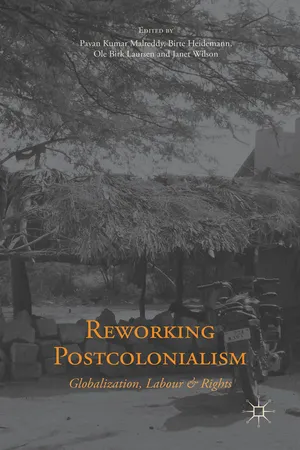
An interdisciplinary collection of essays, Reworking Postcolonialism explores questions of work, precarity, migration, minority and indigenous rights in relation to contemporary globalization. It brings together political, economic and literary approaches to texts and events from across the postcolonial world.
Once Were Internationalists? Postcolonialism, Disenchanted Solidarity and the Right to Belong in a World of Globalized Modernity
Frank Schulze-Engler
From at least the late 2000s onwards, postcolonial studies has moved into a phase of disciplinary revisionism – a wider trend towards introspection, self-reflexivity and self-transformation that in recent years has produced calls for ‘Reframing Postcolonial Studies’ (Gopal and Lazarus), for ‘Revisioning Post-colonial Studies’ (Mayer), for ‘Rerouting the Postcolonial’ (Wilson, Şandru and Welsh) and for thinking of new directions in ‘Postcolonial Studies and Beyond’ (Loomba et al.) as well as musings on ‘Postcolonial Remains’ (Young) and ‘What Is Left in Postcolonial Studies?’ (Parry). Such a flurry of revisionist activity can be taken as a sign of uneasiness, discontent or possibly even crisis within a field that can look back on an amazing institutional success story of moving from the margins of neglect into the centre of attention in a wide number of academic disciplines and discourses over the last two decades.
Before we get too carried away, however, by the idea of a crisis of postcolonialism or the possible ‘end of postcolonial theory’ that our colleagues in the United States contemplated a few years ago (Yaeger), we would do well to remind ourselves that it seems hard to identify a point in time in which postcolonialism was not, in fact, heavily contested and in some sort of crisis. As early as 1995, Stephen Slemon, one of the protagonists of early literary postcolonial theory, noted wryly that ‘the attributes of postcolonialism have become so widely contested in contemporary usage, its strategies and sites so structurally dispersed, as to render the term next to useless as a precise marker of intellectual content, social constituency, or political commitment’ (7), while already more than a decade ago Graham Huggan asserted that ‘postcolonialism has come to prominence even as it lurches into crisis’ and that ‘critiques of postcolonialism are rampant, yet postcolonial studies prospers; the postcolonial field has grown rich, it seems, on accumulated cultural capital while being increasingly acknowledged as methodologically flawed or even intellectually bankrupt’ (279).
One of the reasons for the discontent and disenchantment that seem to surface in so many current self-reflexive postcolonial debates arguably lies in the fact that postcolonialism today means too many things to too many people and that there is little agreement on what the ‘postcolonial’ actually stands for. While some people believe that postcolonialism is primarily a mode of reading texts or discourse analysis, others think that it is about the study of a so-called postcolonial world, while yet others are convinced that it is (or ought to be) a form of political activism.
While it is true that unless some sort of consensus can be reached on these issues (which seems unlikely at the present time) there appears little prospect for ending postcolonialism’s internal discontent, at least some sort of consensus has emerged among the widely differing postcolonialisms struggling to define the future of the field: that globalization is a vital and inescapable challenge that postcolonialism needs to address in order to remain relevant and to safeguard its own future.
The first part of this essay will take a critical look at two very different models of understanding globalization that have been influential in recent postcolonial debates: Robert Young’s thesis that postcolonialism should be equated with a Third World–based ‘tricontinentalism’ that carries on the legacy of socialist internationalism; and Walter Mignolo’s theory of ‘coloniality/modernity’ that suggests a sharp global divide between European modernity and its colonized others and advocates a ‘delinking’ of the colonized world from what he refers to as ‘European modernity’. I will present a critique of both approaches and argue that they ultimately rely on ‘unconditional’ or ‘enchanted’ solidarity; that is, the identification of a group of people to whom unconditional support is due on the part of an academic field that believes it needs to transform itself into a form of activism. I will also argue that both approaches are much too narrow and schematic to grasp the manifold effects, conflicts and contradictions engendered by globalization processes in different parts of the world and the complex issues explored in literary works that engage with these globalization processes.
The second part of this essay will present examples from Indian literature, indigenous literature in Canada and New Zealand, and African diasporic writing in Britain that show how struggles for ‘the right to belong’ in a world of globalized modernity have shaped the globally interconnected system of English-language literatures and cultures. What emerges from these texts, I argue, is neither (pace Young) a neo-Marxist tale of an internationalist-inspired ‘counter-modernity’ nor (pace Mignolo) a ‘decolonial’ vision of opting out of modernity altogether, but an intricate critical engagement with different local modernities and an endorsement of ‘the right to belong’ in very different social, historical and political circumstances.
Enchanted Solidarities: Socialist Counter-Modernity vs Decolonial Anti-Modernity
Let me begin, then, with a brief account of Robert Young’s proposition that postcolonialism should be considered as a political discourse based on the history and politics of what used to be called the ‘Third World’, an entity that Young himself has repeatedly referred to as the ‘tricontinental world’ of Africa, Asia and Latin America. This thesis is set out at length in Young’s massive study Postcolonialism: An Historical Introduction, a remarkable feat of scholarship that documents and analyses the parallel and intertwined histories of anti-colonialism and socialist internationalism. The two deeply problematical aspects of this study on which I would like to focus relate to the conclusions for contemporary postcolonialism that Young draws from his eruditely presented historical material. First of all, Young suggests that postcolonialism should be inspired by an international solidarity based on the strategic partnership between workers’ struggles in the industrialized countries and anti-colonialist movements that, he asserts, continues to the present day:
The liberation movements against the colonial powers worked in parallel, and in solidarity, with the struggles of the European working class in the metropolis, just as class struggle in India provided a historical model and well-developed practice for relations with the colonial and post-independence powers. Today this historic international solidarity between workers against the forces of capitalism, central to any Marxist political practice, continues . . . (9)
Secondly, Young argues that postcolonialism should be inspired by the ideas and practices of the anti-colonial movements that transformed the twentieth-century world, and that postcolonialism should, in fact, be seen as a set of theories and practices that carries on the legacy of these movements:
Postcolonial critique is therefore a form of activist writing that looks back to the political commitment of the anti-colonial liberation movements and draws its inspiration from them . . . (10)
This book has presented a small number of the many histories, rebellions, political campaigns, cultural identifications and theoretical formulations that evolved during the twentieth century as part of the anti-colonial struggles that together, at great human cost, freed the world from colonial domination in a remarkably short period of time. Today, tricontinental, or ‘postcolonial,’ theory and its political practices seek to build on that rich inheritance . . . (428)
I find the implications that Young draws from his historical work problematical for three reasons. Firstly, the idea that socialist internationalism has been able to retain the transformative and utopian potential it may once have had in pre-Stalinist days seems hard to reconcile with the realities of a world that has witnessed the anti-communist revolutions of 1989–90, and it is hard to imagine who in the twenty-first century should actually be the carrier of the socialist ‘counter-modernity’ that was championed by the so-called socialist world during what Eric Hobsbawm has called ‘the short twentieth century’.
Secondly, by attaching the label ‘postcolonialism’ to the intellectual and political traditions of anti-colonialism, Young de facto provides an academic field with an imaginary history. This is not to say, of course, that the history of anti-colonialism did not take place or that the anti-colonial movements did not bring about arguably the most monumental change in twentieth-century history, but it is an undeniable fact that protagonists of ‘tricontinentalism’ such as Frantz Fanon, Amilcar Cabral, Mahatma Gandhi or H
Chí Minh neither employed the conceptual apparatus that is today associated with postcolonialism nor, indeed, considered themselves postcolonialists. Conversely, in material terms contemporary postcolonialism undeniably remains a primarily academic activity, and whatever its analytical merits, it surely cannot be considered a social or political force even remotely comparable to the anti-colonial movements that shook the world half a century ago.1 The identification of postcolonialism with anti-colonial ‘tricontinentalism’ may have been meant as a political and historical grounding of an otherwise overtheorized academic field, but it can also be seen as an attempt to ennoble this academic field by attaching to it a political and historical muscle that it does not, in fact, possess.2
Thirdly, there is a distinctly nostalgic note to the idea that contemporary postcolonialism can or should be inspired by the great anti-colonial revolutions of the twentieth century. This is not to deny their decisive historical impact, of course, but there can be no doubt that they developed that impact under very specific historical and intellectual conditions. The utopian power of Fanon’s The Wretched of the Earth, for example, had everything to do with the fact that it was written at a time when old authoritarian systems of colonialism were falling apart and hopes that a totally new social world was in the making were running high; more than half a century later, it is more than doubtful whether the spirit of that particular historical moment can – or should – be revived.
The political and methodological vision that Young produces from the rich historical material assembled in his study is, I would like to argue, one of ‘enchanted solidarity’: it invents a great tradition of brave resistance on a global scale where the struggles of the workers of the world seamlessly blend into the struggles of the colonized peoples of the world, and it turns postcolonial academia into the guardian of that great tradition. This vision seems to forget that we not only live in a postcolonial but also in a postcommunist world, and that the original grand ideas and projects of both socialist internationalism and anti-colonial nationalism have followed highly contradictory historical trajectories and have often become aligned with oppression rather than freedom. Some of the most dictatorial and murderous regimes in the second half of the twentieth century (for instance, the Khmer Rouge reign of terror in 1970s and 1980s Cambodia) have, in fact, been erected on the ideological foundations of a combination of socialist internationalism and Third World Liberation, and we just have to think of present-day Zimbabwe to realize how easily socialist anti-colonialism can be transformed into a ruthless and cynical ideology of oppression employed to further the interests of small power elites (Chan and Primorac; Godwin; Ranger).
For Walter Mignolo, most of the issues touched on so far are in a certain sense illusory. In a lengthy essay entitled ‘Delinking: The Rhetoric of Modernity, the Logic of Coloniality and the Grammar of De-coloniality’ that sums up his widely discussed ideas on modernity, coloniality and decoloniality, Mignolo sets up a strict dichotomy between ‘emancipation’ (a dynamic that essentially seeks to remain within the global system established by European modernity) and ‘liberation’ (a fundamental epistemic break with European modes of knowledge that seeks to move beyond European modernity altogether). Globalization, Mignolo suggests, is the enforced expansion of European modernity across the globe through a process of sustained colonization of the South by the North (and of the indigenous populations of the South by modernizing elites aspiring to be part of European modernity), and only a total break with – or ‘delinking’ from – this mode of understanding (and dominating) the world can help the still colonized part of the globe to liberate itself. Mignolo has few sympathies for Marxist-inspired notions of a ‘counter-modernity’ that to him are little more than attempts to reform rather than to abolish the Western-generated ‘rationality’ that underlies an inherently evil system of domination. As he caustically puts it, ‘to imagine a new global left means falling back into the old house while just changing the carpet’ (500). Postcolonialism hardly fares better, however, since according to Mignolo its postmodernist and poststructuralist modes of critique also fail to instigate a total break with European modernity:
Coloniality and de-coloniality introduces [sic] a fracture with both, the Eurocentred project of post-modernity and a project of post-coloniality heavily dependent on post-structuralism . . . The de-colonial shift, in other words, is a project of de-linking while postcolonial criticism and theory is a project of scholarly transformation within the academy. (452)
Mignolo sees his own project of ‘delinking’ as ‘an-other’ mode of thinking that is primarily inspired by the political practices of indigenous peoples and aims at a rearrangement of power relationships on a truly planetary scale:
A delinking that leads to a de-colonial epistemic shift and brings to the foreground other epistemologies, other principles of knowledge and understanding and, consequently, other economy [sic], other politics, other ethics. . . . Furthermore, delinking presupposes to move towards a geo- and body politics of knowledge that on the one hand denounces the pretended universality of a particular ethnicity (body politics), located in a specific part of the planet (geo-politics), that is, Europe where capitalism accumulated as a consequence of colonialism. De-linking then shall be understood as a de-colonial epistemic shift leading to other-universality, that is, to pluri-versality as a universal project. (453)
While the radical anti-European stance entailed in this ‘universal project’ has undoubtedly contributed to making ‘decolonial theory’ one of the most fashionable recent additions to the theoretical arsenal of postcolonial studies, there are sound reasons for remaining sceptical about the ‘epistemic shift’ advocated by Mignolo and its purported uses for cultural and literary studies.
Firstly, the concept of ‘delinking’ is based on an account of primarily Amerindian indigenality struggling to move outside of European modernity. While there are indeed a number of Latin American countries where indigenous majority populations have traditionally been ruled by non-indigenous, Europeanized or creolized minorities, in many other countries indigenous populations form minorities rather than majorities, and it is not at all clear how the ‘pluri-versality’ at which Mignolo aims is to be achieved, all the more since he explicitly distinguishes his perspective of ‘delinking’ from notions of cultural relativism. His assumption that indigenous populations are somehow naturally located outside the scope of modernity altogether furthermore raises pressing questions with regard to what Michaelsen and Shershow have called the ‘epistemological and political arcadianism’ (39–40) of his theory.
Secondly, the conceptual enterprise of ‘delinking’ recycles a baseline concept of 1960s and 1970s ‘dependencia’ theory, which postulated that the developed countries (or the ‘global North’) collectively exploited the underdeveloped countries (or the ‘global South’), that the capitalist core countries...
Table of contents
Cover
Title
Copyright
Contents
Acknowledgements
Notes on the Contributors
Introduction
Part I Globalization, Modernities and Other Histories
Part II Global Displacements: Exile, Movement and Migration
Part III Globalization, Labour and Work
Part IV Globalization, Rights and Citizenship
Index
Trusted by 375,005 students
Access to over 1.5 million titles for a fair monthly price.
Study more efficiently using our study tools.
Frequently asked questions
Yes, you can cancel anytime from the Subscription tab in your account settings on the Perlego website. Your subscription will stay active until the end of your current billing period. Learn how to cancel your subscription
No, books cannot be downloaded as external files, such as PDFs, for use outside of Perlego. However, you can download books within the Perlego app for offline reading on mobile or tablet. Learn how to download books offline
Perlego offers two plans: Essential and Complete
Essential is ideal for learners and professionals who enjoy exploring a wide range of subjects. Access the Essential Library with 800,000+ trusted titles and best-sellers across business, personal growth, and the humanities. Includes unlimited reading time and Standard Read Aloud voice.
Complete: Perfect for advanced learners and researchers needing full, unrestricted access. Unlock 1.5M+ books across hundreds of subjects, including academic and specialized titles. The Complete Plan also includes advanced features like Premium Read Aloud and Research Assistant.
Both plans are available with monthly, semester, or annual billing cycles.
We are an online textbook subscription service, where you can get access to an entire online library for less than the price of a single book per month. With over 1.5 million books across 990+ topics, we’ve got you covered! Learn about our mission
Look out for the read-aloud symbol on your next book to see if you can listen to it. The read-aloud tool reads text aloud for you, highlighting the text as it is being read. You can pause it, speed it up and slow it down. Learn more about Read Aloud
Yes! You can use the Perlego app on both iOS and Android devices to read anytime, anywhere — even offline. Perfect for commutes or when you’re on the go. Please note we cannot support devices running on iOS 13 and Android 7 or earlier. Learn more about using the app
Yes, you can access Reworking Postcolonialism by P. Malreddy, B. Heidemann, O. Laursen, P. Malreddy,B. Heidemann,O. Laursen in PDF and/or ePUB format, as well as other popular books in Política y relaciones internacionales & Crítica literaria. We have over 1.5 million books available in our catalogue for you to explore.